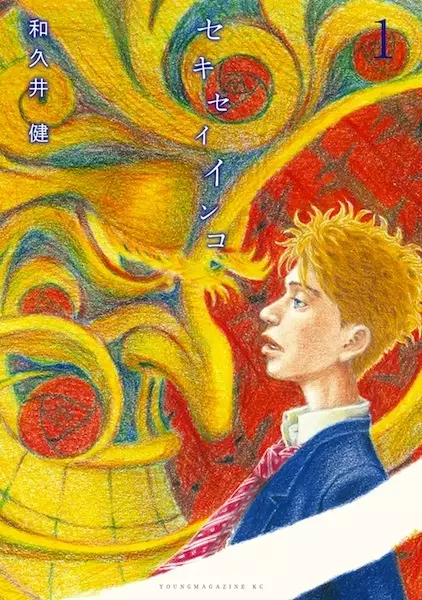
One of the most marvelous feelings when reading works by the same writer, watching movies from the same directors, or seeing how a specific animator plays with visual effects, is the sense of familiarity that comes with the phrase 'Hey, I know you.' As a reader or spectator, you become accustomed to their style, which can enhance your enjoyment of their new attempts and narratives. This familiarity allows you to follow their growth and see how they blend their expertise with new techniques to create something more engaging. Think of creators like Satoshi Kon, Makoto Shinkai, or Naoki Urasawa. But what if that's not thecase? I’m quite familiar with Wakui's works, having read more than half of them, and unfortunately, they have all been incredibly dull, boring, and lacking in substantial progression. It’s been frustrating to read them. Ken Wakui is a mangaka I’ve given four chances, which he procedded to spit on my face in all those 4 chances... But Sekisei Inko, despite being absolutelly terrible, manages to be his best work... Which is not to say much, but as to feel better with myself after reviewing both Tokyo Revengers and Negai no Astro, I came to deliver some silly rambling about one of his precious early works.
Sekisei Inko offers us a story in which our protagonist, Nana (or "Seven"), has lost his memories after the traumatic experience of watching his friend (and lover) Hiwako Shima die in front of his eyes. His suppressed memories take the form of an illusion and a voice in his head called "Memory" as he finds himself caught up in some messy situations. It’s not just messy because of the problems the protagonist gets involved in; it’s messy because of how the story unfolds and the twists it tries to deliver, it tries to drive you crazy with some dialogue and interactions that just don't manage to evoke something on the reader. Another major issue with this manga (which we’ll discuss again later) is its abrupt and absolutelly terrible ending, but we'll get to that, let’s start from the beginning.
There’s this silly thing I remembered while writing the review. It’s not something major, but it’s funny to point out. In the first chapter, when Nana talks to his friends about his memory loss and Hiwako’s death, he says, "About Hiwako..." and his friend immediately slams the grille at the rooftop, telling him, "Don’t talk about it ever again... And she would be so sad to hear you call her Hiwako." But in the rest of the manga, literally in all the flashbacks, Nana calls Hiwako by her name—Hiwako. So what was that guy’s problem with it? And more importantly, why would you treat someone who has lost their memory and is completely lost like that? Is that for real? Don't be an asshole, nameless friend from our protagonist.
But yeah. It felt like a childish reaction from both the character and the author, as if they were trying to force an unsettling and ominous atmosphere from the very beginning, even though we don’t know anything about the characters' lives yet. What’s Nana’s characterization? It’s difficult to build a well-rounded character with amnesia because you have to work hard to avoid making it seem like lazy writing or like you’re just using the condition as a crutch. That’s one of the basics of writing this trope. But even though it’s a basic trope, crafting and delivering a compelling amnesiac protagonist is tough, especially at the start. How do you make us feel empathy for someone who doesn’t even know themselves? I asked myself that, because, at the start, Nana was... just boring. I don’t know, it felt like my stream of ideas dried up. Nana is so dull and one-dimensional that you never feel like you're on a journey with him to rediscover himself or his memories. This could be attributed to many things: the lack of facial expressions, the stiffness in many panels that fails to evoke emotion during key scenes, or simply the fact that Nana doesn’t open up to others, nor do we see his daily life with amnesia. This makes the plot so straightforward that it doesn’t connect with the reader.
And that’s a shame because, in Sekisei Inko, there are sometimes great illustrations, but the catch? All of those great drawings are of "memory", the illusion in Nana’s head. So whenever something happens outside of that, the artwork feels lacking (except for maybe three panels about Nana’s past and Olga). I would argue whether the art is "great" solely because of memory’s existence, while the rest is unimpressive and not particularly memorable.
But I digress. To make it short, one of the biggest issues with our protagonist is that the mystery, even though it revolves around him, doesn’t make us feel empathetic toward him. The plot starts abruptly, with no intriguing concept. And to top it off, this manga has probably the worst case of subverting expectations I’ve seen in any media. That speaks volumes about how poorly it handles its twists and revelations. So, when you have a mystery without an interesting main character (despite him being the focus), combined with awful plot twists, what do you have? Well, nothing. Absolutely nothing."
But then, what about the long-awaited dénouement, or at least the point where things are explained? Well, that happens almost immediately. Did any reader really get excited when they revealed the truth about the powers in this manga? Let me be clear: I think the illusion-based powers the manga tries to present are so atrocious that I can't even begin to describe them properly.
When I saw one character slice a random bystander in half, I thought, "Whoa... things are about to get serious". Then came the explanation: "Wait, what do you mean everything is just an illusion? Huh? People die because their bodies believe the illusion is real? Oh... I see... I see..." That was my honest reaction. On paper, it doesn’t sound that bad, but the issue is that, due to the manga's early cancellation, we don’t get any real explanation about the power’s limitations or how it actually works.
And no, saying, We can't use the power too much or our bodies turn black and we die isn’t enough of a limitation. It's completely arbitrary and doesn’t create any meaningful plot points. It feels like a rule added just to mess with a few scenes and prevent the story from being too boring. As for how the power is obtained, or how the protagonist gained it? Nope, not a single clue. That’s why I say the problem lies with the ending. If it weren’t for the cancellation, we might’ve had more insight into this. As it stands, the power system feels like something pulled from a nightmare, badly conceived and incomplete. It was so flawed that I even read the English translation (since I'm a Spanish speaker) to see if something got lost in translation. Why did I even bother to care about that? Am I seriously that dumb? Well, whatever the case, this power system adds nothing of value to the series and isn’t interesting in the least. We don’t even understand why some people can manipulate senses to such an extreme, or how they could use this ability in a more intriguing way.
What did the author envision happening after, say, 70 chapters? Two characters who can manipulate the sense of smell fight each other? How would the sense of touch work in this setting? Where’s the complexity when it comes to people manipulating all five senses? I’ve ranted about this topic too much already, but it’s justified. I just hope I never come across another power system as arbitrary, ambiguous, and dull as this one. Yeah... that’s probably wishful thinking, right? *Looks at Wakui’s new manga, Negai no Astro* Goodness gracious... Not again please...
And the characters are just as bad, if not worse. Why is the bad guy who tried to kill the main character suddenly siding with him? Who was that old man who died? Why did this character show up just to die? Why is the antagonist so short? Why is this other antagonist still alive? What the actual hell is going on?! To be fair, some of these questions could be answered easily, but when you really think about the author’s decisions and justifications, it feels like a complete mess.
Let’s take an example: why does one antagonist look so young, while the other one is still alive despite his age? Well, it turns out they’re searching for immortality and conducting experiments. Oh, I see... but how did they discover immortality, and what about those experiments? Well, why are you asking me that, dear reader? The explanation is simple and to the point: It just happened, and the rest of the details are conveniently left out. It reminds me of when I was in school and would ask questions like, Why does the Earth rotate? My teacher would respond, It's because of something called rotation, but you'll learn more when you're older. And I’d think, Teacher, I didn’t understand a single thing, but I trust that I’ll get it later. That's exactly how this manga feels, except I seem to have died in a traffic accident before ever understanding how the Earth rotates. You see the parallel here? That’s what reading this manga is like, but with a more mundane—and infuriating—twist."
I remembered another silly thing about this. In one chapter like near the end of the manga, one character question something that was so rotted on the plot like "Hey... Did that really happened or was just an ilusion?" which made the main character to really think about something, as if the author wanted to change the direction of his work su hardly to even change the first approach of the manga to something new... Yeah, the manga finished not even 10 chaptes after that.
-But wasn't this paragraph about the characters?-
-You're damn right.-
Well, about them, and as I was saying, the cast in Sekisei Inko is full of boring and uninteresting characters. I appreciate when characters are distinctive enough that you can have favorites and least favorites, as this indicates a diversity in motivations and expressions. This, along with some worldbuilding related to the characters’ lives, helps us connect with them. Unfortunately, this wasn’t achieved in Sekisei Inko, and it seems to be a recurring issue in Ken Wakui’s manga. In Sekisei Inko, every character feels like a cardboard cutout. The supposed development in the early parts of the story doesn’t feel convincing or significant. For instance, Nana’s friend, who is present throughout the manga, hardly has any dialogue or noteworthy moments. Similarly, the characters Rem and Digi seem to lack clear purpose and their fate remains unresolved by the end. This lack of depth makes them feel more like plot devices rather than fully realized characters. Consequently, the story suffers from being both poorly developed and forgettable. Well played, Sekisei Inko, you sacrificed negative for negative to try to make something positive...
The flashbacks into the main character’s previous life were neither particularly good nor bad—they might come across as boring or disappointing. One issue is that they feel incomplete and disconnected from the main plot. Additionally, the main character regains most of his memories almost instantly and with minimal effort, which makes it seem rushed and disconnected from the audience. Although I appreciate when authors twist historical events and characters, this work only touches on these elements briefly, as if they were mere Easter eggs. The flashbacks also leave many questions unanswered. Overall, the flashbacks and backstories feel almost unnecessary and don’t integrate well into the main plot, which becomes evident by the end.
The ending of Sekisei Inko was as unsatisfying as the rest of the manga, and I’m baffled as to why I expected more. It's somewhat amusing that, with Tokyo Revengers now concluded, I can confidently say that Ken Wakui has crafted some of the worst endings I’ve ever read. It’s so poorly executed that it almost feels intentional. However, let’s give Wakui a break; this manga was likely canceled (actually have no idea, I guess it was because there's no other explanation to such ending). The conclusion tries to be pretentious and philosophical, raising existential and almost absurdist questions about the main character's journey and the seemingly meaningless events leading to a predetermined fated conclusion in his inmortal life. It feels as though both the character Nana and we, the readers, are left wondering why we should care to continue. After such meaningless conversation, the ending comes out of nowhere, is pretentious, leaves everything unresolved, and fails to provide any closure for the characters. If this story was meant to be about self-discovery, all I discovered was that it’s a letdown. Sorry, but that’s how I see it.
Sekisei Inko is also one of those manga where the title seems to be an error or an intentional misstep. You know how “Dragon Ball Z” was named that way to sound catchier, even though it might have been intended as “Dragon Ball 2”? Well, I honestly think Sekisei Inko should have been called Sekisei Unko because it’s shitty as you can get from start to finish, with no real reason to exist other than to frustrate me. My absolute dislike for Ken Wakui only reinforces my belief that he is one of the worst mangaka in the industry. Seriously, in my life, I don’t think I’ve encountered a creator who, despite numerous attempts, has consistently produced failures with zero charm in any of his art. This might come off as unnecessary hate, but bear with me. I’ve read four works by Ken Wakui, and each of them has received a 1/10 rating from me. How is that even possible? It almost makes me think he’s doing it intentionally.
Sekisei Inko was Wakui’s attempt at crafting a more psychological and profound story, but it ended up being an absolute snooze fest, riddled with flaws and lacking any cohesive essence from start to finish. Ken Wakui has delivered his works to the industry of manga and I have extended my arms and hand to him plenty of times, I'm generous you see, yet it seems that, after coming this far and doing 3 reviews in his different works, I've come to the conlusion that I'll sadly need to fucking cut my arms off because this guy is really taking advantage of those chances. With that said, and considering Ken Wakui is the only creator whose works I’ll avoid moving forward, I’d warn anyone interested that reading his work is akin to witnessing a Sisyphean struggle—constantly trying and failing in the same aspects, not once, not twice, but four times. That’s the type of creator we’re dealing with, and you’ve been warned... Cheers