Links go to search results. Availability varies by region.
Find a Specific Chapter
27 chapters total
Planetes
プラネテス ΠΛΑΝΗΤΕΣ
8.24(19K votes)
Ranked #437Popularity #294
chapters
27
volumes
4
Status
Finished
Published
Jan 14, 1999 to Jan 8, 2004
Authors:Yukimura, Makoto
Award Winning
Worth Reading? — Global Verdict
8.9/10
Average Review Score
90%
Recommend It
20
Reviews Worldwide
International Reviews
Scallion
Recommended
9
In the sci-fi genre, there are few books that can generate excitement for the real possibilities of space travel. They reach into your chest and pull out something small and glowing that many of us felt during our childhoods while watching space shuttles go into orbit or seeing stock footage of men on the moon. These books draw out this pure sense of wonder that makes you want to put them down and look at the stars for a few moments. And as we remember the anniversary of man's first steps on the moon, they become more poignant-almost painful. Something catches in your throat,and your head starts to buzz.
Well, that's how I react, anyway.
Planets is one of those books, and one of the best.
After reading Planetes I got the urge to change majors and learn rocketry. It's that good.
Planetes is in a genre of science fiction called "hard sci-fi" (I know some sci-fi fans are going to kill me for not calling it "SF", or speculative fiction...well, whatever.). Hard sci-fi series are categorized by an almost scholarly dedication to scientific accuracy. Typically, there isn't any FTL (faster than light, not for the lose, smartasses) travel, there aren't giant charged-particle cannons, giant robots, beam sabers...
Starting to sound boring, huh? Well, a lot of hard SF novels *are* boring, or at least dry and didactic, and some (like Ben Bova's Mars, which I highly recommend, as it is otherwise excellent) waste too much time dwelling on political drama in an attempt to make the story more presentable. Planetes avoids this problem altogether, even though it's science fiction at its diamond-level hardest.
Being a manga, it manages to maintain some lightheartedness; for instance, Hachi's dad Goro peppers him with porn to snap him out of a nervous breakdown, and a lot of humor is played off of Ai Tanabe's cluelessness. Thankfully, the humor doesn't go as far as atmosphere-destroying face-faults and huge sweat drops...often. The human stories that play out are so interesting that space seems more like a backdrop for the exploration of themes rather than new sources of energy. However, the writer balances the drama and the sci-fi so deftly you'd think he was a musician, and he plays with the metaphysical while he's at it. The inky black expanse of space (and a few more hospitable locations on earth) serve as a backdrop for Planetes' bread and butter: a love story to existence.
Planetes is deep without feeling pretentious. It tackles some subjects even harder than its science: war and peace, environmentalism and economic disparity, and racism. As in real life, there are no simple answers; characters struggle to find the right thing to do, because even though the "right thing" might be apparent, it's never easy, and the consequences for their mistakes have real weight. Yes, I know what this sounds like, but it's all very accessible. The writer doesn't waste words or space; like a spacecraft in itself, the manga series runs at only 4.5 volumes and expresses its themes with imagery rather than huge blocks of text. The rare soliloquy is short, punchy, and leaves you with something for your head to chew on. When the main character, Hachimachi, talks to god (in the form of a white cat) they share only a few paragraphs, but they have power behind them. I also commend Takimura for looking at the world (and the universe) through a more international lens, rather than one that's wholly Japanese. One of the more touching background stories was about the uncle of Toybox's black female captain (wha? Foreign characters that aren't painful stereotypes, or fanciful half-Japanese hybrids?) Fee, and their summers in the Mississippi forests. It has everything and nothing to do about space and its development at the same time, and it's all the more richer because of that.
It's almost impossible to describe some of the scenes in Planetes with mere words. Sure, you can describe the objects in them: the space debris, an astronaut slowly floating back towards the fragile safety of his spacecraft, and a rose drifting behind him, embraced in an ethereal halo of light with the earth looking silently on in the background... But the image speaks so much more by itself. It's a two-page splash with absolutely no text, and it evokes the presence of sounds by the very absence of them. There's this raw emotion slowly flowing behind the ink on the page, and reading all that went on until that point... It's amazing.
Where other hard sci-fi books fall flat and dull- with their lengthy descriptions of plain white spaceships and speculative technology, Planetes entrances. You don't just read about the hull of the Toybox, you *see* it, and that seeing cuts to your insides instead of rattling in your head. It goes past the limitations of text that novelists face, and Yukimura's technical and detailed art does an excellent job in showcasing the power of comics as a medium. You can tell a lot of work went into crafting the future the books present, and it amounts to much more than typical sci-fi fluff. The characters themselves are very simple-looking (I confused Fee and Ai a few times) but they serve their purpose, emote when they have to, and do it well...sometimes too well. While the characterizations are solid, far too many of them wore on my nerves, such as Ai Tanabe's grating naivete and Hachimachi's harsh personality. Despite their flaws, you'll end up rooting for them all in the end.
What I took away from Planetes was a better understanding of how the universe worked, a better appreciation for it, and a desire to see humanity push deeper into her, and to expand its understanding along with our reach into the stars. I desperately want our governments to spend less money on weapons development and more on exploring Mars, and for our people to turn their ambition away from the dirt and towards the sky. At the same time, Planetes reminded me that even if I never leave earth myself, I'm already in space. We're *all* already in space together, on a spaceship called "Earth". Everything is within space: the blue skies, sandy beaches, icy wilderness, the people and animals and trees and buildings...it's all hurtling through space at frightening speeds. And I should be thankful for being able to experience that much.
And stuff.
Haunted by a space flight accident that claimed the life of his beloved wife, Yuri finds himself six years later as part of a team of debris cleaners on a vessel called the Toy Box charged with clearing space junk from space flight paths. The team consists of Hachimaki, a hot shot debris-man with a sailor's affinity for the orbital ocean; Fee, a chain-smoking tomboy beauty with an abrasive edge; and Pops, a veteran orbital mechanic whose avuncular presence soothes the stress of the job.
(Source: TokyoPop)
64,266 Members
119 found helpfulJul 21, 2009
peroxid
Recommended
10
Introduction: I’ve always been into Space. I’m a big fan of Star Wars, I’ve done a work about Space for school and when I was younger I wanted to by an Astronaut. But later I’ve seen the Movie Apollo 13, and realized that Space isn’t as friendly as it seems. It’s quite scary. And the Human being wasn’t meant to go to Space. But the Human being wasn’t meant to fly either, and we’ve defied Nature and today Flying is as normal for some people as taking a walk. And so again we’ve defied Nature and send Yuri Gagarin on the 12th of April 1961to Space. After that day Space was at the reach of Mankind. And until today, evolution has brought Mankind and Space even closer. As of Today, you can already book a flight to Space in Virgin Galatics.
Planetes sets in 2075, in a World where Space flights are ordinary, people live in the Moon and Work in Space. So for me Planetes was quite appealing, but before I’d just heard of the Anime. So when I found out that the Anime was an adaptation of a Sci-fi Manga written by Makoto Yukimura I was delighted (especially because I know Makoto Yukimura from his more recent work Vinland Saga). So I picked it up and read it in one week-end. And at the end, I couldn’t believe how good it was. For me, it was too good to be true. It was the first Manga I’d read, that I really felt that it was a Masterpiece, perfect in every aspect, and which should be read by everyone who is into Space and ,more importantly, psychology.
Story: 9/10
Planetes Story is quite straightforward. In the Universe of Planetes, Space Debris has been a serious issue. So to prevent the accumulation of Debris in Orbits around the Earth and the Moon, there are the so-called “Garbage Men” who clean up Space. Planetes follow a 3-men (later 4, with Ai Tanabe) Crew, who clean up Space. Simultaneously engineer Werner Locksmith is working on a Space ship called Von Braun, which will have a 7-year mission of taking the first Humans to Jupiter, a Gold mine of Helium-3, the Fuel of 2075. Hachirota Hoshino, the most ambitious of the Crew members decide that he will do anything to take part in the greatest Mission in Space History, and to board the Van Braun.
Characters: 10/10
The Characters in Makoto’s Manga are, in my opinion, the Strongest Element of Planetes. Each Character has an amazing depth, and Makoto explores this depth by putting them through the extreme experiences that Space has to offer. Makoto uses the Space to expose the feelings of the Characters, and for doing so he shows the reader how dark Space can be. In Planetes there are four Main Characters, among which you could depict Hachirota for the most important character, and all these Characters are amazingly built. Each Character has a background story linked to him, which connects the reader to each Character. And so the reader begins to understand the actions and feelings of each single Character. What is amazing about all this is that none of the Characters is perfect. Each one of them has flaws, and their actions are dubious most of the times. This can annoy some readers, but it only shows that they all are human. And with all the complexity that the reader is given about the each one of the Characters on Planetes, he starts to find the reason behind those actions, and this is the major reason why Planetes is a Masterpiece.
Art: 10/10
Already with Vinland Saga, I’m amazed with Makoto’s art. I must say that I love the characters drawn by Makoto. But what shocks me the most is the detail of the Backgrounds. They are nothing less than paintings. And Planetes Art is everything and even more that I was expecting. The Characters don’t change from Planetes to Vinland Saga, and the Backgrounds are just stunning. Each Spaceship is drawn with full detail, and looks perfect. What is also very interesting is that this Work is considered to be Hard Sci-fi, so realism is most important, and the Art totally matches up.
Makoto also uses extremely well his Art, to show the darkness and void of the Space. Large Panels, filled up by Darkness really give the reader the feeling of loneliness. And so again Makoto manages to input the characters feelings to the reader, showing how talented he is in both storytelling and Art.
Enjoyment: 10/10
Me, as a reader, felt everything as the Characters in Planetes. There were lots of Negative feelings but when I ended the Manga I couldn’t feel anything less then just pure joy. I can’t describe why I enjoy this Manga so much, so I really recommend for you to read it, and sense all the feelings that Planetes has to offer.
Last Comment:
When I discovered that the Manga existed, I was surprised that it had only 4 Volumes. So I didn’t expect much from it. And now I must say that this Manga has more than some Mangas have in 10, 20 Volumes. For me a Manga like this just comes out every 10 years. But I understand that some people may not like the Manga or just prefer the Anime (which in my opinion is a total distortion of Planetes). This is a Seinen Manga, which for me personally is about Space, but above all it’s about the "Human being", and it couldn’t deliver this theme any better.
83 found helpfulJan 5, 2010
elnino02
RecommendedWell-written
10
"I learned that I couldn't stop loving people." Since the birth of humanity, the sky has always been a source of ceaseless wonder and amazement for our species, whether they be grizzly cavemen in their roughly hewn lodgings or exuberant young kids staring up through a lens, mouth agape. Humanity has always feared the unknown, but they've always been inexplicably drawn to the sheer vastness of the cosmos - a vastness that makes them feel small, and yet continues to beckon, daring them to reach out in return. Planetes is that involuntary gasp, that inexorable sigh that exits our throats once our meagre existences are confronted bythe infinite, it is that realization of how laughably small all our gripes with reality are in the grand scheme of things. And yet, in that all-important epiphany that spells doom for our smug self-belief are we able to find meaning and rediscover our very selves. Planetes embodies that emotion, it revels in it.
Exploring these empty skies necessitates an all-consuming thirst, one that forsakes all other emotions, thoughts, bonds, people in order to extend gloved hands into the inky darkness. It requires an unshakeable resolve, an unwavering belief that the answers are well worth the sacrifice. But is it really worth offering our very souls? Planetes seeks to answer that question, with its cast of very human, very carefully crafted characters. They're all driven by their own reasons to be where they are, do what they need to do, aspire to be what they want to be, and there's nothing more moving and inspiring than to see them get knocked down, resort to a fair bit of soul-searching, understand themselves better and evolve individually and collectively. It is a character-driven story with a rather simple plot, and a very well-written one at that. This inherent simplicity is what allows it to be such a precious, fragile and emotionally resonant experience. For all its depiction of cold, lifeless space, it is, first and foremost, a tale with a warm beating heart at its core.
While being appreciative of space, its beauty and its importance, Planetes doesn't hold back from criticizing its excessive worship when it needs to, stripping away much of the unnecessary romanticism and allowing itself to possess a very balanced perspective, letting the reader view a problem from different sides. The art is extremely good - the sci-fi paraphernalia are very detailed, the landscapes look gorgeous and the characters have very clear expressions. What's striking is the painstakingly concocted setting of a futuristic human civilization in space; it's evident that a lot of time has been spent on research, giving the manga an air of believability - the true hallmark of any great sci-fi work. The mangaka's exceptional talent is on full display as he weaves together moments of humour, seriousness and poignancy seamlessly, propped up with very impressive writing and art that reinforce each other in every panel.
I highly recommend reading Planetes, it will not disappoint.
19 found helpfulOct 26, 2022
Nervin
Recommended
9
Who hasn't dreamt once about going into space, or yearned to know what there is beyond Earth? Or even imagined living in space? Space travel for not only a select few people will become, sooner or later, a reality, be it in the next 50 years or even more than a century. Planetes is a psychological sci-fi manga that covers the story of a crew of space garbage man, cleaning Earth's outer space of space debris. The story doesn't seem interesting at first glance, but in reality it has so much more to offer, making it for anyone with a slight interest in space amust read.
~Story~
The story of Planetes is set in the year 2075, where working and travelling in space has become common. It revolves around the garbage man crew of Toy Box, Yuri Mihalkov, who lost his wife due to a space accident, Fee Carmichael, a chain smoker and mother, and finally Hachitora Hoshino who wants to have his own spaceship to travel in space. Later on a new crew member, Ai Tanabe, will join the crew, that will play an important role.
The plot doesn't just revolve about cleaning out the debris, which of course is a serious matter and problem for space travel. The individual lives of the crew members and goals are shown. Take for example Hachitora or "Hachi" in short: he will do anything he can to be part of the Jupiter mission on the spaceship "Van Braun" to gather the fuel of 2075, Helium-3.
One thing that struck me was how realistic Planetes was; all problems that occurs are all very well displayed and explained, the different methods of travelling, as well as the different equipment and machines. Yukimura goes as far to explain in detail why some changes were made to current space equipment standards.
Some humor is to be found as well; this is however well-balanced with the drama and is great for the story as it keeps it fresh. It's not all just about space, it also touches subjects like space environmentalist trying to halt space exploration, the economy, and it even deals with racism.
The addition of the background stories of some of the characters is very heartwarming and a nice change to the story. It is narrated and displayed magnificently. This will be helpful later on to understand the characters decisions. Take the example of Fee, who tries to smoke but just can't do it to numerous problems that surges; it just makes you feel really sorry for her.
~Characters~
The realistic aspect of Planetes isn't achievable with only the story: without the realistic and well presented characters it would be impossible. The characters presented are all very well thought out. Each character has its own background story and its own flaws, making them have a realistic feel. Some of the characters actions may become annoying over time, but the reader will find himself rooting for those characters over time.
Character development in Planetes is impressive too. With help of the background story, goals and interactions with other people, the main characters undergo transformations that later will mark their path; in addition it makes the reader reflect over on the choices the characters makes.
The variety of characters is satisfying as well. There are people of all nationalities, rusians, indians, japanese and even black people. By narrating the story of Fee's uncle, it simultaneously displays the issues of racism and how it helped Fee's character to develop.
~Art~
The art of Planetes is impressive. The display of the different panels, how everything is drawn is done masterfully. The most impressive thing are the backgrounds. These are done in such detail that you could just stare at it to find all those little details. The vastness of space is represented very well: it induces and displays the loneliness living in space can be.
There is nevertheless an issue with the drawings of the main characters. These are done quite simplistic and makes it for the reader quite difficult to tell sometimes some characters apart from each other. However, the secondary characters are drawn well and are varied. One thing to note is how well some character expressions are drawn, conveying to the reader how the character feels or tries to say without the need of dialogue.
~Enjoyment~
Planetes was without doubt a very good read that is very enjoyable from the beginning to the end with the impressive realistic story, the background stories as well as the side stories, and of course the characters. I personally found that story could continue and focus a bit more on how Yukimura expected humanity to be in 2075, as well as the Jupiter mission, but this is a very small drawback.
Thanks for taking your time reading.
30 found helpfulAug 30, 2015
catullus_d_rus
Mixed Feelings
6
Yukimura Makoto's Planetes is, as I've seen, hailed as a space odyssey that keeps itself grounded by its human elements. That much may be true, but the crucial point which prevents this manga from being great is that very element lauded as its strongest: Planetes is a manga which clearly prides itself on Moments, but which lacks the wherewithal necessary between those to make the Moments impactful. This highlights a pattern in Makoto's work (of which I've now read all, barring some more recent chapters of Vinland Saga) which I would call a fear of subtlety, a fear manifesting most strongly in his character developmentand progression.
Hachimaki: lead protagonist, loud, brash, myopic in terms of desires, unthinking in terms of the desires of others; essentially the archetypal shounen hero. I should note that this archetype doesn't automatically inhibit how great a manga can be — for instance, One Piece’s Monkey D. Luffy is just about the most cookie-cutter a shounen protagonist can get, yet I find little reason to criticize Eiichiro Oda's choice in making him that way. Primarily because One Piece is a manga driven more by its sense of unbounded adventure: keeping the main characters practically unchanging doesn't matter much when it's the setting and world which constantly changes around them. In other words, something has to change in a story for it to be compelling, and if it isn't the characters then it has to be something else.
Planetes of course follows this rule of change: the setting arguably never changes (what with the manga's very interesting assertion that even the planet Earth is in space — one I find very important in a society increasingly globalized by the very technology Planetes easily integrates into its prototypical space-crazed future), but the characters, particularly Hachimaki, usually do. However, Makoto fears his audience will be unable to follow the transitions characters undergo, and thus the character archetypes. Hachimaki is not the only brash, loud, overly charismatic cast member in this brief series, but as he's the most prominent, he is the most susceptible to analysis. So let's trace his character arc and see where Makoto faltered.
For one, this will have spoilers (but I don't think that necessarily matters: how can I really recommend or discuss this manga without divulging what about it I specifically like/dislike?), and for two, I want to preface that in terms of broad strokes Hachimaki's character progression is brilliant. But the steps between which connect Hachimaki in chapter 3 to Hachimaki in chapter 26 are quite erratic.
To begin, Hachimaki is, as stated, loud and brash, and happy enough simply being in space working as a glorified garbage collector (not to disparage garbage collectors -- I'm simply paraphrasing the manga itself, in that many of its characters seem to believe that just because a job is less desirable it automatically makes it less important or admirable). But, after an debris-sweep wherein he was incredibly lucky to survive at all, he comes to the conclusion that "Space loves [him]," and so decides that he'll become a true astronaut by putting thousands of hours of real spatial experience under his belt on joining a 7-year manned mission to Jupiter, so that he can purchase his own vessel and be truly free under the stars. Following this are various crises of character and realizations regarding the consequences his dreams have on others: he comes to understand his own weaknesses, what he means to others and what others mean to him, and finally to see the interconnectedness of humanity even when some of its members fly hundreds of millions of miles away from their birthing port.
This probably sounds like a great story, and that's because it is. But even the greatest stories can be shot by their execution. In this one, Makoto's presentation of Hachimaki's progression completely undercuts its inherent sublimity. Chapter 5, where Hachimaki undergoes testing for “deep-space disorder” by seeing how long he can last in a sensory deprivation chamber, more or less emblematizes the poor execution of this entire manga. He enters the chamber confident of himself, believing he can last just fine because he “knows what space feels like,” but it is found that based on the recent traumatic episode which landed him in hospital had some deeper psychological ripples: even after two weeks worth of attempts, the maximum time he lasts is twenty minutes, where to be an E.V.A. (the job he already has), he has to be able to last 6 hours straight through.
Obviously this would be frustrating: one being unable to do what one could do perfectly fine before. It would therefore be wrong of me to say that Hachimaki’s anger — at having the dream he’d just laid out be undercut — was illogical. It follows logic, but along a caricatural course. Hachimaki, embodying that classic case of over(tly)-expressive, young male protagonist, explodes at this news, and his idea of conquering his newfound phobia is to fight it tooth and nail — almost literally. In the sensory deprivation chamber, he hallucinates a version of himself which embodies all the pessimistic outlooks he bottles up and buries: not only does he scream at it, he headbutts it. When out of the chamber, he’s constantly dialed up to an 11 — the problem being he was already an 11 before, so where does that mean he can go?
The answer is that his base reactions can go nowhere, because from the beginning, due to the byline establishment of his being an archetypal shounen protagonist, he is already naturally inclined toward overreaction. In which case, how can his reactions toward genuine problems feel genuine? There’s no further way for his character to react, no way to escalate.
Following this chapter, Hachimaki falls into Dark Days. Shifting from happy-go-lucky everyman to brooding and self-centered (that is: space-gazing, misanthropic), we descend into the chapters wherein he trains and applies for a position on the Jupiter mission, distancing himself from friends and humanity in the process. And, physically, he earns it. But as a character, he has not earned this new groove of brood, something which settles by chapter 8 upon meeting new coworker Tanabe. That’s because he started at an 11, and when his character needs it most, he can’t go any higher. In fact, from Planetes to Vinland Saga, Makoto has a problem with actually regressing characters: soon enough Hachimaki sees the fault in his aggressively pro-exploration anti-caring ways, and very — I emphasize — very quickly dials back, recanting not only his anger but also any outward expression of passion he demonstrated as a youth. You see this also in Vinland Saga’s Thorfinn: I don’t disagree that characters can calm themselves as they mature, but when the bulk of your story regards the characters being suddenly closer to their state of maturity than their immature beginnings, that bulk better be good. And Hachimaki’s simply isn’t: the situations are set up perfectly, but because his character is created via the outlines of others (Naruto being perhaps a prime example), Makoto jumps the gun in bringing his character to the conclusion he wants.
Here’s to bring in an outside example, a manga which began curiously enough a mere two months after Planetes: Takehiko Inoue’s samurai epic, Vagabond. Vagabond traces roughly the same character arc: Musashi Miyamoto transitions from a hothead, nihilistic duelist looking for nothing more than to be the Strongest Swordsman, to a philosopher killer-turning-pacifist contemplating the very meaning of swordsmanship. Similarly also, Vagabond’s motif revolves around Musashi, lone-ronin, discovering not only his place and importance in the world, but specifically the consequences of his decisions on all the people around him. But Takehiko pulls Musashi to this conclusion with patience and poise, components Makoto is evidently deficient in. The two primary contrasts Vagabond has with Planetes: one, Vagabond is one of the greatest manga of all time (if unfortunately incomplete), and two, Vagabond is set in Edo-period Japan rather than Earth’s orbit.
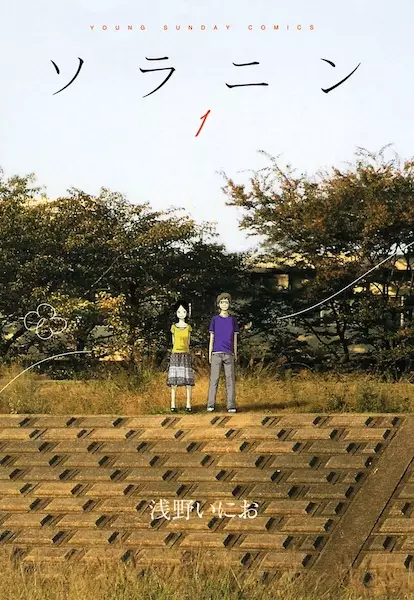
Perhaps then the problems regarding Planete’s character arcs boil down also to an issue of manga length: Planetes finished its run at only 26 chapters, whereas Vagabond is a hefty and ongoing 300+. 300 chapters (primarily) following a single character allows much, much more room for nuance. But I can also think of manga of similar length and core-character-count that achieve nuance and poignance on a level far, far deeper than Planetes has (Solanin at 28 chapters; Buddha at “66” chapters; Pluto at 65 chapters — keep in mind that Planetes has 50-page chapters, whereas I believe all but Buddha have the usual 20). So it comes down more to something I said way up near the top: Planetes prides itself on Moments.
Moments don’t have a terribly strict definition, but if I were to give one colloquially, it would be “epic panels.” Panels, or, more frequently, full pages (and sometimes scenes spanning a few pages within a chapter), which enamor one with a sense of awe, signal the manga’s je ne sais quoi, encapsulate the manga’s entire meaning in single frames: cinematic moments. Full pages of Moments fill the chapters of Planetes, and part of that is because the manga is semi-episodic, with each new chapter usually holding its own separate three-act structure and characters unlikely to return to the foray in later chapters, but keeping the substructure of the story focused on the progression of its main characters (namely, Hachimaki). So just about every chapter you get undeniably brilliant and beautiful panels or pages which more or less summarize the manga as a whole: a character, bedecked in their bulky E.V.A. suit, staring wistfully to the stars beyond; foregrounded in this vast tapestry yet verily not the true focus, as Makoto clearly sees humans not as exploring space but exploring a whole (the universe — or maybe, more, the solar system) of which they make a small but important part just as those distant and ostensibly small dots have their own import. Those are Page Moments. Then there’s Scene Moments: more abstract concepts brought to the forefront of (usually) Hachimaki’s conscious mind via subconscious-attempting-to-tell-him-something-important, for instance chapter 14 which focuses on a Hachimaki’s strange recurring dream regarding an alien creature and him jointly musing at the Milky Way.
In concept, indeed in execution also, I love both these types of Moments. They’re either beautifully contemplative, strange and thought-provoking in their strangeness, or both. But does Planetes earn panels and scenes like these with the story and characters it pushes? No. They’re the saving graces of a manga that would otherwise likely by and by be considered subpar, because they’re the quiet moments desperately needed in a story too loud and in-your-face for the good of its own communal message. These Moments lack significance because they lack the context needed to be significant. The manga visibly eschews subtlety throughout, so adding it in in this manner feels, unfortunately, very forced. My guess is that maybe Makoto thought of all these panels and pages like those separately, individuals gazing into the breadth and depth of the world surrounding them, then structured the entire manga around them, and simply didn’t know how to adequately connect those important points them without rushing. And that’s a shame, because if he didn’t rush this (or, also, Vinland Saga — again a similar character arc for Thorfinn) I could very well see it matching up to the likes of Vagabond. But it doesn’t even come close. I’d wonder if it would fare better if it simply had the muted, nigh-dialogueless storytelling style of “Blame!”
I say that because of the visual presentation of space, interplanetary flight, smokers in a smoke-shunning biome, E.V.A. equipment, politics and anti-politicking, and so on with everything else. The majority of my review may seem negative, but that’s because I’m disappointed: this manga in many respects had clear and powerful potential.
For one, Makoto’s research chops regarding space travel is amazing. Even if the people in this manga don’t feel real, everything around them absolutely does. It’s an attention to detail that reminds me heavily of the recent novel (and recently film-adapted) The Martian. If Makoto had relied less on character archetypes and caricature, rushed less in terms of character progression, then exhibiting the way they so smoothly live in this future world would land phenomenally. Adding to that, his ability to crisply draw high-velocity motion in a world that measures itself in km/s means that when he isn’t focused on making his cast philosophic mountebanks in terms of countenance — I’m not a fan of how he draws people, as he has a tendency for facial non-diversity (compare: eyes, eyebrows, nose) and a penchant for making overreactions overreactive — you can bet that the equipment you see on each panel looks and moves very naturally (or seemingly so; I’m no astronaut).
For a popular culture so hellbent on nail-biting over technological dystopia — the West having that capitalistic fear of economic castration by machine-replacement — Planetes is a breath of optimistic fresh air. Manned interplanetary flight is an inevitability, along with interplanetary economy, transit, family, technology, culture — at this rate. Having all that potential rooted by people, just regular people, and how they’d live in Earth’s orbit in 2075, is something we need. Planetes is something we need: but it’s an idea that can be evolved on, and, especially in terms of characters, improved.