Links go to search results. Availability varies by region.
Find a Specific Chapter
108 chapters total
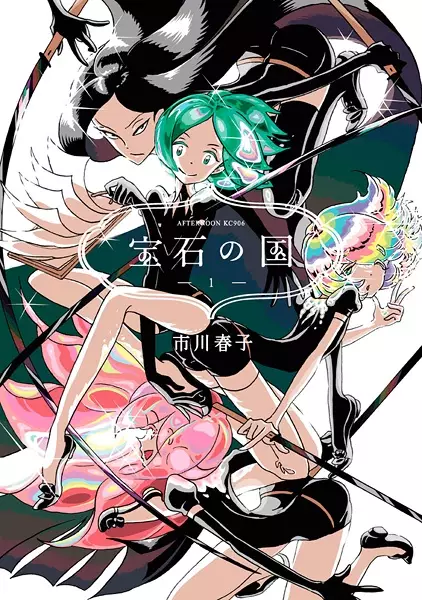
Land of the Lustrous
宝石の国
9.00(60K votes)
Ranked #15Popularity #72
chapters
108
volumes
13
Status
Finished
Published
Oct 25, 2012 to Apr 25, 2024
Authors:Ichikawa, Haruko
Action
Worth Reading? — Global Verdict
8.9/10
Average Review Score
90%
Recommend It
20
Reviews Worldwide
International Reviews
Fguyretftgu7
Recommended
9
it's over. it's finally over. what started out as a charming, albeit slightly unsettling, story of cute rock humans fighting fluffy moon aliens quickly became one of the wildest, strangest and most provocative plots i've read yet in manga. seriously, this manga gets really weird. not too incomprehensible, nor pretentiously abstract, but if you want a simple action mystery story Land of the Lustrous probably isn't for you. PLOT: plot is good. it's not what i'd say is the selling point of LotL, but it's definitely paced well enough to never feel like a scene drags too long. the plot gets really weird halfway through, and some mightcomplain that the second half feels extremely disjointed but i dont know, it works for me.
i will say, there's a portion in the middle of the manga where it does get a bit repetitive and it starts to drag a little. this is due to the setting that the manga confines itself in, which does start to get stale after awhile. thankfully there's a change in setting soon enough, and that's when things start to progress again.
CHARACTERS:
the protagonist (phos) is handedly one of the best ive seen. many amazing protagonists in manga are unlikable or not particularly interesting in the begin compared to the path they will later undertake (i.e. eren, thorfinn) but phos is immediately charming and interesting from the start. there's a sense of incompleteness in phos, which makes their development one of the most fascinating ive seen done in manga.
the other characters are pretty solid too. most of the Gems are dysfunctional in their own way, which makes for an interesting character study on each of them. they get ample page time to establish themselves, and overall i have no issues with them. they do feel set up to flesh out phos further at times, but i really have no issue with that in a manga that is laser focused on its protagonist's development as LotL.
ART:
there are two kinds of amazing art in manga. on one hand, you have the berserks, the vagabonds. those are meticulously drawn to perfection, trying to capture the human anatomy as accurately and as realistically as possible with the pen. on the other, you have LotL.
ichikawa excels at creating evocative, beautiful art while achieving a sense of minimalism in her art. there's no intricate shading, no miura-esque every-pixel-must-be-perfect philosophy behind her art style, but her impressive use of negative space, symmetry in her page compositions and panels are simply incredible. every panel flows seamlessly to the next, and it makes for a great reading experience.
only nitpick is that it can be quite tough to differentiate the Gems, especially at first.
TONE:
i love how bleak this manga can get. i also how love how hilarious it is.
the humour is a constant in the series. unlike many manga out there, where humour is often highly exaggerated and slapstick, LotL's humour is often more quippy, and even in many occasions, pretty damn dark. it's never too frequent to become grating, and the jokes tend to land well.
THEMES:
existentialism and a whole lot of buddhist motifs. sounds pretentious i know, but don't worry, ichikawa does not shove it down your throat to the point where it affects the plot. ive never read a manga with themes that get as existential and abstract as LotL, and as someone who does believe somewhat in Buddhism it is handled in a really interesting manner without getting preachy.
OVERALL:
also the ending's good. it's not anything mindblowing, but it's a fitting, beautiful ending for our protagonist.
a must-read if you're someone looking to read all the classics in the medium. i can promise that you will find NOTHING like LotL, love it or hate it. an imperfect masterpiece.
9/10
Long ago, Earth was struck by six meteorites, creating six moons and leaving a lone island in their wake. Those who could not make it to the island sank to the bottom of the ocean, where, over time, they slowly turned to crystal. As countless millennia passed, 28 of these crystallized lifeforms, known as the Lustrous, rose from the depths and resided on the island. Led by the wise Kongou-sensei, they must defend themselves against the seemingly infinite number of Lunarians, inhabitants of the moons who seek to harvest their valuable bodies for crafting weapons and jewelry.
Houseki no Kuni centers around Phosphophyllite, a young gem about to turn three hundred years old. Clumsy, extremely fragile, and having no visible talent, they are one of the weakest gems around, unable to help in the fight against the Lunarians in any meaningful way. But as the battle with the otherworldly invaders rages on, they soon learn that power comes at a cost that no one should have to pay.
[Written by MAL Rewrite]
175,926 Members
143 found helpfulApr 24, 2024
TrMin228
RecommendedWell-written
10
This is not a piece meant to cover the entirety of Houseki no Kuni. Rather, it focuses on the journey and the ending of Phosphophyllite, and the meaning it ultimately conveys. Phosphophyllite’s journey in Houseki no Kuni is often interpreted as a tragedy of identity erosion, where her sense of self gradually dissolves until nothing of the original remains. However, the ending offers a reversed perspective: it is not a complete loss of identity, but rather a process of deconstruction, one that reveals a core that has never truly disappeared. As the world stands on the brink of collapse and Phos’s body begins to melt away,each layer of material, each former version of herself, is stripped off one by one. This is not merely destruction, but a subtle metaphor for a return to the origin. If her entire life has been a process of constant replacement and improvement, then this moment restores her to a state of original purity.
From this, Phos’s ending provides an answer to the paradox of the Ship of Theseus. If the paradox asks whether something remains itself after all of its parts have been replaced, then Phos suggests that identity does not reside in physical structure or surface memory, but in the most primitive desires. Even after thousands of years of isolation, even as her body has been altered beyond recognition, beneath those hardened layers remain the simplest and most fragile wishes: “I wonder if Sensei would be proud of me” and “I really want to see everyone again.” These seemingly small desires carry immense weight, for they represent the most “human” part of her, the longing to be acknowledged and to belong, which has driven her entire journey since the very beginning. The sense of “lightness” Phos experiences in her final moments, along with her complete dissolution, carries two layers of symbolic meaning. On one hand, it is liberation from the burden of fate and the responsibility of salvation that has lasted for millennia. On the other, it is a state of serenity, where one sheds all layers, all identities, all temporary forms and ego, leaving behind only the simplest essence.
The tragedy lies in the fact that Phos finally achieves the “usefulness” she has always desired. She saves everyone, yet there is no one left to acknowledge her, and that very power becomes meaningless because no one needs it anymore. What remains is only a faint voice echoing in a vast universe with no one to respond. At the end of her pursuit of usefulness, she becomes the most powerful being, yet is left with the same loneliness she had at the beginning. If once no one needed her, now there is no one left at all. This idea of liberation is further reinforced in the final chapter, when the fragments of Phos, now scattered and dissolved, become a great and radiant comet. This comet does not merely drift freely through a new universe, embodying absolute freedom, but also serves as the final bridge between a fading world and a new beginning. Through this, the author presents a cycle of rebirth, completing a full journey: from a gem that longed to prove her worth, through immense suffering to attain a form of divinity, and finally to letting go of everything to become a free light, traveling across the sky of a world she helped save.
This ending is not merely the conclusion of a life, but a paradoxical statement about the nature of being human: we may change almost everything in order to survive and adapt, yet deep within us remains a fragile but persistent core, the most human and pure part of ourselves that longs to be loved. And it is at the peak of material dissolution, when all identities and temporary selves have been stripped away, when she exists only as something as light and distant as a comet, that Phos truly finds peace and perfect freedom, while still retaining her purest self, just as she once expressed: “If it can make someone feel at ease, then that’s enough.”
In the end, the beauty of Phos is no longer the brilliance of a gemstone, but the beauty of a soul that has shed all its chains, becoming an eternal part of the vast universe.
17 found helpfulMar 22, 2026
Vxerix
Not RecommendedFunny
1
I went into Houseki no Kuni with very high expectations. Almost everyone I saw online described it as a modern manga masterpiece, praising its deep storytelling, unique world, profound themes, and breathtaking art. After hearing such consistent acclaim, I was certain I had found something truly special that would stand among the best series I had ever read. At first, the manga does deliver on its surface-level appeal. Haruko Ichikawa’s art style is distinctive and genuinely beautiful. The character designs feel fresh and creative, the desolate world has a haunting, elegant atmosphere, and the early chapters carry a quiet, almost fairy-tale-like charm, mixed with anintriguing sense of mystery. It is easy to see why the visuals alone draw so many people in. However, as the story progresses, the cracks begin to show, and the initial excitement fades. What starts as an interesting and somewhat charming protagonist quickly becomes a frustrating character to follow. Their journey becomes repetitive and emotionally exhausting rather than meaningful or satisfying. The constant shifts in behavior and mindset start to feel forced and self indulgent instead of like natural, well crafted development. The rest of the cast fares little better. While the other characters look visually striking and have interesting concepts, most remain surprisingly shallow. They often feel more like symbols or tools to move the plot forward than real, multidimensional beings with depth and growth. This makes it hard to care deeply about the relationships or conflicts that unfold. Pacing is another significant weakness. There are long stretches where almost nothing of substance happens, filled with dialogue and philosophical reflections that try hard to sound profound but frequently come across as pretentious or repetitive. Then, without proper buildup, the story suddenly rushes forward, feeling jarring. This uneven rhythm makes the overall reading experience feel dragged out and directionless, especially in the middle and later parts. Thematically, the manga aims for big, ambitious ideas about identity, purpose, and existence. While these topics have potential, the execution never reaches the level of brilliance that so many fans claim. The tone gradually shifts from its early gentle melancholy into an overwhelming wave of bleakness and despair. What could have been a thoughtful exploration instead feels like nihilism for the sake of nihilism, leaving the story emotionally draining, lacking enough substance or payoff to justify the darkness. By the final volumes, the gap between the massive hype and my actual experience had grown enormous. After investing so much time based on the near-universal praise, I felt let down. The beautiful art and original concept are ultimately wasted on a narrative that never earns its reputation as a masterpiece. It promises depth and emotional resonance but delivers mostly frustration and hollow sadness. In the end, Houseki no Kuni is a visually stunning work that falls short of its towering reputation. It may appeal to those who enjoy extremely bleak, artistic stories, but for me it was a long, disappointing read that never justified all the glowing recommendations.
35 found helpfulApr 28, 2026
Nivo3041
Recommended
10
There's something inside any piece of fiction than always makes the spectator heart race, when you see the "magic" inside a world written down by the mind of a perturbed, fascinating, brilliant or weird insight of someone, or maybe all of them coming together to make a work so special, so unique that it feels magical. Whenever I start a manga, anime, visual novel, video game, etc I always think "Well... What do you have to offer to me?" as a way to suppress my own excitement and mind before making judgments in any work... I think here with Houseki no Kuni I found oneof the most exciting, emotional and "magic" world this medium can offer. A work doted with so much color despite being monochromatic, a work doted with so much humanity despite not having a single human, a work so emotional despite being so draining and desolate... House no Kuni is one of those work that works because is a manga, that takes absolutely and completely advantage of the medium it is written on as to make everything more compelling and charming with its characters, narrative and drawing.
I'll make this review short. And I'll treat the gems as "she" despite being non-binary because it is more easy for me to write this down. Thank for your comprension.
Our story takes place in a world where mankind has going extinct, and the world is inhabited by gems that are invaded by lunarians, a weird race that attacks, destroys and kidnaps the gems; Phos, our protagonist, laying in the ground with nothing to do, is wakened up by one of her gems comrades for a work offer... I want to summarize it as simple as this because the twist and the progression in Houseki no Kuni makes it that looking back at this chapter holds a so significant narrative and feeling in it that it is just incredible. Basically Phos is looked down funnily by her comrades gems because the strength of a gem is based in their hardness scale... Then how do our protagonist Phos starts? And that's the first approaching with its character: Phos wants to be stronger, to be able to defeat the lunarians despite having a hardness of 3.5, making it impossible in the eyes of everyone around her and even in the eyes of the master of the gems; Kongo.
And with the main plot summarized... What's so special about Houseki no Kuni? I think everyone who has read the manga will answer you the same: Phos, we, as lectors, are drawn upon such a journey of self-understanding coming from Phos that it is so emotional driven it can make people be fond of our protagonist problems and dynamics with other: The feeling of wanting to improve, to help others, just to see all crumble as you continue still going bad ways because of the way you're hurt, that is something that resonated with myself throughout the whole manga, that human feeling of self-hate because you don't fit with everyone else, that strong loneliness of wanting to change... Just to still being unaccepted by the rest... I won't explain in too much detail about Phos journey as experiencing it reading page by page is something that will just be stuck in the lector's mind for a long time. Phos change in the entire manga feels so natural and so well calculated it just can't stop amaze me, people often think Phos is rewritten by the author to make the protagonist fit in the story and Buddhist themes more, but that couldn't be further from reality. Trauma builds character, that's the philosophy in Ichikawa (the mangaka) as she continued the series with Phos, the excessive well thought dialogue and interaction between characters works as an example.
In one of the most tragic event for our protagonist, we heard how she is entrusted with the task of "helping sensei to not feel lonely" which is a phrase that resonated so much with our protagonist to the point where we see a real and straightforward correlation between her character progression and this idea that is hurt to see, despite all her changes throughout the story Phos continues to show her self to others in some ways: when she first changed she was still playful and kind to others, after that she still considered Kongo an important piece of her life, and after that she still wanted to help the other gems. That's what is so incredible about how the dialogue is structured and how everything is delivered in this manga, because it makes a twist around our characters, specially the protagonist. Ichikawa tend to make her paneling in which two character are talking some mundane things by a strong following of little change in expression to make it feel real and alive, so when a character speak out the main topic of their exchange in dialogue we're always welcomed with a big panel focusing in their expressions and positions, why? Because Ichikawa's way of portraying the relationships in Houseki no Kuni works as a full exchange between people who are hurt with a dynamic to make it like both character are part of the problem (the examples being between Phos and Cinnabar/Diamond and Bort) and I just absolutely adore how her paneling helps build scenes and dialogue, that's why I said Houseki no Kuni takes full advantage of the medium, because the monochromatic and the like "geometry" in the drawing in Houseki no Kuni is so perfectly well crafted that help us understand more the feeling that this work delivers the best: Loneliness.
The negative and positive space just along the structure of Ichikawa's art makes it so the themes and messages are perfectly cohesive with each other. This is not a work where the art is realistic neither it tries to be, but the style it has on its own is just so incredibly good and intriguing that it just went over my favorite art in all of the medium. I love everything about houseki no kuni's style and arts decision: The fact that even backgrounds are little to almost never drawn is something that works because of how it is handled (which normally would be a lazy and mediocre choice for an artist) and how the crippling feeling of misunderstanding and loneliness is present. Ichikawa's artwork and thinking is something that deserves praise. For example, in every volume until volume 11 (where something really big, happens) there is one character that is almost always drawn; Cinnabar, but she is dawn always in the page holder, being apart from every other character... Why? Because that's a subtle way of showing, a paratextual way of depicting Cinnabar's problems and themes in a clever and interesting way that works within the medium of a written work and portrayed it in paper. The budhism messages are a touch so lovely to this work that I always felt like everything was structured so well done I felt even little myself compared to the themes.
That thought-provinkg themes of Buddhism, incredible protagonist and the beautiful writing is what makes this work feel special and so magic. Houseki no Kuni is a manga that I followed since school since I was like 13 years old and is finished now that I'm 20 years old. Is a story whose themes followed in my path of life to this day and watching the culmination and how I even managed to understand the cycles of hatred, the loneliness, the sorrow, the fear of change, the fear or forgetting and the forgiveness is something that resonated in some aspects of my life as I have grown up, and the story continued unraveling itself. I may sound silly as I also feel I went on a journey of my own while Phos was going in hers. Sometimes I wanted to give up and feel far away from the world and the people, just as Phos did. I feel like I was lost in trying to please everyone else except me, just as Phos, that's why I'll always have a soft spot to Houseki no Kuni (despite having an overall excellent quality and being one of the best), but just as Phos continued and tried and tried until she achieved peace, I still continue struggling with life too, that's how much this works means to me. A fantastic even cosmic journey of how little we could be in the big picture, about what does it mean being human and the nature itself of us as humans. This manga portrayed so many things in such a creative and interesting way that I feel like this is one of those works that I'll cherish forever in my life and a work so interesting and marvelous it makes me wonder about the structure and the dynamic of a manga. I love Houseki no Kuni and Ichikawa for this work. This review works as a way to just shower this page with my gratitude and with the love I feel for this media.
I thank you, Haruko Ichikawa, for making a work as Houseki no Kuni. I'll remember it for as long as I live.
13 found helpfulJul 8, 2024
diedforamir
Recommended
10
For anyone on the fence, please please read Land of the Lustrous. Land of the Lustrous is without a doubt my favorite manga of all time and possibly my favorite story in media. The story has this level of sophistication that is rarely seen in the medium when it comes to aspects of the human condition. It attempts to answer what makes us human: our desires, passions, and values we have. I understand some of the criticism people have of Hnk has to do with how philosophic it tries to be and I can understand why it is a turn-off for some people. But ifyou deeply enjoy psychoanalytical character studies then you will deeply enjoy Phos. Phos goes through one of the most heartbreaking and tantalizing character arcs you will see in the entirety of Animanga. But their tragic journey is beautifully and ethereally told. If you can get past the weird premise you will be treated to one of the best characters you will ever witness. For reference, LotL is very similar to something like Code Geass where much of the series's appeal is from its main character. There are still very enjoyable and well-written side characters but they take a back-row seat for Phos's development.
Basically if you love high-concept fantasy and tragic stories, Land of the Lustrous is the perfect manga for you.