Links go to search results. Availability varies by region.
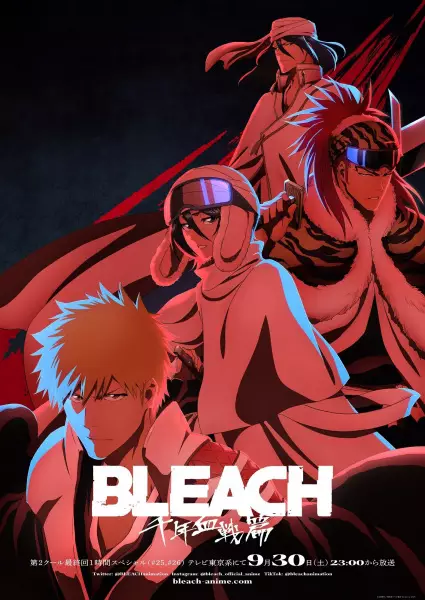
BLEACH 千年血戦篇-訣別譚-
13
TV
Finished Airing
Jul 8, 2023 to Sep 30, 2023
After a brutal surprise attack by the forces of Quincy King Yhwach, the resident Reapers of the Soul Society lick their wounds and mourn their losses. Many of the surviving Soul Reaper captains train to battle without their Bankai, the ultimate technique wielded by the fiercest warriors. In the previous assault, Ichigo Kurosaki narrowly managed to help fend off Yhwach's fearsome wrath. However, to ultimately defeat his godly adversary and save his allies, Ichigo must now undergo severe training that will push him beyond his physical, emotional, and mental limits. Though Yhwach already holds the upper hand in this ongoing blood feud, he also successfully recruits Uryuu Ishida, Ichigo's close friend and rival, to be his successor. Yhwach strikes out once again at the weakened Soul Society, intent on finally obliterating his long-standing enemies. As Ichigo struggles to attain new power, the Soul Reaper captains fight for survival and borrowed time. [Written by MAL Rewrite]
7.5/10
Average Review Score
65%
Recommend It
20
Reviews Worldwide
To preface, I shall rip the band-aid straight off: BLEACH: Thousand Year Blood War - The Separation isn’t a replication of cour 1’s excellence. However, this is because the critically acclaimed cour 1 is nothing less than a 10/10 as a flawless narrative masterclass of beautiful thematics, symbolism and poetry brought by Tite Kubo to the forefront of his story to loom over Bleach’s radical expansion and acceleration of plot-points as well as the many foreshadowed twists that came with it here in the series’ most ambitious and ultimate arc; all whilst encased in state-of-the-art production values and direction. It is a perfect showcasing ofthe battle genre which–true to Ichigo’s motif–shattered fate; and became something greater and more successful than what most anyone was expecting. One that had successfully revitalized the series from a classic into a neoclassic. Competing with what is nigh-universally acknowledged as the pinnacle of Bleach (at least, for now) is obviously a feat in and of itself. But cour 2 still retains the essence of the first with the same cinematic productional aspects; nothing less than a 9 whilst at the same time serving as an intermediate between the initial narrative blitzkrieg of cour 1 and the apocalyptic climax and prophetic unification of Bleach’s story in the next two cours. For you see, TYBW has 206 chapters. Cour 1 adapted Ch 480-542 and this cour adapted around 70 chapters, leaving around just 80 chapters to be adapted within the next two cours. Substantial new extended content is all but confirmed and just where TYBW needed it. Thus, The Separation will (reassuredly enough) be the weakest cour in this series’ greatest arc, where everything comes full circle and we end at the beginning. It is difficult to truly display The Separation’s brilliance (as well as the previous cour’s) without spoiling it. The Separation begins immediately after the events of the ethereal ‘The Blade Is Me’ - the most important moment in the entire story in which we see the culmination of Ichigo's character interwoven with all of the powerful major themes and recontextualizing foreshadowings of Bleach as well as the nigh-conclusion of his character arc. Cour 2 carries on the incredibly sharp and polished, streamlined 13-episode experience and is still filled with a powerful architect and depiction of emotion. The pacing is a stark contrast to the 2004 anime and mirrors the streamlined experience of binging Kubo’s cinematically paced and presented manga of aestheticism. Cour 2 is laced with back-to-back dynamic fights, and these all serve a purpose either to the overarching and ambitious plot-heavy narrative structure and/or several character pieces. Dialogue, subtext, symbolism, themes and the wrapping of character arcs are all executed in very powerful ways through these fights. They have meaning and aid in character writing which works in tandem with Bleach’s worldbuilding and lore. This series has always been a character-driven story. It is a collection of character pieces that explore different themes and concepts but which the overarching plot catalyzes and serves to unite as a cohesive whole. The power system in Bleach (Reiatsu) is a major contributor to this. Cour 1’s romantically written and beautiful climax the ‘Everything But the Rain’ flashback and the subsequent ‘The Blade Is Me’ (EP11-13) not only proved that Bleach is not merely about fights but also its intimate characters, plot revelations and developments; but as well as how the series iterates on its themes and concepts smartly. Reiatsu is inherently adjacent to the major themes of identity and duality in this series, which was fully demonstrated when we learned about the balancing nature of the Hollowfication process; White, and thus Ichigo himself, inherently being tied to these major themes by proxy of this thematically rich mechanic once looking at the nature of his Hollow-Shinigami powers. The Zanpakuto, or the Schrift, or the Resurreccion, is the characters’ fingerprint; an extension of their soul and personality. Aside from having immaculately designed powers to look at, it helps us learn about the characters through brilliant displays of their identity manifested through combat. Every single character is given abilities that complement them and there’s always an underlying theme to their movepool rather than an uncorrelated, random mess. This cour reinforces Reiatsu as an exemplary power system. The Separation truly plays to its strengths as a character-driven battle series not only by using the gorgeously produced and choreographed battle spectacles as the foundation for which character pieces are developed but also by tying these pieces into the wider world of Bleach. Examples of this sophisticated assimilation of storytelling elements are Komamura and his relation to the Beast Realm, Ichibei and his progenitive relation to the Bleach cosmology, and Yhwach alongside his Schutzstaffel and their relation to the Soul King. Reiatsu, unlike most power systems such as Nen, is not a needlessly convoluted and mechanical one for the sake of it. It operates on soft logic because Kubo recognizes that characters and narrative are more important than the power system and environment and that creatively unique abilities paired with interesting match-ups are far more important for writing engaging fights than needlessly complex mechanics that read like pseudo-science and are ultimately a trivial slog for the reader. It’s why despite many of the fights’ similar structure in this series, they are still engaging along with other aforementioned factors such as authentic character drama and exchanging of ideological and philosophical dialogue if not the characters themselves, rather than a fixation on power system mechanics debased from reality. A good example of all of this is As Nodt’s battle with who I will not spoil. The dialogue and his character dynamic with his opponent are genuine and the abilities displayed here are among Kubo's most creative. The interaction between his Fear Manipulation and his opponent’s Absolute Zero is ingenious and thoroughly engaging. It’s fun seeing busted abilities thoughtfully counterbalancing each other; with one of my personal favourite things about the final arc being how the power system leans towards more hax and abstract/conceptual abilities; thematically befitting as it reflects the escalation of stakes in this arc and the Quincies seeing themselves and being portrayed as a higher class of elite soldiers compared to the Shinigami and Arrancar. The power system is capable of creating esoteric yet easy-to-follow abilities without being convoluted or having to resort to mindless beam spams and fist-waving instead. Another example is Kenpachi’s fight. Not only was this a great beneficiary of the refreshing pacing of the TYBW adaptation as an efficiently condensed single continuous high-octane action sequence due to many of the manga panels being art pieces, but this fight embodies the essence of Bleach. It's a story where the very concept of "To fight" is a centralizing force. Kenpachi has always embodied this the most, and after his intimate battle with Yachiru Unohana the First Kenpachi in EP9-10 ‘The Drop’ and ‘The Battle’ of cour 1, he became the embodiment of a Shinigami–the true embodiment of death. Meanwhile, his opponent who I will not spoil has the power to imagine anything in and out of existence, which is the otherworldly and dynamic nature of the fights in Bleach taken to its utmost extreme. Kenpachi cuts down anything thrown at him, including oneshotting a meteor capable of nuking the Seireitei and slicing through the fabric of space itself because he is just that much of a "monster". It's thematic with him being THE Kenpachi and displaying through BATTLE the weight that such a title holds. Kubo went about creating such an overpowered ability in the opponent perfectly, by essentially turning the whole fight into one big thematic execution; and the conclusion for his opponent is layered in symbolism and poetry. The beauty and the beast dynamic and the brawn vs brain dynamic of these two fights respectively are merely the final thematic touch. However, probably the very greatest example of Bleach’s deceptive amount of depth regarding battles is Ichibei’s this cour, which serves as the finale; embodying the true essence and soul of Bleach thematically, conceptually and aesthetically whilst it insurmountably pushes forward the lore and worldbuilding of the story along with the two conflicting characters in the aptly named episode titled ‘A’. Kubo’s characters, main and side alike, contribute to the themes and worldbuilding of Bleach, and are intelligently utilized throughout the story so as not to take away from the core narrative and characters. For the most part, characters come into the narrative, contribute their part, and exit stage left. For instance, the supporting characters Yachiru and Isane–who among many had their character arcs in focus last cour–are neatly wrapped up in this one in respect of the battle between the two Kenpachis, or their two Captains respectively. And this will be a reoccurrence for others such as Nanao in the future. Character interactions in this series are always sentimentally written and meaningful. Even tertiary characters like the otherwise one-note comedy relief Keigo in this arc gets nuance and depth to him with his outburst towards Kyoraku after learning of the Soul Society’s possible dark intentions for Ichigo. The TYBW adaptation also includes Kubo’s elegant chapter epilogue poems for each episode, which serve as pseudo-supplemental content that enriches his already powerful characterizations. This all applies to the Sternritter as well, and their approach to character writing is refreshing. The Espada gathered together for their own reasons, they were individualistic in nature. Aizen got them under his control simply because he was stronger than them. But with the Sternritter, they follow Yhwach because he’s their king. They believe in his ideology and they all bear the same grudge against the Shinigami. There is no need for full-fledged backstories for all of them besides the war 1000 years ago which we get this cour as anime-original content, for the strong yet subtle thematics displayed here justify it. It is something that’s always been characteristic of Kubo’s writing: The Arrancar arc shared a similar plot structure to the Soul Society arc but was thematically polar to it and is how this structural iteration is justified: The Hollow-centric arc created an intentional yin-yang, or inverted mirror with the Shinigami arc that ingeniously iterates on the two races’ opposite interactions with Humans (Shinigami release the soul, Hollows consume the soul) and the overarching theme of duality via the series’ very structure itself. On the topic of duality, the main villain Yhwach serves as a great parallel to Aizen. Aizen is a slow-burner who is methodical, conniving and planning in the shadows. You can see his machinations from the very beginning of the canon manga timeline back in the ‘Turn Back the Pendulum’ arc. Yhwach is the opposite: He is introduced in the final arc, and thus, we immediately get to know him and he is even immediately more impressive in many respects as he is immediately boots-on-the-ground, even killing Yamamoto - the pillar of the Soul Society, before targeting the Soul Palace. Actually, he and his soldiers accomplish more against the Soul Society than Aizen and his army in just the first invasion. All of this makes total sense as well; Yhwach is a warlord, whilst Aizen is a scientist. They both ultimately play the overarching villain in the story and want the same thing, but for different reasons with different end-games; with the latter having a personal connection with the Soul King and Ichigo having personal stakes against them both for different reasons. Kubo even tells this duality visually, with Aizen dressed in all white and slick, whilst Yhwach dressed in all black and dominates the page composition. Both are excellently written characters for thematically inverse reasons and regarding the Sternritter in particular, their actions can believably be justified and sympathized with. Kubo hits the perfect balance between pure evil and sympathetic for his villains. They aren’t cartoonishly evil and shallow like in Oda’s writing, nor are they cornily humanized and declawed like in Kishimoto’s writing. Kubo writes ruthless villains and leaves their moral interpretation up to the viewer. This moral greyness especially works because Bleach operates under a morally grey, nihilistic world that allows for more nuanced lore, worldbuilding and cosmology; and which begins being placed centre-stage in this cour. Such a world inevitably seeps into the cast and shares onto them its nuance and creates these complex characters such as Aizen, Yhwach, the Shinigami’s entire purpose not as heroes but merely arbiters of the universal order, and by extension their complicated dynamic with the Quincies. Depending on how you look at the final battle which the fate of existence rests upon, it is between either two morally evil characters, between two morally ambiguous characters, or one good and one bad. The Sternritter are consistent in their great characterization and depiction as a terrorizing force for the Shinigami, with none of them being push-overs and which required inherent identity introspection from the Shinigami in order to be overcome. Some xamples of this were the beautiful (and in the latter’s case, tragic also) closure of character pieces for Rukia and Komamura that tied back to Byakuya and Tosen respectively all the way to their beginnings in the series. Even Byakuya is revitalized here through simple yet ingenious strokes by Kubo that make him one of the most pivotal players; Kubo characteristically doing much with little. My one singular gripe with cour 1 was Byakuya not dying after his brutal loss against As Nodt despite a flawless closure to his masterful character development that would’ve elevated Rukia, Renji and As Nodt’s characters as well. Alas, this was unfortunately out of Kubo’s control as he wanted to prioritize his own life from the death threats he was receiving for the daring decision to kill off such a massive fan favourite, thus did a 180 on Byakuya’s fate only a few chapters later. However, in spite of that, Kubo intelligently justified Byakuya’s existence here despite being ultimately done with his character writing with how he was implemented as a supporting character, and this was even reflected in his subtle power-up in contrast to the Bankai, Shikai and Shunko awakenings of many others reflective of their character progressions after they were all forced to lick their wounds and mourn their losses from the brutal Quincy blitzkrieg last cour. The Sternritter being the menace to the Soul Society also rewrite the architecture of the Seireitei with their own gothic European palaces, castles and building of the Wandenreich as the Schatten Bereich engulfs the Seireitei from beneath and envelopes it in a sky that’s soaked in blood red. It’s reminiscent of the humiliation they made the Shinigami suffer in their first invasion and these visual overhauls against the Shinigami are hauntingly imposing representations of their dominance up to this point. There is also something novel about the Thousand Year Blood War taking place beneath a blood-soaked sky. And, Kubo takes inspiration from other forms of media such as music, as well as high art, philosophy, mythology, history and religion when writing his world and characters (such as Aizen representing Nietzsche’s “ubermensch”, or the Bleach cosmology being based on Buddhist Samsara). In relation to the Sternritter as a collective in their motif, there is clear inspiration in aspects from Nazi Germany and the Roman Empire. Their revolutionary technology from the last cour and here with their occultist undertones mirroring occultism in Nazism with Uryu performing the ritual of drinking Yhwach’s blood in order to be bestowed his Schrift; all whilst being thematic to the race war Yhwach is initiating. All of this is to say that it shows the deceptive amount of thought and care put into these multi-dimensionally designed characters and world by Kubo. However, I can’t deny that the emotion here in cour 2 is generally weaker relative to the emotional rollercoaster that was the first. Amongst the biggest reasons why everything adapted in cour 1 is almost universally regarded as the pinnacle of Bleach is because of the incredibly powerful impression left by the Sternritter. The Sternritter’s blitzkrieg of the Seireitei was very real in its depiction of warfare whilst providing us with the very peak of what the battle shounen genre is capable of with its prowess in spectacles. The Wandenreich declare an ostentatious and symbolic declaration of war by killing the Captain Commander’s Lieutenant just to spite the Shinigami, they lie about invading in 5 days for a tactical advantage, they overwhelm the Shinigami with advanced technology in the form of the Bankai-stealing medallion (literally robbing them of a part of their soul and identity), there is a morale boost and subsequent shattering among the Shinigami, EP6 ‘The Fire’ and EP7 ‘Born in the Dark’ are chaotic and with pacing that almost marches in a rapid tone, and of course, Yamamoto’s seething hatred for Yhwach in their very personal feud that’s filled with powerful subtext, followed by his gutturally ignoble death (he still died standing like the warrior he was, though); the Quincy with complete disrespect for and mockery of the Shinigami using cheap tactics as a reversal to the similar ones the Gotei 13 had used on them 1000 years ago. It was all very dark and gritty, and perfectly encapsulated resentment and despair. Aside from the breakneck pacing itself being fresh and keeping TYBW dynamic, the fruits of its labour can already be seen from this arc onwards. In its most minor extent, this cour still sees a surge in anime-original content every episode through polished storyboards that make existing scenes more impactful or provide fresh perspectives of concurrent events in the timeline; and through small meaningful character dialogues that enrich characterizations and character dynamics. An example of this is all the subtle changes to the Sternriter’s meeting with their emperor Yhwach. Many new faces are introduced here much earlier in order to better their intrigue rather than an abrupt introduction later where they play their centrepieces, and Bazz-B is portrayed as having his own group much like Bambietta with the ‘Bambis’/Femritters. There are subtle additions that provide foreshadowing and earlier establishing of plot-points for pay-offs down the line, such as Haschwalth’s dialogue with his maid regarding to Uryu and Yhwach’s shadowy plan for him, or Ichigo’s passage through the Soul Palace relative to the sinistry of Ichibei. Even minute things like ordering all the Sternritter by Schrift alphabet at the communal shows the attention to detail for this anime. Anime-original content at its most major, however, is creating entirely new sequences for new plot-points and the development of existing ones. For instance, the ominous tears in the fabric of reality that loom and disappear are revisited here. Or, in what is the greatest example of anime-original content this cour, and that which was left a mystery in the previous one: The historical context of the entire run of this arc and the crux of its namesake - the Thousand Year Blood War. In what was arguably the greatest episode of cour 1–EP7 ‘Born in the Dark’–we got an incredible flashback of the original Gotei 13 and the battle in the Seireitei itself 1000 years ago; and this revelation is fully realized here in EP13 ‘Too Early To Win, Too Late To Know’ with the lengthy flashback of Yhwach’s original Licht Reich and his dynamic with Ichibei. Elements of the biggest mystery in Bleach–the existence of the Soul King–are now being unravelled to their eerie core and thus, the expansion of the Bleach cosmology. Many of these character and lore/world bits are much-needed incorporations from the Can’t Fear Your Own World sequel to the Bleach manga - an incredibly written sequel light novel to the manga by fellow Bleach enjoyer the author of Baccano–known for his masterfully concocted ensemble casts–and supervised and drawn by Kubo. It is a work that completes the Bleach canon and elevates its lore and worldbuilding to some of the best and most fascinating in the medium. And it’s reassuring to see this external canon being assimilated into the main source. All of this is indicative of the passion project and love letter to Bleach fans that this anime is by the Pierrot staff. This isn’t a soulless 1:1 adaptation capitalizing on nostalgia, it’s an immaculately produced endeavour by Bleach fans and overseen by industry-setting direction by Taguchi with Kubo as a guiding figure and conceptualist. Creative liberties extend to certain chapters being slotted elsewhere where more appropriate and sometimes carved up to the point of being completely unrecognizable from the source material. The TYBW adaptation continues to have state-of-the-art theatrical levels of art, directing, compositing, storyboarding, animation, backgrounds, music, sound design and voice acting. The Separation follows the same smart resource management as cour 1 - it accomplishes all of these production feats, and when allowed to truly move with its key animation, it produces amongst the best fights in the medium due to state-of-the-art animation carrying all these other nigh-flawless productional strengths along with it. Visual artistry and directional finesse persist, like how this cour symbolically began with Yhwach in abstract imagery and ended with him just like in cour 1. True to Kubo’s manga, the TYBW adaptation has a clear appreciation for aesthetics. And regarding music, Sagisu does an exceptional job balancing out the nostalgia and new tracks while, as he himself stated, respecting the European-inspired orchestrations for the Quincies. Furthermore, he gives deeper meaning to the tracks as they symbolize character arcs. The transition cards are great too, which aside from being aesthetic, is a clever directing decision that doesn't interrupt the flow of the action whilst maintaining viewers aware of the lore bits with conveniently put-together information within the episode itself, thus being part of the general experience without the need for outside material. We get a lot of cinematic wide-angle shots this cour too to show us the grand, otherworldly expanse of the Seireitei, the Soul Society, the Soul Palace and its individual Zero Squad palaces (with Ichibei’s palace even getting a name, thematically enough), and the Silbern hidden within the Schatten Bereich as the narrative begins unravelling the enigmatic lore and worldbuilding that this series has to offer. The few moments of CGI that exist in this anime are sharply implemented as well, with industry-setting compositing complementing it. Tone, atmosphere, colouration and lighting are aspects of this anime that are utterly flawless and so effectively create immersion to an even greater extent than the manga. The lighting, effects and animation all combine to create impact. Soft lighting is used to give everything a more subtle glow and let colours truly pop, whilst the utilization of dynamic lighting creates more emotionally charged, powerful scenes. And whilst Kubo’s thematically relevant black and white backgrounds work excellently in the manga for placing emphasis on his characters and their emotions in the panels, the anime meanwhile has some of the most gorgeously detailed and scenic backgrounds in the industry to bring those characters to life on the screen. ‘Kubology’ prevails this cour and The Separation continues with the sophistication of cour 1. Not to the same extent, perhaps, but that is to be expected and it is there nonetheless. This cour adapted the weakest parts of TYBW and thus, this will be the weakest cour of the adaptation. Yet, in this part still exists amongst the highest points in the series, such as As Nodt's battle, Kenpachi’s battle and Ichibei’s battle. It continues to exude the status of a passion project and is an adaptational work of art that undeniably elevates an already great source material with its own strengths. TYBW is Kubo’s most ambitious arc; the unprecedented culmination and cultivation of Bleach’s narrative and the rapid-fire progression of his characters, wider world and thematics. They all return this cour and will escalate in the next. Bleach is a sophisticated shonen rife with literary devices such as symbolism, visual/textual metaphors and allegories. Kubo’s nature in artistic and poetic storytelling has led to a masterstroke in thematic execution and structuring that involves beautifully meaningful and eternal themes such as death and the afterlife, identity and self-discovery, duality and balance, sacrifice and redemption, honour and duty, friendship and loyalty, and power and ambition. These themes intertwine and evolve throughout the narrative of Bleach, but especially so here in the finale, where a complex and multifaceted story engaging with both personal struggles and grand-scale conflicts is truly realized. The series’ lore and worldbuilding begin to properly unravel in this arc and here in this cour in particular with their ascension into an expansive yet interwoven ethereal cosmology of great immersion. There is both a deep elegance to Bleach and a dark undercurrent to TYBW with its subtle visual storytelling and the powerful way in which it utilizes the abundance of subtext that’s in its world; all layered by a mature, articulate and aesthetic cast comprised of profound characterization and compelling dynamics with one another. "All human beings have things that cause them comfort, and things that cause them fear. When they enter a place that causes them comfort, if questioned as to why they feel comfortable there, they cannot form a clear answer, merely saying things such as 'because I do'. But when they enter a place that causes them fear, even the dullest of fools can identify the causes of that fear. Darkness, cold, height, confinement, pain, contamination. People can list any number of reasons to be afraid. This is because at the most fundamental level, 'comfort' leads to 'life', whilst 'fear' leads to 'death'. While people cannot give a clear answer why they want to live, they can give any number of answers why they do not wish to die." -As Nodt
Click an episode to read its synopsis.
BLEACH-Complete Review Thousand-Year Blood War Arc - Review part 1 and 2 (contains spoilers from part 1) Prologue I can't be the only one who have shed tears though out all of these early episodes.. It only took about ten minutes when I first heard Orihime and Chad, then saw them to ACTUALLY FIGHT.. Of course ICHIGO came in with a Bankai. I can't even imagine what fans of the series must have felt after they’ve waited 10 years to finally see and hear them again. It's crazy emotional, even for me who only knows them for like a year now. I have totell you, I fell in love. Im in LOVE with the cast and the vibe of this series. As a Naruto fan myself, I'm thankful that there is a Shounen out there like Bleach. However .. Bleach is an epic shounen with ultimately legendary goated cast of characters. Namely one of my favorite Rukia, but she is "just" one out of the countless amazing characters created by Tite Kubo. Bleach has a unique storyline as well, in which we follows the adventures of a teenager, Ichigo Kurosaki who at one night became a Shinigami. The Shinigami's, also know as (Soul Reaper's) are the guardians of souls and they're fighting to protect the (Soul Society) and by doing that they're also maintain the circle of transmigration in order to prevent the collapse of the worlds. Now, as we are in the Thousand Year Blood War Arc, which includes the Quincy's, the polar opposite of Shinigami. Whose motives are to kill all souls (Hollow's). They are also incredibly powerful individuals, thus our task in TYBW are much more bloodier then ever before. Story 5/10 In reality, what happens is that one side stirs up the other side by name calling them < the other side answers with a Bankai = fight. In short. This is a Battle Shounen. They fight, because... they have to fight. (That's basically sums up all characters reason to fight and the story core motives as well.) The weak character uses his bankai 24/7 while the strong character refuse to use anything and instead of fighting start a chat with their enemy, but they can't get along in the end. The problem here is it is as repetitive as it gets. There is no high points in any action or unexpected turn of events in the majority of times. Therefore the overall enjoyment comes of flat and the excitement is really nothing, but illusion. Illusion, because the feels is there. What I mean by this is we have the most epic characters ever, we have a scene, but most of the times it fails to pull of guard the viewer. Ichigo vs Renji = what we gained and what the characters gained? where the story moved as a result of that fight? No where. Ichigo vs Ulquiorra = Same thing. Also, the reveal of Ulquiorra number should have done in a much more epic way. So the fights in Bleach the main thing of what this show does, is a lackluster. (Atleast for me) “One’s reality, might be another’s Illusion” - Itachi Uchiha Although, as I said there are some memorable moments that with your great skills of "illusion" or imagination skills makes it even more perfect. Like the first Bankai, or Ulquiorra.. or Aizen.., but in reality the execution of these moments are not slightly above filler qualities. Writing 2/10 My main concern with the series was the writing and the execution of the events. Especially the fights. Each fight outcome was predictable and there were no layers of them at all. They just hitting each other brainlessly. The level of convenience in the script is also pathetic. Especially in this new season. Not to mention, or lets put this way, it’s needles to mention the level of plot armour this show possesses towards their main cast. Ichigo died like four times, Rukia and Byakuya at least one times.. It’s comical, but just as all of the training Ichigo had to do to gain powers and to be able to defeat his enemies. In the first season his training wasn’t that laughable, but still stupid because he just fought non-stop with swords and childrens, however since this arc his training sessions is dumbed down even more so than this: - You need 10 years to learn, but we only have 3 days so you can actually do it in 3 days. - Ichigo dies - You have to train, we are in the middle of the fight, but that’s alright, you only need 2 years, what is actually hours in our lifetime. - How convenient. - Ichigo dies - you have to.. stop In general his training sessions looks like this now in TYBW: First, He takes a bath. Second, He eats food. Third, he watches blacksmith making swords. Fourth, walks and stare “strong” people. Fifth, jumps down of stairs. Now, lets talk about how the fights in Bleach looks like: Good character looks weak against the “bad” character. - The bad character kills the good character. - After a few seconds the good character levels up and defeats the bad character that is now weak as hell. Repeat over and over again. Every single time, they introduce themselves to each other. For example, it was the cherry on top in this arc when Shunsui Kyōraku introduced himself to Jugram Haschwalth. As they introduced their names, titles, their favourite food and drinks, there was no time left to their fight to even begin…postponed to a tea party after. But when they do begin to fight, it goes like the bad side is super strong, but stupid or arrogant so they don’t kill their opponents. When the good side is super strong they also fail to kill their opponents.. Or good side is stronger than the bad side then the bad side levels up. They playing with the now weakened good side like they are the strongest for five literally seconds, then a super strong good side character defeats the bad side with one move.. Also, the reasons behind things like how they so conveniently recovered their bankais by just eating some beens.. every time.. big brain rocks. I would preferred to see more of Ururu, Ririn and Nel over these predictable and over convenient fights. What I absolutely hated in this show was how poorly some of these goated characters were written. Tōshirō Hitsugaya character for an example. Poor guy was beaten up by literally everyone.. still alive and act like he is the coolest. The waste of Unohana is baffeling me to the ground. In reality she is still the Kenpachi, but she literally threw away her life and title just to make Zaraki stronger.. (?) but even with that he still got triumph over by ywatch one episode later. The other thing is the abilities and power system. Some Bankais are actually cool and meaningful, but since everyone using it 24/7 it losed its weight of exclusivity. They are also way too unbalanced and most of them can’t lived up to the hype at all. Or what about Bambietta characteristics? She takes a guy to her room and slices him up just because she is bored? what the hell is going on? Some parts of this series is funny and cute, but there are things that not just disturbing, but disturbingly idiotic and dumb. Just as the entirety of Aizen character and his super intelligence slash manipulation is a complete joke made up by the fans. He didn’t planned shit. He let out that hollow to do “things”, but he never imagined the outcome of the events, he just went with the flow and fans calls it as “his plan”. Also, I don’t understand how his sword work because he clearly not used ~ Kyokai Suigetsu ~ on Ichigo at the final of season one. Or Aizen should have won, but clearly it was “his plan” to lose. Otherwise the show would have been ended. How convenient. Madness, madness going on in the story.. completely uninspired, bland, random stuff happening without any real induction. Ichigo family for example or Zaraki’s zanpakuto’s was interesting and quite well written for the most part. As of the few things that comes to my mind at the moment as applause-worthy in the whole story. Although there are some “memorable” moments and a few really good “vibe” moments that you can feel what Bleach is supposed to be, is not justify how badly they were written and how bland and boring the rest of the story were executed. Characters 8/10 The concept of Bleach is surely amazing, the Shinigamis and Quincy’s were an interesting concept. Top notch character design and overall aesthetic of the narrative. Also it holds one of the most unique and goated characters in all of anime. For me Rukia character is easily one of the best character ever created in anime. But we can also mention Yoruichi and Urahara as well. Ost 9/10 Bleach ost's are beautiful. They are truly amazing scores and they made me love every single episodes, because of the vibe they've created. The voice actors… I just can't find the right words to fully describe how incredibly goated all voice actors are, but I have to say thank you for Rukia's VA, Orikasa Fumiko. Thank you so much! Art 8/10 Compered to the previous seasons I gave the same rating for this entry as well as by how the adaptation goes. Pierrot is a great studio, they made an amazing work on Bleach. The characters, the fighting effects and some landscapes were made close to perfection. This season were a little shy at using colors, but overall I can't say any bad word to the animation. Enjoyment 3/10 I honestly like Bleach and its atmospheric hype it creates, but I can count on my one hand how many memorable, well-thought-out moments were there that I’ve been able to actually enjoy. It is all about fighting and it’s nothing groundbreaking even in that category, there are better and more interesting battle anime out there. Conclusion, Overall, although of its flawed writing and luck of suspense, it makes up for it in atmosphere where it creates the feels in music, themes and in its characters aesthetic. Which in some cases are enough for someone to cherish, experience and to behold. I am genuinely happy for the Bleach fans, but if you are looking for an anime that has more to offer than bunch of epic characters non-stop fighting each other for the sake of fighting, Bleach is not your anime. ⭐️ 4/10 Thank you for taking the time to read my review!
Another masterpiece I couldn't imagine I would experience with Bleach even in my dreams. this final arc is really doing the story justice as the story is now more obvious and clear. and the amount of improvement and consistency in this arc is impressive. My only complaints are the sound design is weird for me and there were too many fights some of them were great but the others were so rushed and at last, there was some unnecessary fanservice which wasted Orihime's character after I finally started liking her. But other than that this part was as great as the last one and iteven has so much better fights than the last one. Zero Squad actually surprised me the most they were top-class and for me, the last 3 episodes of this part are the best I have ever seen in Bleach. Senjumaru and Nimaiya really carried those episodes and I liked those characters so quickly despite their little screen time
Somebody get Kubo out the damn kitchen. As if cour 1 wasn't a banger, this cour really exceeded my expectations. Just the new anime exclusive scenes and extended fights that weren't in the manga was so amazing. I think I said this in my cour 1 review but it's one of the understatements of the decade to say the anime did the manga justice. I think I also said this whole new season is way better than og bleach even though I love og bleach. Story: The wandenreich launches another invasion on the soul society during the gotei 13's recovery from the previous invasion. Meanwhile ichigo trainswith the leader of squad zero ichibe hyosube after learning about the origins of his mother and who "zangetsu" truly is. Uryu joins the sternwritters and aims to learn more about his heritage. Art: I don't think there's a whole lot to say about the art. It's just beautiful in every shape and form just like cour 1. Obviously the art in this entire new season so far is the best bleach has looked. The red sky is pretty controversial especially for manga readers, but I thought it fit the tone of this arc. In the manga, it's a dark gray sky with a couple clouds. Just by looking at the art, it makes me want a remake of the original anime despite the the original being great as it is. Fights and Animation: Great animation and fights overall. Even the minor fights like toshiro vs bazz b had solid animation but nothing groundbreaking. I've seen this minor trend of people call bleach's animation a "slideshow" which I find delusional. I will admit there are parts of the animation that looks like a "slideshow" but the character's power up effects and the colors overall make up for it just like cour 1. Don't know what exactly what anime they're watching. Anyway my personal fav fight in this cour is rukia vs as nodt. The squad zero fight in the last 3 episodes were phenomenal but personally my favorite is definitely rukia's iconic fight with nodt. Characters: Also not a whole not to say about the characters. Both the good and bad side are still the same characters from the last cour fighting for the fate of the world. Conclusion: Just overall a fantastic anime adaption of this cour from the Pierrot staff team. So far this might be the best work the studio has ever done. Cour 3 finna be a banger next year. Such a pleasure to have Tite Goatbo part of the production crew so he can fix his issues that he had in the thousand year blood war manga. Not only is this my favorite anime season of 2023, but my favorite season of any anime I've watched. COOK KUBO COOK!!
Bleach TYBW Season 2 Review - A Clear Case Where Adaptation Expansion Was Done Right --Introduction-- Battle Shounen manga are tricky to write at times. For one reason why, their critical reception (be it positive or negative) by the public usually undergoes a rather binary surface analysis in regards to what works and doesn't according to their usage of a collection of plot devices that define what it is for such an audience, and what ultimately gets subverted enough to become its own thing within the analysis, which is why innovation is rather sought after within the genre (and perhaps, a bit too prioritized and overglorified forits own good, as it's not necessarily a must, nor an automatic positive/negative element). Bleach is a work that was most definitely in the more innovative side for its time (the late 90s and early 00s), and such a claim can be double checked even very late in its run, despite still relying in many minor exposition elements that at that point were showing their age. One Piece, Naruto and Bleach were considered the Big 3 not only because they were massively popular juggernauts that seemed to air endlessly with their gigantic anime adaptations, but because they brought with them an ever-evolving wave of world-building-focused battle shounen stories that came to become the staple, the base to be followed from that point onwards, if you wanted to create a long-running series in the genre. One could also point out other contributors for other sorts of tropes which most definitely also influenced even the big three, such as HunterxHunter's mind games and radical change of settings every other arc to keep things fresh, or Gintama's parodizing approach to everything that represented Shounen Jump content by the time it started publishing (be it gag manga, battle manga, sport manga, bildungsroman manga, Slice of Life manga, and the list goes on). This sort of approach would come to influence on how other Battle Shounens in the future would come to be playful with old tropes and even justify them in interesting ways that would make for both a convenient use for exposition, and also as a way to pay homage to the old school elements in a way that evolved the formula towards something more grounded over time (even Bleach, as late as in the final arc. started using such parodic elements to some extent to call out its own tropes in regards to one in particular that I'll mention right now). My favorite example of the latter, a battle shounen I'm also enjoying quite a bit airing in this very same Summer 2023 anime season would be Jujutsu Kaisen, for example. It takes inspiration and pays homage to several of these elements in the now considered old school (thus no longer innovative for this day and age), and use them in ways that makes them smoother. Such as the good old "I'll now proceed to explain my every move and why you are getting absolutely trashed", which usually resulted in the counterpart responding with "And I'll explain why I can counter that move and why you are going to lose", because we are not using mind battles with lengthy monologues in those (only in some fights, as truth be told, even with a proper execution, they can get very tiring very quickly to read, and even more weirdly paced when animated). While Jujutsu ends up falling victim of both disadvantages at once at times, what it decided to do to shake up the formula was to just state "the more I explain and the opponent understands, the more effective the technique will be". And when it doesn't, we get lengthy, glacially paced mind battles, with HxH-like textbook size narration that really hopes you are sharp with your knowledge on the power system. So, with all that being said, what is to say about Bleach the manga, compared to what we are getting now in this anime adaptation, that would make this entire section even worth the reading? As one may have guessed at this point, this adaptation decided to both maintain its old school elements (whether they aged a bit compared to something like a spiritual sucessor series like Jujutsu Kaisen) and also create different scenarios by expanding upon fights with anime-original action, and making them more compelling instead of necessarily following that formula with a straight adaptation (more in the lines of the successful JoJo's Bizarre Adventures anime adaptation by David Productions). --Story/Fights-- The story covers roughly volumes 61 through 67 of the original manga (heavily expanding upon it later on with some very interesting side information from both databooks and sequel novels that really complements the overview and worldbuilding in a major way). That's around 66 and a half chapters, more or less only 3 more than the previous season covered. Which is actually surprising, considering how battle-heavy this entire section of the story is (some episodes covered 8 full chapters in one go, like Gremmy's fight). We came to understand why when suddenly, other episodes in the cour started expanding upon the material with entirely new content, particularly the final 3 episodes, which is likely why there weren't to many more chapters adapted compared to the first cour's wordier content. The Second Invasion is a portion of the final arc in which we get an all-out war with non-stop cool fights all over the place (very reminiscing of aforementioned JoJo series, which starting from part 3 gives us an enemy stand per story section of a given part, usually divided in multiple chapters, and, likewise, adapted either in one go or two episodes in the faster paced anime adaptation, compared to the slow weekly pace of the manga anyway). It's far better appreciated in a marathon for me, personally. That's true for this entire arc in the manga, really, it just wasn't fun to follow it weekly due to how much focus we had in action, which made all these fights take months to be completed. This problem is nearly absent in the anime adaptation right now, but that was the possible ultimate reason why the anime just couldn't continue adapting the way it was doing beforehand (5 min recap, 7 minutes fight, 5 minutes flashback to what just happened in the fight so far including the previous episode, and 3 minutes for OP/ED, with the rest of the time being used for the comedy skits at the end of the episode). That was a sick joke not even the numerous fillers were remeding by the time we reached Hueco Mundo. The formula for said battles is like stated above, and I cannot stop thinking how influenced by JoJo's own it is. You have Rule of Cool, insane power abilities being used in twisted ways and zigzagging the tides for the entire duration of a fight, which 90% of the time ends with the good guys winning against the threat (the other 10% being either a setup for the arc where defeat is inevitable or genuine deaths of major protagonist/antagonist characters, which in JoJo usually only happen as the Parts are coming to an end (while in Bleach, they are mostly reserved to the charismatic antagonist major cast, which unfortunately for fans, are some of the favorites, particularly Ulquiorra). Formulaic as it may be, that isn't really what the battles are about, and honestly, negatively addressing as something formulaic or predictable just because the good guys will almost always win is as much of a falsely equivalent statement as saying that series that kill their characters unpredictably are in any way necessarily better. When it comes to Battle Shounen, execution and fun trumps most other elements. If the hero doesn't have the so-called "plot-armor", one will be wasting precious character development and established iconic figures, usually for the sake of stakes, development of others in the cast, or shock value. It's a waste of time to even argue with anyone that will say something is predictable because a central character won't die, and given that Bleach is an assembled gigantic cast of slowly introduced main characters that share the spotlight for just as long as the protagonist himself in several regards. It's not necessarily neither a good or a bad thing, it all depends on how you are executing a final act of a battle-focused story in which several characters will live to the end or will die in big numbers. In the case of Bleach, luckily, they kill major characters or permanently debilitate others to great effect in this Final Arc, whether they are or not numerous. What results of it are several battles with fan-favorite characters participating in battles against enemies that are just as fun as they are insane with their destructive potential, as Quincies' powers gifted by Yhwach are ludicrously gargantuan. It comes to apply, of course, the discourse from before about having fun with these old school elements, such as not just once a character on the good guys side will brag too much about a power that could clearly win the battle... if only they stayed quiet! Resulting in hilariously brutal beatdowns from enemies until the big shots come to the rescue and win the battle. That also happens with enemies, and some are more self-aware than others as to how dumb and funny it is for both their allies and their enemies to get bodied by their own ego while they explain in detail why they are awesome and why the enemy will get destroyed for the sake of exposition (there's even more to come from this next cour, and in there, some of the best comedic bits are precisely about this sort of thing lol). Overall, it's a whole lot of fun with some old school elements that also get their own little anime exclusive expansions here and there for a more engaging battle from start to finish. You just have to keep in mind that it's playful with these elements in general since the very beginning of the story, a bit more substantially so now that we reached the endgame phase. TL;DR the story mostly used these fight elements for rule of cool and smooth exposition on the spot with all the action, meaning thus SO SHOULD YOU! --Characters-- Quirky as usual, Kubo never needs much screentime to make most of the villain cast chaotically fun to watch. In the short time they have to establish their own thing to make the battle entertaining they do so. As for the more important ones, naturally they get much more depth than those, but they are selected few. I don't personally think that's necessarily a problem, and I don't think all villains have to have any sort of substantial depth to them before they go down in the hands of the good guys in this genre of story. In fact, as of late, I think this is getting more and more detrimental due to -again- poor execution when paired to themes being delved upon by the conflict in hands (I'm looking at you, Kimetsu no Yaiba, giving every single villain a sad backstory that doesn't really add much to the overarching other than "see, they had feeelings too"). In the case of Bleach it's very simple and you really don't need these characters to be surprisingly deep characters you HAVE to know all about by the end of their lives within the conflict with a sappy, 10 minutes long flashback just before they die. The little glimpse at the miserable life of some is usually more than enough to make you think "damn, this guy's life sucked, and I feel bad for him even though the only thing I know is that he was trapped in a closed space and that never knew true freedom even in his own imagination, which was kept in check so that he didn't grow too strong". How many minutes did it take in the anime to give you that impression without interrupting a single second of glorious high-octane cool action? But 3 seconds of eyecatcher text explaining this bit, and 2 minutes for the character explaining his feelings to his adversary, and it was all very effective. You can do a lot with very short time as long as you have the good old keyword "execution", even cry for a life going by in 5 minutes of film in Pixar's Up. The same goes for a strong first impression that keeps you engaged. Bleach never needed much time to establish a cool character in a way, and make them somewhat memorable and fun to watch and read about, for as short as that time was, and this is what I would call a strength if anything. An achievement in simplicity matters little for one that always expect depth, but it's not like depth is always necessarily a must to give you a compelling product in its own regards of storytelling and, in this genre, most importantly, fun. TL;DR the characters are fun to watch, and the most important ones get nice depth to them as the narrative requires them to. --Animation/OST-- To keep it short, it's very well animated, albeit not perfectly consistent (but what wasn't can easily be fixed in the BD release (the actual final product), which is the same as last cour, pretty much, I wouldn't be much bothered by the nitpicks in that regard. OST is really nice and I listen to it here and there in separate (these are mostly cool remixes from the glorious old soundtrack), but I have one complain that I don't think I've heard much about, which would be: The volume is a bit messed up, the OST is too low at some particular times, and thus makes a lesser impression because of it. When it's in proper volume, the scenes give you that feeling of "IT'S GOING DOWN BABY!", but when they are not, let's say I cannot completely feel like Number One. --Enjoyment-- It's rather clear that I enjoyed this anime adaptation a WHOLE LOT. Final Score is a solid 9/10. I'm looking forward to all the nice adaptation expansions yet to come with the next 2 cours.