Links go to search results. Availability varies by region.
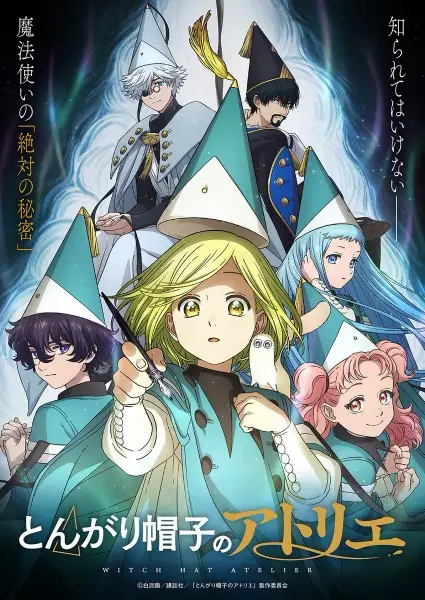
とんがり帽子のアトリエ
13
TV
Finished Airing
Apr 6, 2026 to Jun 29, 2026
In a world where witches wield breathtaking magic, Coco, coming from a humble background, often wishes she were born one herself. After all, the secret behind casting magic is strictly guarded from non-witches. But when Coco manages to catch a glimpse of the witch Qifrey casting a spell, her revelation on the truth behind magic drastically alters the course of her life. However, Coco's curiosity pays a steep price when a disastrous spell cast in ignorance brings a tragic fate upon her beloved mother. Qifrey takes the shaken girl in, recognizing both her resolve to save her mother and her link to a group of forbidden magic heretics. Secrets are a heavy burden, and between navigating a society that views her as an uninvited guest and mastering the art of magic, Coco must give her all to prove her worth as a witch. [Written by MAL Rewrite]
7.5/10
Average Review Score
55%
Recommend It
20
Reviews Worldwide
When people talk about fantasy anime today, they often think of battles between good and evil, grand adventures across unknown lands, journeys to become the strongest in the world, stories filled with harems, or narratives centered on character growth and self-improvement. WHA is no exception in terms of its premise. It begins with a simple setup: an ordinary girl accidentally enters the world of witches after an accident involving magic. However, beneath its colorful and seemingly innocent magical world lies a surprisingly thoughtful story. Behind its beautiful and enchanting appearance are questions about childhood growth, disability in a magical world, the darker side of knowledge,and the different ways people perceive magic itself. Although the anime has only adapted a small portion of the story so far, at this stage WHA is primarily focused on Coco's education alongside her friends under the guidance of Qifrey. Even so, it already introduces a number of small questions that serve as the foundation for much larger conflicts and ideological struggles later on. The first thing I appreciate is how the author places children within a society built and governed by adults. While each character has a different personality, goal, and way of living, they all share a love for magic in their own unique way. I think choosing characters who are still growing up is a very smart decision. Qifrey's apprentices are at an age where curiosity is a natural human instinct. Think back to when you were a child. Weren't you curious about everything around you? You probably asked the adults in your life countless questions about why things existed and how the world worked. At the same time, there were probably things you wanted to know but were told not to ask about or not to explore for one reason or another. When something is forbidden, do we simply stop caring about it, or do we become even more curious? Personally, I would want to keep digging until I understood both the answer and the reason why adults did not want me to know. In that sense, the young characters in WHA constantly find themselves facing barriers imposed by people older and more powerful than they are: what is allowed to be known, what is forbidden to know, and what must be forgotten. What makes WHA interesting is that it does not punish Coco's curiosity in a conventional way. The series does not say that curiosity is wrong, nor does it encourage children to blindly obey adults. Instead, it shows that every piece of knowledge comes with consequences. Coco enters the world of magic because of her curiosity, but that same curiosity also leads her to accidentally turn her mother into stone. As a result, learning magic becomes more than simply acquiring power; it becomes a lesson in taking responsibility for what one knows and what one chooses to pursue. Because of this, Coco's journey is not simply about learning new magical techniques or drawing new spells. It is a journey of growth through confronting the realities of the world around her. The series suggests that maturity does not come from becoming stronger or learning more skills, but from realizing that the world is not as simple or as beautiful as we once believed. Another aspect I find particularly interesting is a topic that many fantasy anime tend to ignore: the place of disabled people within a magical society. In most fantasy stories, disability is either overlooked entirely or conveniently solved through magic. WHA chooses a different approach. Tartah is perhaps the clearest example of this theme. What makes his situation especially interesting is that his difficulty lies in his eyes, arguably the most important tool a witch can have. In a world where magic is learned through observation and drawing, being unable to perceive the world in the same way as everyone else makes his education significantly more difficult. As a result, Tartah's story is not only about disability but also about access to knowledge under unequal circumstances. He accepts his condition as part of who he is rather than as something that exists solely to earn the audience's sympathy. Although he struggles with distinguishing colors, he continues to study, overcome obstacles, and move forward alongside his peers. Through Tartah, the series presents a character who learns to live with his limitations rather than magically overcoming them. This makes his story feel much more genuine. What ultimately defines people is not the absence of flaws, but their ability to accept, adapt, and continue moving forward. Even in a world capable of miraculous feats, human imperfections are not easily erased. Through this, the anime raises an interesting question: if magic can change so many things, why do limitations such as illness and disability still exist? Is it because magic itself is not all-powerful, or because society has placed limits on how magic may be used? The anime does not provide a clear answer, but Tartah's very existence ensures that the question remains present throughout the story. From here, the series begins to touch on a broader subject: the darker side of knowledge. In WHA, knowledge is not portrayed as something entirely positive. Coco enters the magical world because of her curiosity, yet that same curiosity leads her to use forbidden magic and causes an accident that changes her life forever. What makes the series compelling is that instead of punishing curiosity, it asks a larger question. If there exists a form of knowledge that is extremely dangerous, who has the right to decide who may access it? Is the act of hiding knowledge truly meant to protect people, or does it become a tool that allows a small group of individuals to hold power over everyone else? These questions remind me of nuclear weapons in the real world. Humanity has known how to create them since the twentieth century, yet the knowledge required to develop and produce them remains heavily restricted. This leads to a similar question: is limiting access to knowledge meant to protect humanity from catastrophic consequences, or is it a way of preserving power in the hands of a select few? This is where the anime begins to hint at these issues through the existence of the Knights Moralis and those who practice forbidden magic. While it does not provide definitive answers, WHA demonstrates that people's views on knowledge can differ greatly depending on their experiences and position within society. Among all these themes, my favorite is the way the anime presents knowledge from completely different perspectives. To ordinary people, magic is something wondrous, almost like a gift from the world itself. To Coco, it is the gateway to a world she never knew existed. To teachers and mentors, magic may be a responsibility that must be carefully managed. To those who stand in opposition, magic may be something that should never be restricted by laws or institutions. Each person sees magic differently depending on where they stand. Because of this, the conflicts in WHA are not simply about right and wrong. Instead, they arise from different perspectives regarding knowledge, authority, and freedom. Even though this is only the beginning of the story, the anime already shows that it is far more than a basic fantasy series about magic. Beneath its beautiful and enchanting exterior lies a story about personal growth, the limits of humanity, and the way we perceive knowledge itself. Those ideas alone are enough to make me excited to continue exploring this colorful and fascinating world.
Click an episode to read its synopsis.
Promise of Michelin star meal, but a serving of a luke-warm appetizer with good plating. This review will not be popular, but just note that I myself enjoyed the season and gave it an 8. But that right there is the problem. It felt like it was going to give me a 9 Visuals and fluidity of animation: was the best feature of this season. High production and definitely miles apart from the generic fantasy or isekai that resemble visual novels at times - ***9*** Characters: Generic tropes, but enjoyable nonetheless. Characters giving hints of backstory started fleshing them out, but not enough shown to separate them fromgeneric trope A girl, generic trope B girl, etc. 6.5 when viewed as a single entity. But as a whole and with implied growth, I suspect season 2 will fix this issue and consideration must be given that this is an origin season - 6.5 bumps to ***7.0*** Music: Not much to write about, but decent soundtrack. What was done well was the placement and timings - ***7.5*** World Building - Again, only 13 episodes, but the bits and pieces given thus far fleshes it out just enough that you still feel immersed in it, and hints of bigger things to come -***7.5*** Pacing - This is the one that will be most controversial. You will either hate it, or love it. I personally love slower paced anime that allow for more character depth through introspection and growth, while others may prefer a faster paced pew-pew type style(which I love equally as much). The problem with 13 episodes Witch Hat Atelier is that it is slow, but doesn't really give us much beyond that. It could be argued that it is similar to Frieren in a way, but there is less growth in this anime than in Frieren. =The 13 episodes seems like an appetizer, now getting into the anime and what it's about, just whetting our appetites before the main course, and then.... the meal is over. The check has arrived and you're still starving, confused as to what part of this was meant to be an exceptional and mind-blowing culinary experience. Even as a lover of slower paced animes, this simply did not finish what it started, and thus did not achieve the whole purpose of a slow burn =Due to this feeling of expecting a full experience but receiving a beta, I can only consider the pacing/13-episode-decision as a failure as at the end of the 13 episodes, nothing has changed since the first episode. Therefore, for me - *** 6 ***
Witch Hat Atelier It's similar to cleaning before an important visit. You make the necessary arrangements to make it look good. But we all know the dirt is still hidden under the rug.. One undeniable aspect of this anime is its incredibly high level of production and animation. Bug Films wanted to rectify the misstep of their previous anime, and they succeeded in a memorable way. Every episode, no matter how you look at it, is incredibly difficult to find a flaw. Every frame, every movement, every sparkle—everything is meticulously crafted to ensure it looks its best on screen. The aesthetic is exquisite. Everything stands outexactly as it should. A visual presentation worthy of accompanying a highly creative magic system. Magic in Atelier is, in a sense, "artisanal." You have to know the theory and perfect it through practice. There are no shortcuts, no exceptions; everyone has to pick up the pen to cast magic. These two aspects can leave you mesmerized and unable to pay attention to anything else. Just like a fake diamond. Now, if you try to see beyond that dazzling facade, you'll find a story that doesn't know which direction to take. It doesn't know the message it wants to convey, nor is it clear what goals it wants to achieve. The beginning of this adventure is supposedly a non-magical girl trying to save her mother from a forbidden spell she herself cast. So far, so good; we have the typical call to adventure found in fantasy stories. After that, the script seems to have been in a shootout and taken all the bullets, because it's riddled with holes. The story starts to become convenient, ignoring events at certain points only to revisit them when it suits the plot. You start with the urgency of saving a mother, but as the chapters progress, that theme fades away. Coco, the protagonist, has no sense of urgency or hurry to help her mother. Instead, she's simply amazed by being able to use magic and practice it. Coco is inconsistent because she's introduced as someone skilled in tailoring, a craft. She's supposed to be able to handle the magic system of this world. We even see her replicate advanced magic circles without any problem. When she becomes a member of the Atelier, it seems like they reset her to factory settings, because otherwise, I can't explain the downgrade in her abilities. The adults in this story are merely decorative. Qiffrey is the main problem. Let's be honest, Qiffrey is useless and, on top of that, an imbecile. He doesn't have what it takes to be a teacher, and yet he has four girls in his care. We never see him give a class or a lesson. On the contrary, it's the girls themselves who provide feedback to each other to grow and learn. Qiffrey isn't necessary as a teacher; therefore, he's useless. Now, many will say, isn't calling him an imbecile a bit much? I'd agree with you, if it weren't for the fact that he spent half the season searching for a clue to find his enemies, and when he finally finds it, they just beat him up like a sack of potatoes. So, he's an idiot for not protecting the only thing that would help him achieve his goal. Qiffrey is infuriating on many occasions. If he doesn't teach, if he doesn't fight, if he's not useful, then what's the point of having him in the anime? These are the questions that keep me up at night. The ending is a direct insult to any viewer. Leaving an arc unfinished as a cliffhanger is the cheapest way to beg for attention. It's a mediocre hook to keep you waiting for a hypothetical second season. Because at the time of writing this review, there's still no announcement about it. That ending is only appealing to someone who's read the manga, who knows the story. They're the only ones who could be hyped for what's to come, because they're the ones who know what's coming. For someone who's only watched the anime and is tired of these abrupt endings, I'd simply throw it in the trash. Plus, to maintain the quality of this season in a second one, you'll have to wait at least two years. Either you get bored waiting, or the production team sacrifices quality to release it faster. Whatever the reason, the future of this series isn't as bright as the fandom thinks it is. Atelier was so focused on being beautiful that it forgot to ask itself what it wanted to say. In the end, animation quality is like cosmetic surgery. The prettier it looks, the more it's trying to hide.
Witch Hat Atelier is quite challenging source material to adapt. The manga's detailed art took every advantage of its medium to create a truly immersive experience, but a lot of it would be difficult/impossible to replicate in the anime. But at it's core, Witch Hat Atelier is an ode to the art of drawing. And it shows in the beautiful animation just as much as it did in the gorgeous drawings of the manga. The passion that went into this project is impossible to miss. This story is a masterclass in atmospheric storytelling. From the bright magical world viewed through the lens of a child, tothe darkness lurking around the corners, each element of this world feels vibrant and exciting. Witch Hat Atelier slowly pulls the viewer deeper into its world by continuing to ask tough questions, ones that are rarely asked in a magical fantasy setting. Such as why are only witches capable of doing magic? Is it true? Is it fair? What would be the alternative? The soundtrack compliments the show incredibly well - equally in its charming, triumphant and ominous moments. Listening to it often feels like delving into an old fairy tail. And when it needs to, it really heightens the building sense of dread. Coco is a perfect protagonist for this story, because in a world where magic is heavily restricted, her childish love for it (which comes from years of admiring it from afar) makes her a danger to the status quo, while also allowing for the audience to experience the awe-inspiring fantasy world through her eyes. I also very much appreciate this story's approach to character writing in general. It does not rush to prematurely explain everything about its characters, which makes the glimpses into their true selves all the more intriguing, and leaves a lot of room for future developments. Even when a character behaves in a way that is questionable, it lets the audience sit with the feeling of discomfort. Aside from setting up great character arcs, this approach also compliments conflicts at the core of the story - encouraging to constantly question who is right and who is wrong. In conclusion, I had a lot of fun watching the first season of Witch Hat Atelier, and would definitely recommend it, especially to fans of high fantasy.
I don't expect this review will go down well with fans of this anime, because although I like it, I don't love it and I have issues with it This is an anime I spent a lot of time talking to friends about and going over, if it was bad I wouldn't do that, but as it had potential to be great, it caused some debate amongst my friend group. So I will start with the end, and I won't spoil anything but I will say that it ends on a cliff-hanger, For me this is a major issue as I believe an anime season should bringits arc to a close or at least find a cut-off point that feels like a natural stopping point, you can tease a second season, you can leave certain threads unresolved for future seasons, but a season should feel 'whole.' A good reason for this is that many seasons have a 2+ year gap between each season if the anime is lucky to be picked up for a new season. This is why we have cours, it clearly indicates to the audience that the season is split into two or more parts and we don't have to wait long until we get the next part While it has been revealed that they will be a second season, no indication (at time or writing) has been given to when that will be, and the reality is by not making this 'Part 1' the date of the second season is now a big question. I bring all that up first because getting into something only to have to wait for an unknown amount of time to get a conclusion can be a big ask of people, and it may make people decide to wait until closer to the release of Season 2 before watching it. With all that said, getting into the anime proper, it is without doubt a beautiful series, it is very well animated, from the breaking of the bread to the action sequences, I couldn't help but feel it was seeking to one-up Mushoku Tensei as bread breaking is apparently now how we judge animation quality. The world is beautiful, it has a slow pace and everything is given depth. The magic system is very well developed, it is well thought out and has hard rules, not just to establish what spells are allowed and what is forbidden, but how magic functions, what is needed and how the details matter with line length and shape altering how spells function. This is without doubt the strength of this series, because it establishes the rules of the world, and then adheres to them and you are able to be drawn into the world. Another thing that this does well is that it recognises and seeks to show that a society may be bad or deeply flawed, but that doesn't extend to the individuals living within it, and you have to take each person as an individual. It doesn't tell us what to think, but provides enough information to work out the flaws and the issues so we can arrive at the answers and what the author wants to present, such as with the Pact, we are told this ended conflict, but it is clearly flawed taking a sledgehammer approach to things where a scalpel would have perhaps been better. So with all that considered why do I only like it and not love it? First lets start with something minor, but it bugs me, the terminology, there should have been a better name for non-magic people other than 'outsiders.' It may seem insignificant at first, but when talking about it and talking about Qifrey, it is clear he tends to sit outside of the established society and rejects it, this makes him an outsider - or rather it would if that term didn't mean non-magic people, but as that term is being used for non-magic people it confuses matters and we have to find a new way to describe Qifrey and his place in the world. Richeh's character and role as a 'problem student' I would have rather had her character get established early on, or have signs of it be there in early episodes, as it is it felt like as soon as we were wrapping up Agott's character arc we needed another 'problem student' to have a character arc and so she was selected. This then leads to episode 12 getting sloppy, there are hard and fast rules, there are things that are already established, and yet this episode not just conflicts with what is stated in episode 11, but seemingly episode 5 also conflicts with episode 12. I can't say more than that because we'd be getting into spoilers, but both cases it comes down to things being drawn, and in the first case how it is drawn. And then there is the big one, Coco's trauma, or lack of trauma, it does a great job of showing the sense of wonderment that she feels stepping into the magical world, but considering the events she just went through at the start, the first few episodes should have her fairly traumatised, instead it is only when we get three quarters of the way through Season 1 when it realises that Coco should be traumatised and having nightmares, it feels like an after thought, like an oversight, something that was forgotten about until it is needed to trigger the events of the episode. This is my issue with this whole anime, Coco's trauma isn't there and is an after thought until it is needed for story events much later on, Richeh's nature as a 'problem student' is not there until it needs to que her up as a problem student because it is now time to focus on her character growth. Characters need to have their backstories thrown at us so we know their issues so that we can then watch them overcome them with their moment of character growth that happens just at the crucial time, it feels a bit cheap, especially when characters who have long term issues quickly overcome them because the plot requires it. If the magic system feels grounded, then the characters don't. For me, I think this is where Silent Witch is significantly stronger, it handles its characters well, and the character growth in that is slow, it is painful and it feels earned. It's a good anime, it's close to being a great anime, but it doesn't quite land, I like it a lot and I'm looking forward to more