Links go to search results. Availability varies by region.
MOTHER2 ใในใฎๅ้บ่จ
13
1
Finished
1993
6.0/10
Average Review Score
50%
Recommend It
2
Reviews Worldwide
I've never been much of a gamer. Don't get me wrong, there are a few games I enjoy, but as someone with the attention span of a goldfish, investing hundreds of hours into a single story is not something I can easily accomplish. Because of this, I've always been particularly defensive when it comes to manga/anime adaptations of video games. "Sure," I would say. "The game is almost always better, but the manga/anime isn't for the people who played the game. It's for people like me who can't or won't play it. As long as the story is coherent, who cares if details are leftout?" Well, today I eat those words. If there's one thing that the Earthbound manga taught me, it's that not all video game adaptations are meant for newcomers. Mother 2: Ness no Boukenki starts off fairly accurate, but right off the bat, there were some major differences. Buzz Buzz and King, for instance, play a much larger role than in the game. This didn't really bother me - creative liberties are to be expected in game adaptations, especially for JRPGs with a silent protagonist like Earthbound. The story continued like that, skipping over some details, but also adding characterization to some of the side characters. Pretty standard game adaptation stuff, really. However, things take a turn for the weird after Jeff joins the party. Instead of continuing onto Fourside, we are instead taken to a completely new location: Twin Pigs Village. From here, the story goes completely off-script, delving into a plot about parallel universes, featuring some new characters and a few references, here and there, to the original game. I see what the mangaka was trying to do, of course - the parallel universe thing suggests that this isn't supposed to be an alternative to the game, but rather, a supplement. With only thirteen chapters to work with, my guess is that the manga took this angle because there simply wasn't enough time to delve into the full story. But by that point, can this even be called an adaptation? Had I not played Earthbound before reading this... Well, I wouldn't say I'd have been terribly confused, since the story does make sense on its own. But I certainly wouldn't have been given an accurate representation of the source material. That being said, this manga does have some merits for those who have played the game. The art was really unique, and fit the retro vibes that made Earthbound so special. It reminded me of Garbage Pail Kids, Osamu Tekuza, and Dr. Seuss all at the same time - a weird combination, I know, but it was quite charming. The characterization was a lot of fun, too; I mentioned earlier that Buzz Buzz and King had a bigger role in this story, but I also really liked the softer, more sympathetic version of Porky we see here. (You can really tell this came out long before Mother 3 was conceived...) Bottom line, if you haven't played Earthbound already, you're better off playing that than reading this. I usually loathe when people say "just play the game!" when reviewing an adaptation, but in this case, it really is the better option. If you have played Earthbound, feel free to read this - it's not great, but it's short, and offers an unconventional take on an unconventional game.
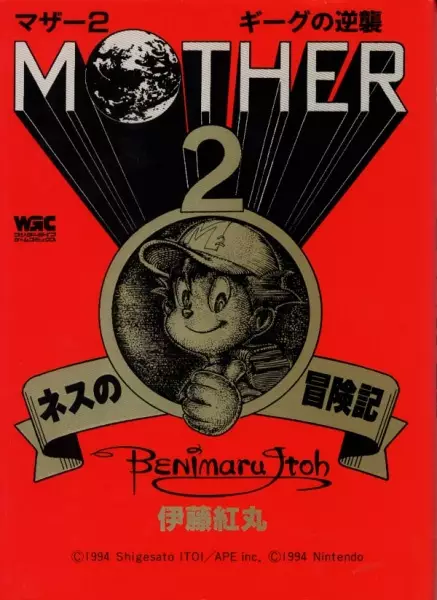
A manga based on Shigesato Itoi's cult video game "Mother 2" ("Earthbound" in North America) and illustrated by Benimaru Itoh.
Ah, Earthbound, now there's a classic game. In the 27 years since it first hit shelves in Japan, how many creative people have claimed it as a source of inspiration? Indie game devs, comics and reviewers, and even South Park writers have built some part of their art around recapturing the feeling of Shigesato Itoi's avant-garde video game adventure. This tie-in manga, by Nintendo old-hand Benimaru Itoh (who also drew the Star Fox and Super Metroid cartoons for Nintendo Power,) is far from alone in its ambition of directly adapting the game - you can find all sorts of fan artists trying to turn Earthboundinto a comic online. None of them have managed to capture the original game's unique vibe quite right, though. I'm sure part of that is because Itoi's style truly is inimitable, but it's also because Earthbound is SUCH a video game that it's impossible to adapt to any other medium. Sure, it's story-driven in a way that seems like it would translate to a book or a comic better than some other games, but all its most impressive moments were deliberately designed around the perspective of a silent protagonist and the interaction between a player and a set of game mechanics. A webcomic having main character Ness get grossed out at finding a hamburger in a garbage can doesn't quite have the same impact as dropping that burger into his inventory and letting the player eat it if he wants. Take the final boss fight, for example. It's an unbeatable representation of pure evil that doesn't even keep track of how much damage your attacks deal. There was a conscious intention that the player, upon seeing its distorted skull-like face and hearing the unnerving dissonant score, would freak out and unload all his mightiest attacks to no effect, until several turns later, exhausted and about to lose, he might resort to praying for salvation - which turns out to be the only way out. Sure, you could recreate the arc of this fight in manga - have the kids throw out big flashy moves, get beat down, and then start to pray - but that wouldn't really carry the same impact that YOU, as the player, finding yourself that helpless conveys. Maybe that's why this manga just doesn't have that part. Or maybe that's because it came out in 1993, a year before the game, and was based on a version that didn't have all the story details finalized, as evidenced by the screencap printed on the first page, which has slightly different geography than the same area in the released game. Combined with the lack of printing space that made this a breezy 13 chapters, that might be why it deviates from the canon story around a third of the way through, introduces new stuff with no in-game basis, and skips over a lot of the plot. From the perspective of a Mother fanboy who dug this up almost three decades after the game came out, that's disappointing. I wish we got to see places like Moonside, or the Your Sanctuaries, or Magicant, and the manga's final battle doesn't hold a candle to the groundbreaking storytelling the game would end up having. I've spent a lot of time comparing this to its source material, but the point I'm trying to make is that it's best approached as its own thing, or at least that you shouldn't expect it to exhaustively cover everything the game did. After all, if you want that, just replay the damn thing. As a curio for fans, Itoh's comic is honestly kind of cool. It has a really unique Seuss-inspired art style that almost doesn't feel like anime at all, which is surprising considering how samey a lot of anime and manga art can get, and its cheerful adventurous tone makes it a light and pleasant thing to read. I got a kick out of the expanded role of the Runaway Five, the comic's interpretation of the lead characters and their interactions, and especially the elevation of Pogo Punk, a generic enemy from the game, into a significant secondary character (even though I personally like Yes Man Jr. better.) Or at least that's true up to a point. There are some important changes that didn't have to be made, and that ultimately remove the element of discovering the dark side of the world that is a crucial aspect of the game's story. On one hand, it's nice to see Buzz Buzz get a chance to follow Ness on his adventure, but his death at the hands of the kid's next-door neighbor was important to setting the tone for the rest of the game. Ness doesn't fight policemen or watch his corrupt mayor get re-elected in the manga, and he doesn't get led into a trap by his own libido either. I miss those things, because they're fun and had a point, and they would've been totally adaptable to this medium. Speaking of Ness' neighbor, the change in roles for Porky, from true villain of the game to JUST his outward ineffectual facade, is also too bad. In the game, you meet an alien life-form bent upon destroying all humanity, but the most terrifying figure you come across is the petty narcissist who lived next door all along. There was a lesson in that. That's a good microcosm for the manga. It's cute and charming, but it lacks the depth and artistry that make the game so important.