Links go to search results. Availability varies by region.
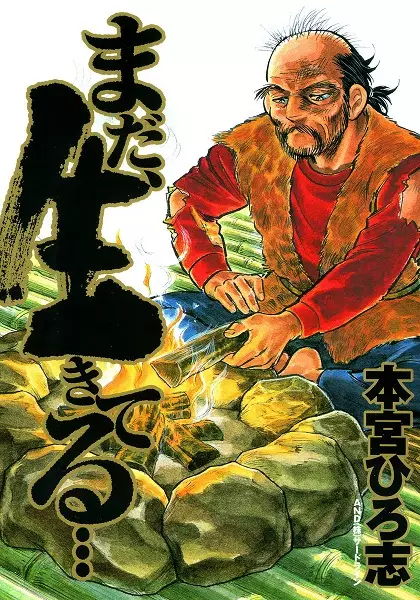
まだ, 生きてる...
Ongoing
2
Finished
Jun 2009 to Aug 2009
Kenzou Okada, 60 years old, is fired after a whole life spent to work. His wife and children leave him without money. He tries to commit suicide without success and decides to live a new life in the forest that doesn't let him die.
7.3/10
Average Review Score
100%
Recommend It
3
Reviews Worldwide
Kenzo okada, 60 years old, is a tired man : fired a day before retiring, after a life devoted to his work as a salaryman, he finds out that his wife and his kids have left him and emptied his bank account. Without any family, money or job, he realizes that all his hard work was worthless and decides to take the train and retire in his home village to hang himself. Unfortunately, the branch that he chose to hang himself breaks. After being on the verge of death, he decides to live the rest of his life as an hermit in the mountain, milesaway from the metropolis of Tokyo, far from all the daily worries of this new corrupt Japanese society that is emerging with globalization and the economic crisis. Quickly, his life will take another turn when he finds a woman who tried to commit suicide and failed the same way as him and will convince her that life is worth living .This saved life im-poses new responsibilities upon him and will take care of her as a father would. “I’m…I’m not dead…and even so… the sun…would still rise. In this world, death spares no one, but I am still alive. All right…I will go to the end of the way.” While this story is about survival, it goes beyond simple material survival as it questions the meaning of life and challenges the context of the fixed model of success in Japanese society. We can only be impressed by the choices he makes and how he evolves as a character, from a submissive and frail old man that accepts everything to a strong and fierce man that does not fear the gaze of others and can actually revolt against what he deem is wrong. Mada ikiteru is a manga that reads fast and goes straight to the point, and while it could be argued that some scenes could be longuer and its themes could have more depth added to them, it leaves a strong impact that could not be achieved any other way and leaves you awestruck by this transformed man and his power of de-termination. Through a realistic drawing the author tells the distress of a man dam-aged by the torments of life, who tries to rebuild himself and forget his sorrows. Motomiya's drawings are majestic and offer us splendid panoramas on a nature not very often put forward. The strength of the drawing is of course accentuated by the dialogue, every word being poignant of realism, and the characters that characters that inhabits these pages. Every last bit of feelings is amazingly shown: the despair and incomprehension of the beginning, the rage and the discov-ery of hidden resources in us, the intelligence and especially the acceptance that there is a force superior to us. It is an ode to going back to nature, to the reappropriation of goods by one's own work, the surpassment of one self and condemns a dehumanized consumer socie-ty.The journey of the two characters illuminate the message of the author. Mada Ikiteru skilfully illuminates the entire paradox of Japan's capitalist years, between a society that is always progressing and individuals who sometimes remain aggrieved. I also recommend watching salaryman kintarou which was also created by hiroshi motomiya, another good social drama and one of the he only things available of him. Note that this was only a review of the first volume and its story is self contained. The 2nd volume focuses on Mazao Okada, Kenzo’s son who will try to find the whereabouts of his father and will follow in his steps, while also being skillfully mastered, I won’t go into further details because I would be forced to spoil major plot points that would possibly ruin your enjoyment if ever you have the chance to pick that up.
Review for Mada Ikiteiru, I Am Still Alive. Story : 6/10 Nothing original. A city dwelling man who lost everything decides to live in the wilderness. But the little challenges he faces over time change him. And that's where it gets interesting. Character : 8/10 Chara development is the forte in this manga. From a wimpy, weak salaryman to a hardened mountain man, seeing the growth in our protagonist is what brought me the most enjoyment. There's a female character who also goes through a transformative progression, but I don't want to reveal too much of the plot. We learn more about our hero's family in the 2ndvolume and it does add a good layer of bittersweet feeling to the story. Again, I don't want to reveal too much or spoil the second volume, which is to me even more emotional. Art : 7/10 Correct, good. But not exceptional. Could do a bit better, but it does fit the manga and is solid without dipping down at any point. I would recommend it for a more mature audience. I know I would not have enjoyed this one at 15, but it hits different at 30+. Also the criticism of man's role in society, the work culture, is a background (though not sufficiently explored) to the story. 7/10 enjoyment overall
This easily became one of my favorite manga (and surely my favorite short manga, although I didn't believe that to be possible) for the sole reason of it's concept (and execution). This manga showcases just how far removed we currently are from anything close to what a natural human is supposed to live like in terms of food, health, lifestyle, relationships and technology (lack thereof), which not only people don't seem to realize (because of brainwashing), but it’s also crucial to the current state of the world and one of the reasons of so many psychological, but especially physical issues that people have thesedays. The main focus of the manga is an old man betrayed by the world who decides to give up on it and him finding satisfaction and a purpose not in the technological advances of the world, nor in money or anything else specific to these times, but in a simple, humble, life in the woods, far removed from jobs, money, people that tell him what to think and what he is "allowed" to do (just like slaves are ordered by their owners). Even the title is pretty suggestive: "I'm Still Alive" - which characterizes the protags journey in this manga fairly well, seeing as he manages to live and grow old despite trying to use a rope to help himself, having no money and, at first, being homeless in the woods. And through all that, the manga shows how there is no need for money or even a fancy house or apartment in order to live a fulfilling life, just a cabin in the woods built by your own hands while nature provides all the food that is needed in order to survive and thrive: animal meat, organs and blood. Just like that, a story set in the modern world suddenly becomes a story set in prehistoric times, where the mc, while mainly living in the woods, is still bound from time to time to the current world, making for quite the funny and sometimes insightful scenarios and conversations that show just how far removed the protagonist is from the current state of the world, but also his character development. The protagonist goes from being a wimpy dog of his coworkers and family to becoming a confident, mature, free man that takes his life in his own hands and becomes a man worthy of respect, a hunter that can provide and fight for himself and his freedom (and later on, for someone else), despite living a "new" lifestyle that is sure to get people's looks and critiques (especially irl). Especially in the first quarter, there are a few scenes that highlight the modern insanity that we live in: people OWNING land (although the land is owned by the planet itself), people being conditioned and brainwashed to think a certain way (the protagonist becoming a free thinker, not manipulated by media or "science") and people needing to "prepare" or "cook" food (humans being the only animals that think we need to do that, because we eat seeds, oils, flowers, leaves, grass and animals raised in bad conditions that damage it's quality and our capacity to eat it raw). Since the second half of the story is kind of hard to tap into without spoiling anything, what I can say is that it perfectly highlights the natural way people used to live in more primitive times and what makes them happy, which sure as hell ain't school achievements or a slave job, but relationships and living free in nature. The main reason I give this manga only a 7 is just because of it's simplicity and length, while I don't think it subjectively hurts the experience, I do believe a more complex and nuanced take on the subject matter presented in this manga could only benefit it's message. That's about it for this manga, while it ain't no masterpiece and I don't expect that anyone will have the same respect and appreciation for this work, nor the same enjoyment I felt while reading through it, what I can say is, if anyone read through this, you probably already know if this story does or does not interest you. It's a quick read, so I don't think it's a waste of time even if you happen to be mixed or not enjoy this. I also recommend the sequel, it's very similar to this work, both of which you can find if you look for them.