Links go to search results. Availability varies by region.
η«Ήε δΎ
84
8
Finished
Aug 7, 2006 to Mar 15, 2010
9.2/10
Average Review Score
100%
Recommend It
6
Reviews Worldwide
Glorious, subtle, beautiful, moving, detailed, evokes Hokusai, the Edo era, unusual-don't be put off by the art, it is so against the grain of mainstream manga but it is astonishing, the use of shade and light and ink blots. I think the only manga I have even given 10 in every category, but I cannot fault it. The story is so perfect as well, interweaving and intensely thought-provoking PLEASE read it or try-a fantastic story and piece of artwork-just..wow
Story: 9 Your typical samurai with a haunted past moving to a new place to try and forget about it all. (Rurouni Kenshin, Sword of the Stranger, Gintama even) The manga pulls from historical, action, and slice-of-life genres, culminating in an amazing battle between Senou and a larger-than-life assassin. Moments of serenity, sorrow, sentimentality, and savagery intermix in a simple but poignant plot. Art: 10 Takemitsu Zamurai is filled with tropes from the samurai canon, but it paints these cliches anew with vivid brush strokes, truly making the story and exploiting the essence of manga as a medium as opposed to the (light) novel, makingfull use of splash panels, dialogue-less scenes, and humorous doodles to convey much more than words can. The style is entirely unique in manga (at least in my limited experience), as if drawn from a Japanese calligraphic painting, or perhaps a darker Okami. The art is really what makes this piece; it creates the atmosphere and absorbs the reader into it. Character: 10 Senou Souichirou is our hero here, and a great deal of time is spent on his characterization. However, his interactions in Edo bring him into various vignettes of the lives of others around him, contributing to the slice-of-life feel, although in TZ, these slices-of-life will often come from a katana. Enjoyment: 9 Nothing to complain about, just not enough to bring it to a full 10. Certainly worth my time. Overall: This manga is not ground-breaking in any fashion (except for perhaps the artistic direction), but it is an exemplar example of the classic samurai tale and if you enjoy that sort of thing - I know I do - Takemitsu Zamurai very much deserves your attention.
Although the rounin Souichirou Senou quickly discovers that most of his new neighbors in the Katagi Apartments do not trust him, his childlike wonder at the world around him allows him to strike up a friendship with the carpenter's son, Kankichi. With Kankichi's help, Souichirou begins to establish a life in Edo's tenements and exchanges his longtime sword Kunifusa for a bamboo blade, due to his newfound desire to refrain from violence. Unfortunately for Souichirou, avoiding conflict in Edo is not always possible. Before long, Souichirou finds himself stalked by the brutal assassin Shinnosuke Kikuchi, who delights in butchering anyone caught between him and his target. Each time Souichirou must step forward to defend himself or the people of the tenements, he reawakens the intense bloodlust of his younger days and resurrects memories he would much rather forget. [Written by MAL Rewrite]
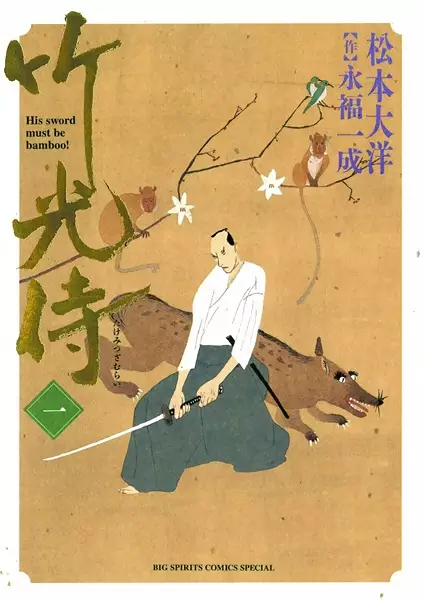
A mysterious Ronin that lives in a town, wandering and displaying a somewhat strange behaviour throughout the days: despite being so passionate about nature and life, why is it that some greatly fear him, while others love him? The premise of Takemitsu Zamurai is quite interesting on its own, yet what really makes it stand out is the peculiar art that magnificently blends with the narrative, portraying itc characters greatly. The very first thing any reader would notice is the peculiar art style of the manga. For many, their first impressions would range from being an unappealing, lazy style, or even plain terrible, where only thestory could keep this work appealing. However, it becomes sooner or later apparent that the art style is in fact of very high quality: while other mangas have highly detailed and realistic art style, Takemitsu Zamurai could be seen as the opposite, being quite abstract. It manages to portray the various character's very personality, difficult to the more "realistic" approach. Furthermore, there is hardly any need of dialogue as the author managed to even include the various emotions and atmospheres through the art, with great fluidity that matches narrative and art in a fantastic manner. It could have no dialogue at all, and readers would still know what the main story is about. Regarding the story itself, it is mainly focused upon Senou Soichirou, a Ronin with a passion for life - to such a degree that he does bizarre things such as chasing a butterfly in the very same manner as a butterfly. This naturally raises caution in the villagers, which makes for some endearing interactions with those; be it the landlord, the little child living next to him, or even some high-ranking officials. The manga does have a main drive, which is exploring Soichirou as a character, while delving in the mystery surrounding him and the people who know him. This may appear as something complex, yet in essence it is not quite: although the uncertainties surrounding the protagonist do get gradually revealed, it is not that impressive as it may seem at first sight - the intrigue about people wanting him dead is of simple nature as well. Rather, the execution of it is quite impressive. Now when it comes to the conclusion of the manga it is both satisfying and a bit disappointing at the same time. The final message of noble family being righteous and loved by all is was a bit jarring at a personal level, which of course is not the same to every reader. As for the characters of the manga, once again, the main focus lies on the protagonist, where all the characters take a backseat. This does not mean that those are of lesser importance: these help Soichirou grow as a character, being influenced likewise. Be it exploring his true nature, or simply exploring the situation of some of the cast. However, this does not really apply to the antagonist, which leaves a bit of disappointment in the reader as he has is hardly explored as a character. The protagonist himself may seem bizarre, as the initial impression of anyone would be that of weirdness and what not. Surely enough, he receives appropriate characterisation alongside some great interactions with the people surrounding him. Tekemitsu Zamurai was as a whole a very satisfying read, where seemingly simplistic story would not really be that much of importance. The art style was surprisingly good and befitting, although admittingly, I myself was quite swayed by the style and doubted its validity. This is definitely a manga I would recommend to anyone who is not adversed by the art style; it is after all still a great read. ` Thank you for reading.
I've never written a review, but I've seen a bit of misconception of the series, and I just want to give my views on what makes this story tick. Takemitsu Zamurai is a brilliant multi-character story involving the ronin Senou, a village child Kan, the assassin Kikuchi, and about half a dozen other fleshed out characters. I've seen some write that the series revolves around only Senou himself, but that couldn't be farther from the truth. In a very short 8 volumes, this series starts and completes all of their character arcs whilst tying most of them together with each other. A major theme of TakemitsuZamurai is being what you're born as, and not being able to escape that fate. The characters have dreams as any else, but all wind up being exactly as they began. When I say being born, I mean it both literally and figuratively. Much of the cast were born into the class system from their parents, and after their journey, end up falling prey to that same system- being very emblematic of how much of the ancient world and Japan worked. On the other hand, characters such as Kikuchi and Omorusaki were "born" and bound to a single experience that changed their course of life and had to live out the rest of their lives by that. The story ends in a both happy and poignant place. It is not a basic happy ending, but one that involves a great deal of regret. A major arc of the story involves Senou wanting a very average, everyday, enjoyable life, tied around Kankichu, a village boy who looks up to Senou, wanting exactly the same thing so that they can spend their lives together. Kankichi, being an actual child, and Senou, a man who never got the chance to grow up, both sharing the same, youthful dream. A dream that, by the end of the series, very painfully doesn't come true. The one thing that these characters wanted above most all is the one thing they couldn't have, and that's where the heartache in the ending comes from. However, like almost every real person, we all have childhood dreams, and for most of us, they never come to fruition. They are what they are- immature hopes that you think about when you don't have a true grasp on the world. The death of those dreams is natural, and while that is sad, their is happiness after. Senou wishes to escape the sword and the demon inside him, and in the end, loses his arm and his literal ability to fight. He loses his average life, and is forced into a job he never wanted. Yet somehow, through that all, in the last chapter, he's happy. Kan is happy. The death of a childhood dream doesn't mean the death of life. For these characters and the others in the series, happiness is obtainable- it just might not be where they're looking. One last thing here but the art is absolutely outstanding, the storytelling and panel composition is wonderful. You can hear the narration and see the characters move.
A story of life. A wandering man, the people that intertwine with him, and the strings of fate and time. All come together for a satisfying and truly amazing manga. Never have I ever been able to just feel the wind from the pages and the warmth of smiles. I literally could not get enough of the composition the way the literal frames seamlessly flow. A standing shadow casted on your lovers crouching frame, the reflection of a pondering man in a pond, tears over the river bridge, rage of death, combing anothers hair. I am amazed. There is a reason abstract art conveys strongeremotion- how do you convert intangible feelings into a visual form? Matsumoto figured it out. Be careful, 84 chapters sure felt fast....