Links go to search results. Availability varies by region.
バイオメガ
43
6
Finished
Jun 14, 2004 to Jan 19, 2009
7.3/10
Average Review Score
69%
Recommend It
16
Reviews Worldwide
[Spoiler Warning] Typical Nihei: gorgeous if extremely repetitive black-and-white art (in contrast, the few color illustrations come off as childishly garish and ugly) typically showing explosions and combat (rarely varied or exhibiting any imagination - if I had a nickel for every time Zouichi busts into a room and instantaneously shoots everyone in the head, I could probably afford to buy the entire printed manga), Nihei's obsessions like improbably powerful guns, borrowing of fantasy tropes that are wildly inappropriate (eg swordsmen and duels), a story that verges on gibberish (can anyone explain how the bear's wish could possibly lead to transforming the Earth into a megastructure?). It'sdifficult to see why _Biomega_ exists when _Blame!_ does almost everything it does. Literally: the zombies are effectively the same, the biotech/body-horror pushes all the same buttons like the skull-mask-faces, the art is the same, most characters could be swapped with their counterparts with no loss, the fetishization of young women and the protagonist's inexplicable attachment to them is present in full force, some elements like "Toha Heavy Industries" are identical, and in particular, the protagonist and setting and AI companion are so exactly identical that all the way up to the ending I assumed the big twist was going to be that _Biomega_ is actually the prequel for _Blame!_ explaining where Killey and The City come from (there are some differences like the gun's phlebotinum being 'brainwaves' rather than 'gravitational beams' but nothing that a good writer couldn't retcon or handwave away). To some extent, _Blame!_ is better: at least, the conception of The City megastructure is, like Niven's Ring, a resonant idea, and the greater obscurity of _Blame!_'s story means you can at least fool yourself that it is deeper than it looks. But on the other hand, this leavens the ridiculous bodycount and numbness that a reading of _Blame!_ produces and - _Biomega_ has a bear.
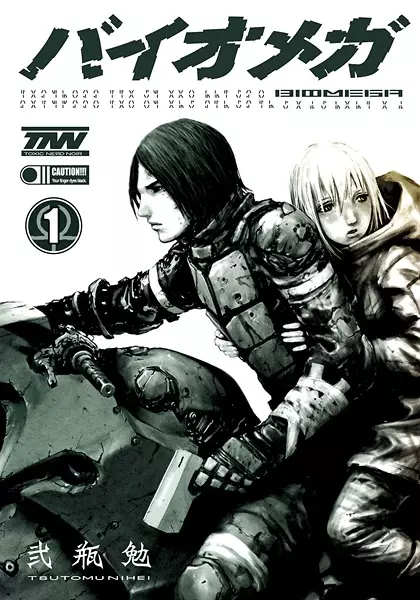
In Tsutomu Nihei’s nightmare vision of the future, the N5S virus has swept across the earth, turning most of the population into zombie-like drones. Zoichi Kanoe, an agent of Toa Heavy Industry, is humanity’s last hope, and he’s not even human! With the help of Fuyu, a digitized intelligence built into the computer system of his Heavy Dual Coil motorcycle, Zoichi’s search for the key to salvation will take him on a journey across surreal landscapes and hurl him into a battle against mind-bending evil. (Source: VIZ Media)
Biomega is depressing and distressing. The most part of characters are without exspression and few talk. The edifices is very elaborated and dominate the landscape. In this view human aberration fight for change the world. I love the style of the author Tsutomu Nihei. The design of Biomega is detailed, with gigantic structure that dominate the protagonist Zoichi Kanoe(but is same to Killy!). Is a artificial human, and search Ion Green a immortal human, for prevent the diffusion of the virus N5S as transform the human in zombi(call Drone in the manga). Together with Blame this is the better manga of Tsutomu Nihei.
Biomega – Spoiler Free – Recommended TLDR Story – 6/10 – 6 x 0.275 = 1,65 Art – 10/10 – 10 x 0.2 = 2 Characters – 5/10 – 5 x 0.225 = 1,125 Enjoyment – 8/10 – 8 x 0.3 = 2,4 Total: 7,175 -> 7Story – 6/10 Biomega’s story starts quite linearly and is not confusing, although it will become more dense as the story progresses. This story is an authentic LSD trip, and not in a bad sense. However, there are also some leaps of faith here and there – and where gravity ceases to work for some reason at a certain point in the story. In terms of scale, it greatly accelerates at some point, and it is quite imaginative in doing so, although just too many characters appear out of nowhere, and a new plot is weaved before our very eyes. Probably the most significant criticism that Biomega can receive isn’t that the story is bad, not at all, but just that it doesn’t fit into six volumes and ought to be at least twice the size to be better developed, with better characters and a more logical fluency of the sequences. There are also some random time-skips, which don’t add to the story's believability, unfortunately. Again, if the story were bigger, all of this could have been accounted for. Art – 10/10 Nihei never disappoints when it comes to the art. With a sublime and unique art style, Biomega is pure eye candy. The panels have a good consistency and fluency. Character design between Nihei’s works is really similar, but in an individual story, it works well, although some characters, mainly the AIs, do look alike. Characters – 5/10 The characters are Biomega's weakest component. Although Nihei doesn’t use many dialogue balloons, preferring to let the panels talk in of themselves—a perfectly valid strategy, mind you—characters aren’t simply developed for the most part. Characters appear without development or a background in most cases and disappear just as easily. We know very little of the main character and his AI, for they aren’t simply explored. The secondary and minor characters receive almost no development whatsoever, being more of a placeholder than anything. This also applies to the main villain. Enjoyment – 8/10 Enjoyment is a big part of Biomega. Nihei knows how to create a story that is fulfilling and very entertaining to read. Its watermark – letting the art speak through itself without many dialogues – allows for a delightful read. Moreover, the fantastic art style proves itself to be one of the main arguments for the enjoyment that his works have in general. It is just a feast for the eyes. Although, in this case, the story and the characters aren't all that well characterised, where only a more extensive story would have allowed for a more thorough development, this still is nevertheless very positive, more than deserving of a positive recommendation.
It's strange for me to read 18+ rated Manga since I am 14 but I did love the thought of the story so I brought the first the 2 volumes. The art may seem as though it is weak and dark, but the widescreen shots of the surrounding landscapes are excellent I think they give the series a light feel, when looking at the landscapes I feel an overwhelming feeling of nostalgia which makes me love the series more. Unfortunatly I found the characters inhuman and wooden, I could not see emotion (even though the main character isn't human) but still a little emotion can goalong way to make the story more alive. The only character that has real emotion is the grizzly bear which adds some light humour to the series. Overall I enjoyed this series, the story is enganging and also with little words and more visual storytelling it ticks most of my boxes. I would recommend it to those who love gore because it is in abundance through the whole series, and with needed humour too it is a must read before you die. Good times and nightmares xx
Biomega isn't a series that should be read about, its one that should be seen. That's how aesthetically-driven of a comic it is, and how completely idiosyncratic it is as a representation of the mind of its insane author, Tsutomu Nihei. Despite this, however, I'm gonna make something about it that is designed to be read, because its not like I have much of anything else to do. Seriously, though: my first recommendation to anyone wondering whether or not to read Biomega is to look at the pictures, and if you love them, read it. However, even if your mind is blown initially, you maystill be disappointed in the end if you expect this series to adhere to any normally held standards of quality. If I had to describe Biomega in one phrase, it would be "a beautiful mess." This has two meanings in my mind. First, its an utter mess of a manga that happens to be very beautiful. Second, and more importantly, though, it is a work that's beauty largely is derived from its messiness. In broad strokes, Biomega's plot is about its initial setting, Earth, destroying itself in an icky, gooey, action-packed apocalypse and being reborn as something else, a new celestial body of confusion, mystery, and beauty, all of which are completely inexplicable and impossible to understand. Yet as a metanarrattive as well, Biomega itself echoes these themes, because its progression as a story in and of itself is one where its initial premise and all included logic are destroyed in an icky, gooey, action-packed cascade of images, and are reborn in the form of an entirely different manga for no real discernible reason. Biomega isn't a story with a beginning, middle, and end; it is more of a continuous downward spiral, where its world, characters, and images become stranger, more confusing, and far more interesting along the way. It starts as an extremely linear action piece, but if you read it expecting it to stay that way, you will be sorely disappointed. If you expect insanity, though, I think you will leave satisfied. Read the first volume of Biomega, its hard to not compare it with Nihei's first serialized manga and what many consider to be his magnum opus, BLAME(!). Blame also is hardly a typical or fully coherent story, but the presentation of its setting, a massive, solar-system-sized non-euclidean cyber-city built by sinister post-humans and being explored by two silent immortal cyborgs, is at first glance a lot more creative. The City of Blame is meticulously detailed, atmospheric, and inhuman, while the similar city which Biomega starts off in is far smaller, less ambitious, less well-drawn, and still inhabited by humans. At its outset, Biomega is a serviceable zombie apocalypse story set in this city, with its only major distinguishing feature being its ambitious and technically proficient action scenes, which are far better than the often difficult to follow fights in Blame. Other than that, Biomega seems pretty boring in comparison to Nihei's previous resume, and this, I think, is what leads a lot of people to drop it, and which has led Biomega to rarely be included in discussion of Nihei's best works because of this. Keep reading, though, you'll find that Nihei himself agreed. After a change in magazines following the release of volume 1, which included a shift from weekly to monthly publication and a commensurate skyrocketing of art quality, Biomega becomes a different beast entirely, grotesquely morphing into some of the most balls-to-the-wall action insanity in the medium of manga as a whole. No longer is the main conflict a zombie outbreak caused by some vaguely Umbrella-like corporation, but instead it becomes a plot to turn...the world into...biological goo(?) so it can be reborn...or something, orchestrated by immortal psychic cyborgs battling each other from imposing cyberpunk monoliths that loom over the surface of the increasingly disfigured planet once known as Earth. There's eygasmically deformed monsters, brilliantly-paneled fights, and an utterly epic battle featuring the main characters riding a super-motorcycle vertically up the exterior of a space elevator while fighting off a plantlike stalk of flesh emerging from the planet hundreds of miles below. This is in volume 4 out of 6. The earth is destroyed, there's a bunch of shit that makes the Akira movie seem coherent by comparison, and then you're left wondering how the rest of the series could possibly end. Well... The last two volumes take place in a different setting where everything looks different and where thousands of years have passed without our protagonist's knowledge. What started as a cyberpunk action romp becomes a high fantasy epic set on a string-shaped world whose scenery looks like if Nihei's, HR Giger's, and Yoshitaka Amano's artstyles all fucked and had a premature harlequin baby. Random, bizarre new characters are introduced, about 20 Vaati videos worth of lore are hinted at and dismissed, and literally thousands of years pass, all in the span of TWO SHORT VOLUMES. Its mind altering. For some it could be maddening. Yet somehow, in the upside-down universe Nihei has taken us to, it almost works. In a way, Biomega represents everything that I love about what Nihei, and manga in general, is capable of. Because its all possible only through Nihei's incredible visual creativity and technical mastery. In Biomega, the unpolished architectural brilliance of Blame and the sketchy darkness of its own early chapters give way to some of the richest, smoothest, most detailed, and most simultaneously transcendent and disturbing black-and-white art I've ever seen. Composition is masterful, action paneling flows effortlessly, and every page contains new, unearthly visual delights. The middle section of the series is completely unhinged action, but the final two volumes, as borderline incoherent as they are, contain so many unorganized fantasy ideas that they seem practically bursting at the seams with Newtype-level psychic creativity. The barriers between flesh and metal, between artbook and comic, between brain and body, between bad storytelling and alien genius begin to disturbingly melt unto each other, eroding into hyper-detailed manga goop more and more with each turn of the page. This manga may seem perfect if you like oddball designs and intense, hyper-violent action, yet it will disappoint you if you want it to be bound to those things exclusively. Biomega is a bizarre aesthetic experience that pushes the boundaries of manga itself in all the right ways and all the wrong ways, all at once, yet push those boundaries it does. And in way, it embodies perfectly one of the most unique aspects of the intensely author-driven medium of manga--the chaotic creativity that comes with a brilliant artist ascribing logic to his flow of aesthetic ideas that fundamentally lacks any. Weirdness, grossness, worldbuilding, artistic prowess, all purely for its own indulgent sake. That's Nihei, that's art, that's manga.