Links go to search results. Availability varies by region.
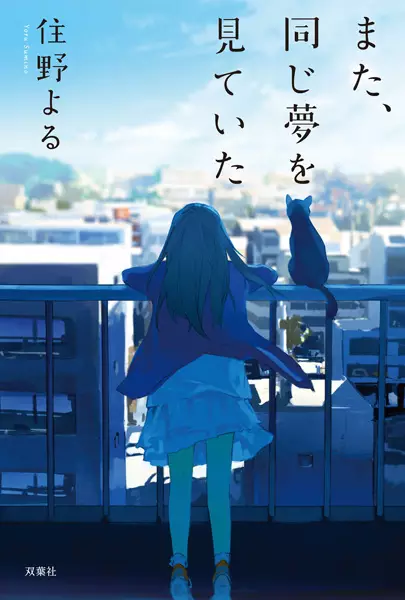
また、同じ夢を見ていた
11
1
Finished
Feb 17, 2016
8.5/10
Average Review Score
100%
Recommend It
4
Reviews Worldwide
Spoiler free! How would you define happiness? That’s the question being asked by this thought-provoking story. I’ll be honest I wasn’t expecting a whole lot from this novel but the faint air of mystery and the brilliant, relatable characters are what kept me reading. I found myself wanting to read more whenever I had some free time. It’s never overwhelming but this is the kind of novel that will get you thinking about life, similar to that of Sumino’s other works. You’ll also be happy to know that in terms of endings a happy one awaits you, that’s not to say there are no emotional partsthough. This does take a certain level of maturity to understand the full depths of the story as it covers a vast range of topics and themes that some may find hard to read. That in itself isn’t really why you need that level of maturity it’s more the way that these topics and themes are presented to you. The story is told from the perspective of a very outgoing grade school girl, who doesn’t fully understand the things that are happening to those around her, meaning that the topics and themes lie under a feint level of mist. This is not a bad thing at all, it’s one of the most redeeming factors about the novel. Overall this wonderful novel is definitely one to read whether that’s online or physically (which I recommend as Seven Seas have done a great English adaptation) as it taught me to do things a little differently in life.
Bold and witty Nanoka Koyanagi believes she is above the typical assignments that her teacher gives in school. Rather than participating in her physical education class, the young girl crafts a foolproof argument to avoid any activity altogether. Instead of being impressed, Nanoka's worried teacher decides to give her a new task—to find the meaning of the word "happiness." As Nanoka mulls over the answer to such a difficult question, she seeks advice from two of her closest friends: Obaa-chan, an elderly woman living in the woods; and Abazure-san, a young woman living alone in a nearby apartment. Along the way, Nanoka befriends high school student Minami at an abandoned building, whom she initially met while Minami was hurting herself. Each of them has a different outlook on life, making Nanoka's mission to figure out what it means to be happy even more challenging. During her search, it seems that there is something bigger drawing Nanoka to these three women. The more she investigates, the closer she gets to her friends and learning about herself. [Written by MAL Rewrite]
This is an inspiring story about a little girl in search of happiness. It tackles the obstacle of the question itself: "What is happiness?". Through the whole manga the little girl tries to find the right answer or, as it turns out, more of them. She doesn't want and is not satisfied with a simple answer, even though she is aware that happiness is also found in eating sweets and delicious food, she is digging deep to find the real, core meaning. What is even more interesting is that she is so very young to be facing such a difficult question in a difficult way thatshe choose to tackle it. Making a presentation about happiness was something they had to do for a school project and it's very fun to see how the majority of kids interpret it and how she does. The contrast between her and ohter kids is evry strong and it is defitintelly an aspect of this story that should not be overlooked. At the first glance everything seems very normal, with the fact that she is, in a way, very mature and eloquent for her age (even though there are moments when she definitely acts like a kid she is). However, there is a twist, or a few! The ending itself blew me away and I love how the name of the manga plays a very big role through it and especially at the end. It is genious. She keeps looking for answers through others and mostly herself - which definitelly sends a big message across, even for adults: happiness lays inside of us and in people around as, as well as in the little things. *The only complaint I would like to point out is very vividly shown self harm which is not necessary and there should be a TW, as well as censorship, in my opinion.
Mata, Onaji Yume wo Miteita is the story of an elementary school girl, "Koyanagi Nanoka", finding the meaning of "happinness". Right at the beginning, she is assigned by her teacher to find the answer to that. While thinking about it, she visits 3 friends, a teenager, an adult and a granny, named "Minami", "Skank" and "Granny", and discusses with them about what happinness means. Each one of them has different views on life and what happinnes is, as it is expected from their age gap and they also face different struggles. There are many sensitive themes, which makes the story seems dark sometimes, contrasting withthe main character's innocent and optimistic perspective. The story has an interesting premise, good pace, variety of deep themes and good characters, as well as a twist to the three characters' connection with Nanoka and the name of the novel, which really surprised me. Regarding the main character's relationships, I think Nodoka and Kiriyuu's relationship was similar to Sakura and Haruki's one from Kimi no Suizou wo Tabetai, so you may like that part of the story if you liked the author's previous work, despite the romance not being a major theme here, since the characters are just children. Unfortunately, despite the gripping and sensitive themes, the way the story deals with them is rather simplistic and it never really goes deep into them. That has much to do with the main character being a kid and the story being narrated by her. The way she thinks, acts and even her humour is extremely childish and it gets boring quickly. There's nothing deep about her catchphrases "like is like..." and even her conclusions on "happiness" are obvious and ordinary. Another problem is that all the story becomes predictable due to a scene that makes everything crystal clear, which was a good moment but happened too early in the story. It was a good read overall, the storyline was engaging and solid, but I think it's slightly overrated, as there's nothing groundbreaking, the plot is simple and has some problems like I said. I would recommend it, especially if you like other works by Sumino Yoru, but you should read it without high expectations. I also think I would get a lot more from this book if I read it as a kid, maybe it wouldn't be so redundant for me.
How would you describe happiness? A question every person would likely answer differently to, some more so than others. I Had That Same Dream Again is a about a young girl, named Nanoka, looking for an answer to that question, combined with the aspect of growing as a person by coming to the understanding that not everyone is the same. The answer to the question of happiness, how emotions are experienced, and how we react to them. They all differ with each individual. Nanoka does not go through this journey alone, but is guided by various characters: a high school girl struggling to fit in,a young woman with a night job, and an elderly grandmother-like woman with a whole lifetime of experiences. These characters guide Nanoka in finding the answers to her questions and problems, allowing Nanoka to become a better person. In return, albeit not on purpose, she helps them by giving joy to their lives. The writing of the characters was very well done, with their emotions, actions, and answers all quite fitting for who they are. The primary example would be Nanoka, a young elementary schooler who is more mature than her peers, yet clearly still a child at heart. Her more simplistic answers, her naivety about the world around her, and her responses to the emotions she feels, all show that. This helps create a nice contrast that makes her feel quite realistic. Furthermore, she can be described as a righteous girl, but lacks the experience and understanding of other people's emotions to approach the issue at hand softly. This leads to frustration when her actions are not welcomed in the way she expected. The writing style is smooth to read, with transitions feeling smooth, words fluent, and emotions of the characters alive. It is written in a simple and easy to read manner, as commonly seen in light novels, but had plenty of descriptive words and sentences to clearly set the mood of the scenes. The conversations were also pleasant to read: not scripted, nor too much like a real conversation. They kept to the matter at hand, yet brought in enough uniqueness to make the characters feel alive. The pacing is definitely on the slower side, but as the main focus is the gradual discovery of answers to questions and behavior of other characters, it felt quite fitting. The smoothness of the writing definitely helped the slower pacing, allowing it to remain a pleasant read even when less was happening.