Links go to search results. Availability varies by region.
įžŖé
36
3
Finished
Jun 26, 2007 to Jan 25, 2012
8.4/10
Average Review Score
88%
Recommend It
8
Reviews Worldwide
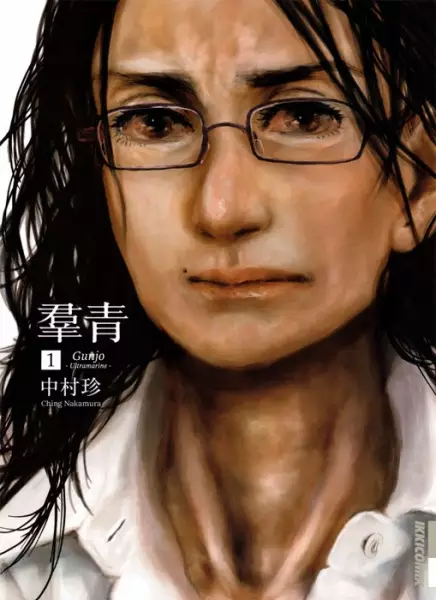
The cruelest thing about love is it can't happen with just anyone. For a happy-go-lucky Otaka Chiyomi, the person who seized her heart just had to be a classmate who was contrary to her in everything but gender, Ezaki Soko, whose smile was all it took for Chiyomi to throw away all happiness in her life for. That was only where this romantic heavy little series started. "Gunjou" explored the consequences of being overcome by intense love and pride, so much so that they fucked up your whole life. How can Chiyomi continue to love her old classmate after she heartlessly made her into a murderer,and without even a glimpse of being appreciated after all the dirts she went into for her? And how will the very proud and stubborn Soko take responsibility of having destroyed the life of the only person in this world who was ever truly kind to her? They both are walking on complete different grounds to each other and their contradictions will always hurt one another. As depressing as the manga sounds though, I grew warmed up to the characters while reaching towards the final book. You will think Chiyomi is a fool and inconsiderate at times, but you won't be able to help but fall in love with her. And I personally disliked how conceited Soko was at first in spite of her misfortunes. She was a bitch to Chiyomi. However, the manga makes these two characters exist both to defame and compliment each other. It was because of Chiyomi herself that I eventually came to have high regards for Soko as the story ended. It was a heavy read. Not to mention the art style is not the least bit to my taste. I found some important scenes to be so disgusting it made me thought the mangaka did it on purpose to scare readers off, since the story was kind of spooky. I meant she could draw decently for most panel, and this is a female's romantic series we are talking about. It made this manga appears distastefully unique though, I would give her that. Nonetheless, I am glad I have completed it. When you are growing older and influenced by this distorted world you have lost your touch of genuineness, and having finished these volumes brought the touch back to me. It is definitely one of the manga that offers its readers more than the price they pay for.
"I want you to kill him..." Her husband abuses her on a daily basis. Unable to stand it any longer, she asks her lesbian friend to kill her husband for her. And unable to say no to the woman she loves, the lesbian kills him... Only 22 years old when the series began, Ching Nakamura offers up a work carved from flesh, blood, and bone. (Source: Kotonoha)
This is one of the best mangas I read in a while. I enterd this expecting... Well, surely not expecting this. I don't want to spoil anything but if you like in depth characterization and genius writing of heavy themes you'll like this. Story is an 8 I'd say. It is fairly original but nothing too special. Although it is the perfect setting to reveal the psychological drama and turmoil in the characters. The art is ok. I'll give it a 6 although I did not enjoy it that much. You don't mind the art as the manga pulls you in and doesn't let yougo. Characters... outstandingly fleshed out. A perfect ten. You'll see their thoughts, their feelings and weaknesses and small strenghts they have in them. 10/10 Overall it's not a perfect ten(because of the art mostly) but I'd give it a 9.9 if I could. I'm gonna read it again some time for sure
My first impression was the resemblance to My Broke Mariko. The tortuous relationship between two women who have been intimate since adolescence, the distance established over time, the theme of suicide involved in the reunion. But Gunjou goes further; Gunjou gets entangled in the minds of those two tortuous souls, and brings up the theme of love, what it means to be a woman, what it really is to love, what it means to be loved by someone, the ideology of existing in society and forming bonds, family, and the contradictions between what actually happens in the heart and social conventions. Gunjou has deep charactersthat involve you and make you forget how dark the premise of the work is, in many moments. The plot cradles, like a sea, in very high waves, and calms down. A good part of the bitter dialogues of the two main characters make you swallow hard, forget to breathe. Perhaps it is not a work to please, or even to move; the script seems to have as main objective to involve you in those minds and make you forget any previous judgment, be it positive or negative. There are no good guys, or heroes, just the cruelty of reality and existence.
This story is not for everyone. First of all, as much as it falls into the GL genre, this story is above all a psychological drama, and does not follow typical requirements of a love story. The personalities and decisions of the characters are not intended for a healthy narrative, whose goal is to educate you about love or sexuality. It's also not about acceptance, and while this is briefly outlined throughout the course, it's not the focal point and I don't recommend it to people who have high expectations for it. The plot centers on Soko, the woman abused by her husband, and Chiyomi, the womanwho kills him. The narrative focuses on their individual motivations, as well as the psychological and physical consequences of the crime they committed. It is a raw and realistic story that chronicles the weight of the journeys and the bond between these two adult women brought together by will - or fate - and living in Japanese society. It is important to point out the clear power imbalance between the two characters: they had very different upbringings, , which makes it difficult for them to understand each other at moments, but it's also a fuel to draw them closer: Even though the two of them pretend to accept themselves, they manage to see right through each other. They both have traumas, fears and insecurities that have never been addressed during their lives, and this social context plays a role in shaping who they are, especially their flaws. At many times, it is possible to be irritated by their actions and thoughts, and even wonder if these people are good or bad after all. But that's a possible coping mechanism for people in stressfull situations, especially when they've been suffering in silence for entire decades. Still, even if it can seem like it, it's not entirely pessimistic. The author shows several times and with different characters that no one should be defined only by their past, and that even if it seems too late, it is possible to find yourself and move on while trying to find closure, even if it's an everyday task. More than anything, it's a story about recognizing your own loneliness, and perhaps, learning to ask for help.
STORY: 4 The story revolves around two female protagonists and their relation. The first woman was abused by her husband and the second killed the husband although there is no love to be gained in return. There's three volumes showing the aftermath of that murder committed in the name of love. The atmosphere is heavy and tragic and tries to provide real-life in-your-face drama. Alas somehow dialogues always feel a bit off for a realistic story and prevent the reader to empathize with the characters. ART: 5 Art is not great compared to the average of the industry and you can find some anatomical mistakes here and there. However,character drawings immediately sets this manga apart because there is no lookism. Lookism can be seen as a mechanism of social domination where the marker is beauty (instead of race for racism or gender for sexism). Cultural productions like Hollywood movies or mangas are full of it: if you were to pick a random person in the street a few times you would find a few people that are not 'attractive' in the eyes of society. But in stories it's extremely rare to find a main protagonist that could be perceived as ugly, even for average characters. On the opposite characters that are 'ugly' are never random but are defined by their appearance, which implies that good-looking people are the norm (while it's not the case in reality). This is similar to the way women (see the Smurfs) or black people (see the trope of the token black friend in TV) are essentialized in fiction. Almost every single manga uses good-looking protagonists (especially in the case of women) by default and not-good-looking protagonists only with a reason (because they are dumb and funny, bad, to show they have suffered, or just because they are feminists..). Gunjou does not follow that trap and the same character can be drawn either cute or hideous depending on their emotions like in real life, which does a good job at making the story feel real. Too bad though that the dialogues don't manage to serve the same purpose. Moreover, those are women that can look unattractive and even their naked bodies are crudely realistic instead of being something erotic to gaze at. POLITICAL POTENTIAL: 5 The interesting content is more about feminism than politics. FEMINISM: 7 This title completely centers on two women and their complex relationship. They don't even desire a man. Patriarchy is present and responsible for a great part of the misery occurring. There's no man to save the day and characters are not sexualized, that's already so much for a manga that I guessed that the author is female. Apparently the author is a woman and gay, let's hope cis men can also tackle such works someday. CONCLUSION: 5 A heavy drama that cares about women and has non-conventional art. It's a pity that the weak dialogues block a full immersion.