Links go to search results. Availability varies by region.
çéłććł
105
18
Finished
Oct 24, 2002 to Nov 24, 2012
8.3/10
Average Review Score
78%
Recommend It
9
Reviews Worldwide
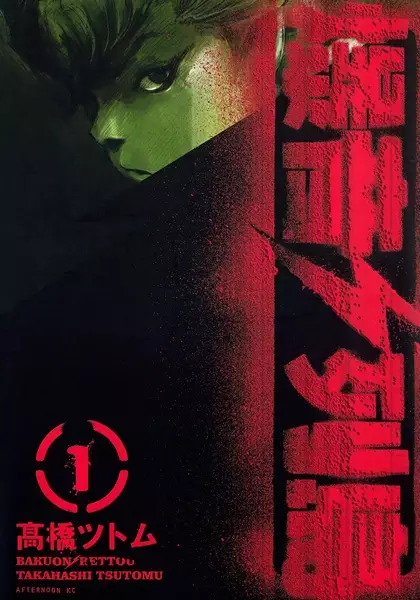
This is a work of unbelievable quality: a proper confessionary bildungsroman in plot, a masterpiece in art, blossoming with loving depiction of Japanese motorcycles â in motion, no less, at night, in city lights, running, growling, flowing. Personally, I think Tsutomu Takahashi usually bites more than he can chew with his concepts, but in Bakuon Rettou he truly overdelivers. Itâs a mature work of a mature mangaka, who draws from years lived and pages drawn â and emerges in unimaginable power. The story is autobiographic. The author himself was a part of a biker gang, of bosozoku â a subculture drawing its last breaths in 80-swhen the events of the manga take place, and outlived it. In the ending notes he says that he wanted to write this story before he hit 44, after which he thought he would lack the energy to write about teenage experience, he even discarded another promising concept for it. But you start to suspect the personal nature of the story much earlier. It has the qualities of best childhood novels â itâs raw, painful and doesnât pull punches, it lends them all in fact. The early mushy and embarrassing foundations of life are mercilessly examined. The main character, Takashi, at that point of his life is a lowlife shitty kid, who may or may not grow. Reared in a broken home, an early school dropout, he protests and seeks and fails as he can through his boyhood. And at the very precipice of it, he encounters his biker gang, drawn in by the idea of comradery and purpose. He meets other similar boys and girls, mostly boys. They gather at evenings and ride together. I would have never imagined it is possible to draw a mass of moving motorcycles so well. The light beams, the shapes, the machine details â you practically feel the warm wind of Tokyo night blowing in your face, you hear the roar, feel the exhilaration. Takashi starts the engine of his bike, leans in and smiles tenderly, and you understand why. Bakuon Rettou revels in these moments of freedom. After all, according to the author, itâs also a manga about young boys feeling invincible. The gang connects several generations of young men. Their life trajectories are very different. Not everyone has the luck to survive, not all choices are good choices. The manga starts as a historical piece with a heavy dose of psychology â Takashi is directionless, alienated as forming brains usually feel, we observe the epoch, the last stands of bosuzoku, the people of this gap in the society. But as their time to be reckless runs out, itâs a race of who survives, who graduates into adulthood. The stakes are high, itâs genuinely gripping. The ending is a bit didactic â but why exactly not? Bakuon Rettou roughly translates as Detonation Islands, and you canât build on light, sound or emotion. Itâs about transient, but also formative time, a beautiful, but costly freedom, available only once. It has this sense of duality, of good and bad forming a unique life. The comments of the author are positive â he speaks about fun times and the surviving friends, but it often reads rather heavy, to be honest. Contrary to his notes, I think he shouldâve been at 40+ to be able to analyze that messy age with such a mature balance. He is and he can tho. Bakuon Rettou is so overly, excitingly good itâs almost scary. The usual overambitiousness of the author is finally replaced with something warm and living, true to psychology and the time period, thanks to the autobiographical roots. The art is majestic too, displaying expressionism and plasticity rarely seen in manga, with a wealth of detail, of human types, of places. With the addition of the incredible motorcycle drawings, neither simplified nor overly technical. These motorcycles would alone have gotten my recommendation for this manga on the worst of my days. The two pages spreads depicting bosozoku night rides are what comics has been invented for, itâs a loss not to see them. The same can be said about Bakuon Rettou as a whole. If you wanted a strong psychological manga â here you go. A bildungs-manga â even better, for its depiction of the growing pains puts Bakuon Rettou on the level of Punpun. You like Tsutomu Takahashi as an author? The thing in front of you may be his masterpiece. And if you are interested in motorcycles and biker subcultures â go no further. Bakuon Rettou is honestly major. Big manga, big heart, big drawings, big skill, a big chunk of life gifted to a reader. It breathes and it beats and it roars like a powerful engine. It's a loss for a manga fan not to read it. It was a fantastic ride.
Kazei Takeshi moved with his parents to a new house and new school. One of his new friends is a motorcycle enthusiast and soon invites him to meet with his gang, the Zeros. Takashi comes to love motorcycles and soon gets involved in the gang's fights and issues. What has he got himself into and is he ready to face the consequences? (Source: MU)
Story The story is very realistic. It's great if you are looking for something more down to earth. I didn't relate with the themes of the story, but if you like gangs and old-school motorcycles, then I think you could have a really great time. Art The art is great. I don't think I have anything else to add. Characters Other than the main character, there was no one else to root for. It's also kind of fun watching Takashi become an asshole. EnjoymentI enjoyed it despite not being into motorcycles or hang wars. Overall I recommend this series if you are into realistic stories but as for me... meh
Delinquents is a subgenre of manga that deals with the shenanigans of teens rebelling with the intent of finding their purpose in life. While not so popular in the medium of anime, it is one of the most recognisable, if not popular genres of manga, with several magazines across different demographics dabbling with them, aiming to find the next hit. It shouldnât come as a surprise that 2 of the 3 most popular manga running during Shounen Jumpâs golden age, happened to have delinquent leads in it. And while the halcyon days are now far behind (usually seen to be somewhere between the late 1980sand 90s), modern works such as Beelzebub and Tokyo Revengers forward the cause of these brash and passionate brats and gals. And while a lot of these series often resort to an over-the-top testosterone approach in terms of execution, which is quite entertaining in its own way, donât be surprised to find series which tackle these rebels in a much more humane and subtle way. The focus of our review today is one such series. Written by Takahashi Tsutomu from 2002 to 2012, this is quite possibly his finest work Iâve read so far. He himself was a former bosozoku, a subculture revolving around customized bikes and rigid social hierarchies (a whole other topic in itself) and his work oozes with a sense of personality and intimacy, which is unlike his other works. Bakuon Rettou is the story of Takashi Kaze, as he grows into his own as a bosozoku in the Zeros. Growing in somewhat of a dysfunctional family, Takashi is wallowing in indolence as he seeks to find some sort of spark which would move him from this state of stupor. All of this changes when he first discovers the Zeros. A bosozoku gang like any other, their sense of majesty and dignity stupefies him as he finds kids not older than him, conducting themselves with great poise and maturity. Intent on being like the âcool kidsâ, our impressionable MC joins them as a grunt. The stage is set and it is up to Takashi to deliver the goods. What then follows is hands down some of the most realistic character growth that can be found in the medium, as we see Takashi grow as an individual with each experience. Each encounter, be it positive or negative only serves to solidify his beliefs and be an example for the younger members of zeros. His initial sense of being a rebel to escape his mundane life transforms into a sense of authority, a will, if you will of what makes him, him. And as we see get to see this metamorphosis unfolding in front of our eyes, the story ends with him passing on the mantle to kids, who were just like him all those years ago. The story itself plays out in a rather straightforward way for the most part. Takashi navigates from one situation to another and behaves like any other teen placed in such a situation. Where it shines though is in the sense of atmosphere that Tsutomu conjures up. People familiar with his other works should know that he excels at this, but rarely has it felt so poignant as in this work. It could very well be that given his involvement with such groups in the past, there is a sense of authenticity to it which feels incredibly cathartic to us as the readers. And it is in this atmosphere that we find ourselves transported to that place, at that time when bosozoku ruled supreme on the roads of Japan. Takashi as a lead is quite plain. Born in a broken home and having no opinions of his own, he is far from the usual stereotype that is associated with delinquent leads. But the one thing that is similar is the urge to struggle against the status quo and to grow as an individual. And in this, he is one of the finest delinquent protagonists out there. Not all his choices are satisfying and often tend to be wrong when seen from societyâs point of view. But all of these only end up serving to strengthen his convictions as he grows into a more responsible role in the gang, leading to the glorious climax of the manga. The art of the manga is absolutely gorgeous. I have already touched upon the sense of atmosphere that oozes throughout the manga, but Tsutomuâs sincerity is for all to see. Rarely have I been moved by motorbikes and his mastery of the craft brings these bikes to life. The engines roar loudly, the atmosphere is palpable and the delinquents are ready to leave their mark on history. And this is just some of the incredibly powerful moments that Tsutomu manages to create in his manga. In this nostalgic and transient piece, we come to the realization that even if one day we grow up and have to move on from the things that defined us, we have a duty to pass on the torch to the next generation, who will struggle in turn. And thus, life goes on! It is with this intent that I write this review, to shed light on a gem of a series, to pass the mantle on to future readers of this work. Oh! And while you are at it, do check out God Speed You! Black Emperor. It is a documentary which sheds light into a Bosozoku group called Black Emperor.
Took me two days to read all of Bakuon rettou. It was like 100+ chapters too the bum behaviour is off the charts. But nah this was a really enjoyable read itâs definitely put me on manga thatâs not adapted. Itâs basically Tokyo revengers but good. A lot of stuff in this manga is based on real life experiences from the writer too. Havenât seen any gang/delinquent media, despite there being so much of it, actually be able to empathise with the gang members on an emotional level. Just gapped by real world knowledge in writing I guess. Like this clears everything else in thegenre itâs not even close. 8.5/10
That sleeve doesn't need a long review, it was simply some of the best sleeves I've ever read Character Well-developed character, as well as other characters Overall I will certainly read more of this author's manga, and I hope i bid more and more, from what I saw the manga was based on the personal life of mangaka, and it really made me very happy, because the mangaka was not afraid to show his vision when he was only 16 years old. And may your deceased friends rest in peace If you are reading this review, I highly recommend you read and enjoy, I'm not a good guy with criticism,but I recognize when something is good