Links go to search results. Availability varies by region.
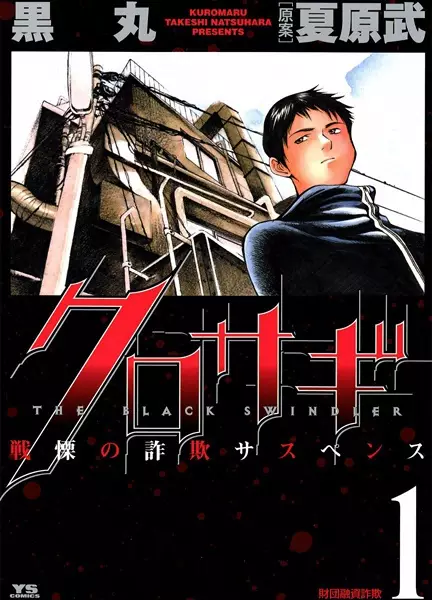
クãƒã‚µã‚®
220
20
Finished
Nov 13, 2003 to May 29, 2008
5.0/10
Average Review Score
50%
Recommend It
2
Reviews Worldwide
Story:Ok, so you get this kid who had a bad past-common character background. He seeks retribution against all swindlers because his father was driven into debt by the swindlers and attempted to kill his family then himself. Of course the protagonist survives but the rest of his family was no so fortunate. He gets taken in or begs to be taken in by a notorious swindler who is currently an underground bartender that deals with selling information. So he goes around stealing from the rich and giving it to the poor metaphorically and becomes the ant-hero story to story. ThereIS NO climax; the plot is as plain as it is, the techniques he uses to swindle are horribly thought out and very unimpressive that leaves you in huge disappointment. His access to tricks in his bag makes it almost modern fantasy story with no interesting point that draws you in. You'll see the protagonist pull up methods that would never be likely in anything but the early 1900s where you'll wonder, "how dumb do you have to be to be scammed by these brainless scammers(literally)."Overall this was a VERY disappointing manga; if you're interested in something interesting avoid this. Art: The art isn't very current or "new" despite being published in 2004. The art style suits more of the late 80s and 90s manga art. Character: Kurosaki-Character development was not very deep nor a highlight part of the manga. You get Kurosagi who is the anti-hero of the story with some dark past he gets angry when brought up and triesto play the cliche guy that tries not to get anyone involved because of the dangers and doesn't try to get close to anyone. You see his motives are pure but his methods aren't and the author tries too hard to get him seen as the cool wannabe genius swindler. Yoshikawa, Tsurara-Then you get the female neighbor although who doesn't play much of a part in the story you'll see it get squeezed in as L from death note. She basically attempts to be the one kurosaki can open up to-which he does not, and tries to be the true sign of justice. Because of her interest in becoming a lawyer kurosaki tries to push her away so she doesn't become tainted. Kashima, Masaru- And at long last you have the vigilante cop/detective who believes he is the true justice and above the law. He plays it tough using threats and blackmail to get to the truth or at least some tips on hunting down Kurosaki. Simply the menace of the story just so the manga isn't limited to only one and a half characters. Enjoyment- I thought I liked it at first but then I gave it some thought. Man did I waste a large amount of my time. Many readers often continue to read manga from a certain series because the story is actually interesting or something unique that draws interest, however this manga isn't either. This manga has little plan in where its actually going and it seems like things are just thrown in together with no climatic discovery. Unlike other battle of the wits mangas this one tarnishes the genre; the techniques Kurosaki uses are extremely simple and utterly unlikely where there are no twists or turns that are planned out. The author simply makes things happen as they go. I would honestly not recommend reading this if you favor Death Note, Code Geass, or Liar Game.
White swindlers (shirosagi) are those that cheat people to take their money, red swindlers (akasagi) are those that swindle the opposite sex, and black swindlers (kurosagi) are those that cheat the white and red swindlers. After his family is swindled by white swindlers, Kurosaki sets out to avenge them by becoming a black swindler. (Source: ANN)
Having read the whole manga 2 years ago (not an MAL member by then), and recently going through ts sequel, I wish to share an opinion of this manga after 2 years of condensing: this is an informative collection on operation and prevention of fraud techniques, but not a great story. Plot: 7 The plot is simple: Kurosaki, a young swindler vowed only to cheat money out of fellow swindlers, investigate them through victims of the swindlers or his boss Katsuragi (operating his own "Katsura bar" as a disguise), then approaches the swindlers and cheats money out of them by no less than the amount the victimsare cheated of. The 20-volume story is pretty independent between arcs, illustrating a wide variety of fraud methods, from domestic ones like prepaid beauty service contracts and sure-win lottery, to commercial ones like defrauding lending banks and insurance agencies. While the plot is fruitful to learn to beware of different loopholes in daily and commercial transactions that may bring in fraud, and demonstrating how some "proof" documents are easily forgible, the story pattern is admittedly repetitive. This is a major reason why I had to take a long break after the 20 volumes. Kurosaki's performance is also understandably limited to a simplified description of "phishing" and outwitting other swindlers. It would be outrageous to expect a published manga detailing step-by-step guidance on how to commit fraud (especially on professional fraudsters). The focus of the story, rather than intense battles of wits, tends towards educating the public to beware of the fraud techniques and how cruel the reality can be. Although the arcs are largely independent and episodic, an overarching plot line does exist between Kurosaki and Katsuragi, but has not been resolved in this story (resolved in the finale of the series). Characters: 6 Characters in this manga largely serve as device to show readers the plot. Kurosaki is almost the only common point between all the fraud arcs. He is practical, but also challenges other characters (law executors) as arrogant, which is quite a realistic opinion from the underworld (as the author also proclaimed to have worked as a swindler). Yoshikawa (female lead(?), a univeresity student studying law and aspiring to become a prosecutor) and Kashima (a young police officer, serving as a complete opposite of Kurosaki's values), while serving as the conventional main cast group (but appearance being less than often), tries to bring in the point of view of lawful citizens and executors of law. The only highlight is a debate between Kurosagi and Kashima on why they had chosen such different paths despite having similar back stories, but, unfortunately, Kurosagi failed to justify the merits of his chosen path, not to mention convincing readers of his choice. Certainly, such justification would unlikely be published on a manga. Art: 7 Typical 90s to 00s manga art-style, the regular cast and characters (victims, swindlers etc.) in the same arc are largely differentiable. Although the same cannot be said for one-off characters across different arcs, there is not any need for readers to do so. Enjoyment/ Overall: 7 Kurosagi only succeeds in being a fruitful casebook of fraud techniques, no matter in domestic or commercial contexts, by an author with proclaimed first-hand relevant underworld experience. Although published over 10 years ago, some fraud techniques are still prevalent nowadays, especially in Asian countries. An example is the re-emergence of "Ore Ore Sagi" (phoning victims and impersonating their acquaintences, and later claiming they have got into trouble and request victims to bail them out with a handsome sum of money). For shortcomings, it fails as a captivating story with persuasive characters, or any deep or inspiring discussions into the relation between lawfulness and righteousness. Kurosagi is a good read for readers interested in understanding operation and prevention of fraud, and perhaps even some operations of finance in real life. However, this niche market is likely the only group Kurosagi can capture and appeal to.
