Links go to search results. Availability varies by region.
Find a Specific Chapter
54 chapters total
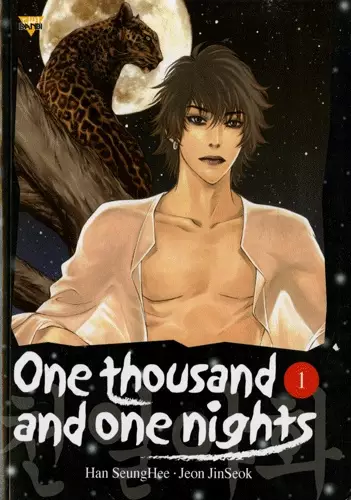
One thousand and one nights
천일야화
7.85(1K votes)
Ranked #1426Popularity #6142
chapters
54
volumes
11
Status
Finished
Published
2004 to 2007
Authors:Han, Seung-Hee, Jeon, Jin-Seok
Boys Love
Worth Reading? — Global Verdict
8.3/10
Average Review Score
75%
Recommend It
4
Reviews Worldwide
International Reviews
Cindy-Uchiha
Recommended
10
Story 10: Story to be divided into 2 parts: the real life & the stories. Real life: twist on the 1001 Nights classic. You have the crazy sultan, but Sahaar is a boy instead of a girl who took his sisters place to be sent into the harem. Sahaar calms the sultan with his stories. Besides their relationship, there's also the history of the Sultan that made him the crazy ruler he is now, which is also really interesting. The stories: the irony is that this manga is a twist within a twist. really good and interesting, and I believe some, of not all, are realhistorical stories with a twist. And since they're stories, the twist is okay (I usually get annoyed when seeing people twist history). I'd rate those stories really high if they were seperate mangas.
Characters:
A lot of development on the Sultan's side. He starts of as this crazy dude, and you'll slowly discover what made him that way, and you'll see him deal with his past and become a better man. For his kingdom and for Sahaar hihi.
Sahaar kinda stays the same. The only thing truly developing is his feelings for the Sultan. He's very likable: smart, pretty, capable.
Also that guy with the lamb omg read it and you'll know.
2 found helpfulMar 12, 2020
Community Discussion
Drama
Fantasy
Synopsis
Everyone knows about the story of Shahrazad and her wonderful tales of the Arabian nights. For one thousand and one nights, she entertained the mad Sultan with the adventures of Aladdin, Ali Baba, Sinbad, genies, and many other mystical creatures. But what if Shahrazad was actually a boy desperate to save his sister's life? What kind of strange things would he do to make sure that he survives to tell the tale? This new twist on one of the greatest classical folk tales just might keep you awake for another One Thousand and One Nights.
(Source: Yen Press)
4,044 Members
neptuneskisses
Recommended
8
Ooh this is a difficult one to rate! First off, the art is lovely, full of absolutely stunningly beautiful men (especially as the volumes go on) - sadly the historical real-life characters on which some of the stories are based probably didn't look quite so stunning.... There are some gripping stories in the mix here too although this is a bit more uneven IMHO. You're not always that invested in the characters of the stories - kind of inevitable when they're of short duration - and I found myself a little impatient at times to get back to the main story. Sehara is a very sweet character,but I found it really hard to get invested in the relationship between Sehara and the Sultan, Shahryar. This is after all someone who is chopping off a girl's head every night....and the reasoning/explanation eventually given for why he's gone off his trolley and started this mass killing spree does not seem nearly sufficient enough to redeem him/make him more sympathetic at all!
At one stage I was going to give up, but then would come along a story I really got into. I especially enjoyed an absurdly complicated story set in ancient China that's based on an historical text and would presumably be a lot more accessible to an audience more familiar with the main historical figures (Clamp's Gate 7 suffers from the same problem) - I spent some time backtracking to try and work out exactly who everyone was and how they fitted into the rather complicated timeline and feel like I have an enhanced knowledge of Chinese history as a result (albeit a rather madly constructed shoujo-manga alternative universe version, but hey).
So overall it kind of annoyed me in parts, kind of lost me in parts, but then gave me a huge amount of enjoyment in parts - one of *those* kinds of manga/manhwa!
2 found helpfulOct 17, 2014
thewhitesea
Recommended
10
I'm not one to usually write recommendations, so please forgive my lack of fluidity, but I felt that I just had to after finishing this series. One Thousand and One Nights (or, A Night of a Thousand Dreams, as some sites call it) is a beautiful rendition of the original tale, and while I've never actually read the original One Thousand and One Nights, I believe that this manhwa has more than done it justice. Story (9): The overall story is done pretty well- sure, there are the few cliches of the 'driven mad by -love' kind of crisis with Sultan Shahryar, and the whole'falling for the person who helps you' romance that he and Sehara eventually embark on, but personally, I didn't find it all that off-putting. The fact that the story of Sehara and Shahryar does stem from the original One Thousand and One Nights doesn't allow the writer the flexibility of deciding how they fall in love, but the writer does an amazing job in the development of the plot leading to the romance. The fact that it's two men isn't something that's an in-your-face, forbidden romance type of thing. It's just like anything else in the series, it's different from what the normal perception is, but that in itself isn't what makes it stand out. Unlike other BL or yaoi, the fact that it's two men isn't what defines the story.
I need to point out that the romance, just like the original tale, is not the crucial element of this series. It's a subtle, gentle force (and a real slow build, you should know) that reminds you of the purity with which Sehara tells his stories, and the gradual care that Sehara develops for the sultan. He tells his stories initially in order to to ensure his own survival, but his purpose changes to telling the stories to make Shahryar a better man, to impart philosophies and morals to allow him to make better decisions that will save his people. The stories themselves add the the intricacy of the plot- they let you see more sides to something than what is originally presumed. Even the author's notes at the end of each volume (I highly encourage you to read them) tell you so much about what goes on in addition to the original stories that he bases them off. I do no justice in describing the marvellous wonder of these stories, so I implore you to read them in the series yourself. They move me to a great extent, which not a lot of manga/manhwa do, that I am actually able to empathise with the characters, and understand their motivations, even if they are portrayed as the villain.
Art (7): To be honest, the art was what made me hesitate on reading this series. It's not excellent, but it's certainly not bad. Like most manga/manhwa, it has panels where the effects and the drawings took my breath away, and others where it made me cringe slightly (though I'll say that this didn't occur that often, and the former effect thankfully occurred more). The overall fairy-tale effect was quite ethereal, and aided by the grace with which the characters are drawn with, I would say this series provided a rather beautiful atmosphere. One thing I have to say that definitely stood out, though, were the CLOTHES. Some of the garments, royal or not, were stunning. Some of Shahryar's vests (I'm not actually sure what they're called, sorry) deserved their own harem, just for how sexy they were.
Character (10): Initially you might not like the characters all that much because they're fairly typical. The caring martyr who sacrifices himself for the sake of his stubborn sister, the aloof sultan who does what he wants and threatens others if they don't obey him, the bodyguard of the sultan who never speaks a word and hulks around intimidating people, the misunderstood voice of reason of the sultan who was imprisoned due to the latter's spoilt nature, etc.. Despite all of this, what makes the characterisation of this series so amazing is you see them all gradually grow outside those little cookie-cutter personalities. As you learn more about the events in the story, their characters gain depth. Sehara becomes more elaborate, Shahryar stops wallowing in his self-pity long enough to apologise and help other people, Jafar (the imprisoned one) grows in his capabilities to be far more than just an underling, and Maseru (the bodyguard) is a wonderful, touching embodiment of loyalty and a very gentle soul (he and his lamb make me cry).
I loved how Sehara wasn't a teary-eyed, blushing and fawning uke who relies on the seme loving them like most in the genre are, and I definitely loved how Shahryar was the one who needed Sehara's guidance, but only in order to fix his pre-existing problems, and not as a constant desire for possession. The power balance between the two is very equal, you don't get the sense that one of them having more power in the relationship, and that's something I really love seeing in a manga/manhwa relationship, be it BL or not. Even when they are heavily dependant on each other, it isn't made in a way that they have to be with each other in order to be complete. Each of them are already their own person, but they compliment each other in such a way that together, they create greatness.
You should definitely give this series a try. At least stick with it for a volume or to, and it'll show you the wonderful messages that any human can be improved with. I for one, feel that I have taken away many life lessons from Sehara's tales. I'm extremely sorry for the fact that this manhwa isn't more popular, because it is an amazing, overlooked gift that needs to be shared with more people. If you, like me, really love it, it's available on Amazon- so we can not only support the creators, but this amazing work can be readily available to us on your bookshelves.
3 found helpfulJul 2, 2014
abystoma2
Mixed Feelings
5
First of all, I would like to note that although this is marked as a BL, that is but one of the elements of the storyline, not strictly the main focus. So, even if you happen to dislike that genre, that doesn’t necessarily mean you will dislike the entirety of this manhwa. One Thousand and One Nights is inspired by the namesake tale, and retains the format of telling stories within a story. One major change to the “main”, overarching story would by that, you’ve guessed it, the position of a princess is overtaken by a man, giving it a yaoi-ish vibes. Fortunately, it doesn’t gomuch sexual so rather than being very explicit – which usually doesn’t end up well for the quality of the work, One Thousand and One Nights stays on the fanservice and teasing level.
This format is why I found it a bit difficult to rate – because the inside stories, while themselves varying in quality, mostly weren’t bad. However, the main storyline didn’t interest me much. The character of a sultan was unsympathetic right from the start (though understandably so), but has stayed uninteresting to the end, with the little progress feeling undeserved as the story blamed his situation and others for the sultan’s fault. This ended up causing fluctuation in enjoyment, depending on which part the story currently focused on. The story within a story format also started being a bit confusing with later volumes, as not just tales, but also historical events (though not entirely historically accurate) and even contemporary, modern age stories were woven in.
This paired with final volume that seemed like it’s taken out of a completely different series with its sudden shift in the plot made me lean more towards the rating of 5 rather than 6. After all, adding up the 6/10 of the inside stories and 4/10 of the main story does have a simple mathematical answer.