Links go to search results. Availability varies by region.
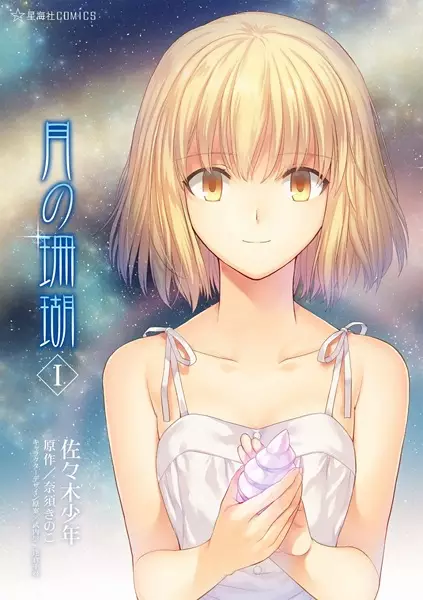
月の珊瑚
4
2
Finished
Jul 7, 2012 to Jan 22, 2019
9.5/10
Average Review Score
100%
Recommend It
2
Reviews Worldwide
"Tsugi no Sango"(Moon Coral) is one of the early works of all-too-famous Nasu Kinoko, who is known for his story to "Tsukihime" and various "Fate" series. It can probably be described as "Tsukihime Prototype"(similar to "Fate/Prototype"), as here the Moon plays an important role in the story as well. However, it shares more similaries universe-wise with another short story by Nasu - "Notes" Now some words about the plot. Here we have a post-apocalyptic(Or sort of) world set in a year 3000 or so. The humanity has long reached it's peak of existence and slowly began to deteriorate, "loosing its will to live on". The maincharacter(from the first sight) is Kataribe - "the storyteller girl". Some characters also refer to he as the "princess". The main story begins when she encounters a strange tiny man in a spacesuit(Kobito) and tells him a story which her grandmother used to tell her. However, further on we see how the story actually played out from its character's point of view. A funny thing is that the story told by the girl differs from the actual turn of events, her own interpritation being the reason to it. The main idea of the plot, in my opinion, is finding the meaning of "love" and being able to "love" certain individuals or humanity in general. Each character in this story has their own opinion on "love": Chikyuu(the moon guy) discards his love for humanity and leaves for the Moon to live in solitude, Kataribe doesn't know the true meaning of loving someone and etc. Overall, the story is very beautiful and dramatic. Most characters are very developed and have distinguished backgrounds. However, I wish they told us more about the main protagonist - Kataribe herself, such as her childhood, how she came to be the princess and so on. "Tsuki no Sango" is a short, yet very dramatic story which definetely deserves more attention than it has now. So, if you're into such plots and stories or just want to pass the evening reading something "light", then you definetely should read this manga. Trust me, it'll be worth it.
The story takes place in approximately the year 3000, when humankind arrived at the peak of its civilization, but is loosing it's will to keep living. It follows a girl, called "princess" by those around her, living on a small island with a fifty person colony and a shinning coral reef. She is descendant of Moon people, and it focuses upon how her ancestors supposedly came to Earth.
Eu recomendo o mangá Tsuki no Sango para quem gosta de histórias curtas, contemplativas e que ficam martelando na cabeça mesmo depois de terminar. Apesar de ter uma aparência simples, é uma obra que carrega um peso temático bem maior do que parece. O grande destaque de Tsuki no Sango está nos temas que ele aborda. A obra reflete muito sobre solidão, o que sobra da humanidade quando não há mais humanos? Se você curte obras introspectivas, com clima melancólico e reflexões sobre o fim da humanidade, essa é uma recomendação fácil. A arte também ajuda bastante a construir esse clima. Os cenários possuem uma estética simples,mas conseguem transmitir bem a ideia de um mundo vazio e abandonado. como se todos soubessem que estão vivendo em um mundo que já acabou faz tempo. O mundo apresentado também desperta bastante curiosidade. Mesmo sem mostrar tudo de maneira explícita, Tsuki no Sango consegue criar a impressão de que existe uma história muito maior por trás daquele cenário. Isso deixa a ambientação ainda mais interessante, porque o leitor fica constantemente imaginando como aquele mundo chegou naquele estado e o que aconteceu com a humanidade ao longo do tempo. Mesmo em um cenário vazio e decadente, a obra ainda consegue criar momentos bonitos entre os personagens. Isso gera um contraste muito interessante entre a frieza daquele mundo abandonado e os pequenos sentimentos que ainda continuam existindo. A sensação de passagem do tempo também é extremamente forte. Tudo na obra parece antigo, distante e desgastado, como se a civilização tivesse virado apenas uma lembrança esquecida. outra coisa que eu também gostei é de como ela fala sobre esperança e medo do esquecimento. Você realmente sente que está observando os restos de um mundo antigo. Outra qualidade muito forte é a maneira como o mangá utiliza o espaço e os cenários para contar a própria história. Os lugares parecem abandonados há décadas, mas ao mesmo tempo carregam vestígios de uma civilização que um dia existiu. Esse cuidado com a ambientação ajuda muito na imersão. A obra também trabalha bastante a ideia de legado. Mesmo com a humanidade praticamente ausente, ainda existem vestígios deixados para trás, e isso cria uma sensação muito forte de que os personagens estão caminhando sobre ruínas carregadas de história. Tsuki no Sango parece perguntar se a existência humana realmente deixa algo duradouro ou se tudo inevitavelmente será apagado pelo tempo.