Links go to search results. Availability varies by region.
Find a Specific Chapter
118 chapters total
I Saved Too Many Girls and Caused the Apocalypse
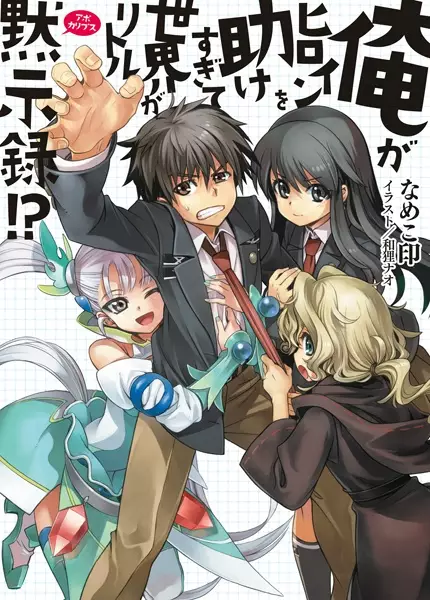
俺がヒロインを助けすぎて世界がリトル黙示録〈アポカリプス〉!?
6.59(0K votes)
Ranked #16897Popularity #14717
chapters
118
volumes
16
Status
Finished
Published
Jun 1, 2011 to Jun 1, 2016
Authors:Watanuki, Nao, Namekojirushi
Fantasy
Worth Reading? — Global Verdict
7.0/10
Average Review Score
50%
Recommend It
2
Reviews Worldwide
International Reviews
abystoma2
Mixed Feelings
6
At the point of writing this review, this novel is ranked among the worst rated novels on MAL. I have already read a decent amount of bad light novels, some of which were even quite favourably rated, so seeing the general reception through the score I braced myself for the worst, a terrifyingly painful experience. So imagine my surprise when Little Apocalypse turned out to be… decent? This have could been helped by my fondness of fictions that work with concepts. Because what Little Apocalypse does is it takes the trope/cliché of a harem protagonist just so constantly running into girls that happened to be inneed of saving and thus adding them to the harem. And that is exactly what the “superpower” of our protagonist is – to keep getting dragged into stories of various heroines. The strength of Little Apocalypse lies in this being a literal condition. This turns it from being cliché into being meta. This way, the storyline can also get more ridiculous and what would otherwise be considered overboard, as it makes sense within the laid out logic of the world.
Thanks to this setting, the scenery frequently varies and the novel doesn’t stick to two or three boring sets. Already the first volume shows clever use of such, as when switching between different plotlines/heroines the protagonist is involved with, the protagonist uses the difference in these settings to solve problems by borrowing from one to use in another in a fun fusion of genres.
It’s not all great of course (otherwise my score would be considerably higher). As is the trend with longer novels, the middle part is considerably weaker as the stories get more formulaic and less impactful, and not always is there time to properly develop the newly introduced characters. Still, once in a while there is an interestingly written paragraph of two, which is already more than I can say about the middle section of some other LN series.
I also appreciate that Little Apocalypse doesn’t go the cliché route of protagonist’s parents being absent either figuratively or literally. Instead, they too are actual characters in the story, and even though they don’t appear that often, they are directly involved in the overall plot and hold some extent of influence on it. This too helps Little Apocalypse to be a bit more than just another completely mediocre harem. Time travel elements are introduced and while not ideal, the story is aware enough to include reasoning why time travel can’t just instantly solve all the problems in the series and offers explanation why it’s only the actions of protagonist that could influence the fate. Explanation that ties to the initial concept of the protagonist’s power, so that’s nice.
The final arc of the story too is sparingly fine, as it actually ties up the major plot elements and draws from what the previous volumes set up. It’s actually kinda funny that in the afterword the author mentions that he originally intended to have “our adventure is only beginning” kind of ending, but thankfully rethought that as such kind of ending is usually insulting towards readers time spent with the series. So you do actually get a satisfying finale to the story.
Overall, there are plenty of much better books to read. Plenty among novels too. But if you don’t depend on quality that much and just want something “light” to read through, this is not so bad of a choice.
Namidare Rekka has a very unusual birthright. After his 16th birthday, he will be drawn into many different stories. Each story has a heroine, and each story depends on him to be the hero. On his first day of high school, a strange uniformed girl that only he can see shows up. She claims to be from the future and claims that his rescuing of many heroines is going to cause serious trouble for the future.
It's not long after this encounter that his troubles begin. His childhood friend Satsuki invites him somewhere, possibly to confess her feelings for him. However, before she can, she's kidnapped! Rekka wants desperately to help her, but he finds himself being tossed into various sci-fi and fantasy worlds, each with their own heroines in trouble. Will he be able to get back to Satsuki? Will he be able to save all the others? How can he really tell the consequences of his well-meaning actions?
(Source: MangaHelpers)
1,355 Members
2 found helpfulOct 27, 2022
hexashadow13
Recommended
8
tl;dr: A light novel series with a plot centered around combining stories that is pretty formulaic but has enough variety to the stories that it’s pretty interesting. This light novel series is about a boy named Rekka who on his 16th birthday inherits what is called the Namidare bloodline. Those with this bloodline are destined to encounter heroines whose stories are fated to end in tragedy unless they are assisted by a Namidare. Rekka is hesitant at first to get involved with this because it seems completely outlandish and he’s just a normal high school student, but after getting pulled into enough stories he loses thishesitation and embraces his bloodline whole heartedly.
The problem is that this isn’t entirely a good thing. Simultaneously with inheriting the Namidare bloodline, a strange being that only he can interact with named R suddenly appears floating around him. She informs him that over the course of his life he saves far too many heroines who all fall in love with him, including a lot of powerful and important ones, which results in them all going to war over him, literally, resulting in what’s known as the War of All, the greatest and most encompassing war of all time. R had been sent back by those in the future to try to push him into settling down with one of the heroines before this can occur.
While the first part of the premise isn’t all that unique, the second is absolutely and utterly ridiculous and pretty unique as far as I know. The second part also doesn’t really matter at all until the final arc beyond with the only manifestation of it before being that there’s a ghost girl that doesn’t do anything but make fun of Rekka floating around him at all times as well as some side story elements.
Still, the first part relating to Rekka get involved with lots of heroines was pretty well executed. This light novel series is mostly very formulaic. There’s some variation, but with most of the volumes it starts off with a few prologues from the perspectives of a number of heroines, usually three, who are all facing some sort of major issue independent of each other. It then shifts over to Rekka who is just living his life like normal when due to various circumstances, he ends up getting involved with at least one of the heroines. He decides to help her and goes to work on that, but in the middle of being involved with that heroine, he also ends up getting pulled into being involved with the others, and in turn ends up helping out all of them. Through all of that, the heroines end up getting fleshed out and often get at least some level of character development, and as expected also fall in love with Rekka and establish some way of staying connected with him in the future.
There’s an arc in the middle that is two volumes long but that otherwise follows the same formula. There are also a few side story like volumes that kind of follow the same formula at times, but they’re much lighter in that the heroines in question aren’t facing any sort of major issue and thus the majority of the volume is spent on slice of life. The final arc encompasses three volumes and is completely different and is an entire other discussion. But otherwise, it’s pretty strict in sticking to the formula.
I don’t think that’s really a bad thing though because the standard loop was implemented well enough. The range of stories that Rekka gets involved with is quite wide, ranging from stories involving defeating the demon lord of other worlds, to stories involving intergalactic politics, to stories centered around cooking competitions. There’s also a decent amount of variation to how things proceed, with often some level of misdirection leading to twists and some type of complication at a more personal level with the heroines that is unique to each volume. Thus, even if it does repeat the same structure, the building blocks are varied enough to prevent it from feeling repetitive.
It also does a good job of making use of those building blocks by having a much larger focus on the heroines than the protagonist. The protagonist has no special abilities whatsoever, and him not having abilities and having to rely on others is a core theme in this series that doesn’t change throughout. The only thing he is good at is analyzing his circumstances, taking stock of what he has and what he needs to do, and coming up with plans to accomplish those goals.
Of course, the most important of what he has is always the heroines with him. These heroines come from all sorts of stories and have all sorts of personalities, circumstances, and ability sets. He’s always involved with multiple stories at a time, so the plans he comes up with involve crossing the streams of the stories he’s involved with in order to do so, which due to how the stories differ end up pretty interesting. Furthermore, the heroines that he saves end up following along with him on adventures to save other heroines, though as the number of heroines builds up the narrative generally comes up with some reason or another why all of them can’t always come with him.
The first couple volumes are pretty simple in that they’re pretty much just relying on the novelty of crossing the streams of the stories to make the story interesting, and as it’s the beginning that’s enough to keep things interesting. But it doesn’t solely rely on that because as it progresses and more heroines to get involved the plans become increasingly complex and genuinely interesting beyond just the fact that they’re combining things that aren’t usually combined. There’s some level of plot armor sure, but for the most part things felt well thought out and well written.
Rekka is a standard heroic protagonist in that he has the goals of saving anyone and everyone no matter what, but what makes him interesting is that he’s completely willing with no hesitation to lie, cheat, and trick others in order to achieve those goals. While he’s certainly not a cold calculating type protagonist, his thoughts when he’s trying to come up with plans do give him some level of chess master like edge due to how it somewhat feels like he’s treating the heroines with him like pawns, absolutely not expendable ones, but still pieces on a board that he can control. Because of this, even though the focus on him is pretty minimal he’s still a pretty solid protagonist that makes the series more interesting.
So, the characters in terms of how they directly relate to the plot is pretty solid. How the plot deals the characters themselves is much more a mixed bag. To put it simply, as the title itself makes clear, there are way too many heroines. The formula involves introducing multiple new heroines each volume that also stick around so it’s no wonder the cast ends up so bloated. As such, while there is some development of the heroines past the arc they’re introduced in, it’s pretty rare and generally pretty minimal, with it occurring mostly only in the slice of life side story portions.
While heroines do appear past their introduction, their investment in the stories beyond that is generally pretty much simply that Rekka is involved in it, so they decide to help out too. Just being present is enough to allow for moments like small interactions between characters that build up into creating characters that are more memorable and likable, but there’s nothing that builds off the resulting investment in the characters to hit any particularly strong emotional beats. Furthermore, there are a lot of heroines that don’t even get that. As it’s constantly introducing new heroines, the ones that are introduced at the end will obviously get no time beyond their introductions.
And even with earlier ones, whether they appear in future volumes is also dependent on their ability set. For example, in one of the early volumes, one of the heroines introduced who was powerful became a mainstay that ended up getting a pretty decent number of scenes, while another that had pretty much no abilities rarely appeared after her introduction. I suppose all this is unavoidable when dealing with so many heroines which the story inherently requires, but depending on which of the heroines are your favorites it’ll inevitably be disappointing for some.
Still, even if a lot of them were flat and overall there was a general lack of any character growth, I did like the cast of heroines overall. There wasn’t a lot of substance but what was there was good. There was a lot of pure fluff, but the fluff was enjoyable, just as enjoyable as the heavier plot portions to the point I’d say as my favorite heroine was actually one of the side heroines whose scenes were pretty much entirely all fluff. The resulting relationship development from all that fluff was absolutely null, but that was amusing too in a sense.
Harem protagonists that are dense on romance are a pretty standard staple of the genre, but Rekka goes beyond that to the point it’s clearly satirical. This is made clear in that the the premise makes it absolutely impossible for him to not understand what’s going on, but he somehow does anyway, which is one of the main sources of jabs that R throws at him. There’s never any romantic development, but there’s also never any suggestion of any possible romantic development that then doesn’t really materialize as is so often in the genre, so it never feels frustrating as it often does with most other dense protagonists in harem series. It’s simply funny. There’s also a decent amount of comedy beyond that, especially in the side story volumes, that further helps add variety which keeps the pacing solid and helps things from feeling repetitive.
With all that said there definitely were some major rough edges. There’s the standard stuff like heroines that were villains getting forgiven way too easily in such a way that it just feels kind of bizarre and awkward from a character and plot point of view. And because there’s so many heroines of course a lot of them are simply going to be full of tropes and generally in ways that aren’t particularly interesting.
The biggest issue though, is that half the initial premise, everything involving the future and the War of All, was clearly fundamentally flawed from the beginning, and as things proceeded regarding the rest of the premise it only became more fundamentally flawed, resulting in a final arc this in terms of plot is a complete mess. Firstly, the premise of the heroines starting a massive death and destruction filled war over him is absurd and as the reader is introduced to the heroines that will supposedly become a part of this war, it just becomes more and more absurd. In general they’re all pretty standard good people and thus not the type to do so. There’s an attempt at trying to justify it, but it is incredibly forced.
Secondly, the core premise of R having come back in time to change the future such that a war doesn’t happen doesn’t make sense. There are the obvious issues of a time paradox there, but beyond that in earlier volumes there was already time travel that adhered to certain rules that results in that premise making even less sense. As the final arc progresses, in order to achieve a resolution the plot involves other worlds, but because other worlds had already been brought up earlier with an already established system that doesn’t work for the purposes of what was needed in the finale, it basically describes the new other worlds as worlds that are more other and thus operate on a different rule set, which doesn’t make sense, and which combined with the issues relating to time lines and such, makes how everything was finally resolves make absolutely no sense. Thus, the final conflict doesn’t feel justified in how it came about or in how it was resolved, and thus in terms of plot at least the ending is completely unsatisfying.
Still, it did manage to do a pretty decent job of handling the heroines, especially the side heroines, so I felt it was somewhat satisfying just for that. Though at the same time, it felt kind of half assed, in that it kind of implies a harem ending but it does that through having Rekka essentially commit to not choosing a heroine and choosing to rely on all of them rather than having Rekka actually properly commit to choosing all of them, so that felt like a copout. So I’d judge how satisfying the ending was overall as somewhat satisfying. Still, even if it’s obvious from the beginning that the ending will have issues, it’s easy enough to ignore them for the majority of the series so that didn’t hamper my enjoyment of the series overall all that much.
As for some final general comments, the art was only okay. It was kind of dull which is kind of surprising considering how much it had to draw on to make things interesting. The quality was decent and style okay, but the designs, especially character designs, weren’t that good. The translation by J-novel didn’t feel like it had any major issues, though I can’t say how well it compared to the original text, and while the prose was never especially amazing it was simple and straightforward enough to follow along really easily so for the type of story it was and considering this is a light novel it was solid enough.