Links go to search results. Availability varies by region.
Find a Specific Chapter
168 chapters total
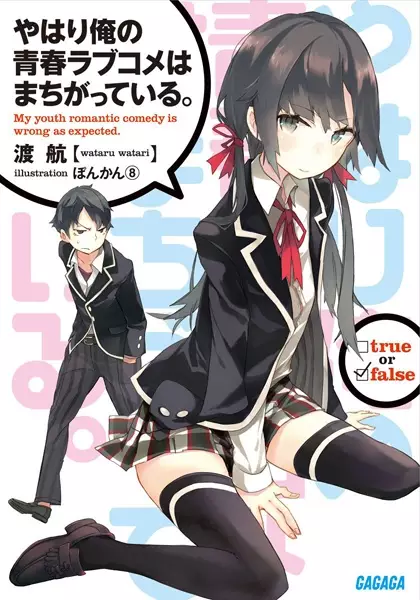
My Youth Romantic Comedy Is Wrong, As I Expected
やはり俺の青春ラブコメはまちがっている。
8.75(22K votes)
Ranked #57Popularity #231
chapters
168
volumes
18
Status
Finished
Published
Mar 18, 2011 to Apr 20, 2021
Authors:Watari, Wataru, Ponkan⑧
Comedy
Worth Reading? — Global Verdict
7.5/10
Average Review Score
64%
Recommend It
11
Reviews Worldwide
International Reviews
abystoma2
Not Recommended
5
I was promised a masterpiece. A novel full of well crafted dialogue and deep story with a social commentary. Needles to say I got none of that. The whole time while reading this I was waiting for the breaking point, the part when it gets good, the big twist or something, as I couldn't believe this is what the huge amount of people are praising. Yet here we are. Oregairu is a harem light novel. No matter how much it tries to hide that with pseudointellectual monologuing, it is still a harem LN. Of course, I'm not saying that anything harem is inherently bad (look no furtherthan Monogatari Series or Sayonara Zetsubou Sensei), but Oregairu certainly failed to make the genre interesting.
In other reviews, you can see "this isn't your typical romcom novel" being noted a lot. That's a lie. This is your typical romcom novel. The only difference there is that the protagonist is (self)described as a loner and loser. A loner and loser yet he gathers supporting characters around and 2+ girls hinting theirs interest in him (this is a romantic comedy after all). You guessed it, it's just a self-insert character at his core. A character for the unpopular folks to identify with and to fantasize how they'll get surrounded by girls too. And Hachiman is self-insert not only for the reader, but also for the author, as the author himself even mentioned that in the afterword. Everyone else is just a background character for the MC to interact with, really. Yes, even the secondary lead consisting of the two girls. And have I mentioned considerable chunk of the whole content of the novel is the MC fawning over a trap? If that is your thing, good for you, but otherwise be beware you might cringe a lot.
I suspect that the reason for mostly positive reception is that almost nobody who didn't like this from the start is going to stick around to actually finish it. And it is the right decision, there is no improvement or reward for forcing yourself through the novel even though you do not like it. The only reason I haven't dropped this is because of my personal no drop policy, and even then I was tempted to just drop this numerous times. It's not outright awful, but it is boring most of the time.
The social commentary, the beloved philosophical and psychological aspect of this franchise. It just turns out to be a shallow "people are bad and people in a group are even more bad" rambling. The philosophical level of Oregairu is unironically on par with "We live in a society" memes. It brings nothing new to a table for your understanding of society if you made it through a highschool. As mentioned above, all of this really feels just as an excuse for the reader themselves to feel cool - "Those normies don't even understand how cruel society is", "I'm actually totally smart and capable, I just hide it because I'm a lone wolf", "Girls would totally like me if they got to know me more" etc.
As usual with light novels, unless I'm reading an official translation, I'm unsure if the writing style is a fault of the author or of the fantranslation, but I'll have to make do. The writing is bland and there are almost no descriptions, just a string of dialogue and inner monologue of the protagonist - even more than usual with light novels. Contrary to what their recommendations might try to convince you of, the style is in no way similar to Monogatari series. If anything, it's more Hyouka-tier, and that is no compliment either. Popculture references are sprinkled over the novel in attempt to make it more interesting, yet (especially in the first few volumes) the references follow the pattern of "What am I, X from Y?!" or "I see, you know about X as well". This is not a hyperbole. The beauty of references is that you get them only if you know what it references, this is just smashing them in your face. Thanksfully this reference "humor" is used less in later volumes.
The illustrations are amateurish and unimaginative. It's mostly just the characters, well, standing there. As if to complement to writing, the art style is also bland. And just a little pet peeve and again mostly in the first few novels, the boob physics are hideous and on a level of bad ecchi. Though to be fair after finishing the series I can say that the art actually improved, so at least that's something positive.
Overall, there seems to be a lot of readers enjoying this, so you might very well become one of them. Just be warned that there is a chance you might be unpleasantly surprised.
Hachiman Hikigaya, a student in Soubu High School, is a cynical loner due to his traumatic past experiences in his social life. This eventually led to him developing a set of "dead fish eyes" and a twisted personality similar to that of a petty criminal. Believing that the concept of youth is a lie made up by youngsters who face their failures in denial, he turns in an essay that criticizes this exact mentality of youths. Irritated by the submission, his homeroom teacher, Shizuka Hiratsuka, forces him to join the Volunteer Service Club—a club that assists students to solve their problems in life, hoping that helping other people would change his personality.
However, Yukino Yukinoshita, the most beautiful girl in school, is surprisingly the sole member of the club and a loner, albeit colder and smarter than Hikigaya. Their club soon expands when Yui Yuigahama joins them after being helped with her plight, and they begin to accept more requests.
With his status quo as a recluse, Hikigaya attempts to solve problems in his own way, but his methods may prove to be a double-edged sword.
[Written by MAL Rewrite]
77,127 Members
192 found helpfulSep 22, 2020
cchigu
Recommended
10
"Yeah, I'm being stupid. I know that it's out of question. I know how this will end. I'll be left with nothing. Even so, I want us to think, writhe, struggle... and find... something genuine." - Hikigaya Hachiman Oregairu is a pilgrimage destination for people who set out to quench their thirst for finding something genuine. It takes its characters, and you, the reader, on a journey to explore the themes of self-realization, inferiority complex, cynicism, and social awkwardness. The seasons have changed. Compared to my teenage-self, I have gotten better, become more open-minded, met new people, found people that I love, and have stopped hatingmyself. But one thing that has remained the same, is my love for Oregairu. Its bittersweet aftertaste still lingers. Even though, sadly, I no longer relate to Oregairu.
[Story & Writing] The story and setting of Oregairu is a simplistic high school club-themed slice-of-life, which is good, considering what it is trying to achieve. The story is just a device to dig deep into the psychology of teenagers, in order to explore its themes. Going in expecting a prioritization on romance will disappoint you, but for me, it is the least important aspect of Oregairu.
The novels are written from the main character's point of view so that the readers can see and judge the thought process behind every action he takes. Additionally, Oregairu is written in a roundabout manner, the monologues and the dialogues are all very vague and open-ended which means that the reader is free to form his/her own opinion on them. So even if you think that it is all bullshit, it doesn't mean you are wrong, it just means that Oregairu is just not for you.
That being said, Oregairu did not know where it was headed for the starting 3 volumes, and hence these volumes feel disjointed from the rest of the series. Mind you, they are still entertaining but they certainly lack the true Oregairu essence. Needless to say, they could have easily been compressed.
[Art] In the author's own words-- "The story is penned by the author of the light novels in order to create cute scenes for the illustrator to illustrate". Luckily, Oregairu had the pleasure of being illustrated by Ponkan8 (also drew Shirobako's character designs). Their art kept on improving with each passing volume and is certainly an eye-candy. Although, the last couple of volumes suddenly saw a huge downgrade. I still wonder what happened.
[Character] Oregairu's characters follow the basic archetypes that you will find in similar light novels, but what differentiates them is the layer upon layer of characterization the author has put with each chapter. The way the characters grow throughout the series is nothing but a sight to behold, it is subtle and yet significant enough.
Hikigaya Hachiman is my teenage-self. He is a pessimist, a hypocrite, a coward, an edgelord, cynical, anti-social, and a loner. Until high school, he tried to be a normie but failed. Now, he has completely given up and has ended up deceiving himself in believing that his current self seeks and needs no modifications. He performs actions in a way that, even though produces the outcome, ends up sacrificing himself. He is adamant about not forming new relationships and maintaining the status quo but slowly by slowly, he comes to self-realization that he is the way he is because he is afraid of getting hurt.
Yukinoshita Yukino is another loner teenager, with a lack of self-esteem because of her exceptionally talented elder sister. Even though she herself is talented, she constantly keeps on comparing herself with her sister. She keeps people at bay because of the consequences of her own talents and beauty. Throughout the series, her self-esteem gets hit more and more.
Yuigahama Yui seems to be your typical normie teenager and has developed a crush on the protagonist. The novels do an exceptional job to flesh out her characters by guiding the readers through her actual personality.
Most of the side characters in the novels are given enough screentime and a proper characterization that separates them from the original archetype they were originally based upon.
[Enjoyment] Enjoyment is highly subjective. Personally, I was engrossed enough to devour two novels in a single sitting. Sometimes, the drama can get too heavy but honestly, that is the best part. A warning-- Initial 3 or 4 volumes might give a fake impression of what Oregairu actually is.
Oregairu might not be the greatest fiction on the planet, but for me, it is more than that. Oregairu is an easy recommendation for people who want to dig deep and want something genuine.
174 found helpfulSep 20, 2020
Hypokrites
Mixed Feelings
5
Remember how popular the topic of Disney princess movies turning little girls into helpless princesses due to portraying their women as “damsels in distress” was? Yeah, that’s been the star of the show for a while. But what people fail to mention is the other side of the coin—how those same movies hardwire boys into thinking what makes a man is to risk life and limb for these very damsels, often at the expense of their own safety and well-being. A savior complex. What makes you a decent person? Not your smarts nor personality, but how much suffering you can endure without complaining. Oregairu doesn’thave castles to raid or dragons to slay, but it runs on the exact outdated script. The only difference is, instead of a prince charging into battle, you’ve got a dead-eyed high school boy doing all his “heroics” from behind the shadows, ruining his own life and image for the sake of people who wouldn’t show up to his funeral.
Hachiman Hikigaya: A Mouthpiece, Not a Character
That high schooler is Hachiman Hikigaya—self-proclaimed cynic, professional loner, and a part-time philosopher who just discovered Nietzsche last Tuesday. Good news: if you’ve spent your teen years thinking the world is garbage and everyone except you is an idiot, then Hikigaya is your kindred spirit. Sure, he does make good points, but most of the shit he spills out is either redundant topics from Philosophy 101 or some shit you’d see from a Twitter account named “Deep Nihilistic Quotes.”
Everyone likes to call this character relatable. And by everyone: pretentious teens who think they’re the most mature and philosophical person in the room. Which… yeah, to some degree I’d give them that. But that says more about the fans rather than Hikigaya himself. His worldview flips faster than a politician's during election season. One moment he swears he doesn’t care about anyone, the next he’s bending over backwards to “help” people he openly can’t stand. There isn’t a timeline of emotional and situational development—just sudden shifts of “heroism” whenever the plot needs him to save the day.
And his big heroic move? Dragging his own reputation through the mud for other people’s sake. I wouldn’t call it noble; maybe theatrical. He’s so committed to his martyrdom, Jesus would look away in shame. Problem is, this behavior isn’t realistic nor believable one bit. Hikigaya is less of a person and more an epitome of every “misunderstood genius” trope you’ve ever seen—introverted, intelligent, selfless, secretly kind—oh, and he just so happens to attract two heartthrobs without even trying. Yeah, super realistic.
Don’t get me wrong, Hikigaya is still an interesting character. But not because of the way he is written. He’s got a certain charm, he’s funny in his own self-deprecating way, and you can trace some growth over the series. But every time that “growth” surfaces, Wataru Watari takes the wheel away from his protagonist and uses him as a soapbox to deliver whatever social commentary he wants to spit out. That’s where Hikigaya’s phantom of maturity comes from—a teenager with the voice, baggage, and existential fatigue of a thirty-something salaryman. He’s compelling, sure. But not because he’s a methodically well-written character; he’s compelling because of the pseudo-intellectual soliloquies Wataru uses to lecture his audience, for better or for worse.
That’s my biggest gripe with the series. Instead of creating a chain of development that’ll allow our protagonist to see these mature themes and answers on his own, he’s already a built character who doesn’t need directions to mature. The author was so excited to rant about his disdain for the world, he just imposed the adult baggage he had onto Hikigaya instead of creating a coherent narrative. It isn’t deep or meaningful; it’s performative. Had he made the protagonist a more believable high schooler, had he made him face hurdles instead of falling to martyrdom, and had he been more patient in writing, this could have been the best coming-of-age story the light novel industry could offer. He has the skills—you can nitpick a few well-written scenes and compelling dialogues—but he was too proud a Nietzsche stan to not yap about his worldview through his protagonist.
Watari’s problem is that he’s too in love with his own work. You can practically hear the author’s voice bleeding through his characters. And while personal investment is good, there’s a fine line between sincerity and using your cast as sock puppets for your own TED Talk.
Let’s be honest, if you’re reading this review with your MyAnimeList account, veins popping out of your forehead, odds are you probably see a little bit of yourself in him. Except, you know, two pretty girls helplessly falling in love with you.
Codependency: Unresolved Conflict
Speaking of those two pretty girls, they are probably the most narratively frustrating characters in the entire series. Yui Yuigahama and Yukino Yukinoshita. Yui, to be completely frank, is nothing but convenient. Literally her only role in the story is to keep Hikigaya and Yukinoshita from falling apart. She’s not a character, but a support to keep the love triangle rolling. Oh, there’s conflict between dead-eyed boy and dead-eyed girl? Here’s Yui to save the day. The story fails to give Hikigaya and Yukinoshita independent growth both as individual characters and as love interests.
Codependency this; codependency that. Wataru Watari highlighted that the main conflict of the story is the characters’ inability to sustain their relationships without a club to glue them together, yet there was no resolution to the story and the outcome came out entirely forced. Thank you, Yui (They did you dirty).
As for Yukino Yukinoshita, the main heroine. She’s basically Hikigaya in a wig: same social isolation, same stubborn worldview, and same “I’m better than you because I read books” vibe. Much like how the story positions Hikigaya as someone grounded in his beliefs until he needs to save the day, Yukinoshita is portrayed as an unshakable ice-cold princess, until the story needs her to shake. She does receive the most development in the series, but like I previously said, it’s forced and unnatural; only with the help of her co-heroine could she have become the person she ended up as.
Despite the amount of screentime Yui received, the story could have just been Hikigaya and Yukinoshita. No other characters mattered. All this talk about our main cast outgrowing codependency, the author didn’t figure out that every other character’s relevance is codependent on their ability to make Yukinoshita and Hikigaya get together.
Codependency to Convenient Storytelling
And then there’s the Service Club—a pretty neat concept: basically a grievance system that helps out students’ personal requests. It was a breath of fresh air: a club that actually does something, helping people with their problems instead of just reading books, eating snacks, or just using the club room as a venue for character interactions. However, somewhere down the line, it mutates into this bureaucratic nightmare of student council meetings, vague planning, and logistical filler that lasts entire chapters to fill Wataru’s page quota or something. Early requests were simple and reasonable; however, further into the story the Service Club was basically invading other people’s privacy. Helping with confessions? Snooping into career plans they explicitly told you to stay out of? That’s not wholesome club activities; that’s meddling with other people’s business. Stalking with extra steps. What for? Obviously, doing wholesome requests will run stale, and the author obviously needed to raise the stakes of the story, but this development is just unreasonable and irrational. Which is ironic because Hikigaya was supposed to be this hyper-rational guy, yet he jumps on these requests like a hungry dog on table scraps.
Which brings us to the issue: convenience. This story runs on convenience like it is diesel fuel. Dialogue bends over backwards to force misunderstandings. Conflicts appear out of nowhere, like the infamous fake confession scene. And while convenience in storytelling is unavoidable, Oregairu builds entire arcs out of it, only for them to matter in the moment and vanish without touching the bigger picture.
To even make the protagonist seem like a good person, Wataru’s writing depended on stepping down on a decent character to make Hikigaya look good. Hayama wasn’t necessarily a decently written character, but someone with a good heart. However, he was evidently written to be Hikigaya’s rival—someone with opposing views and methods to his, but also as competition in whatever category Wataru wants them to compete in. This brings us back to Hikigaya not developing as a person because he’s already a built character from scratch. So to make him somewhat interesting, he pitted these two characters against each other to create more tension, making it seem like he’s outgrowing someone even though he’s just bringing Hayama down if you look at it from a wider perspective.
Final Thoughts
I don’t believe Oregairu, to the core, is a garbage story, though the way I’ve trashed every aspect of the light novel may make it seem like it. It had potential, and at times it actually delivered decent storytelling I was compelled by. So sure, I’d recommend Oregairu. It’s the romcom equivalent of a toxic relationship—frustrating, full of bad communication, but you can’t just break up with it because it has enough charm to reel you back in (I will not elaborate on why I know how that feels). Although I would recommend watching the anime instead due to the amount of unnecessary dialogue and logistical fillers that would put even caffeine to sleep. So if you like the same old harem setups with extra cynicism and a little bit of existential dread—or if you’re just an edgy teenager—you’ll have the time of your life. Just don’t expect it to be a flawless, soul-piercing masterpiece fans make it out to be.
116 found helpfulDec 7, 2020
cent1ent
Recommended
10
We all yearn for something genuine - relationships, emotions, feelings - but while doing so, we end up creating fakes. The question that remains is - where is the line separating the genuine from the fake, and who gets to draw it? Before going any further lemme say this - Oregairu is one of the most emotionally complex, deep, realistic, and thematically well-written story I've ever read. On the surface, it seems to be a clichéd love-triangle (or even harem) romantic comedy, a stereotype further amplified due to the anime unfairly selling it as a harem-styled story, with skewed focuses on the characters. I expected nothing special whenI started watching it, but I found something completely different and wonderful. Neither romance nor comedy is the prime focus here. The story is very deep and well-structured, and deals with themes that I haven't seen explored in any of the anime I've seen or manga / light novel I've read.
Story:
A simple and generic sounding plot it is, but it eventually grows much deeper and more complex. The progression and development of the story is steady and well-paced, things don't feel rushed or drawn out at any point. It has its fair share of anime and weeb-culture tropes, but those are now a part of the aniverse, and do not, in any way, jeopardize the quality of the story.
The most prominent theme here is fake vs genuine, the conflict the characters face when they seek something genuine in their relationships whose foundations themselves are fakes.
Further, questions arise as to what is it that you can call genuine, and what can be branded as fake? who gets to decide what emotions, feelings, ad relationships are fake? This theme is prevalent throughout the story, not only for the main trio's, but for many side-characters' situations as well. The ending (light novel) properly wraps up everything, and is a great thematic conclusion to the story.
Characters:
The characters are the highlight of this show, because they have many layers to them, and are very well written. The character motivations, thoughts, and developments are very well written - sometimes subtle, sometimes drastic, but always beautiful. These developments are in sync with the core theme of the story, which makes them much more endearing to watch.
Popular opinion out there is that this is the one of the most emotionally complex story in the aniverse, something I agree with, compared to others that I've read / watched. What the characters say, what they are thinking, what their motivations are, nothing is presented easily for the viewer to just accept, one has to to put effort into thinking about stuff to understand, comprehend, and appreciate it all.
There are many interpretations that can be drawn of some scenes and conversations, and there is plenty room for misinterpreting stuff, which I've seen many people do. There are also people who didn't understand the depth of this story, which is a possible reason for the relatively low score of the (insufficiently adapted) anime has on MAL, while the light novel is ranked at #15.
Overall, Oregairu has possibly the deepest, most intricate, and beautiful story out of all the anime I've watched or manga / light novels I've read. When reading this, keep in mind not to rush, and not to jump to conclusions. The story and characters have many layers to them, try to think about and understand them. It is a great experience, a very thematically intricate and wonderful story, one with pretty valuable life-lessons and an emotional impact that won't be fading away anytime soon.
35 found helpfulNov 1, 2020
SgtBateMan
Not RecommendedFunny
5
>You're asking me will my love grow. I don't know, I don't know. You stick around now, it may show. I don't know, I don't know... I'd tried to find something similar to this work, from the musical lyrics to the peers Haruhi Suzumiya and Koten-bu Series, but nothing truly fitted the frame. Then I remembered I had watched How I Met Your Mother, and even though its ending was justifiable, the audiences' reception would change after that amount of time spent with the series. Still different is the case of Yahari Ore no Seishun Love Come wa Machigatteiru. __Characters__ Let's be frank. Oregairu is character-driven, so talking aboutthem will automatically do the work here. Warning: What following has the potential of upsetting the fanbase, so be ready.
__Yukino Yukinoshita__ is the front of the work. Any discussions of the work will eventually lead to her. Despite the attention she received, the character is the biggest failure. She had wished to change, yet Yukinoshita was the one showing the least effort, if ever existed. If she had genuinely wanted to do so, here could be some suggestions. I think Yukinoshita the Elder already spoke of something similar to 'codependency', and what should have been her answer is 'Why don't you sit back and enjoy the flow, Nee-san? I will prove this codependency of yours, and just wait for his dance in my palm.' That's how to shut Haruno Yukinoshita up. She had had a tongue, a very sharp one, but why did she need to behave like a cat eventually? Against the mother, well, let her be the plan maker instead of Hikigaya, suck him dry and recharge him with the word 'I love you', because it was already the end and why there was still no sign of Yukinoshita's Revolution, let alone the opportunity of freeing herself from the shackles of Hikigaya's solo performance so far at the gist 8th volume, which would have built up the much better momentum towards the end? If those things had been done, other ships would have been effortlessly sunken. However, I don't hold any particular hatred towards the character. Her state is what the author wanted to preserve, and her annoying constancy spoke the unshakable will of his. So congratulation on him getting the waifu. Yuki is always a good example of overcoming dependent tendency, and it is my pleasure to say the full name, Yuki Souma.
__Hachiman Hikigaya__ is the protagonist of this novel. Past experiences had left such bitter taste that he considered kindness was the cruelest thing. It got him resolving the least imaginable logic, which consequently made him self-explode many times during the journey. However, what he sought for was something genuine, and if it weren't to prove after bending, twisting, shashing, then there shouldn't any belief laid in it at all. If the character had always been himself, then it would be fine, but actually, it wasn't. He had desired for something genuine, yet proceeded kicking the balls to others and remained passive for the entire Yukino Yukinoshita's True End (Shin involved). Investigating further, there was no Hachiman Hikigaya in the first place. IT HAD BEEN THE AUTHOR ALL THE TIME. WAKE UP, JAPAN. ~~Wataru Watari~~He never considered getting out of his cocoon, so the character is so bloody relatable and realistic. Also, if you dream, dream of winning, being a proper individual. Don't be a loser just to get the girl, but in such case, it would no longer be the good old insertable Hachiman Hikigaya, wouldn't it?
So far only boring characters? There are also the interesting:
__Yui Yuigahama__ was seemingly a character academically disadvantageous, big boobs, TOTALLY UNATTRACTIVE... but when it came to common sense, she was such a clever person. She knew and understood everything, so most of the time she was playing the role of an observer. However, when Yuigahama was on stage, she shone brilliantly. The character possessed things the other clubmates didn't, so in the darkest hours, she was the one keep everything binding together. She was always the first one taking a step forward, leading the story out of the stagnancy with her 'I want everything', which is my greatest impression of the work, from the portrayal of the surrounding to every expression of the characters. Eventually, her influence surpassed that of the narrator, and I used to think of which season would be remembered every time taking a whiff of that smell, tea or fruit tart, because I firmly believed the bakery product would be much better to become a straight-forward person, or gain weight.
The supporting characters were also prominent. __Shizuka Hiratsuka__ deserves the title of a (lonely) mentor. __Haruno Yukinoshita__, as well as her childhood friend __Hayato Hayama__, were loners full of conflicts and regrets. __Iroha Isshiki__ also found herself solitary. The author had gathered many kinds of lonely souls in his work, and the way they struggled finding a solution was so human, but certainly it is not that realistic. On the other hand, __Saika Totsuka__ had initially appeared forgettable, but turned out he was the first to graduate within the series. After the revaluation, I believe these characters, along with Yui Yuigahama, were the motivation for me to pursue the end. Nevertheless, there is still this unshakable sensation that many of them were the devices buying time whilst Wataru Watari making the decision that should have been thrown out 5 volumes earlier.
__Something other than the characters__
References are just fillers. I never paid any mind to them, not to mention they mostly missed.
The illustration really grew with the course of actions, even though the quality was inconsistent at times.
__Conclusion:__ Honestly, I've never been onto the Shi* War, as all necessity would be for the characters to grow naturally. Nevertheless, Yukino Yukinoshita's True End offered no such thing. It had been fun, until it no longer was.
>Away, I'd rather sail away, like a swan that's here and gone.
A man gets tied up to the ground, he gives the world its saddest sound, its saddest sound.
Certainly, reality wasn't that kind regarding to what had happened so far.