
Links go to search results. Availability varies by region.
秒速5センチメートル
3
1
Finished
Nov 16, 2007
9.7/10
Average Review Score
100%
Recommend It
3
Reviews Worldwide
"...they say that it's 5 centimeters per second." "What is?" "The speed at which cherry blossoms fall. It's 5 centimeters per second." (This is a review of the novel that also makes comparisons to the film and manga versions. Think of it as my feelings for all 3 versions.) I began reading the novelized version of "5 Centimeters per Second" in order to have a different experience of one of my most loved stories in anime. Having already watched the film numerous times and reading the manga once, I already had a rough expectation of what to feel while reading this story. This expectation, however, prepared me littlein what I ultimately felt while I read, invoking something much sadder, and much more genuine. All versions of "5 Centimeters per Second" follow the same basic pattern divided into 3 distinct sections, detailing the life of the protagonist, Takaki Tohno. They are: "Cherry Blossoms," "Cosmonaut," and "5 Centimeters per Second." The novel however, has an extra story, called "The Sky Outside the Window." Something interesting I learned about the creation during this reading of "5 Centimeters per Second" was that Makoto Shinkai had roughly 10 stories he had written for his fledgling work, before ultimately picking 3 stories to represent the film version (which is the original version, the manga and novel came later.) Briefly, "The Sky Outside the Window" is a very short story of a girl named Miyuki Ogawa, who is staying at home from school due to the blowing typhoon. Like many of the characters in this work, she is unsure of what she wants to do with herself. She has a novel started but is not entirely sure what she is going to do with this novel. After being inspired by the sight of the dazzling world during the eye of the typhoon, she begins to be a little more hopeful in leaving a little trace of herself in history. Interestingly, I remember watching a video of Shinkai talking about his early career, how he spent many hours creating "Voices of a Distant Star," and how he wanted to leave a little something for people to remember him by. Whether this is a coincidence or not is entirely up to interpretation. Watching the film and reading the story is an entirely different experience. What the film could describe using its stunning visuals, the novelized version had to rely on words and the imagination to produce a similar effect. I feel, that by both watching the film and reading the story, viewers can certainly understand the story, but in very different ways. To see the beauty firsthand and using words to imagine it are ways that enhance the appreciation of this work. The overarching theme of this work is that distance creates conflict. Physical distances and emotional distances, whatever kind of distance that puts us at odds with others is a central focus of this work. For Tohno, he is physically separated from his first love, Akari Shinohara, and in the later stages of his life, he is emotionally separated from the many people he comes into contact to. How people deal with this distance is of profound importance in this work. For Tohno, time does not appear to have moved at all after his final night with Akari. For Kanae Sumida, she tries to hide her feelings behind surfing and her unrequited love for Tohno. And finally, for Akari, she seems to have simply moved on. When faced with this decision in life, the choice to move on or stay in the past will have great significance and lasting effects. The novel invoked the feelings and mood of Tohno's life very interestingly, by making the prose less...beautiful as the novel progresses. His childhood is written in the perspective of him as an adult, after the events had happened, and perhaps a little after the ending of the novel. His childhood is written with many beautiful images of cherry blossoms and the pseudo-philosophical monologues about his life, his love for Akari, and the overwhelming sense of happiness and loneliness he feels when he is together with her. His high school years, written in the perspective of his classmate, Kanae, is also characterized by his seeming lack of attachment to nothing. He is certainly kind, but it is in a more distant and nonchalant way than what most people would be comfortable with. The biggest changes, however, takes place during the final stages of the novel, the appropriately named "5 Centimeters per Second." Here is where the film, manga, and novel diverge greatly. Up until this point, all versions told basically the same story in varying degrees of detail. The manga, for example, adds extra scenes and fleshes out some of the characters, even including an extended epilogue after the original ending of the film. The novel does not include this scene, however. It ends in the same place as the film. What the novel does better than both the film and manga is detailing the final stage of the 3 stories that make up this work. In the novel's final section, we learn a great deal of Tohno's life after high school. While this section of the story is the shortest in the film, it is the longest in the novel. Many new details surface about him, including his university days, various relationships, and job careers. The most important revelation, I believe, is that Tohno works for a mobile phone software company, ironically enough. The novel details his initial excitement with work and his droning life as a programmer. Tohno feels that programming is almost mythical, in that he can control a program that can hold all the secrets in the world. Secrets that he wishes he could tell and things that he wish he could hear again. Also in greater detail in the novel is his different relationships with women, all, surprisingly, ending in separation of the two. Risa Mizuno, who is only briefly mentioned in the film and a little more so in the manga, plays a much more important role in the novel. We can understand much more about her, her being one of the few people Tohno can say he cares about. Finally, between all 3 versions, this is the most clear in what he wants to do with himself after he sees something he links to a miracle. I felt sad all throughout, but something about the simplicity and genuineness of his final words made me feel a little more hopeful about the story. In the film, it ends with a bittersweet collage set to "One More Time, One More Chance," and reading the final few words left an impression on me much like that song did when I first saw this movie quite a while ago. I feel that the ending can mean a lot to different kinds of people. It all depends on what we have been though up until that point. Whether or not we choose to stay, look back, or simply move on can say a lot about our experiences and opinions of others. "5 Centimeters per Second" gives one such interpretation through the eyes of Tohno, someone who is still living 15 years in the past. This story has become one of my most beloved stories ever told. I greatly enjoyed reading the novel thoroughly and picking up all the new details that I learned through reading a novelized version of the story. Whether reading it or watching it, I feel the magic and bittersweet feelings of the story can reach out to audiences. It will mean something different to all kinds of people, and that is why I think this story is so brilliantly crafted. It leaves an impression, a kind of imprint on audiences, to remind them of how distance is so ever prevalent, how memories are ever so painful and joyful, and how things will change with time. However, even after all that, "I'm sure you'll be alright!"
Novel adaptation of Makoto Shinkai's Byousoku 5 Centimeter anime. A tale of two people, Toono Takaki and Shinohara Akari, who were close friends but gradually grow farther and farther apart as time moves on. They become separated because of their families yet continue to exchange contact in the form of letters. Yet as time continues to trudge on, their contact with one another begins to cease. Years pass and the rift between them grows ever larger. However, Takaki remembers the times they have shared together, but as life continues to unfold for him, he wonders if he would be given the chance to meet Akari again as the tale embarks on Takaki's realization of the world and people around him.
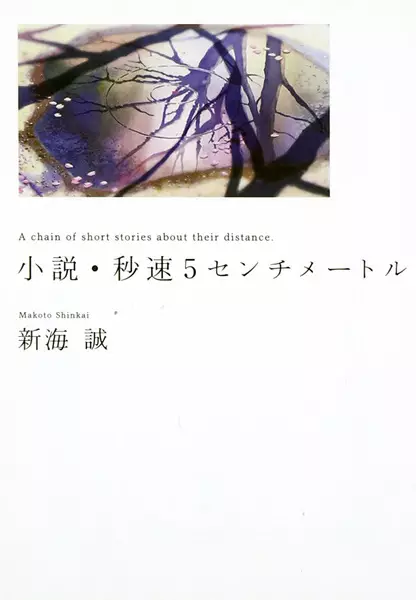
‘5 Centimeters Per Second’, a romance where if you’re looking for the stereotypical happy ending, you will not find… Okay, so one thing that’s nice about this novel is the fact that it starts off with a beautifully written, short story before diving into the 3 main arcs. Think of it as an ‘Extra Feature’. This story is about a girl who wishes to leave a trace of her existence in this world so that she may never truly disappear once she is gone. It’s short and sincere, a nice add on. -The 1st arc of the story seized my attention immediately as I foundmyself drawn into the environment with the intense amount of detail that the author placed into the story. That, and the way the story was being told, from the main characters perspective 17 years later while reflecting on his past. You can see in detail how the story builds his suspense during certain parts, and at the same time, your own. This chapter is filled with a bitter sweet sense of belonging, as well as an empty void of the world which you are placed in. -The 2nd arc of the story was my absolute favorite. It is soo incredibly rare to find a story that is told from a secondary characters perspective about the main character; in addition to that, it being told realistically by a girl that is painfully in love with him. She has these simple, little meek goals she sets for herself and she brings out feelings all the way from Abysmal Lows to Heavenly Highs in a way the reader can understand them. What is also executed nicely is how the story shows you how and kinda why she feels the way she does. She has such a cute personality the way she is both in, and outside of dialog with her friends, family, or even by herself. -The 3rd arc of the story returns back to being primarily about the main character, secondly about the girl that is talked about in the 1st part of the story, and thirdly about the girl in the 2nd part of the story as well as others. This I want to say was my least favorite, however, it was by no means ‘bad’. I still enjoyed it very thoroughly. This part grows closer and closer to the current day which the main character lives and when he was telling the 1st arc. So this is basically what happened in the long stretch of time beginning with the events after he graduates high school to now. His personal career, love life, depressing moments, and his past struggles are all told in detail here. In conclusion: I loved this story! I can relate to 2 of the characters with certain things, the novel was beautifully written from beginning to end, and it can leave an emotional impact on the reader. If anyone reading this hasn’t watched the Movie or read the Manga, then I have to say that the Novel is the best way to start this story. Reading this will lead you to a significantly greater understanding of the other 2 versions, I promise that.
Today is the 21st day of the 21st week of the 21st year of the 21st century. So, when I watched the animated version, I was not too fond of the story. I have always felt that something is missing, or maybe the animated version didn't tug my heart. So today, 21st May 2021, around 5.00 am, I have decided to read the Light Novel version. Believe me; I wasn't disappointed at all. Somehow I felt like this story is closed to reality indeed at some point in our life when we used to go to school. Many of us promised to marry the boy/girl weliked then. But, sadly, with time, many incidents happened, and we somehow didn't end up with the loved ones from our childhood. Chapter 1 was written by the author so well that I could read that chapter, again and again, countless times. It feels like it brings back our childhood memories with no regrets, no tension, etc. Chapter 2, In the animated version, I failed to understand Sumida Kanae, but after reading the LN version, I felt like she should've been the one to end up with Toono Takaki. Chapter 3 was confusing in the animated version but well written in the LN version. I hope that both Toono and Mizuno had a good time with each other the time they spent together. Not saying this novel is 100% closed to reality, but still, if we have something to learn from this novel, we should learn to accept the fact of our life. Just because one is an adult doesn't mean that s/he doesn't have any regrets in life, any complaints in life. Try to understand them; maybe they are dying like Toono from inside; who knows? I wonder where did Toono end up after the story? I hope that he moved on like Akari. The worst possible thing is that he committed suicide. According to Wikipedia, "Seventy percent of suicides in Japan are male and it is the leading cause of death in men aged 20–44". If the author has written it based on Japanese men's, then it's likely to happen something like that. Finally, I enjoyed reading it. One of the best LN for me, I must say.