Links go to search results. Availability varies by region.
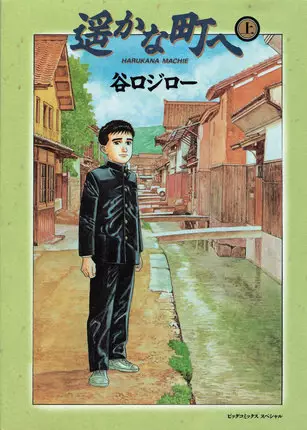
遥かな町へ
16
2
Finished
Apr 10, 1998 to Nov 25, 1998
8.3/10
Average Review Score
100%
Recommend It
12
Reviews Worldwide
If you were given a second chance, if you could live your life over, how would you live it? What would you do differently? Could you (and should you) change the flow of events that had transpired? Fiction has always been fond of time travel. There have been numerous, some more, some less successful, attempts at exploring this concept. It is a potent theme that has tickled the imagination of many and to which many writers turn to. One of those writers is the author of Harukana Machi-E. One may rightfully ask whether Harukana Machi-E can make something noteworthy with a tried and tired concept like this.The answer is, fortunately, a resounding yes. Actually, I lied there a bit. Harukana is not really about time travel. Don’t let the synopsis fool you, that is not a theme this manga sets to examine. Rather, time travel is a plot device, a means of setting the story in motion and putting the protagonist at a desired time frame. Coming from the pen of an award-winning mangaka, Taniguchi Jiro, Harukana Machi-E (translated as “A Distant Neighborhood“ in English) brings us a personal story of a middle-aged man, Hiroshi, who, during a visit to his mother’s grave, suddenly gets transported into the past, back to his middle-school days. With his adult consciousness, memories and abilities retained, Hiroshi finds himself in the body of his 14-year old self, 35 years into the past, at a period of a single crucial event that would have a profound influence on his later life. There he begins a journey of reliving and rediscovering his past, people and events. It is also there that, after realizing not everything is unfolding exactly as he remembers, Higuchi faces his big dilemma – should he try and change the past? And if the answer is yes, how could that influence the future? Despite such a fantastical premise, Harukana Machi-E is very much down-to-earth. There are no crazy time traveling hijinks, no world-changing events, no super powers, no shounen heroes nor villains. Instead, what Harukana provides its audience with is a bittersweet, rather intimate and relatable story of a single person and his family that reads more like a literary work than a standard manga. The plot is unlikely to keep anyone on the edge of their chair, nervously biting their nails in anticipation since it never tries to be neither bombastic nor groundbreaking. Rather, the story unfolds in a leisurely manner, never using the sense of urgency to force the reader to flip the next page. It gives the reader time to slowly savour the artwork, characters and their interactions, muse on the questions raised by the protagonist’s narration, and, bit by bit, gets sucked into the world of the protagonist’s small Japanese town and its residents. In a manga like this plot would mean little without well-developed characters. And it is obvious that the author paid special attention to them. From the protagonist to his schoolmates, family and townspeople, Harukana Machi-E’s cast consists of realistic and relatable characters. There is no trace of artificiality; they truly come off as real people you meet every day. As a result, their feelings, interactions and reactions appear natural and believable. Naturally, the focus is on Hiroshi’s character, but others, especially a couple of his classmates and family members receive a fair share of fleshing out as well. That is an impressive feat to accomplish in only 16 chapters and speaks volumes of the mangaka’s skill. Looking at the premise, Hiroshi could’ve easily been an annoying, self-pitying protagonist that exasperates the audience. Thankfully, that doesn’t happen. Although often depressed, troubled and selfish, his character never crosses the fine line between being realistic and being obnoxious. Truth be told, the manga does approach the maudlin territory at a couple of occasions, especially when it tries to convey the protagonist's feelings about his mother. However, the author manages to successfully steer away from delving into unpleasant melodrama that would irritate the reader. Whether intentional or not, Hiroshi’s father, Yoshio, is the one character that the reader may find too distant and hard to understand. His actions, especially towards the end, come off as somewhat unsympathetic and odd. However, he is most likely deliberately portrayed as distant and incomprehensible in order to reflect how the protagonist sees him since the story is, after all, narrated from Hiroshi’s point of view. This becomes even clearer as the story unfolds and we realize that Yoshio plays the role of a foil to Hiroshi, enabling the author to easily contrast the two characters and their life choices. During the process of weaving Hiroshi's tale, the mangaka doesn't fall into the common pitfall of making the supporting cast too dependent on the protagonist. Instead, while playing their respective roles, most characters in the manga feel as if they have lives of their own, lives that flow with, not because of the main character. The protagonist is at the centre of the story, but is in no way at the centre of its world. Apart from characters, Harukana Machi-E excels in the art department. Even at first glance, it is apparent that Harukana does not look like the majority of the manga fare. Taniguchi’s art is highly accomplished, crisp and clean. Again, just like it is the case with characters, realism is what makes Harukana’s art work. Taniguchi’s attention to detail in depicting background, whether scenery or urban structures, is impressive and, coupled with careful, movie-like framing, gives the manga near-photographic artwork. Thus, the author succeeds at bringing to life Hiroshi’s small home town of Kurayoshi and, in a way, invites the reader to embark on the journey into the past. Similarly, the character designs follow the principle of realism as well, while also retaining a very small, but necessary dose of “cartoonism”. Worth mentioning is a certain Ghibli-esque quality to the author’s ability to effortlessly express a wide range of emotions on characters’ faces and this is quite a delight to look at. Harukana Machi-E examines and explores a variety of themes and issues. The most apparent ones, which even become a sort of a leitmotif, are the themes of regret and loss. They permeate the manga, creating a sweetly melancholic atmosphere. In addition to those, this short manga finds time and space to tackle other, mostly related themes such as grief, frustration, remembrance, acceptance and appreciation. Never trying to be preachy or coming off as pretentious, Harukana naturally, through its characters and their actions, speaks to the reader about the importance of coming to terms with oneself, learning to appreciate and value what one has and accepting the inexorable fleetingness of life. As perfect as everything said up to now may seem, Harukana, of course, is not impeccable. Although expected and understandable, the rather abrupt ending and resolution may feel anticlimactic and will probably leave some readers with a slight feeling of dissatisfaction. The lack of any explanation regarding the time travel aspect may have a similar effect. However, Harukana never was a story about time traveling, so one can’t really hold this against it. Its length can be regarded as both a flaw and a strength. Being only two volumes long, it may be argued that Harukana's shortness doesn't allow the manga to fully spread its wings. However, at the same time, it means that the story never loses steam and no scene feels superfluous. “Short but meaningful“ may very well be the rule Taniguchi chose to follow with Harukana. Personal and down-to-earth in its presentation, distinctively Japanese in execution, yet universal and timeless in themes it explores, Harukana Machi-E is a highly recommended read, especially if you are in search for a mature slice of life drama with believable, relatable characters that is very likely to make you think and reflect on life. Or if you're simply tired and want a breath of fresh air. In that case, I cannot recommend this short manga enough. Oh, yeah, one more thing… Once you’ve read the manga, I suggest you keep it (unless you’ve borrowed it from a library, in which case you better not). You will probably want to revisit it several years (or decades) down the line when your own childhood and past starts feeling like a part of a distant neighborhood.
Fourty-eight-year-old salaryman Hiroshi Nakahara accidentally takes the wrong train to Tokyo after a business trip in Kyoto. He decides to accept his situation and sit back when he learns that the train is headed toward his hometown in Kurayoshi. As he walks the streets of his childhood neighborhood, Hiroshi realizes how significantly the place has changed in the 20 years since his mother died. While visiting her grave in the Genzen Temple, he is transported back into the body of his 14-year-old self. Retaining the memories and wisdom of his middle-aged mind, he is now an eighth grader in junior high school. Hiroshi's regained youth enables him to escape the reality of being an adult man with a wife and two daughters. Unaware how to return to his original time, he begins to relive his adolescence. During his time travel, Hiroshi attempts to uncover the reasons for his father's abandonment of the family in hopes of understanding him and his actions. [Written by MAL Rewrite]
For most of the people on this site, there are probably things in life we all regret. Things we wish we could have done differently if given a second chance. Even as a much younger reader than what the manga was probably targeted at, I can sympathize with the idea of doing things I’ve done in the past differently. Harukana Machi-E (hereby referred to in its English title A Distant Neighborhood) is a story that addresses this deplorable feeling felt by many people around the world, taking an 48 year old man back into a pivotal moment of his youth. The main character of the storyis Hiroshi, who upon the opening of the story comes off as a slightly bitter old man, suffering from a hangover, who suddenly finds himself taking the wrong train and visiting his old home town. Upon visiting his mother’s grave he faints, and wakes up to find himself stuck inside his 14 year old body, reliving his youth. However, he still has his 48 year old mind, and he finds himself remembering lots of things of his past. He comes into contact with old friends who would later meet their death, that would move away, and dreamers who would end up forgetting their dreams and living an average life. This memory adds a beautiful sense of melancholy to the story, and creates for interesting character interaction and development. However, the real story comes into play when Hiroshi release that not everything is happening according to his memory. Thanks to his 48 year old knowledge, he finds himself excelling academically, and really just enjoying the simple things of life; this change in personality does not go unnoticed by his peers. After discovering this Hiroshi takes it upon himself to pave the road to a different future, much different than the life he initially lived where his family was broken apart and suffering. This is the true beauty of the story, it is a story of change, regret, youth, family, and the simple beauties of life. That’s not to say the story doesn’t have his flaws. A lot of times Hiroshi just seems to forget that he has a wife and kids in his real life as a 48 year old, he does briefly think about them a couple of times before the end of the story, but the moments are so brief and uncommon that you really begin to wonder if he cares that much about his real family. While that is a major flow, it doesn’t hinder any of the emotional impact later in the story, and the overall story still flows extremely well and is beautifully written. Despite only being two volumes, each character in the story feels nicely developed. Whether it be the members of his family or several of the his classmates in school, most of them have time to tell their own stories, and each of them play their part nicely. Hiroshi is, of course, the most interesting of the characters. The mix between a 14 year old body and 48 year old mind gives him an interesting, reflective train of thought, and none of the dialogue comes off as unnatural despite the odd mix. The art is well drawn and has good detail, none of the characters look incredibly handsome, there are no cheaply drawn comedic moments, no mysterious flower blooming in the background-in short it should appeal to the audience it was targeted at. I can’t really recommend this enough, all the characters are realistic, likeable, and well developed, the story is outstanding and should gain some sympathy among the readers, and most importantly it’s just a fascinating read that contains all the elements needed for a good story. It’s a shame the story isn’t well known, A Distant Neighborhood is a simple yet engaging read that has all the elements to appeal to a large audience, I recommend this to any fan of emotional, well developed stories, but it really should appeal to anyone who finds the story idea to be good. Truly a hidden gem of manga.
This was a very interesting read. It was a story full of heart and heartbreak and realizing who you are. The story is, in a nutshell, about time travel. I wasn't very attracted to the idea at first, but I'm glad that I chose to read this. The story is carried out in a very literaturical (I don't even think this is a word, but whatever) fashion with Hiroshi narrating through the whole thing. After reading the first few chapters you start seeing the beauty of the story. The art was very different than what I am used to seeing, but very good. The character's emotions reallycame through in the art and was able to perfectly set the scene in every panel. The character designs were very well done and varied, giving each character a specific look which gave it a higher sense of immersion. The characters are another part of this story that makes it so incredible. The main character is a very sad, depressing character throughout, but he doesn't annoy the reader with self pity. He manages to feel real by being selfish and selfless at the same time. And at the end Hiroshi realizes what he had and learns to love what he has. The mangaka did an incredible job of fleshing out all the important characters and forming their relationships with Hiroshi. You can REALLY identify with them and they don't feel like manga characters, but real people. The mangaka did a very good job in creating "real" characters. This is really a hidden gem. It's too bad that it isn't more well known because it is really an incredible read. It teaches a very powerful lesson of learning to deal with pain and acceptence and learning love what you have. This manga is a MUST READ and I strongly urge you to not pass it by.
I had to wait a few days after finishing Harukana Machi-E before I wrote this review. I just couldn't believe how much I liked this manga. If I had reviewed this manga immediately after I finished it I would have done nothing but rain 10s down upon it. Now that it's sunk in, nothing has changed. STORY: 10/10 What would you do if you were a 48-year-old man who was visiting your mothers grave. You closed your eyes to pray, and when you opened them you were 14 year old again? But you arn't the only one to suddenly lose 34 years. The world does too. You'vesomehow gone back in time, but you have the conscience of a grown man. What would you do? Would you date the prettiest girl in school? Would you try and stop your father from leaving? What else would you do differently? These are the same questions Hiroshi asks himself as he begins to understand his situation. The story, without a doubt, is beautiful. It is only two volumes long, but thats all it needs. The story isn't weighed down by countless arcs and dozens of useless characters. It is perfect from the mundane first word to the shocking last. ART: 10/10 The characters have noses and eyes proportional to their face. It's not your typical "everyone is bishonen" artwork. The backgrounds are extremely detailed to the point of being photographic. It's almost like you can feel the water dripping down his face as he stands in the rain and smell the salt when he stands at the beach watching the waves crash into the shore. The art truely grants the story life. CHARACTER: 10/10 Since Harukana Machi-E is two volumes long there arn't many characters. And each one adds something to the story. Weather it's the loving father who mysteriously left Hiroshi's family the first time around without giving a reason. Or Hiroshi's shy friend who wants to someday become a writer. Or Hiroshi, who is so caught up with being 14 again, he almost doesn't want to go back. They're all perfectly crafted to be as realistic and as enjoyable to watch as possible. ENJOYMENT: 10/10 I couldn't wait to find out what happened next. Would the prettiest girl in school fall in love with him? Could he somehow get his father to stay this time around? Is he ever going to return to the future? This manga is incrediblely hard to put down and it keeps you wanting more after every chapter. OVERALL: 10/10 Pursue your dreams and love your family. A beautiful message for a perfect manga. I advise everyone, manga fans or not, to read this manga. You'll be glad you did. This manga deserves nothing less than a perfect 10.
Taniguchi often reads like some of the old impressionistic writers. Form, time, direction all seem to have their own shape; they breathe on their own accord. The world then is distilled down to sensory syllogisms, where truth and fiction really are just extensions of one another. Consequently, all that seems to matter is the continuity of perception and the exaltation of sense, transforming into ephemeral experiences embedded in some forgotten psychology. These are never presented as factual, but as fleeting moments offering glimpses into all that was lost. These stories are appendages of the self: ones that serve to internalize the world and externalize theindividual - ones solely predicated on perspective. What is seen, what is felt, and what “is” are all units crafted by an ever-changing reality, shifting not only in a temporal space but within the abstract confines of the mind. Perception is powerful. Nothing encompasses the aforesaid more than Taniguchi’s acclaimed manga "Haruka na Machi e", or otherwise known as "A Distant Neighborhood." It’s a work that seems to override traditional form and structure while challenging linearity and time to bring forth a compelling narrative with stunning artwork. Before discussing the actual story, Taniguchi’s art in this manga must be mentioned. As striking and thought-provoking as the story is, the art is sublime. Taniguchi draws with a sense of realism and nostalgia – a style that suits this story almost perfectly. His stories often feel like meditations or Zen-like introspections of the mind exercising itself onto the world. The moments in between that are being grasped, coalesced, and digested by the senses and cognition are expressed poetically and with the utmost clarity. Expressions, space, distance, textures, gradients, forefront, backgrounds are crafted with an unreal degree of precision and artistry. The narrative is thoroughly rooted in the art and its often through the art and imagery that much of the progression takes place. Additionally, the story is equally compelling. The premise starts off deceptively simple: a 40-something everyday salaryman (Hiroshi Nakahara) takes the wrong train. He notices the scenery changing into something unknowingly nostalgic. Eventually, he ends up at his childhood town. Things have changed. He too has changed. The streets he once knew are unrecognizable. His old home and parent’s shop have also disappeared. Unsettled, he goes to pay respect at his mother’s grave. He falls asleep and upon waking, strangely finds himself transported many decades into the past – when he was only 14. Again, the streets change. Again, he changes. From this point onwards, the story focuses on Hiroshi’s decisions to change both, his world and of those that once inhabited it. He still retains all his knowledge and skills as an adult, and so embarks on his second chance to redeem his past and perhaps his future. HaruMachi confidently conveys the complex completeness of each emotion and conflict. Taniguchi exerts complete control over the intricacies and depth and subtly reveals them through intuition and imagery. Hiroshi encounters the same interactions and events but tries to alter them to get more optimal outcomes, whether it be finding love with the prettiest girl in school or helping his frail mother. Yet the focus is never on the meaning of these interactions or how they will change Hiroshi’s life. The future has already transpired. What’s important is Hiroshi’s inevitable realizations about himself and his place in the world. What’s hidden beyond the entirety of this current timeline is push for acceptance, through understanding all that/those he could not and did not. Thus, this is not an exciting time travel story. This is not a narrative hung up on changing the future. Time and history are all living; dismissing their autonomy is out of the question. What then HaruMachi sublimely shows is the opposite: despite the feigned ability to change things within a repeated microcosm, in the grand scheme of cosmic affairs, things will remain as they need be. What matters is perception and how that perception evolves into awareness (and to inherit the ability to alter that as needed, to live, if not with contentment, then at least with acceptance). The ideas about self-awareness and acceptance echo across the work. These arise from an ethos of a society that is designed to discourage individualistic fervors and the results of such a design on the individual questioning it through their own existence. This is truly where the art shines. Much of the initial set up is Hiroshi traversing his environment while recollecting and subconsciously, lamenting. Taniguchi crafts the slivering pieces of the past, through the elaborate, naturalistic setting as it was and as it is, revealing the bridge between Hiroshi’s memories and his emotions. Both are at risk but impeccably visualized through the transitioning realities that Hiroshi experiences. It’s remarkable how each idea is translated into an image, from the sweeping scenery to the colliding characters. It’s all attuned to create an atmosphere that moves alongside fate, never to rebel against it, but always to affirm it. There are two crucial events that reinforce the established nature. First is the eventual breakup of Hiroshi and pretty girl, Tomoko. Second, is his father’s abandonment. The most defining and personal event for Hiroshi seems to be his relationship with Tomoko. She was the prettiest girl in the school and in the original timeline, has married a diplomat and moved abroad. During Hiroshi’s “redo” he impresses her with his maturity and knowledge and they start dating. Tomoko falls hard for Hiroshi, but slowly recognizes the fact that she simply cannot understanding him or his feelings. Their relationship is thoroughly developed and despite her being smitten with him, she becomes increasingly upset and insecure due to her inabilities. She runs away. And so, ends that romance, as well as any hope for finding love and fulfillment in his future family life. Second and arguably, the most important event in Hiroshi’s redo is the unchanging event of his father’s sudden departure. It is explained that at some point in his 14th year, Hiroshi’s father abandons them, which implicitly causes the early death of his mother. Reliving his life, Hiroshi comes to realize his premature understanding of his parents and their lives. He wants to save his family. He wants to protect his mother. He wants to know why his father abandons his perfectly stable life and loving family. On the night his father is meant to leave, Hiroshi confronts him and demands an explanation. His father wants something more; he wants to escape the never-ending, looming existential dread and to find something life-affirming. This poignantly captures the reasoning for the time-skip and the internal truth that haunted Hiroshi from the get-go. He too suffers the same dread as his father. Forced into a life of unfulfillment, where neither his family nor his job offers any solace, he finds himself “escaping”. The time skip thus is a mere tool, one that he embraces fully, to live out his teenage desires where he knew he had concrete goals and desires that could lead to happiness, regardless of their impermanence. This duality of change and stasis is heavily manipulated throughout the story, but they are also simply tools for attaining the awareness needed to realize the limitations of self-imposed control and influence. And so, he unsurprisingly returns to his original timeline. Again, he changes. In spite of changing many events in his “redo”, things in the present are as they were. Nothing is different. Tomoko is still married to the diplomat, living abroad. His wife and children are who they were prior to him leaving. Friends and family who were dead are still dead. He’s still a 48-year-old everyday salaryman with a heavy heart. Nothing changed, except now he’s fully self-aware. Nothing evolved except his perceptions and his resolve. Ultimately, that’s what matters. After all, Perception is powerful – it can and does change everything.