Links go to search results. Availability varies by region.
ăăŁăŠăăăă§ă!
22
7
Finished
Dec 1995 to Apr 2000
9.0/10
Average Review Score
100%
Recommend It
3
Reviews Worldwide
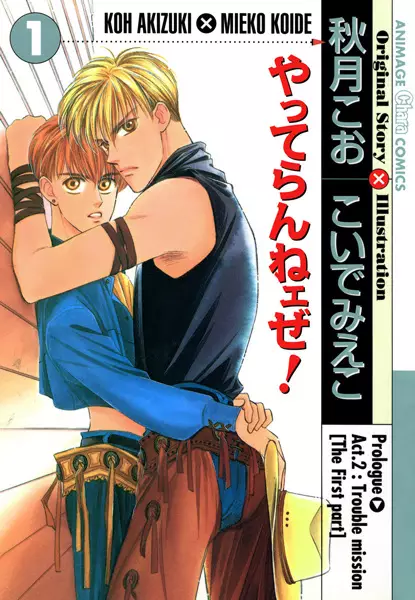
Itâs not rare for me to express my disdain for the yaoi genre as a whole. Rather, I often wonder why I call it a genre I enjoy. I love the concept, but the execution tends to be absolutely horrible. Have you ever read a yaoi manga in which a tall, dark, and angsty bishounen commits borderline sexual abuse against a short, blond, angsty bishounen before they have a teary-eyed love confession? I know I have, about twenty times. In fact, sometimes I wonder if maybe I should stop reading yaoi altogether, to save myself from this barrage of weak titles. Luckily, there are enoughgreat manga even in this genre that Iâm thankful I can put up with the crap. Some series are just amazing, not just made for the enjoyment of naĂŻve teenage girls and constantly falling back on the clichĂ©s of their genre, but designed with the elements that make up an honest-to-goodness high-quality title. Yatteranneeze! is definitely one such series, and it honestly feels to me that itâs almost too good to be called a yaoi manga. Sure, it starts out simply enough: Fujimoto is an honor student who decides to shed his nice-guy image, and turns to bad-boy Masaki to help him. On the way they get twisted up in their affections, both emotional and physical. Drama ensues, but everything gets sorted out in the end and they become a couple. ClichĂ©? Sure. But unlike other similar manga, the plot isnât used as an excuse for nothing but fanservice. As a matter of fact, the story goes on to chronicle the relationshipâs progression. Between the not-so-interesting events that happen in every school life manga in the universe (culture fest, anyone?) and of course the occasional steamy scene (highly enjoyable in their own right, I might add) Fujimoto and Masaki struggle with complex emotions. For a while, Fujimoto struggles with his sexual orientation; later Masaki is afraid that his previous lifestyle may have given him AIDS... and nothing is solved with just a kiss and an âI love youâ. The problems are addressed with the tactfulness and realism that one would expect in any other work of teen fiction praised by critics (think Rainbow Boys). The characters suffer in a way thatâs relatable rather than unbelievable, and thatâs why the potential drama works to the plotâs advantage. Thatâs also why the characters are key in what makes Yatteranneeze! great. It may star one âexperiencedâ boy and one shy, cute one, but thatâs really just another example of how this is a manga that uses predictable stereotypes in unpredictable ways. As the series goes on, the characters develop and grow, influencing each other in noticeable ways. As anyone who has ever been a teenage can tell you, everything that happens to you during your teen years, good or bad, can help to shape you, and Yatteranneeze! really reflects that. This applies not only to the main characters, but also several side characters, most notably Masakiâs delicate brother Chisato and his loose-cannon best friend Kanae. Their story and relationship is also very well-written, and unlike most side relationships has ample time to develop somewhat â but not enough to keep me from wanting more of these two! (Unfortunately, while there is a one-volume sequel known as Yatteranneeze! Gaiden that focuses on Chisato and Kanae, itâs more or less a volume of yaoi-fied business talk and quite disappointing.) I canât help but wonder how the mangaka of this series are capable of doing things with their characters that other yaoi mangaka canât seem to grasp, but they do so beautifully. That said, if I had to name the weakest element of this manga, it would undoubtedly be the art. Not that itâs bad by any means â far from it! â but at the same time itâs nothing amazing. The volume covers are very nice; colorful and with a nice variety of poses from volume to volume, although thereâs a lot of text so theyâre a bit cluttered. Flow from panel to panel is generally easy to follow, and of course the scenes that keep Yatteranneeze! from being PG-13 look great. Otherwise, though, the art is only above-average: it wonât keep you from reading, but you probably wonât run out to buy the artbook either. Yatteranneeze! is what you might call a hidden diamond in the rough. It shuns what one might expect from a yaoi title and displays an engrossing story and amazing characterization. Itâs perfect for the blasĂ© yaoi fan wanting more from the genre, readers who want to see what the big fuss about yaoi is but are afraid to start, and even people who arenât necessarily interested in yaoi but like good manga and donât mind some gay erotica. And unlike certain, more popular yaoi titles, itâs guaranteed not to keep people from coming back!
Fujimoto Hiroya is at the top of his class. He's the Student Council Vice-President, spends all his time studying and is the idol of all the "good girls". But the truth is, he'd trade it all just for the chance to be someone else... someone popular, outgoing and carefree... Someone like Masaki. Masaki's what Fujimoto's friends would call an "idiot". He'd rather play soccer than study, almost never cracks a book, and is popular with all the "normal" kids. He's got flashy clothes, bleached hair and a reputation just a lousy as Fujimoto's is good. In the summer of Fujimoto's freshman year of high school, he resolves to change his image and his life... all to make friends with Masaki. But can dyed hair, new clothes and a piercing really change a person inside? Classic BL by the "dream-team" of novelist Koh Akizuki and mangaka Meiko Koide. Please note that this title deals very frankly with some rather "heavy" issues including, but not limited to homophobia, gay bashing, coming out, HIV/AIDS, promiscuous sex, rape, and suicide. (Source: DokiDoki)
When it comes to yaoi, there's honestly not many series that can come close to Yatteranneeze. The story may seem cliche to many people. In fact, I know I've seen the same basic idea in a few shoujo mangas. Hiroya is a good kid on the student council who consistantly gets good grades and never does anything you would even consider calling rebellious. Misaki is smart enough when he applies himself, but he never does as he's too busy being the opposite of Hiroya, as rebellious as is possible for him to be. And naturally they're the main characters and the couple focused on inYatteranneeze. Hiroya decides he needs a change and he wants none other than Misaki to teach him how to be a cool kid rather than an upstanding student. If that were all there was to the story it would maybe get a 6 from me, but there's much more to it than that. Yatteranneeze is one of the few yaoi series I've seen actually focus on a lot of issues facing gays and people in general, including homophobia, AIDS, rape and more. Overall the story was a great blend of comedy from Hiroya (who is, at times, overwhelmingly innocent), drama and romance, all excecuted in a way that makes you want to keep reading. I'm a bit biased on the art. I love mid-90s manga artwork and Yatteranneeze is a prime example of this. The character designs are all relatively simple, which fits the series as it's only portraying relatively normal students in Japan. Overall I really liked the artwork of the series though it wasn't anything revolutionary it went along very well with the series and was always consistant and at times was very beautiful. I have to say if there is a bit of a downfall to the series it's character. However I'm still giving it an 8 for very good. Character development was actually superb, by the end of the series you can see how all this time has affected the main characters and even some side characters. However I never really loved any of the characters. Misaki is the only exception, the rest of them were nice enough and didn't make me want to stop reading, but I wasn't overjoyed with them in any way. Often times I find series more enjoyable than anything else, which is how I felt reading Yatteranneeze. Every chapter ended in such a way that I wanted to read the next one. The romance is believable and the drama is somewhat over-the-top at times but it makes it even better. Overall I found that I wanted Hiroya and Misaki to stay together, whenever something threatened their relationship I would actually become sad because I wanted them to be together. I rarely care about couples that much in any series, which just shows how much I enjoyed this one. So overall I give Yatteranneeze a nine. I'd recommend it to anyone who wants a good love story, as long as they're open-minded to yaoi, because I think that even someone who isn't a fan of yaoi could read Yatteranneeze and see past the fact that it's two boys to the point that it's as simple as a great love story.
Often times when reading manga you might find yourself struggling to finish even just one chapter before losing hope, skimming the pages as you skip through lines of dialogue only to find yourself dissatisfied three minutes later. Truthfully, this is the case with most shounen-ai manga. You may stop once or twice to gawk at a seductive scene or chuckle at an awkward situation, but the majority of the time the story is coincidental and uninteresting or the characters are nothing more than objects of affection. This is not the case whatsoever with Yatteraneeze. Written by the talented Meiko Koide and, lesser known, Koh Akizuki, thestory follows Hiroya Fujimoto and Ryuu Masaki, two high school students on opposite sides of the social order at their school. By using meaningful plot devices, controversial topics, and realistic relationship developments Koide and Akizuki have created a shounen-ai manga that breaks away from many of the clichĂ©s and fluky plot elements that hold many manga of the same genre from reaching their true potential. Admiration is a feeling many of us have experienced, whether it be the sports superstar, the successful actress, the popular mangaka, an older sibling, or maybe just a trendy nobody living next door, but to what extremes do we go to so that we can be like them? Hiroya Fujimoto, the vice-president of his schoolâs student council, is tired of his average life, his average personality, and even his average hairstyle. âWhat would my life be like if I was that person?â Have you ever asked yourself? Have you ever gone so far as to try and find out? Insecure, introspective, and hesitant, Hiroya, tired of not standing out and not taking chances, has a story we can all relate to. Though his individual plotline is more childish compared to Masakiâs we are thrown into an inspiring, yet often touching tale of his journey to find himself. Hiroya pledges to become what he believes he truly wants, a confident and stand-out individual like the person he admires, Masaki. However, a new hairstyle, new clothes, and a comically placed earring can not change who a person is on the inside, a true awakening to oneâs self requires dedication and the ability to persevere through the criticism we experience, but can one do all of that alone? Masaki, an abrasive rebel-type who feels no shame from ignoring a planned meeting, is the main cause of Hiroyaâs pledge to change. From an outsiders point of view Masaki is nothing more than a troublemaker with dyed hair, but behind that wall of ignorance is a teenager with a lot of issues. As said earlier, Masakiâs role in the story is much more mature as he deals with problems surrounding his family, his familyâs relationships, and even his own health. As the story progresses, the leads of Yatteraneeze develop to heights rarely seen in the shounen-ai department. Quickly avoiding the âseme-ukeâ trope, we learn that Hiroya and Masaki are complex and complicated individuals and when their stories collide we are given the opportunity to watch their relationship grow into a realistic experience. They learn to deal with obstacles that would normally tear a couple apart. Through this hardship they begin to accept each other for the best and the worst in each others personalities. There are few important side characters, such as Masakiâs brother and boyfriend, Masakiâs ex-girlfriend, and also other students, such as a girl, and also a boy, who both develop slight crushes on Hiroya. These characters add very little to the story and are never truly developed further then their shared emotions. The plots they are involved in, such as a photo scandal and a memory loss situation, are not as well written as the other parts of the story, but donât detract from the work as a whole. Artistically, it is obvious there was a lot of attention to detail in Yatteraneeze, and Meiko Koide is a master of translating emotions through her art. The style of the work grows and develops like the characters and the plot, starting with a slightly more lighthearted feel and slowly turning more mature. The character designs occasionally appear misproportioned, but itâs not extremely important. Yatteraneeze is truly a gem that might often be missed just because it is not exactly well known. Despite a few minor flaws, Yatteraneeze shines as an amazing show of well developed characters, an engrossing story, with also a few heart-dropping-teary-eyed scenes, and a respectable take on many controversial topics that many manga are afraid to cover. If youâre looking for a shounen-ai with a very realistic feel you canât go wrong with giving Yatteraneeze a try! (This is my first review, so if you read to this point, thanks for reading! Tips/criticism would be great!)