Links go to search results. Availability varies by region.
ă©ă€ăă»ă€ășă»ăăăŒ
16
3
Finished
Aug 11, 2011 to Oct 11, 2012
6.6/10
Average Review Score
40%
Recommend It
5
Reviews Worldwide
What makes a good short manga? Most manga are written with the idea in mind to make them go on for quite a while, or even with a full set plot in mind, may go on for several volumes. In this case, Life is Money spans only 3 volumes, which is, in my opinion, the perfect length for this story. Plot: Meguru needs 100 million yen for his sick sisters heart transplant. After being scammed by a group of people and outcast by people who believe he stole the money, he's desperate. So desperate that he listens to the sly words of a bar patron whotells him of a high risk game that can earn him 100 million yen. With his deathly ill sister in mind (and more tricks from the bar patron) he agrees. What follows is a game similar to one you could find in Liar Game, though instead of a deadly debt, there is literal life on the line. It's a mental game, if a player gets to stressed out, or breaks a rule, he'll be trapped in a mental prison and die. There are also other elements, such as cutting off a players sense to add to the challenge of the game. It's a survival manga, not much more too it. But what follows is more interesting, an event comparable to the stanford prison experiment. At first it seems simple, all they have to do is ignore each other. But quickly the rules change after one of the player hogs the only food they were given and says he'll only hand it over if they agree to give him some of their winnings. The plot progression is not the most interesting part of the manga. You could almost call it predictable in some aspects. What makes it interesting is the character development and how they react to scenarios. Characters: Meguru is our protagonist, with a noble means for the money. However we no little of our other characters and why they are there. This is what makes the manga a great read. We learn more about who these characters are, why they're playing the game the way they are, whether or not they care about the winnings to begin with. Even Muguru who seems endlessly optimistic at first finds himself falling into a rugged Hell. This is what makes the manga really interesting. We don't know who these people are but as we learn, people who we thought were simple or good quickly show a dark undertones to them or motivations that aren't exactly pure hearted. It's simple in that sense, exploring the need for survival and darker human motivations, but it does it all too well. Sometimes the characters can't help themselves. Other times their dark side is of their own free will. I adore all these characters, be they good guy or bad guy, as all of them are written quite well. The art: The art in this could get quite cartoony at times and very over dramatic. It only did it at times during high stress character moments. Not much else to say. Think Panty and Stocking, only slightly heavier anime tones instead of western The bad: This series really shoves it's morals down your throat. I understand it being as short as it is, it needs to get it in somewhere and somehow, but it never does it quietly or subtly. It always decided 'OH, here's a good moments to comment on life and humans.' It never really flowed naturally and really hurt how much I enjoyed the ending of the manga in particular. Life is Money overall: If you want a survival manga, I more recommend Battle Royale or Liar Game. However, if you want a manga that focuses on characters and you can really enjoy unraveling the layers of a person, then this a manga for you.
One billion and death...? To get a surgical bed for his sister, Meguru has chosen to participate in an underground community. Between illegal gambling and games, he will participate in a nightmare. (Source: GanGan Online) Included one-shot: Volume 1: Izime
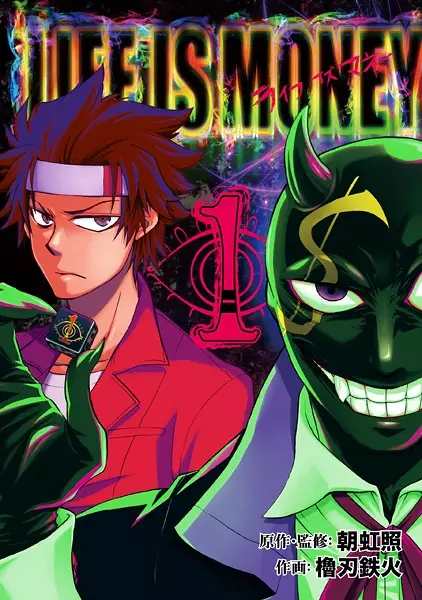
Everyone who reads manga or watches anime has surely seen a scenario like this. Money on the line, lives on the table: a fight to the death. That's what happens in Life is Money...but it's not how you imagine it. There's no physical violence allowed - so how do you kill? The truth is more disturbing than you think. Quite possibly one of the most under-appreciated manga out there, Life is Money is truly a psychological manga, yet retains many shounen elements. There's a hero, a villain, an intriguing story, and interesting characters. Let's hear a bit about the story: Meguru Fukurokouji is in need of 100million dollars for an urgent heart transplant for his beloved sister, who could die at any point. Taking out a life insurance policy, he decides to become a martyr so his sister can live on. But wait. At the end of his rope and about to say his final goodbye to the world, he is approached by a man who offers him 100 million dollars. All he has to do is win a game, although there's a chance he might die. Then again, it beats his chances of surviving a 5 story drop from a bridge. Soon he finds himself among ten others who are just as expectant as him. Black Tapia (the black - man? - with horns) appears and tells the group of the rules of the game they must play. Each player must survive a grueling ten days inside a prison complex. Simple, right? There's entertainment, a fitness room, even a relaxing music room. Everything seems great until they discover the other rule. In this prison, each player's heart rate cannot exceed a limit, or they will be subject to a "mental prison", a horrifying form of death. In addition, each day they must roll a dice to determine which of the five senses they possess will be "disabled" for the day. Roll a five? You're not allowed to hear. Roll a two? You can't taste. Roll a six? Everything resets. It's a painful and grueling ten days in what can be described as no less than hell. Art is, in general, good. Backgrounds are nice, but not great. Characters are also sufficiently detailed. All in all though, I have to say that the art just doesn't go above and beyond the necessary. That's all right though, as the story covers for it. Character development is great. You get to see Meguru meet and interact with the other nine people and learn about each. You see him go from depressed to wimp to badass to hopeful. The weakness here is that some other characters are not as well developed, some not at all. Whereas you learn a lot about Meguru and his friends, you fail to learn barely anything about Black Tapia and 2-3 of the players. Although this is not exactly necessary, it would've been helpful to many readers. Overall, a great and fun read. Even though it's short, it definitely shouldn't be missed by anyone who enjoys a good story. It's very under-appreciated, and it needs more popularity. Don't hesistate to pick it up: it's short and there's little commitment. I'm sure you won't regret it. Thank for reading and I'll see you in my next review.
I'm going to review this manga with a major assumption. If my assumption is correct, then my score would stand, if not. Well it'd be far worse off. So let's get into it. I think Life Is Money was given a short window to end about 3-4 chapters. But before we get to that let's talk about the positives, and for that it's due to an interesting premise about a game where players are just forced to live in a location for 10 days, with a small game each player has to play where they can be forced to lose one sensefor the day. I feel like the senses lost is a bit extreme. (Taste means you also can't speak for some reason) But it adds an interesting and unique twtst to the "game" at the heart of it. The other huge positive is the art style. There's a very unique art style that Life IS Money chooses to use, especially for a number of it's full page horror panels, and they are damn good. I'm not a horror fan, I'm not normally not focused on the art, but I have to say these are both memorable and well detailed. On the other hand... well this isn't really a spoiler, but around chapter 10 you'll notice a problem. They're on day 3 of the the experiment/game at the heart of the story. 3 out of 10, so originally I thought the main character was going to die suddenly. That's not what happens, instead the manga that has long interesting chapters suddenly breaks into the fastest dash ever. There's a large interesting question, and instead the manga RACES through the final 3 or 4 chapters, jumping forward several days, dropping almost all the plot threads, and just getting to the big finale, and the ending. The problem though is the buildup for these big moments aren't complete. The main character just is thrust into a situation at such a breakneck speed that the payoff of what he is going to is completely lost. The lost threads are interesting questions fans should have been asking about, and the flash forward is a payoff that is unearned. Imagine if you watched a great murder mystery but 30 minutes into the film, the movie jumps to the final minutes, and says "The inspector confronted his demons, and figured out the Butler did it! The end." The thing is that's what Life is Money does. The good news is the manga does end and does tie up an important plot line, the bad news is it's such a train wreck of a final couple chapters that it really tears down all the narrative that has been build up to that point. I give this manga a 5 only because the build up to that point, the art, the design, the ideas are so good. However that score is based on the fact that the ending was made out of necessity. I'm forgiving some of the sin because I imagine this rush was due to limitations and the results of those limitations are the best possible. If this was actually the intended result of the manga, and it was always intended to be this rushed, I'd probably drop this to a 2 or a 3. Basically read the manga for the art. If you want to read this because of the story... Read something else. I'm currently reading Gambling Apocalypses Kaiji and that is a very different story, but it's far better than this one.
Life is Money is a very interesting concept of combining a sort of death game-esque trope with the idea of sensory confinement, and how that plays with, if given the correct specific outside stimuli, it can lead to the entire breakdown of the psyche. The manga would make a solid premise and story for this; however, this often ends up not being the case, with points in the story where it falls flat right before able to hitting the nail on the head. Either done with suddenly taking narrative shifts out of nowhere, having characters built up one way only to act in anything butsaid way, or just weak executions ingeneral . The main premise is that our main character is tricked into a death game where each day he has to roll a dice with strangers, and depending on that outcome they can either lose a sense permanently for the 10 days they are confined, causing a negative feedback loop should someone get too unfortunate, leading to total sensory deprivation or luck up and have their senses saved. This isalso also where the second part comes: if someoneâs stress gets too high during the confinement, a monitor on their body will go off, instantly killing them. Thus forcing them to outlast the life or death game while controlling their level of stressors with their slowly reduced sense so they donât die. In premise, thatâs a really, really good idea, and I personally was really stoked to see it play out. And although the manga at times does a good job of showing what itâs like to lose your major senses, it does a terrible job of showing the deaths due to mental overload (death by being stressed over the threshold). Just imagine, you know the way to kill someone is by psychologically torturing them and making them die due to the stress, so one of the mangaâs kills plays this off by having everyone circle around a character so they canât leave and they call the character mean names. This entire whole scene genuinely feels like how kids would bully each other during middle school. Most of the deaths play out with being confronted: one of the characters somehow discerns a characterâs deep-rooted insecurity based off a single convo (at times even no conversations), they begin talking down to the other person about said insecurity, and then they freak out and die. (Thereâs only a single death in the entire manga where this is executed to a somewhat dissent level.) This formula wouldnât have been so bad if the manga just tried to build things up marginally better, like if there was more investigation behind a personâs history to get their flaws to surface, or if they changed how they caused a mental overload, maybe this would be more palatable. But it feels like because the series is so short, everything moves at a breakneck pace with the story. Not to mention, the main character and those around them feel sloppily written. There are times where the character witnesses a death or something traumatic and because of it they feel the need to lock in and suddenly take things seriously, only to then be pressured and instantly back down and revert to their helpless selves from how they were in the beginning, and it feels like that cycle just continues up until it suddenly doesnât for the last few chapters. Along with other characters serving nearly nothing to the plot because they have so little relevance and interact so barely with other characters that it would have been more effective to write them out from the story entirely. This can lead to things being frustrating in how the situations play out. The ending personally wasnât bad and didnât leave any bad taste, with it being basically the best-case scenario ending. And the art style wasnât personally anything bad. I do wish that at times they did tone down how comical they made the depictions of people getting stressed out, since the over-animating of characters from how they are drawn normally almost came off as âLooney Tunes-ishâ, but thatâs only really the problem for the first half for the most part. Overall, not the worst thing, but just an alright series. Itâs a good series to just read in a day if you have time to kill and want to burn some time and forget it afterwards. Youâre not really going to actively want to read what happens next, but itâs not like itâs a punishment either to read it. Just an overwhelming meh.
In one line : When the work on the art biases my judgment. With such a headline, things seem to be already settled. Yes, my enjoyment mainly came from the art. While "pretty" seem to be a sort of common criteria, I consider it to be a rather limited view. If art and beauty can go together, they aren't an outmust necessity. Art can also be about distortion, abstraction and symbolism. "Life Is Money" uses those aspects pretty well and has therefore this "different" feeling to it. And sadly, it is the only strong point of the manga. Nothing much can be said about the story,it is a rather typical story of "people brought up together to participate in a lethal game" and brings nothing interesting, different or new to the subject. Though it had potential, I didn't feel it was well developped or used, or that it even attempted to it. Putting it in perspective, it could be argued it's due to its lenght, but even the first chapters didn't seem to go too deep into it, despite promising premises of losing one or several of your senses. The characters are even less mentionable. While I applaud one of them, I cannot say their personality and archetype wasn't written all over their faces right from the start, bringing close to no surprise to the various "twists" or events occuring. I would only want to kudo a devil-like chara, who I expected a few things from to only be denied and to raise an eyebrow at the main's protagonist sudden change of attitude toward the end. Let's not mention pairings as in 15 chapters, two charas get close enough to want to get married and have children together. So yes, there's, overall, nothing good or bad to say about story and characters, except they are a good excuse for the chosen art style. It's a manga that misses an opportunity as with its art style it could have really brought something to the genre, which has a usually more conventional design. However, an art style alone isn't enough, the story/characters have to bring something as well, or, at least, be a little more than average. (6 in the review, to tone down my biased judgment, but 7 on my list)