Links go to search results. Availability varies by region.
ăłăăăŻćĺĺ˛
120
8
Finished
Nov 1988 to Dec 1989
9.0/10
Average Review Score
100%
Recommend It
2
Reviews Worldwide
How much do you know about Japan? Since youâre on this site, itâs safe to say that you are at least somewhat interested in the culture. You've likely picked up some scattered facts about the country. You know that losing the second World War irrevocably changed Japan; did you know theyâd been at war almost a decade before WWII officially started? You know what a kamikaze soldier is; did you know that this was largely created out of desperation after Prime Minister Tojo (according to this manga) declared: âI would rather see this whole country die than admit the smallest defeatâ? You might even knowJapan had an âeconomic miracleâ after the war; did you know this was a series of small booms largely influenced by the Korean and Vietnam Wars? Before I get to why this series is worth reading, I need to state that the MAL write-up is insufficient in every way. the series is a sort of guided tour through the Japanese Showa period (1923-1989) using a spirit, but Showa (which Iâll call the series for brevityâs sake) is a serious history. These 120 chapters present a meticulously researched glimpse into the events of the time and what it was like to live in the country as these events occurred. Everything from political upheaval and economic trends to short-lived fads and headlines of the day are represented in these pages. The character of Nezumi Otoko (the supernatural narrator for most of the series) is there only to streamline the events and help elevate the series into more than a series of facts. But, if this was just a history book with pictures, it wouldnât be so special. Showa is also the autobiography of a man with an incredible life. Shigeru Mizuki (who lived through the entirety of the Showa period) intersplices the story of the era with the story of his life. If you arenât interested in the story of a slacker who lost an arm in the war and would go on to be one of the pioneers in the manga industry, then I do not know how to interest you. That said, it cannot be stressed enough that this is a history first and foremost, and it is the way Mizuki tells this history that gives its power. Through Nezumi Otoko, the reader is able to âwitnessâ some of the best and worst of the twentieth century. There is no shying away from harsh or unpleasant topics. Nezumi shares panels with Hitler, looks rapists and war criminals in the eye, and tiredly shrugs as he describes some truly horrible events. Yet, no one is made an obvious villain; no event is considered unjustly simple. Mizuki (and Nezumi) offer the situations and motivations that led to each event. If you are interested in this series, you should also know that most of it takes place during World War II. As Mizuki explains, this was the ultimate turning point, and it is impossible to fully appreciate how much everything changed because of these years. Every battle is covered, every major decision made by the military and by the government. I defy any reader to read these chapters and not be filled with both horror and pity as they read these chapters. The phrase ânoble deathâ will never mean the same if you read this. And at the centre is Shigeru Mizuki, an artist who calmly acknowledges his faults, mistakes, and regrets as he relates his story. I wonât pretend that every chapter is enthralling, or that the art is always brilliant, though the juxtaposition of realism and the cartoonish works well to add variety. I donât know how to rate this series. Itâs a serious history of a tumultuous period in one of the most interesting countries in the world; I canât rate that based on its entertainment value. To sum it up, this is a quick glance at the events that led to a culture we all love, at least in some degree. If youâre only here for entertainment, youâll likely be turned away by some of the more horrible things discussed, but if you have ANY interest in learning about the history or culture of this country, I cannot recommend this series enough.
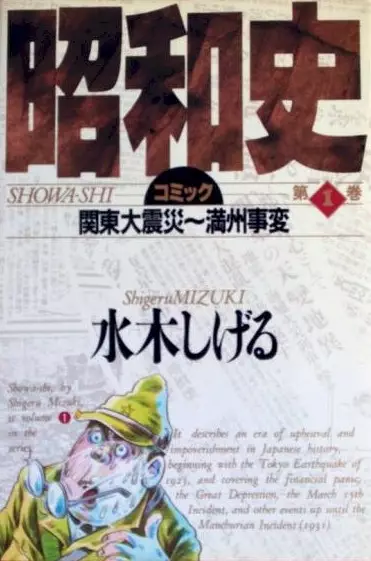
A historical story using Ghosts to explain the life times of the reign of Emperor Hirohito. Comic Showa-shi describes an era of upheaval and impoverishment in Japanese history, beginning with the Tokyo Earthquake in 1923, and covering the financial panic, the Great Depression, the March 15th Incident, and other events up until the Manchurian Incident in 1931. (Source: Volume 1 cover)
Deleted my main MAL account Kaushik17 âThose who fail to learn from history are condemned to repeat it.â The late Shigeru Mizuki was known as the master of the yokai genre, popularizing and bringing traditional Japanese folk tales to a modern audience and thus leaving his indubitable mark on the anime/manga medium. While he certainly deserves the plaudits for this and rightfully so, his historical works often go unnoticed. Showa is one such work, where Mizuki guides us, the reader, through the reign of the Emperor Hirohito. His reign saw the rising militarism of Japan resulting in the disastrous Sino-Japanese wars which merged into WW2, leading the nationto ruin. The work also covers the aftermath and subsequent recover of Japan ending with the death of the emperor. While this in itself is quite the herculean undertaking, the work also doubles as an autobiographical work, where Mizuki shows different pictures of his life, all the while highlighting the importance and presence the yokai had on his worldview. It shouldnât come off as a surprise that he became the torchbearer for the genre bringing joy and fear of the unknown to many. The work (at least in English) divided into 4 books spends a good chunk of its first book identifying the reasons for the rise of militarism in Japan. We are given names and the deeds of certain actors which would come to have a lasting impact on history. We are then guided through the WW2 from Japanâs perspective, seeing jubilant crowds giving way to a shocked people coming to terms with their defeat, best seen through the panels showing the Jewel Voice Broadcast. The last book then covers the post war period and subsequent economic miracle catapulting Japan to the ranks of the foremost economic powers in the world. All the while, Mizuki does his best to show how he and his family and friends were affected by these grand decisions. Mizuki was quite the laidback individual having a rather jolly approach to life. And he managed to have that positive take to life even after losing his arm in the war. It is here that we get to see the hold the charm of yokai had on him from a very young age. It was his belief in them that arguably saved him through the worst theatre of conflict in WW2, the Pacific theatre. And it was this belief in them that also laid the groundwork for his subsequent rise to fame through his manga. One of the first things that comes to the readers attention is the fact that Mizuki navigates between a historical record and autobiography with aplomb. This is in no small part due to the presence of Nezumi. A character from Kitaro, who serves as a guide through these personal and historical events, adding a layer of detachment and objectivity to the read, elevating the work further. Mizuki does not add his own interpretation of events, but instead presents the events as factual as possible and provides enough information to enable the reader to formulate their own opinions. The work as he mentioned is first and foremost written with the intention to show what exactly the Japanese people had to sacrifice in order to be where they are today. As an autobiography, it is quite fun to read his experiences as a young child and adult growing up in that rather turbulent time. His cheerful and lackadaisical approach to life is in sharp contrast to the rather grave situation Japan finds itself in. It adds a sense of realism that while the top leadership was falling to ultranationalist tendencies, the people itself were like anywhere else, looking to make ends meet and generally blissfully ignorant of the big picture. Mizuki still retains this attitude to life, which is incredible given that he saw first-hand the horrors of war, only going to show his resilience and zest for life. One thing he comes to time and again is being thankful to life. Mizuki does this by comparing the people of post war Japan with the native friends he made in Papua New Guinea during the war. The latter are not necessarily materially rich, but are happy with life. In contrast, the more Japan grows and the richer it gets, the more its people want. Itâs no wonder that he often visited the Islands after the war and maintaining a collection of things, including music from these trips. It is to his credit that Mizuki doesnât bombard the reader with one event after the other as it would make the work rather unwieldy and intimidating to one not familiar with history. But focusing on certain key events along with his itâs impact on the populace only serves to give us both a horizontal and vertical view of things. His art ranges from realistic character designs to his iconic quirky character designs, all the while presented with luscious backgrounds to enhance the sense of immersion in the read. Some of the iconic imagery from the 20th century associated with Japan such as General Douglas MacArthur meeting the Emperor is quite fun to look at in a different medium. People not used to older art styles or not found of history might not necessarily enjoy this. But look past those, and you will find one of the best works on the Showa era in any medium. The work uses the strengths of the manga medium to shed light on the Showa Era and bring attention to the reader that knowledge of history is key to avoid repeats of tragedies. In short, I couldnât recommend this work more.