Links go to search results. Availability varies by region.
éŠãŪåģ ãŧåĢãŪč
9
1
Finished
1999 to 2000
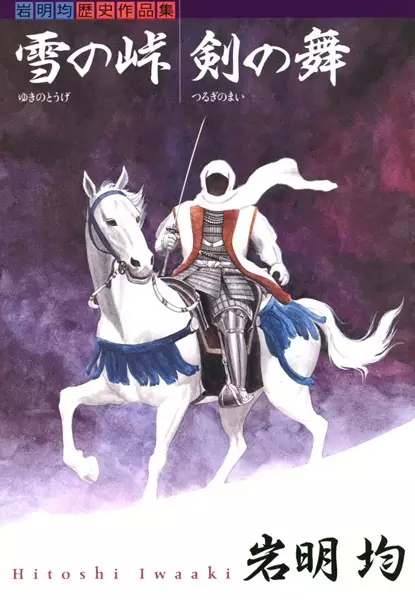
1-4. Yuki no Touge In the end of the Sengoku period, the great daimyo family of Satake is driven away from Hitachi-no-kuni to Dewa-no-kuni after the Sekigahara battle. They plan to build a new castle there, but the head of the family, Yoshinobu Satake, listens more to the young vassals' advice than that of the experienced chief vassals'. The experienced vassals oppose and start to plan something to defend their place... 5-9. Tsurugi no Mai It's Sengoku period. Haruna, a daughter of a farmer family, gets herself raped and her family killed by hooligan warriors in the chaos of war. Using the funds she got of the Go stones stolen from the warriors, she joins the dojo of the famous Nobutsuna Kamiizumi to learn kenjutsu in order to get revenge on the warriors. There, she meets Kamiizumi's apprentice Bungorou Hikita, who starts to teach her the art of the sword with the shinai that Kamiizumi has just invented... (Source: Translated from Wikipedia.jp)
6.3/10
Average Review Score
67%
Recommend It
3
Reviews Worldwide
Really enjoying Parasyte -the maxim- I got the idea to check out the other works from the same author in the hope of finding something very good. This one volume contains two independent quite short stories set in feudal Japan. Yuki no Touge: Pretty slow story. Kind of reads like a historical record but it is quite interesting to follow the clan building their new castle and an intrigue. Tsurugi no Mai: After a girl gets raped and her family is killed she takes up swordsmanship in order to get revenge. Since the story is very short there it feels rushed and stays a simple revenge story.They were quite a few very interesting characters that are kind of wasted on a 1 volume Manga and would have fitted in longer stories. The drawings are kept quite simple but are all right. I was expecting a bit more from the stories to be honest but it was still enjoyable to read for 1.5 hours.
This manga is short, so do not expect some crazy character development. Both of the stories it tells are satisfying dramatizations of real historical events. The second story was particularly satisfying. For its length, this is a great manga. The art is well done, and for someone who doesn't already know the history, this was both good entertainment and somewhat informative. To be fully honest I wrote this paragraph because the previous one wasn't long enough for me to submit. Okay it's still not long enough. The art is also well done and in the first half, the plot was focused on sticking to one's decisionsdespite resistance, with a verrry satisfying payoff. In the second half, the plot was bitter but satisfying. I have said satisfying a lot in this review, because that is the best descriptor for this manga.
I'm a sucker for all things related to the samurai, but this manga left me with a decidedly "meh" impression. You may have read that the samurai came to an end in the Satsuma Rebellion of 1877, but in truth they many 'deaths' and 'rebirths' before that. The samurai class served many different roles throughout Japanese history, ranging from tax collectors, to bureaucrats, to soldiers, to military aristocrats. These two stories deal with samurai caught in the culture shift as the Sengoku period became the Edo period. The first 'Snow Ridge' is the more interesting of the two. It deals with a clan forced to relocateand build a new castle after losing the Battle of Sekigahara. The debate over the castle's location turns into an internal political struggle divided on generational lines. The older samurai raised in an age of constant warfare want to build the castle in a highly defensible but remote and impoverished location, while the younger samurai with more skill as civilian administrators than soldiers want to put it where there will be the most political and economic benefit. There is some interesting political maneuvering and a decent conclusion. The second story is rather generic samurai fare. A teenage girl seeks revenge against the samurai thugs who raped her and murdered her family, so she finds a famous swordsmanship instructor to teach her how to fight. The instructor uses a new type of training sword that will become important to the sport of kendo, which allows her to train effectively despite her more fragile body. This story is supposed to symbolize how samurai battlefield skills began to transition to ritualized martial arts, but it ends up being a mediocre samurai story anyone who's seen a few Kurosawa movies could have written. The art for both of these stories is decent but nothing special, and the characters are basic archetypes. It's an OK read for fans of samurai stories.