
Links go to search results. Availability varies by region.
無能の人
6
1
Finished
Jun 1985
9.0/10
Average Review Score
100%
Recommend It
4
Reviews Worldwide
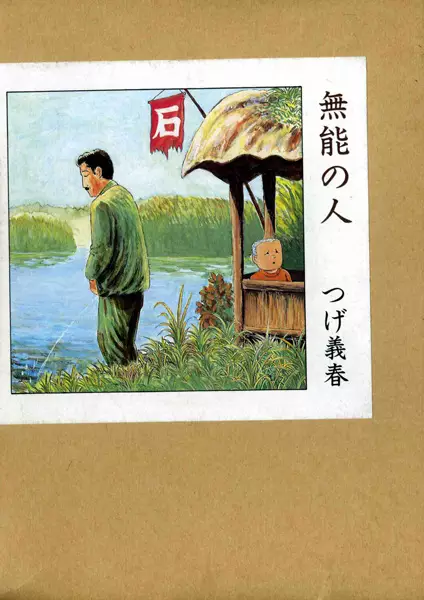
The Man Without Talent, by Yoshiharu Tsuge, is a semi-biographical manga, which shows part of the experiences and emotions of the author himself, with an introspective, realistic and melancholic vision. In the 1980s, when the manga was published, Japan was experiencing explosive economic growth, and the westernization process initiated in the post-war period was already at an advanced stage. As a result, a large part of the population began to live in large urban centers, adopting a Western lifestyle (which encompasses fashion, customs and consumerism linked to the American way of life), and leaving behind, frozen in time and restricted to some inland towns, theancient Japanese customs. That scar on Japan's history can be found very strongly in this manga. Sukezou, the main character, is a stone seller who has a small shop set up by the river. However, it doesn't make much sense to buy the stones from his stall, since anyone can collect them right there without paying anything. The idea of selling stones came from an ancient Japanese art, Suiseki, which classifies stones according to aesthetics. According to this art, stones can represent landscapes, objects, people and even abstract concepts, however, like other elements of Japanese culture that will be mentioned later, interest in this art was in decline, with a small number of collectors, and even this small group wasn't interested in the stones that Sukezou sells. Therefore, Sukezou and his family leave for a journey in the interior of Japan, in search of rarer and more valuable stones. Before talking about the trip, it is important to talk a little about the protagonist. Sukezou was a talented mangaka, but due to disagreements with the comic market, he gave up his career and started investing in completely random businesses, which did not give any financial return. For example: buying and selling antiques that often turned out to be fakes, repairing and selling used cameras, in addition to the aforementioned sale of stones. All these jobs have aesthetic value, but they don't bring enough money to support his family. Sukezou has a son and a wife, who works distributing pamphlets, she is always arguing with him, as she knows of her husband's wasted talent in drawing manga, and blames him for the family living in poverty. It's as if Sukezou purposefully chooses to follow paths that will inevitably go wrong, it's as if he's in a melancholy cycle of self-sabotage, unable to recognize his own talents. During the journey, Sukezou and his family meet a Komusō (emptiness monk), a sect of Buddhist monks who live as beggars, this group flourished and was very strong during the Edo period. Sukezou then, talking to his wife, comments that these monks no longer fit in today's capitalist world, a comment that could go unnoticed but which is actually one of the pillars of this work. Another important passage occurs in the chapter where he meets the owner of a bird shop, who complains that people only want to buy the colorful and flashy foreign birds, without appreciating the beautiful and discreet Japanese birds. Sukezou, outraged by the futility of Japanese society, criticizes the fact that people are becoming more and more individualistic (very influenced by neoliberalism and all ideology coming from the West), and how this individualism is rotting Japanese society and creating spikes in rates of divorce. But soon after, this speech is mocked, due to the fact that both are in decadent marriages, which they hate. Despite the westernization of Japan being one of the central themes of this comic's criticism, nationalist, idealist discourses, which emphasize a supposed purity of eastern values, are also treated with sarcasm. During the journey, they pass through places that are practically frozen in time, on the margins of the frenetic development of Japan in the 80s. They are places that represent the memories of an ancient Japan, which refuse to disappear, and which are gradually being absorbed by capitalist modernity, becoming commodities through tourism. Between the final chapters of the manga, Sukezou imagines himself as the owner of an antique shop, surrounded by old objects, like a shadow, which is disappearing along with ancient Japanese values and customs. Without a place in the sun, in this world that is being formed.
Unable to find a proper job, former manga artist Sukezou Sukegawa has been reduced to running a doomed business venture of his own design: selling stones on the very riverside from where he collects them. Refusing to sacrifice his artistic integrity and re-enter the manga industry, and with numerous failed schemes under his belt, Sukezou firmly entrenches himself into a position of destitution. Despite having a family to care for—including his breadwinner wife, whose opinion of him is ever-souring—he stubbornly refuses to abandon his stone trade. With one misadventure after another, Sukezou attempts to make a profit in a profitless situation, firmly believing that success is simply a stone waiting to be turned. [Written by MAL Rewrite]
Yoshiharu Tsuge shows why he's a powerhouse when it comes to gekiga and serious storytelling. Munou no Hito is a sincere and delightful portray of life in its simplest form, creating with its down to earth narrative an atmosphere that is miserable as much as its hopeful, showing a perspective to being in a bad situation that diverts from what is usually the norm; while other media tend to dwell in the sadness and the depressive nature of failure, the mangaka thrives in the mundane, depicting with earnestness and sympathy flawed personalities that don’t have a “good” life per say. Perhaps a meta biography ofsorts, that bridges the made up and the real with similarities between the protagonists and the author’s life. A manga that should be in the canon of the greats, with Akira and many other, but it’s nature might be too disconnected from what usually makes something be considered a masterpiece, ironically fitting what it so well depicts.
I went to this manga thinking that was gonna be some depressing story about failure and nihilism, but i was greatly surprised!! We have this two elements in the story but they are not exaggerated or the center of the story. The story focus on the main character's efforts to sustain his family and the people and situations that he gets envolved with, that is what make me like this manga so much,i cared about the character,and questioned some decisons that he takes. And of course, the art, that despite being distoant its incredible. I wanted to see what the man without talent woulddo with his life. Great manga! If you like serious themes and introspective narratives, you will probaly enjoy this!
This is the first time that I’ve heard of Yoshiharu Tsuge. Apparently, he’s a cult figure in Japan for his Gekiga works. This story— The man without talent has 6chapters that deals with the worth of a man. Is a man worth something only if he can make money? Should you keep working a job just for money or should you follow your passion? The protagonist was a mangaka initially, but decided that he wanted to do something new. So he stopped drawing, started a side-gig. Unsuccessfully. Tried again, unsuccessfully. And so we see how he has lived his life, and continues to do so. We alsoget to see poverty up close. Have you read the story “Lie thee down, Oddity” By T.F. Powys? That story has a man too, who would rather destroy his life on a whim, than do something that he doesn’t want to. Self-righteous, maybe, but then if you want that level of freedom, you’ve got to be ready for the consequences. I digress. Story 8/10 We get a couple of soft instances that shape this man’s life. There is no dramatic action or romance here. This is a slice of life seinen. It has a philosophical aspect. It is short enough to give a shot. Art 7/10 This is a creation of the hard boiled gekiga world. Art is just a means to tell the story. But I personally liked the art. It is bright, even though it shows dark themes. Character 8/10 To really love a manga, I must demand it to have likeable and relatable characters. The protagonist here, Sukegawa is a easy go lucky guy, who has can dream big and then go to sleep right after that. That part is relatable. Lol. At one point his wife quips -You seem to take every action that is against your self interest. And that felt sharp. Because I think all of us have these thoughts, where we feel “Hey, let’s give up. Let’s bunk school, let’s go drink or let’s punch our boss!” But we don’t. This guy does it. He’s an idiot, but a good man. And his wife is a good person too, for motivating him to draw, because that’s his real passion. Enjoyment 8/10 I had fun reading this story. Simple, short, fun. PS I read about the mangaka. This story is semi-autobiographical. At one point the mangaka even had to sell blood just to make ends meet. He made a comeback in Garo(a prominent Gekiga magazine). And made some money. After getting money he stopped drawing because he said he can’t draw in a life of ease. He also struggled with depression. Later his works got adapted to various languages and got many movie adaptations. Thank you for reading!