Links go to search results. Availability varies by region.
天の鷹
10
1
Finished
Sep 2002
8.7/10
Average Review Score
67%
Recommend It
3
Reviews Worldwide
The best thing that stands out about Sky Hawk is the art by Jiro Taniguchi. The sweeping landscapes and the various skirmishes illustrated throughout are quite a sight. If I had to be nitpicky, it's that there's some same face syndrome, even among characters from completely different races. Now, I would rate this story higher, closer to a 7 or 8, if it weren't for the obvious favoritism toward the weapons and techniques of our two Japanese characters, Manzo and Hikosaburo. I don't fault the author for including them in this era, he gives good reason for how they could have been there in hispostscript by mentioning how the first recorded instance of Japanese immigrants was in 1869. I thought it would be very interesting to see a Japanese take on a historic period in American history, and how Japanese and Native Americans would have interacted. That I was fine with in the beginning. No, what took me out of the experience was, rather than an equal cultural exchange between Native American and Japanese, everything Manzo and, in particular, Hikosaburo teach the Native Americans is so astounding and amazing! So much more than the Native Americans' OWN tools and knowledge. And it feels like they have this reaction at every turn! Because of the decision to place this story in the time period where we have this huge tension between the Native Americans and the U.S. government, there's a lot of concentration on battles. And yes, our two main Japanese characters were previously samurai back in Japan, warriors themselves. But I start disbelieving that they, they alone, survive every battle with seemingly little more than a scratch. And thanks to THEIR teaching the Native Americans--about jujitsu and the long bow (which regularly outperforms every battle with gunfire in it)--it's implied the latter perform better in combat against the U.S. infantry. It's to the point that Manzo and Hiko become like right hand men to Crazy Horse. It's a discredit to the Native Americans' own strength and capabilities and I wish the author had had a gentler touch in that regard. There's a level of this that is fine at first; yes, it would be very interesting to see these different martial arts and swords from another country and be taught how it works. And to be fair, it's not as if every Native American warrior suddenly starts wielding a katana; but they do get introduced to the long bow, as if that's far superior to the Native Americans' own bows and weaponry. I will give Taniguchi some credit, because it sounds like in his afterword that the only way he could get a publisher interested in letting him write a Western like this was by having Japanese characters in it. I would have loved to see what Taniguchi would have done without the need for inserting such influences into the story. Overall, it's a good read, but it could have been so much better if it truly was just about the Native Americans.
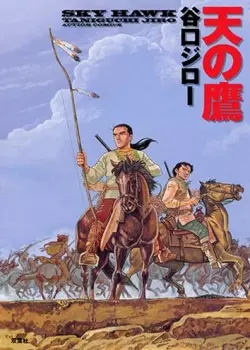
A manga revolving around two samurais, Hikosaburo "Sky Hawk" and Manzo "Winds Wolf," exiled to United States during 1871-1977 period. They will learn to live with Sioux and will fight with them against Custer.
Warning : could be contain some minor spoil Completely amazing !!! Great historical work, A must for indians history lovers ! Jiro Taniguchi is for sure a great author, but let me show you some aspects to demonstrate that in Sky Hawk. Originally, it's an anniversary gift of a friend of mine, so I didn't really know what the story is about, I could just thought about with the cover. Yes, it's a kind of western, the story took place in the late 19th century, with two japanese samurai exiled from their country, named Hikozaburô and Manzô, because of the defeat of their daimyo. So Hiko saved a woman andhis baby when he was hunting, but her pursuers found them, but as ju jitsu's experts, they neutralize the 2 guy easily. After be saved by The Oglagla, a Sioux Tribe, they decided to joined them. And so on, we follow their fights in this tribe with a sort of comparison with indian and samurai way of life. Notions like courage, justice, fraternity, not sacrifice... Even without knowing much, no need to study indian civilization like me at university, the background is very detailed, and the art too. Love the humans approach of Taniguchi, we barely have the impression to be with them in their village, we felt their feelings, the beauty of nature and landscapes, the important place of woman in indian tribes... Really fascinating. At a moment, the two mc were attacked by the Crews, ennemy of Oglagla, but they killed many and be recognized as great warriors, and just a little moment after, we see their complete integration with the ritual that gave them their indian names. After some battle, in which the famous Custer appeared, the end focus on indian alliance to fight against the West Conquest, at the time when US want to built railway until the West Coast. After some skirmich and battle, the last chapter is dedicated to the famous battle of Little Big Horn, when the General Custer died. For a fan of this period, and especially the way of living of native americans, and the spirit/way of thinking that relate our two protagonists and this population, it's unavoidable ! I hope i do not spoil much and motivated you to read this maravellous manga which is Sky Hawk ^^ ( Remind that i'm a neophyte in writing reviews and even in english bc it's not my native language )
The story starts with a man of Japanese origins finding a woman who has just given birth and therefore without strength as she gave birth alone, so the man takes her to his home and makes her regain her strength here we discover that in reality the woman she is a slave who escaped from a camp to save her little girl from certain death, their masters show up at the door of the two Orientals and ask if they see a pregnant Indian girl, they are looking for her not only because she escaped but also because before fleeing she took a bag ofgold nuggets, the Japanese returns the nuggets but the girl won't give it to her, so there is a general uproar and the two Japanese in a short time have the better of the girl's masters, with Judo moves, as the two Japanese are samurai fleeing the war that gripped Japan, the two Japanese are helped by the red skins and from that point there will be a change of front of the two Japanese who see the lands as their new home and homeland of America and the Indians, becoming Indians themselves, with names that recall animals and nature, and they in exchange teach the typical oriental moves to the natives of America who are surprised by the even more unknown features of the pale faces that come to invade their lands. What I can say about this graphic novel is cinematic, the action scenes are masterfully done, the two protagonists are very simple, we don't dwell on their past as samurai but on their present as Indians, but not forgetting their origins since in the battles that will follow in the story, they use tactics learned over years of experience as samurai still using their inseparable katana and their way of thinking is not typical of French, English, Spanish or any other colonizer. I don't know if it's true or is it a narrative device, but the graphic novel Sky Hawk uses the device of the Japanese who emigrates to America, a device that we find in other works by other authors, such as Isamu (Sam the boy from the west) or in Guns Frontier (by Leiji Matsumoto). For the drawing there is nothing to say because I risk being repetitive but in this story there is an evolution in the line, or at least that's what I perceived while reading. In the introduction, before going into the story, we talk about what Taniguchi wanted to blend by taking inspiration from famous films that talk about this topic, for example "Dances with Wolves", "Avatar" or "The Last Samurai", The topics that I found in the story that fit with the movies are: the family found in a completely unlikely place for the protagonist, applying past knowledge with newly learned ones, adhering to a creed and making it his own as if it had been decided from birth. To conclude I must say that this graphic novel is much more dynamic than those previously read by the same author, there is also something to reflect on here, but the battle scenes are phenomenal and they keep you reading, my favorite table is the scene which wants to be a joke to the scene of the last samurai where the legion has to bring down the defenses of the Indians and so they use the Gatling (machine gun that was used at that time) but is promptly shot down by sky hawk as if nothing happened killing the user with an arrow. I give an 8 to the story and 10 to the drawings.