Links go to search results. Availability varies by region.
Marieの奏でる音楽
17
2
Finished
Dec 10, 1999 to Sep 12, 2001
7.3/10
Average Review Score
50%
Recommend It
8
Reviews Worldwide
First of all, I usually don't write reviews for this website. I review anime and manga when I have time on my personal blog, but I tend to stray away from MAL reviews, simply because I've seen so many outstanding reviews on here that I feel like whatever I write will be utter crap. But when I finished The Music of Marie, or Marie no Kanaderu Ongaku, I felt like I just had to at least say something about this remarkable manga. The Music of Marie is one of the most underrated manga I've ever had the pleasure of reading, underrated in the sense that almost noone knows about it. It's definitely an undiscovered gem, and I personally feel like that's one of the best things about it. The author is clearly trying to tell a beautiful story, instead of pulling some deep philosophical stuff out of nowhere in order to make some money. So, without further ado, the actual review. (For the sake of fluidity and time, I'll be using "Marie" to refer to the manga itself. If I'm referencing the character Marie, I'll do it without quotes.) Story: 9/10 The story of "Marie" is deceptively simple, yet amazing. Basically, the character Marie is a mechanical goddess that watches over a peaceful, post-apocalyptic world. The plot revolves around two teenagers, Kai and Pipi, as they go through a series of events that ultimately makes them question their world, and perhaps their entire existence. Nothing is what it seems in this manga; everything is full of mystery and wonder, which is what makes the story so captivating. "Marie" is definitely one of the more different stories I've come across, and the ending is absolutely shocked me to the core. Now, why did I give it a 9, you ask? Well, it's more of a 9.5, or even a 9.8. The only reason why it's not a full ten is because I felt like the author could have expanded on Kai and Pipi's relationship. Even after the story was finished, I still couldn't understand exactly why Pipi was so in love with Kai in the first place. Maybe I missed something...but anyways, for just two volumes, the story and concept was fantastic. Art: 10/10 The art in "Marie" is absolutely gorgeous. I've honestly never seen any manga drawn with such attention to detail. All of the scenery and technology in this manga are drawn so imaginatively and beautifully. I'm not much of an artist myself, so there's little more I can say for this aspect of the review. But basically, the art in this manga is breathtaking. Character: 9/10 To be honest, the characters in this manga by themselves aren't that unique or memorable, though I suppose Pipi is a bit of an exception towards the end. But overall, it's more of the roles the characters play in the whole of the series rather than their individual qualities that makes them shine. Enjoyment: 10/10 I finished this series in one day, and I thoroughly enjoyed it. "Marie" has now been added to my favorites, where it will most likely stay for a VERY long time. Never before have I read a manga that combines philosophical ideas with fantasy so well. Although this series reminded me of Mahou Shoujo Madoka Magica in some ways, I don't even think that could possibly compare to the level "Marie" is on. I'm not religious at all, but I could even relate to the religious overtones found in "Marie". Basically, everyone should read this. Overall: 10/10 I recommend The Music of Marie to every one and anyone, regardless of what genre you usually enjoy. Even if you don't like manga, you will like "Marie".
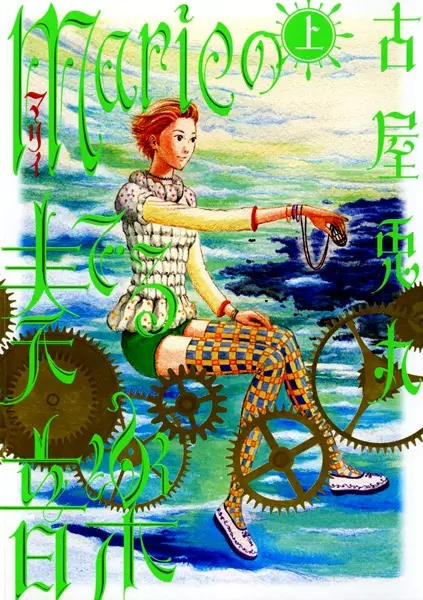
In a surreal world of abundant wonders, Gil is a workshop town specialized in mechanical craftsmanship, boasting the largest population in the land of Piril. People lead simple lives with little to no advancement in technology, worshipping Marie, a mechanical Goddess who keeps vigil of Piril from the sky. Daughter of the top mechanical artisan of Gil, Pipi is a cheerful and popular young girl. She likes her childhood friend, Kai, who has an extraordinary ability to hear sounds inaudible to the human ear. He is the only one in town who can listen to Marie's "music." The soothing sounds that come from her are said to retain the peace and harmony of the land. Kai's affection for Marie deepens as he continues to experience these sounds and see visions of himself through her eyes. Exploring the fantasy world of Kai and Pipi, Marie no Kanaderu Ongaku tackles concepts of religion, technology, and what it truly means to be happy. [Written by MAL Rewrite]
I disagree with most of the fans of this. Is it good? Yes Is it underrated? Yes. Do I like it? no. The art style felt way too shoujo which distracted me from what could have been very good looking artwork The story took too long to go anywhere, half of the entire thing and even then it wasnt satisfying considering I had to slough through half slice of nothing happening.characters were bland and got better but again a bit too late. 6
The world in this manga was without doubt the main selling point, or rather, the only selling point. Which is perfectly fine for me, as I can easily enjoy a piece of work immensely as long as it has at least one very strong and creative point. Unfortunately, I can't say the world was perfect, or even brilliant; at most, I can say it was decent. I found the world presented in the early chapters highly bizarre and full of wonder. Yet as the manga progressed, I couldn't help but lose interest in it. The main cause of my disinterest was the fact that the author didn'tallow for reader interpretation; he diluted the wonder by leaving little to the imagination. It's a problem in the same vein as the author's not trusting in reader intelligence; they believe that the reader won't be able to read between the lines, so they jam in exposition dump after exposition dump to explain everything and ultimately leave no subtlety in their work. There were multiple subtle world-building moments in the manga that were completely negated by an unneeded explanation soon after. Basically, the world was explained, the meaning and theme were explained, and even the very last questionable point in the manga was explained, which I find is a pretty bog-standard path for a manga that had such imaginative potential to take. Interestingly enough, the characters were actually harmed by the world they inhabited, which I find has a bit of a deeper meaning than the author intended. You see, all the characters, with the exception of two, were merely mouthpieces for the world; they existed to explain the world, which, even though it sounds philosophical, is ultimately shallow. If the author had replaced these exposition characters with fully realised and interesting characters, it would have improved not just the characters themselves but the world as well, allowing it to appear even stranger and mysterious. The only two characters actually worth naming are Pipi and Kai. Even though both of them are fairly shallow in their own right, Pipi more so than Kai. Pipi is actually a pretty terrible character by all standards, yet she can at least be called a character, unlike the world-expositors. The problem with Pipi was that her entire character was defined by her love of Kai. She had no goals, motivations, relationships, or traits outside of the box known as Kai. Funnily enough, the one shown interest she had outside of Kai, her garden, was even revealed to be some esoteric profession and dedication of love towards Kai in the final chapter, which fully rendered her character as 100% Kai defined. Kai himself was also fully defined and obsessed with another character, though in his case it worked much better, simply because it worked in tandem with the theme of the manga and raised some interesting personal questions. Though he had basically no personality. There was one plot twist right at the end of the manga, which I felt was pretty ridiculous. The plot twist itself didn't surprise me, as I had thought something along those lines was going on in the first chapter, where the first foreshadow for this twist appeared. The bit that I found ridiculous was the other characters complete lack of reaction (with a few exceptions) throughout the manga, in what should've been a pretty telling situation. Really, I feel the twist shouldn't have been explained at all, and the author should have simply left all the foreshadowing as an interesting little mystery to those paying attention; it would have at least kept my suspension of disbelief in tact. Overall, this manga felt weak; it unequivocally answered every question its theme brought up, which I don't doubt some enjoy, but which I find a pretty boring form of world-building, a form that makes the world feel tiny and unimaginative. The moral questions are also given answers, and I shouldn't have to explain why that's dull. In spite of all the problems I had with it, the manga was much more interesting and creative than what is usually served in this medium, so I would definitely recommend it.
Let's get the good out of the way first here. The art is incredible and very creative here. It's not to be understated how wonderful it is and how easy it is to immerse yourself into the world solely off of the art alone. Without a doubt the best part of the manga is its artwork and visual aspects. Props should also be given to this manga when it comes to the general idea and concept of the story itself. Wouldn't get into it in order to avoid spoilers, but the concepts for this story could have worked if it wasn't for one thing... Thatbeing it really feels like the author thinks the reader is a complete idiot. The dialogue/writing in this manga actively frustrates me to no end. At every chance the author gets, instead of letting the reader understand what is being shown, there is a dialogue box to tell us what is being shown. It is hard to explain without an example. SLIGHT chapter 1 spoilers. So our ML is walking up to the workshop where our FL builds robots. When he gets there, he tells us that all of the 10s of robots were partially maintained by her constantly. This is fine internal dialogue by the ML. Not the most creative way to tell us that, especially when you were already showing us that. Then, the ML says something along the lines of "There are so many of them. It must be hard work" and then while looking at her smiling "She looks so happy laughing like that". See...this is annoying to me. You just SHOWED her working. The art perfectly shows how much effort she puts into maintaining the robots, and how much she cares for them. You don't need to say it too. SHE IS LITERALLY SMILING. YOU DON'T NEED TO TELL ME SHE IS SMILING AND LAUGHING. IT IS A MANGA!! I CAN SEE HER LAUGHING AND SMILING!! ...Okay. Now what if I told you it was like this for the rest of the manga. Every chapter. Practically every page. This example is like from the 2 and 3 page. **This is Important** For the most part, anime/manga isn't a particularly subtle medium in what it tries to do for the most part. I can stand some stupid dialogue or something lazily explained in manga. It's a medium in which showing the story can sometimes be difficult to convey without an explanation. However, this manga far overcorrects for this problem. It partially removes all subtly and interpretation on the readers end. It feels like the author is holding my hand and doesn't respect the reader to interpret the work in any way. I know I am being harsh, but it genuinely ruined my experience reading this manga. It has interesting ideas and incredible artwork, but it doesn't let it speak for itself. Which is especially disappointing for this manga, since the artwork really does say so much for this manga in particular. It's too bad that the author didn't trust the reader to find the meaning by ourselves. This manga could easily be a 7 or 8 out of 10 manga if 40% of the dialogue boxes were removed.
did god create man or did man create god? an ambitious and unconventional work, Osamu Furuya's masterpiece The Music of Marie is a thoughtful and psychological manga that, despite its few chapters, presents a story full of meaning, accompanied by multiple points of reflection. story The world is watched over by the mechanical goddess Marie, who watches over her creation from above the heavens. Life flows peacefully and serenely in a world with advanced technology that makes men happy and immune to all desires. But why can't knowledge progress any further? Had the world always lived in this state of peace? the story can boast of the variety ofits content, presenting a development of the relationship of the 2 protagonists, giving a big space also to a world building cared to the smallest details. in the second part the manga will become more and more introspective and philosophical, without abandoning what has been developed before. all this is seasoned with spectacular twists that will make the reader's point of view over and over again. the antithesis between technological progress and religion is the central point, the key to the reading, which Furuya, in my opinion, focuses on the most. characters Pipi is a rather lively popular girl, persevering, impulsive, pure and kind. right from the start we can see the strong feeling she has for Kai. her evolution will be touching to say the least. Kai, on the other hand, is a quiet, reliable and thoughtful boy. a certain event in the past has marked the course of his life, causing a constant inner conflict on many levels. he can hear sounds that are imperceptible to other human beings. Gule, a secondary character, is both a priest and a scientist, he will have a good development and presents the dualism that will be central in the manga itself. the secondary characters are simple but functional and enjoyable. Art the drawings, even if they have not yet reached the apex of maturity, are however of remarkable workmanship, especially the wonderful and extremely detailed backgrounds that help to immerse oneself even more in this fantastic world. Unfortunately there are still some uncertainties in the trait of the faces and in the perspective in the long fields, but this does not prejudice the reading in any way. A masterful work that will appeal to those who want to immerse themselves in existential and philosophical questions as well as those who enjoy a painful and never-ending story of passion. Must-read.