Links go to search results. Availability varies by region.
ăă¨ăă¨ă
40
9
Finished
Feb 17, 1999 to Jan 17, 2001
6.5/10
Average Review Score
50%
Recommend It
2
Reviews Worldwide
My first review so go easy on me,, take groovy vibes, western theme in an eastern setting and mix it all up with exciting characters and a zodiac theme and you've got et cetera Mingchao uses her gun to blast away her foes The author does a great job of incorporating many different cultures into the plot and keeps you at the edge of your seat. If you like trigun, lupin III, or the idea of both the western and the eastern version of the zodiac ((which is surprisingly rare)) its perf for you. I'd say nothing but good things about this manga to others, it could be better,inall aspects, but tales like this exist so others can thrive. and i fear this story may be lost to time. Give it a shot!!!
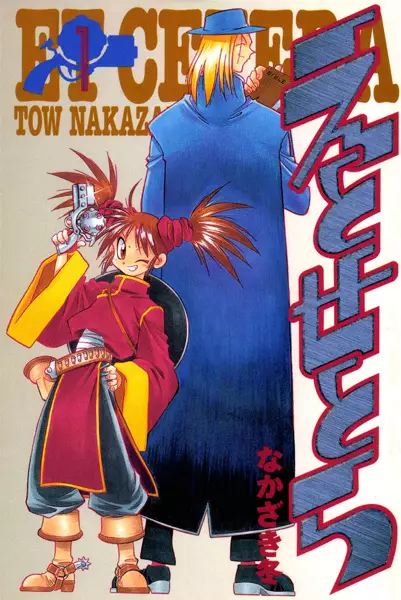
A little chinese girl named Mingchao dreams of becoming a Hollywood star in an alternate version of the wild west. To do so, she leaves her home, protected only by the priest Baskerville who she meets along the way, and her Eto gun, a weapon the requires the essence of zodiac animals to shoot unstoppable animal bullets. (Source: ANN)
Et Cetera is the story of a girl who dreams of becoming a Hollywood starlet, but in order to get there she has to team up with a shady missionary and fight her way through the American West using the magic gun her grandfather left her. It draws its powers from the animals of the Chinese zodiac, and the shots vary based on what animals happen to be around. It has a twin gun based on the Greco-Babylonian zodiac that operates in the same way; both are fairly standard shonen fare. After a few volumes, a crime syndicate based in New York, hunting for bothguns, is introduced, providing an impetus and intensity the story might not otherwise have had. Baskerville is not anyoneâs idea of a missionary. He wears his hair long, he cheats at cards, and he has a decidedly unholy interest in Mingchaoâs Eto gun. At first i thought it was because Mingchao is a Daoist that she doesnât recognize how unlike a Christian priest he is, but she genuinely assumes that everyone around her is who they say they are and trusts them without question â Benkate is another character Mingchao really should be more suspicious of. I find her naivete endearing rather than annoying, but i can see other readers going the other way. Some of the supporting characters get a great deal more development than others; Fino and Alternate are great, while Benkate, Yaghi, and most of the other characters including the villains are little more than cardboard cutouts. Still, they fit together well in the story Nakazaki is trying to tell. The art is very messy, in that patented early-2000s-shonen way. Mingchao is adorable, but many of the adult characters have weird and off-putting proportions. (Such as the womenâs snakelike torsos. And the menâs torsos. Basically what iâm saying is this artist canât draw bare torsos.) It does get ecchi at times, but it flows so naturally â you know those scenes are there for fanservice, but they feel like an organic part of the story rather than something that was shoehorned in. Normally iâm a stickler for calling out historical inaccuracy, but the manga put a disclaimer in the first chapter acknowledging that Hollywood wasnât founded until well after the time period depicted, and frankly, i could see a girl of Mingchaoâs era wanting to be an actress; it would just be heading east to Broadway instead of west to Hollywood. I can forgive that, since it is quite a fun story. On the other hand, there are short stories like the one about a boy and his mother who raise cattle but donât brand them, and then act surprised and offended when their cattle are claimed as mavericks. (By common consensus among cattle ranchers of this period, unbranded cattle were up for grabs.) Mingchao was right to tell them off for not âputting their namesâ on the cows. The geography of this series is difficult to keep track of; it took until the appearance of a map in volume five for me to realize that the entire story didnât take place in California. Even when they start identifying settings, though, there is no strong sense of place. There is one aspect of the story that quite bothered me, that i suspect the average reader would gloss right over. The second volume introduces a character named Luriele, a young girl in a group of traveling performers who used to be a dancer. She had to stop dancing after an accident lost her the use of her legs, everyone believes permanently, and Mingchao is quite supportive of her desire to one day dance again. That all is fine, but the way itâs ultimately handled is that the damage to Lurieleâs legs was purely a mental block, and as soon as Luriele is given a strong enough impetus to walk without her crutches again, she has no trouble at all moving the way she did before. Her muscles didnât even atrophy. Itâs horrible and ableist and cheap, and i canât get past it, even though she was only a minor character. You may have noticed my complaints are focused on the early part of the story; this is because the first few volumes, about Mingchao and Baskerville wandering through the west, are meandering and make it easy to zero in on any problems. Once the manga introduces the syndicate and our heroes have to fight them, the story becomes much more focused and enjoyable, a smoother ride overall, though i think some of the penultimate-chapter reveals were also a bit questionable. Donât come here for a serious Western or historical accuracy, because this manga is silly as all get-out. But Et Cetera is a fun read if you donât think seriously about it.