Links go to search results. Availability varies by region.
ăă©ăăŻăžăŁăăŻă«ăăăă
127
13
Finished
Jan 2002 to Jan 26, 2006
8.5/10
Average Review Score
100%
Recommend It
4
Reviews Worldwide
Say hello to Black Jack is one of the most overlooked manga on MAL due to its lack of English scans and publications (I read it in French). However, it is one of the few manga that left a strong impression on me. Story: 10/10 The story focuses on a young intern in Eiroku (University famous for medicine) and the chronicles of his experience as an intern in different departments of the hospital. Each story arc is a 3-4 months internship in one of the major departments of medicine and Saito (protagonist) is always left in charge of one particular case/patient. However, his naive ideals and stubbornnessmakes him rebellious and doubtful about the ethics of medicine in Japan. From, neonatal care to cancer/chemotherapy to psychiatry, each department provides an unique view on the difficulties and challenges of society. Wonderful storyline, dealing with an extremely mature critical and hard subject with a very strong emotional and psychological impact on the readers. Art: 9/10 Some characters' face are exaggerated in a serious and realistic fashion. The artwork can be categorized as realistic seinen, sometimes bordering on the same category as Vagabond in terms of details. Character: 10/10 The characters are truly multi-dimensional. Many of the "antagonists", i.e. the senior doctors in each department first appears to be insensible and corrupted. However, as the story progresses, we discover that there is no right or wrong between Saito's ideology and that of his seniors. At the end of each arc, not only Saito grows by understanding that his initial thoughts about patient-doctor relationship is too naive, some of the senior doctors also get influenced by Saito. Some regain things from their youth that they have lost after spending too many years in the corrupted system. Enjoyement and Overall: 10/10 This manga is a SHOCK manga, revealing some of the most obscure aspects of the medical system in Japan. While being pessimistic and dark, it still portrays with confidence the presence of hope both for the patient and the doctor...even when there are none....Some of the story arcs, especially the last two ones, very really emotional. I personally shed tears on the cancer story arc and found it to be one of the most deep and well developed emotional and psychological episode of all the manga I have read. I truly recommend this to anyone who is willing to read a realistic manga that criticizes the social system (of Japan) but also add a "human" side to all things. One of the masterpieces.
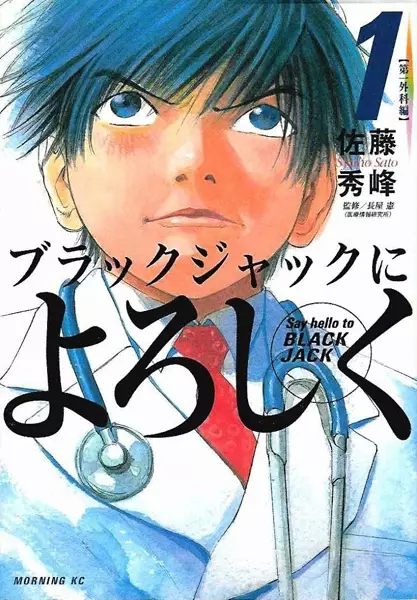
Saitou Eijirou is a newly established intern doctor, who is forced to take on a second night job at another, much smaller hospital because of the extremely low pay he receives. As he bounces between the two different hospitals, he is forced to dig deeper and deeper into Japan's largely corrupted medical society and starts to question even his own initial beliefs, as he asks himself just what being a doctor means. (Source: ANN)
This manga is not for typical otaku, who are looking for a manga that lets them escape the harsh reality. This manga is all about reality. It's hard to read this manga, but it's hard to stop. This is one of few mangas that will make you feel like you don't want to live in this world anymore, and the main reason is the reality of this manga. 100% realistic situations, backed-up with real-life problems and issues that you can find info about in any media. It's no wonder some people rate it so low. Many people read manga to escape into the world of magic, superpowers and maincharacters who always achieve their goals and where the dreams come true. Black Jack ni Yoroshiku is the very opposite. No magic, no superpowers, no miracles. The main character is as real-life human as possible, and dreams are what they are in reality - just dreams, while goals are distant and unclear. Like most people, Saito Eijirou doesn't know what his goals are or why he's doing what he's doing. Like most people, Saito Eijirou has dreams that are ruined by reality. Like most people, Saito Eijirou hopes for miracles that never happen. And like in real life, things never go as planned. All 13 volumes present to you the reality of human life and illustrate how weak and hopeless all the people are in this world. If you've already accepted the reality; if you already realized how powerless you are, then you will find a masterpiece in this manga. But if you're still fooling yourself with "dreams come true" and "believe in yourself" crap, then go and read something more optimistic and fictitious, and come back here years later, after the life will teach you the definition of "reality".
This is a story about a young, intern doctor, fresh out of medical school, who goes from one medical department to the next, driven by a passionate sense of moral responsibility, meets patient after patient who needs his help to survive. In contrast, the Japanese medical system gets in his way, and his senior attendings, who once had that Don Quixote naivety as well, put him down. And yet he still fights, again and again, to help his patients each time, with probably much more success than what would be accurate. The last department he interns in is psychiatry, which focuses on the patientâs stories,and you get the feeling psychology is what the author really wanted to explore this whole time, but I think it would have been more interesting if he also explored, more realistically, a story of our main character having his saviour complex broken down, like thousands of real doctors before him. With that said, this manga is full of stories of patients that take a deeper look into the psychology of what it's like to go through health problems such as cancer, premature birth, and schizophrenia, that are well written, and if youâve had any similar experiences, this could hit you hard. In some panels, the emotion drawn on the charactersâ faces is so well done, you are there with them, you truly, without trying, feel that specific, distinct feeling in their soul, that could probably not be translated as well in any other genre. It was pretty good in all, and if our main character were written with as much depth as some of the patients, I think this could have been an 8/10, especially if you are interested in medicine, I would highly suggest this one.
tl;dr: A manga that has interesting stories about patients and their doctors, but has a protagonist that feels overtly lost and hence doesnât really convey much overall. This manga has a number of interesting sub stories, and most do manage to invoke a high level of emotion, however after reading it it largely wasnât clear to me what it was trying to do or convey. It starts out with Saitou being incredibly naĂŻve and being put off by the harsh realities of what being a doctor is truly like. However, he manages to gather some backbone and determines that heâll do whatâs right to save thepatient. OK, simple enough. That concept works well for the earlier stories where he encounters issues where his patients are put in danger due to bureaucratic issues, corruption, and the egos of those higher up, wherein its clear what the right thing to do is and he boldly does so despite how it would hurt him. However, the manga keeps a similar structure beyond that when he begins encountering issues that are tremendously more complex. These are issues where there very much isnât a right answer that he should just single-mindedly pursue. However, he still pretty much deals with these issues as if there is, and the manga doesnât really make a good case for why heâs in the right for doing so. Furthermore, the complexity of these issues isnât simply in choosing whether to break a rule or take a risk or not, wherein whether the treatment succeeds would be justification for whether he was in the right or not. Rather, these are more complicated cases, where he questions what the point of him being a doctor is and what he truly wishes to do for patients. However, in the end it doesnât really feel like heâs gotten an answer. At the end, he states that heâs stopped asking himself what sort of doctor he wishes to be, but as I have no clue what his answer to that is, it feels more like heâs given up on trying to answer the question than having answered it. Thus in the end, I have no clue what it was trying to convey overall other than things are really complicated, which I donât think is a particularly meaningful statement. That said, independent of Saitouâs involvement, the look into various people and doctors dealing with various diseases in their own ways was interesting and well written, being quite gripping and, as noted, managing to bring out a lot of emotion from me at times, and hence it may be worth reading the series for that alone. Thereâs also a romantic subplot but it was really minor and also didnât seem to have much of a point. I also thought the art was pretty terrible, even if it was going for an incredibly realistic and gritty look.