Links go to search results. Availability varies by region.
Find a Specific Chapter
11 chapters total
Confession
告白 -コンフェッション-
7.29(4K votes)
Ranked #5577Popularity #3378
chapters
11
volumes
1
Status
Finished
Published
Apr 1, 1998 to Sep 16, 1998
Authors:Kawaguchi, Kaiji, Fukumoto, Nobuyuki
Drama
Worth Reading? — Global Verdict
7.9/10
Average Review Score
88%
Recommend It
8
Reviews Worldwide
International Reviews
Dokubachi
Mixed Feelings
6
Allow me to confess that this is not a bad read, but execution and short duration won't exactly put it on top with some of the finer examples. The necessary pace for conveyance of such a story is avoided for the sake of quick culmination. The thrill is there, albeit it is questionable how well you'll be able to immerse yourself next to such predictability. Characters quickly jump into their situational and predetermined roles. There are minor traces of deeper characterization, but are only seen under scrutiny and even as such remains mediocre. Art doesn't really supplement the positive points of this work. Verily, itis detailed and does its job as far as minor aspects are concerned, but in no way does it add to the story. Facial expressions tend to be stoic and unintentionally comical; sort of creates a humorous vibe that has no place in it.
It is cruise-control work in a sense that heavily relies on its end to dumbfound the reader. Problem is that it basically screams atypically-typical finale from the very start, and as such could make one remain unfazed.
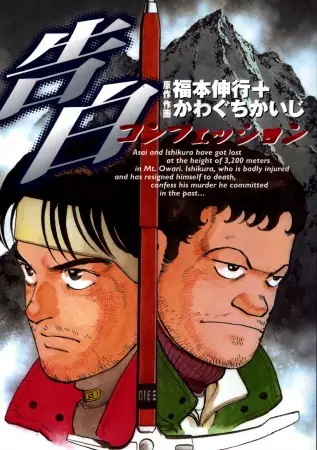
Two miles up in the unforgiving heights of Mt. Owari, hikers and friends Asai and Ishikura are hit by a blizzard and lose their way. Injured and sure of his imminent death, Ishikura confesses to killing a member of their university hiking club five years ago. However, Asai then stumbles upon shelter and carries them both to safety, only to realize that the confession has forever changed their relationship—and that the brutal elements may no longer be the most deadly threat around.
(Source: Kodansha USA)
7,606 Members
Recommended
8
“It’s his fault… for listening…!” A confession might be the greatest relief to the burden and remorse of a sin, especially when you’re on the verge of death. However, one single confession is also capable of tearing apart the masks of pretense and fragile trust between two friends. On a particular mountain climbing trip at Mt. Owari, two friends, Asai and Ishikura, find themselves caught in a blizzard. To make matters worse, Ishikura has also sustained a terrible leg injury during their climb. Ishikura resigned himself to his impending death and confessed the murder he committed in the past to Asai, hoping for forgiveness and that Asaican escape without him. However, Asai did not give up on him. He eventually found an abandoned lodge nearby and carried Ishikura there to seek shelter and call for aid. Rescue is on its way but therein lies one problem. Will Asai give Ishikura up to the police when help arrives? If Ishikura wants to prevent his secret from leaking out, he has to do something and time is running out. With the two of them isolated in the lodge 3,200 meters up in the mountain, the stage is set for the greatest battle of their lives.
Nobuyuki Fukumoto (known for his popular works such as Akagi and Kaiji) demonstrates his deep psychological analysis of the characters as always. The story largely follows the perspective of Asai, as he begins to doubt Ishikura and comes to the revelation that he might be silenced. The two friends begin an intriguing battle where they start to question and guess each other’s intentions behind every move they make. When the game of pretense finally draws to a close, the battle switches into full gear and it becomes a desperate struggle for survival. One would expect Asai to hold the advantage over Ishikura due to the latter’s leg injury, but the tables turn when you’d least expect.
Overall, the story is very compact and well-paced. While there are certain things you might find to be a bit too convenient to happen, I think it is quite excusable for a one volume manga in order to keep the plot going. A 300 page volume is already a lot by normal standards mind you. The entire setup here works perfectly and makes a lot of sense. I like the fact that the battle between the two characters is both psychological and emotional. We have the usual thrills and spills, and the ending itself also provides yet another twist.
In my opinion, both Asai and Ishikura didn’t show a lot of personality, despite being the only two characters here. While the backstory to the “confession” is explained, there isn’t much development to both characters, other than their gradual mental breakdown. They aren’t shown to be particularly smart and their course of action is understandable. Realistic characters are always a plus in my book but they are simply too plain to my liking.
The artwork here by Kaiji Kawaguchi (who also collaborated with Fukumoto on Seizon -LifE-) is pretty good. Generally, the drawing is very detailed and polished. The backgrounds with all the snow and mountainous terrain are especially well done. In any case, at least we are spared the “unique” large nosed characters by Fukumoto. :P
Confession has all the ingredients required for a great story. It’s simple, down to earth, and effective. While it may not be a masterpiece, I don’t have any gripes with it other than the slightly weak characters. Well, if I really want to point out a weakness to the story, it would be the tension. If Fukumoto can bring it to the level of Kaiji, Confession does have the potential to be a near masterpiece. Nonetheless, I find it to be a very entertaining and satisfying read. Anyone who likes a short psychological thriller should definitely give it a try.
25 found helpfulDec 9, 2010
thejackal1234
Recommended
8
Backwards Reading Idiot Reviews: Confession Confession is a short one shot by Nobuyuki Fukumoto, who has a surprisingly long list of notable works, which mostly include gambling series such as Kaiji (three seperate series) and Akagi. Unfortunately I yet to read these series, so this is my first impression of the 52 year old mangaka. Story: Two friends who frequently climb a mountain get caught in a blizzard. In the confusion, one of them, Ishikura gets injured on a rock, and it's up to Asai to save him. After a while andnot being able to find any sort of safety, Ishikura, in the heat of the moment of his belief he is about to die confesses to a murder. A murder of Asai's ex-girlfriend at that. Naturally, he tears up and says what a relief it is to take off such a burden in the moment of death. but then Asai discovers safety of a cabin and Ishikuras eyes quickly dry up.
Quickly Asai notices Ishikuras conflicted feeling about having revealed his sin now that he's going to live. He wants to get away from Ishikura, but it's going to be a few days before a rescue team can get up through the blizzard, so the two men are stuck together.
A combination of lack of talking and emotion quickly make Asai suspicious.
This is as far as I will go for now, and let me say the story had me hooked. Almost like Misery in a sense one of them is trapped and suspicious of the other. The concept alone was enough to entice me for several reasons. Wanting to see psychological development in both of the characters would be enough to make any person want to read this. But you have to consider also, both of these men are stuck with each other with little medical supplies and little food. They're on a mountain, in a blizzard. Should either of these men choose too act rashly, they could easily cover up the act. It's very enticing, just seeing them move about the cabin, seeing them look at each other. Each picture and action makes the other man react in a subtle way. It's this subtlety and only being able to hear Asais thoughts that makes every page edgy, and you filled with wondering of what will happen next in the train of actions and thoughts.
Characters: Since we only have two characters and this is a one shot, I'll be a little brief here. Asai comes across as a slightly unstable, but clear thinking person. In a way he reminded me of the Narrator of Fight Club, he was certainly alright, but possibly messed up in the head. And no the ending is not that he and Ishikura are the same person!... In a way, his psychology even without the tension of the matter was interesting enough. But seeing him trying to process what his friend is thinking, now that's incredibly interesting. Though the author had little time to portray exactly how his psychology works, he certainly did it well in the short time he had it. Asai was probably my favorite of the two.
Ishikura on the other, and I swear I couldn't put it in a simpler way, comes across like Anne Wilkes. No, I'm serious, right down to the almost carefree attitude (though his lacks the peppiness in between any sort of 'outburst'). Now I'm not saying anything by the fact that he's Anne Wilkes (no spoilers to be seen in this review folks) but he literally comes across as quite blunt and very intelligent. Perhaps even more so than Asai. There is the matter that we never here his thoughts, only his spoken dialogue so he does have the unfair advantage when it comes to character.
Art: As I stated in my previous reviews, I am not one to criticize art in a manga as I accept what I am presented with. However, in this manga, art is a little crucial as emotional expressions can be a very important part of this manga, as we focus on the mens psychological development. The main problem I think is that with the features the artist gave the men, is that their emotions can't vary between neutral and fearful. This isn't a typical MCR song, I need a little more emotion. It's the same thing for all 200+ pages. Fearful, then neutral, then confident, happy for about five seconds then fearful again. It seems like the dialogue has more emotion than the characters themselves really at times. However, considering the scenario they are in, I suppose it's forgivable for the lack of expression. Backgrounds and other details like appliances in the cabin are done well, and can be detailed when needed, but for the most time the author can get away with little or no items since it is just a rescue cabin.
The bad: My one and only complaint about Confession is this: it's a little repetitive. Now, it is a one shot, but seriously, sometimes several pages will be devoted to a single statement repeated over and over again. I felt like I was reading an incomplete Abbot and Costello routine. I understand their trying to make it seem like time passes as he thinks over this, but you don't need to waste perfectly good space in a one shot to time passing.
Confession overall (last word): Confession is a great one shot but is not without it's flaws. The story and the characters are great, but the art can be wasted as well as the dialogue. The ending, though unexpected, did not through me for as much as a loop as I had wished it did, and sort of left me like me going 'well that was strange'. But if you have a spare half hour or so, you can't go wrong with confession.
17 found helpfulMay 24, 2011
citrusanime
Recommended
7
Okay, so the Story was made by Fukomoto Noboyuki (Creator of Kaiji and Akagi) and art by Fukumoto, Nobuyuki ( artist of Fukumoto's other collaboration work Seizon -LifE-) So it basically starts off two friends mountain climbing, then they get trapped in a storm after an accident during, that time one of them confessed what sins they committed in the past when one of them thought they were dying. Then suddenly, they found an abandoned cabin full of supplies and a phone (somewhat a weird way to get the story going in my opinion) Story: The story itself is pretty interesting not the bestand its kinda weird how its starts but eventually it gets better. During their stay in the cabin both of them start to lose there minds. I won't spoil it but after, a few more chapters the story gets more shocking by the minute.
Art: The artwork is pretty good, strong, unique and has an impact to it
Characters: both of the characters are well developed and very interesting and I actually, started to feel sorry for one of them
Enjoyment: Its a very good read and it won't take to long to read it.
Overall: Its very interesting to read, so in a nutshell the story, is pretty decent, Art is good and unique, Characters are strong and Overall its a good one-shot if you have time to kill give, Confession a try.
This is my attempted manga review I know its not good but I tried. Thank you for your time, reading my review if you did.
10 found helpfulNov 24, 2010
Beobachter
Recommended
8
The recommendation baseline for Confession/Kokuhaku is simple: if you're a fan of intense psychological thriller, you'd probably love this. Award-winning creators Nobuyuki Fukumoto and Kawaguchi Kaiji provided the story and art respectively for this single-volume manga about two long-time friends stranded in the middle of a mountain blizzard. An unsettling sentence on a pitch-black background set the opening tone, and we are whisked straight away into the thick of it. The rest of the story you should really discover by yourself, but suffice to say that fan of Fukumoto's works (most notably popular long-running series Kaiji and Akagi) would be familiar with what's in store: mountingpsychological tension, dramatic physical stakes, and a pretty bleak view on humanity and morality. I occasionally found Fukumoto 's narrative in Kaiji to be overblown and consequently drag the pace down, even as I deeply enjoy the series as a whole, but there's no such complaint with Confession, which introduced, built up, and wrapped up its conflict at just the length it needs. The manga could be adapted faithfully into 90 minute-ish live action film (something I would really love to see) and not losing anything significant in the process.
There are really only two characters here, the good-looking main character Asai and his crippled friend Ishikura (technically, there is also a third vital character, but she only existed in flashbacks). By the end of the story, we would have known almost everything about these two. The tension, doubt, and constantly changing dynamics between Asai and Ishikura are communicated deftly, interspersed by internal monologues (mostly from Asai's side) that helped building up the atmosphere. If there is a downside to Kawaguchi's art, it is that sometimes the characters' reaction shots are too exaggerated that they ended up looking unintentionally silly, but it succeed at the most important element: nailing the sense of claustrophobia and singular setting in the middle of deathly white storm (and later, a secluded mountain cabin).
Confession doesn’t have a grand concept or ambition, but it’s pretty great at being what it is: a brisk survival story dripping with suspense and paranoia thick enough I feel like I can touch it, and a gripping read all the way to its perfectly executed finale.