Links go to search results. Availability varies by region.
総員玉砕せよ!
13
1
Finished
Aug 8, 1973
8.0/10
Average Review Score
100%
Recommend It
3
Reviews Worldwide
There are many reasons to read Onward Towards our Noble Deaths, and it’s hard to pick which one to start with- a good problem to have. I’ll start by approaching the “single volume aspect.” I’ve read All You Need is Kill and Uzumaki, the two standalone omnibuses I see the most on people’s shelves, and would place Onwards Towards Our Noble Deaths solidly above them both. About 350 pages, but since it was originally published in 1973, it follows the older style of having more frames per page a lot of the time, so it’s well filled, similar in that respect to the text-heavystories of Ohba & Obata (the duo that wrote Death Note and Bakuman), although in a different way that doesn’t have that same text-heavy feel. It’s written by Shigeru Mizuki, and, as it says in the back of the book, is 90% fact (and then they tell you what exactly was changed from the actual happening). Shigeru Mizuki is one of Japan’s most legendary mangaka, on the same tier as Osamu Tezuka, (although I found OTND a little more processable by the modern reader than Adolf) although he’s only recently been introduced to the Western eye. He also happens to have been a soldier, who lost his left arm to the war, along with nearly dying to malaria, and those experiences form the basis of OTND. Mizuki’s art style is hands down better than anything I’ve read pre-90s. There’s a provocative contrast between the backgrounds, which are detailed on par with the best of modern artwork, and the characters, who use Mizuki’s distinct stylistic “cartoonish” rendering that’s reminiscent of Ping Pong, Tatami Galaxy, and other “unusual but better” styles (I haven’t read Oyasumi PunPun yet, but I’d imagine it’s similar conceptually to how that plays out with the main character. As a side note, in Urasawa’s Manben series about making manga, Mizuki gets mentioned a lot, and I think was referenced in the Inio Asano episode because of the similarities). Without spoiling anything, I think I can safely say that OTND is about the tragic absurdity of war, with all the weight of the historical “this really happened” aspect, and a man who suffered greatly from its first-hand perspective. In some ways the themes parallel the classic film Bridge over the River Kwai, only coming from the Japanese soldier’s viewpoint, with the conversations of the characters usually feeling more like Full Metal Jacket. That’s really what’s astounding about OTND- seeing what the atmosphere was like for the “other side,” and the way that one senseless event led to another without anyone seeming to actually want to go down that path, you can’t escape the nagging question, “why did this have to happen?” I want to keep this short, so let me just say that the omnibus is fantastically bound, and looks great on the shelf, as well as in your hands. It’s also nice how when there is a big 2 page spread they usually broke it up with panels so you don’t lose anything to the binding (there was once where they didn’t, I’m not sure why). It’s put out by Drawn & Quarterly, who I’d never heard of before, so they could probably use your support. I’ll definitely be getting more of their Mizuki as soon as I can.
Souin Gyokusai seyo! is a "semi-autobiographical account of the desperate final weeks of a Japanese infantry unit at the end of World War II." Mizuki drew from his own experiences as a soldier in that war to depict the horrors of battle. On an island at the end of 1943, Japanese soldiers are obliged to commit suicide in order to save the honor of their country. (Source: ANN, bdangouleme.com)
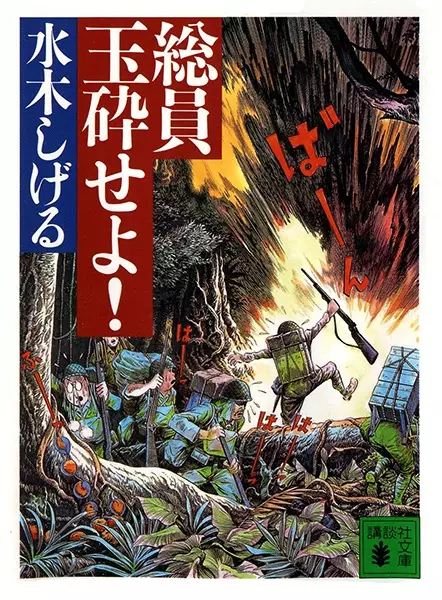
Prologue: Over the course 2016, I spent alot of time on the library in my closest city. And, like any other decent sized library, it had a comic selection. it was in this library i found some of my favorite manga of all time, from Urasawa, Tezuka and many more brilliant minds. I was in a craze for older manga during the fall season, having read most of Tezuka’s mature stories and Yoshihiro’s small story chaos, I came across one of the most unknown (in the west) yet most important works in the medium. Hakaba Kitaro. One of the creepiest and more surreal yet engaging storiesI’ve come across. It lacked finesse and was a bit child-like, but the art and tone were fine for what it set out to do. As with other writers before it, I started searching for other works by its author Shigeru Mizuki (may he rest in peace), and I came across this thin and nearly untouched volume. I’ve never seen such simple art been use to more dramatic effect, with beautiful yet minimalistic color use, and these words written on the front “Onward Towards Our Noble Deaths” “Shigeru Mizuki” Story Overview: We follow a squadron of men from the royal japanese army, who are set to guard a pacific island during the last days of the second world war. We get a sight into the lives of soldiers on the front. how they deal with living on an island with no connection to the homeland and knowing that there is an ever approaching danger on its way. not to say its all negative, there are silly and there are serious encounters. we get to see the soldiers do all parts of the field life, not just fighting. there are chores to be done, officers to hate and dreames of comming home. Visuals: In simular fashion to other manga artists from his era, Mizuki uses very simple character models, and it gets worse considering the small changes between our principle characters who are typically only different by a minor feature or two. This does however, fit very well in with the more goofy tone of the first acts of the manga. It makes expressions more cartoonish and simple, as there is more focus on visuals than on text for the more intense parts of the series. Shigeru does hovewer show that he has much greater talent for drawing than what many of his characters might make you think. The backdrops and backgrounds are either beautiful or haunting and is always packed with attitute and emotion. This is especially true for the nature shots we get in the latter parts of the manga. the jungle truly comes to life in more ways than one. We’re not done with his his character designs hovewer, as there is a clear destinction between who styles being used. we have the more goofy and simple artsyle I’ve described, which is present for the majority of japanese soldiers shown in the manga, especially our main cast, but once the more serious events come in, we are greeted by a gritty realistic style, where shadows overtake the faces of soldiers as they prepare for combat, a simple yet effective metaphor for the horrific things which are done by both sides in the conflict that insuses. the uniforms are also drasticly different at this point, as even with the simpler art in place for facials, there are intense detail and focus put into the folds and imperfections of their army uniforms. Story and Characters: As to avoid spoilers, I will keep this section relativly breif. The historical backdrop and out knowledge of what happens in the future really puts Gyukusai in a peculiar posision. and many will be thrown off by the silly moments which fill the majority of the intro-sequences. I find them however to be pretty interesting and fitting for the reality of war, where people will do anything to stay sane. we come across some stereotypes while others are broken, which can be both a good and a bad thing, depending on the situation. You can clearly see that mizuki tries to remove the stereotype of the agressive japanese, which has mostly been riled up based on the japanese conquests in china, much less the pacific theatre. You can clearly see Mizuki taking his own experiences as a japanese soldier with him while writing this. My biggest issue with the story lies in its inherent lack of true goals. we know from the beginning what really happened in WW2, meaning that the motivations and goals given are for the most part something we already know the outcome of, and its not like the cover photo keeps this a secret. this is a problem many historical war dramas have to deal with sadly, so i wont give to many minus points for it. characterization is something this manga does not do an astonishing task with. I can for the love of me not name a single character from the top of my head. I can remember some of their action, special mentions to mizuki’s self character and the commanding officer of his squadron. they both shown great feats of inner struggle, and both have to take hard decisions which could get them killed, if not executed. especially the concept of suicide in face of defeat is greatly explored. by many characters in this story. Personalities are definitivly made, and you might even get slightly attached to some of these character (not saying much, there exist people who like the fairy tail cast) but there is little time given for many of the characters to be expressed three-dimentionally. To some degree I can accept this thanks to the small amount of time given to tell the story, and the nature of a story we have. Final verdict: If you want a more unique war-drama, then this is definitivly the thing for you. The characterization and story goals might not be that of a top-shelf manga series, but the attention to detail in both art and the life of a soldier are things that definitifly drag it up. Art : 9/10, Its no Berserk when it comes to detail, and the goofier art is eithe hit or miss, but there is no denying that when mizuki wants to too, he can be one of the best. Story : 8/10, I might be a bit biased towards this sort of story, but even with the conflict concluded by history it still shows war in a light few other war dramas do. Characters : 6/10 definitivly the weakest part of the story, but for such a short manga they’re able to accomplish what they need to, and their personalities are not one-dimensional. it does not make the especially memorable however. Final score : 8/10 Media simular to this: Letters from Iwo Jima - a near copy of showing the japanese defend an island against an american invasion in the pacific Theatre of the War.
Souin Gyokusai seyo or Onward towards our noble death is, as the title suggests, a tragic tale of a Japanese infantry unit sent to the battlefront on a suicide mission. Mizuki Shigeru, known for his works like Gegege no Kitarou, presents us a story based on the final stages of World War II when the war was brought to Japan’s doorsteps. A regiment stationed at Kopoko is ordered to send one of its infantry units to retake Baien from the enemy. Upon their arrival to Baien they notice that it is deserted by the enemy, and soon after realize that they face a new challenge ofprotecting this particular place from enemy’s infiltration (by enemy I’m referring to the countries which were against Japan in WW2). Thus, we follow the lives of men in this unit – how they survive in the brutal jungle while always under the fear of an imminent attack from the enemy. Mizuki’s representation of the hierarchy in the chain of command is precise; there is a clear distinction in the value of a high ranking officer from that of a foot soldier. The low ranking officers must follow the orders given to them regardless of how insipid the order may appear. From the start, the atmosphere of the manga is kept akin to that of a real war. Starting from the day to day chores like cooking, washing, and the construction of a base etc. right uptil the mentality of the soldiers amidst all the periodic bombings from enemy fighter jets, the reader is slowly but surely engaged into the atmosphere of the manga. The reader experiences a contrast in mentality through the characters. While the high ranking officers, like Lieutenant-Colonel Tadokoro, take pride in being soldiers and often talk about how dying on the battlefront is something like a samurai’s honor (Bushido – dying in a battle is the greatest of honor), the foot soldiers, on the other hand don’t share the same mindset of giving up their lives for the sole reason of pride and honor since they come from a civilian background and volunteer to be soldiers for reasons like their family’s name or earning their daily bread. They are more practical and share a broadminded approach of retreating and then attacking again with a better chance of survival. The characters are merely the author’s representation of how he perceives life and death on the battlefield. Mizuki’s character designs are plain, absurd and often times identical to the point that the reader has to follow the dialogues with scrutiny in order to distinguish the characters. Comparatively, the background scenery and the landscapes are remarkably drawn and sometimes a single panel is sufficient to comprehend the situation. Art-wise a simple background is used in most panels so that the reader can easily discern the dialogues, though sometimes the picturesque background art of the forest is more than enough for the reader to appreciate the mangaka’s drawing skills. Considering the fact that this graphic novel was published back in 1973, the quality of art is simply awe-inspiring, and is not in any way inferior to works published 40 years after it. The strongest or perhaps the most emphatic aspect of the manga is the irony inherent in the title itself. From the title, Onward Towards Our Noble Deaths, the reader can easily predict where this manga will end up, but by portraying a man dying against his will, the mangaka tries to convey a message that a life coming to an end is nothing but saddening, no matter how much one romanticizes it as ‘a noble death’. There may not be many overt reasons for you to pick up this manga, in terms of a compelling storyline or relatable characters or amazing action sequences; nonetheless, the setting of the story itself is very unique differentiating it from other formulaic plots seen in current manga industry offerings. If in any case you enjoy watching war documentaries then this manga will not disappoint you; just think of it as a three hour documentary, only instead of watching you would be reading it. Note: If you decide to read this manga, make sure to read the afterword and Q&A section too because they present some interesting thoughts from the author which may address some of your questions.