
Links go to search results. Availability varies by region.
GAMBLE FISH
168
19
Finished
Feb 1, 2007 to Jul 15, 2010
5.6/10
Average Review Score
25%
Recommend It
8
Reviews Worldwide
In a school composed of elitist students, which is dominated by gambling matches with very high stakes, Shirasagi, the mysterious transfer student, declares war upon the school by stating that he will bring ruin to it through a series of gambling matches. Who is he? What are his motives? Gamble Fish appears to use an interesting concept, but fails to transmit a coherent and realistic storyline with uninteresting characters. The story of Gamble Fish is simple: Shirasagi, an extreme gambler, who transfers to the famous Shishidou elite school where he challenges students in his conquest to bring ruin to it. As stated earlier, there is agist to the matches: the stakes are extremely high. The bets ranges from "harmless" unaffordable amounts of money to own body parts, subjection to slavery in case of loss, even their own lives. What makes these confrontations even more interesting is, that as the story progresses, more complicated games surges with intricate "death" constructions. This appears to be appealing, but there problems associated with it: the variety of games remain steady, but the various deathtrap constructions do not. In fact, the pacing in which these are introduced throughout the manga is fine for the beginning of it, but this has as problem that it is not possible to keep up with this pacing. This causes to lose the novelty in these traps, consequently a bit in the games as well. To keep the readers interested, the author decides to introduce a different direction for the manga into supernatural powers and myths nonsense, as well as introducing military forces in a game; this is where all realism left. This was a rather big drawback, as so far the mangaka managed to create a somewhat realistic story progression with believable matches, even though being won through sheer luck or plot convenience. Going back to the story, the author manages to represent an image of what he considers how a real gambler is: ruthless, unwavering, knowledgeable and with a lot of guts, which was a positive point to the manga. The characters of Gamble Fish are varied, be it directors or tengu, yet lack any depth. Shirasagi is your typical badass shĹŤnen character who is good in everything he does, is good looking and has immensely success with the ladies. He seems to have an intriguing past, yet little of it is displayed. Throughout the series of matches Shirasagi defeats countless opponents, be it male or female, yet all females fall in love for the protagonist for no real reason, even for harem standards it's pretty unreasonable. There is Mizuhara, whose only purpose is to highlight the main character and remark and explain the games; then all the other females, who basically have no personality at all, being the only distinguishable feature their character design. Some background story has been provided, but no expansion onto it is provided. The villain Abidani was the most interesting character, being a ruthless and insane gambler, which further enhances the ruthlessness and craziness of the manga. Gamble Fish's art style is distinct and clean, yet character designs have the same facial designs, and thus don't really provide any real distinction, besides of me personally not being a fan of the art. Nevertheless, the facial expressions alongside with good shading, makes the art shine, though some inconsistencies can be found. Now the question is whether Gamble Fish is enjoyable. Yes, it is, to a certain degree. But is it good? No, it is not. It tried to display a realistic storyline which was accomplished in the beginning, however with the unsatisfying change in narration in order to keep the manga entertaining, as well as over the top challenges just didn't leave any satisfaction. Characters are dull and shallow with little development, with a debatable art style. Recommendable if you're fan of ecchi/harem with over the top games, though even on these terms it fails to a degree. Thank you for reading.
The story is set at Shishidou, a school attended by rich and elite people. Tom Shirasagi, a gambler, is a mysterious new transfer student who has come from a public school (instead of a prestigious private one) and faces the elitist environment. There, he declares a challenge toward any student and claims he will bring to ruin the whole school through a series of gambling matches. Nobody knows why he has come to that school or what the real motivations behind his actions are. During any match, Tom shows off all of his unique coolness and ability; he employs a wide range of tricks, both psychological and physical, to ensure his victory. In any game, you will constantly ask how he's planning to win, why he's really doing certain things, and what's really going on. At the end of the matches, the tricks are revealed, and they all work in real life, even if they do require one to be highly skilled or lucky in order to perform them. The story centers around the various matches he undertakes and the interactions between the various characters, like Mika Shishidou, the beautiful granddaughter of the school headmaster, who is highly intelligent but contemptuous and superb, or Abidani, the vampiric looking dorm superintendent and main villain (for now) in the series, who has a sadistic personality and whose goal is to make Tom leave his school (or to get him killed). As the story unfolds, more and more about Tom's past is revealed, leading to an unpredictable turn of events. (Source: MU)
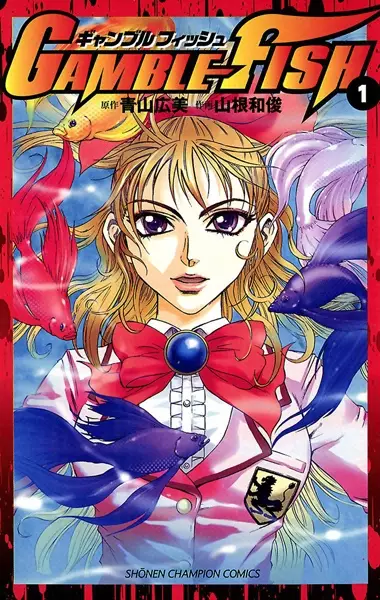
A bit about me. I am a fan of mind-games, gambling strategies and trickery. Knowing this, you can probably see why this unusually titled manga piqued my curiosity. I began racing through the series, bubbling with excitement and anticipation. However, after reading it, I must make a modification to those criteria. I am now a fan of mind-games, gambling strategies and trickery that make sense. Yes, Gamble Fish is a very flawed attempt at creating a high octane manga centred around gambling, steadily getting more and more ridiculous until it begins to feel like a bizarre parody of the genre. It had potential until it becameabsolutely saturated with cheap gimmicks, hackneyed writing, awful characters and general ennui after the manga’s repetitive tricks lose their charm. There is an overall plot here, which loosely strings together the gauntlet of gambling games the main characters must go through. It is simple and forgettable and mainly has to do with the protagonist, Shirasagi Tomu, trying to rescue his kidnapped father by joining an elite school known for its prowess for gambling. We can sense that Shirasagi cares about his father, but this set-up fails because it is never given any real emotional weight. Adding emotional weight to this scenario would have not been difficult at all; it could have been something as simple as showing a flashback of Shirasagi’s life before being traumatically separated from his dad, but the author only puts the bare minimum amount of effort into this whole set-up. This dictates to us that the author doesn’t want us to care at all about the overall plot; just sit back and enjoy the delicious, juicy, psychological gambling games. There is nothing particularly wrong about an underdeveloped set-up in a genre like this, as the quality of the games should be able to compensate for this. The problem is that the games are nowhere near as juicy as they should be. On the surface they look very appetising and you will be eager to sink your teeth into them, but you’ll be disappointed to find that they are dry, undercooked and will probably end up leaving a bad taste in your mouth. I’m not sure why I went for an extended food-related metaphor here, but it seems to summarize my feelings about the games the author has devised. The games are at least quite varied. We get a lot of card-games and dice-games, some of them rigged in interesting ways, and others played straight. Not every game is played at a table-top, with one of the more ambitious games being essentially a massive game of Capture the Flag; allowing for a change in scenery and change in tactics. In short, the author knows not to stay on one type of game for too long, he thankfully experiments greatly with all the possibilities which works in this manga’s favour. Unfortunately, none of these games are stellar. They essentially range from “good-enough” to “absolute garbage”. You will often find interesting tricks and strategies being used to win, but most of these, if not all, are riddled with massive holes that make the believability take a serious hit. The tricks are certainly creative and it is interesting to ponder how one author can come up with so many weird strategies, but the fatal issue is that they simply do not hold water. They are revealed in flashy ways but about two-seconds of thinking will uncover the overall silliness of the strategies. It feels like the author thought up many interesting strategies and winning tricks, but he invested zero thought into making them seem probable. For every strategy presented there are always unconsidered variables and plenty of things that could have gone wrong, which definitely make the clever gimmicks go to waste. At some points, the games forget to even include any kind of gimmicky strategy; instead we have to watch Shirasagi get a ridiculous winning streak with absolutely no kind of strategy to it at all. On the extreme end, Shirasagi can sometimes bend the rules so badly that we wonder why the adjudicators would ever allow it. Towards the second half especially, nearly every game suffers from shoehorned fan-service and/or artificial ways of increasing the level of danger the characters are facing. Fan-service wise, the author really does go out of his way to include it in any way possible. From the female characters having to bet their clothes, or female characters being paralysed and having their naked bodies used as a card-table, or female characters having to stand in a pool full of orgasm-inducing fish (yes, that actually happens), the fan-service is forced into the games in any way possible. Now I have no problem with fan-service, as long as it does not disrupt the tone or the plot. Unfortunately, the ridiculous fan-service DOES affect the tone greatly; turning games that could have been genuinely suspenseful into grotesque wank-material, leaving us no room to get emotionally invested into the drama of the game. Perhaps in a weak attempt to salvage the ruined suspense, the author always makes sure to write some gruesome way for the characters to die should they fail. Again, these constantly come across as artificial and contrived, and get increasingly goofy. A good example of a life-threatening game is E-Card from Kaiji, where the amount of danger is proportional to the reward and the danger arises naturally from the scenario. The deadly traps that Gamble Fish comes up with feels like an 11 year old marathoned the Saw franchise and tried coming up with own cheesy traps while on an energy drink buzz. In short, they are pretty bad. Additionally, the author never explains why these deadly gambling competitions are even legal, and what kind of people would be flocking to an arena to see this stuff. In general, it is disappointing to see the quality of the games rapidly beginning to go into a death spiral as the series continues. The games will still manage to impress you with their grandiose set-ups and overall flair, but in the end they all came across as underwhelming in various ways. The point where the games really go down the gutter is when super-natural abilities are introduced out of nowhere. It completely disrupts the established tone of the manga and ruins the main thing it had going for it. Before then, the manga was tolerable because the strategies and gimmicks that author came up with, despite being improbable and contrived, at least felt creative. Shoehorning in characters with bullshit abilities ruins this element, and subsequently these parts become the worst bits of the entire manga. Thankfully, these moments are few and far between. Probably the biggest problem with this series is the god-awful characters. I will begin with the main character, Shirasagi Tomu, who ends up being an unconvincing portrayal of a “genius gambler”. Shirasagi is supposed to be the fearless badass who does not flinch at the prospect of betting his life on various gambles. This kind of character has been pulled off successfully in the past, the best example being Akagi Shigeru from the titular Mahjong centred series. You would expect a character with such little regard for his own life to be somewhat mentally unhinged, and as expected, Akagi Shigeru is an asocial, potentially sociopathic recluse; character traits that bring believability to this kind of nihilistic personality. Shirasagi seemingly does not care much at all about his own life, but the rest of his character does nothing to sell the former aspect. He is a normal looking and normal acting guy for the most part, and has enough social functionality to constantly be adding members to his harem of groupies (more on this later). We don’t even get a sense of why he is okay with being so careless with his life, another strike against the believability of his character. In Akagi, we see that Akagi gets a rush out of betting his own life on Mahjong. Here, it keeps happening just to make him look cool and edgy. The writer treats his “edginess” like a tap that he can turn on and off as it suits him and the story. Normal guy one second, insane edge-lord the very next. There is absolutely zero consistency in Shirasagi’s character and it really makes the manga suffer. Similar to his edginess, Shirasagi has a certain cocky self-assuredness to his character, which works to a degree but also is very inconsistent. He often taunts and challenges his opponents, which can be fun to watch, but at the beginning of the manga he only does it if he actually has some kind of good plan up his sleeve. Later on in the manga, he literally tells a character who is pointing a gun at his head to “go ahead, shoot, I bet it will misfire!” There is absolutely no reason for him to believe that the gun will misfire, so moments like this come across as absolutely idiotic, and only serve as a cheap way to rile up the audience and make Shirasagi look cooler. If Shirasagi is not betting his own life on a game, he is likely instead betting either huge amounts of money or even his own body parts. Neither of these are handled well at all, in the end just coming across as cheap thrills. Allow me to elucidate. Almost from the get-go, Shirasagi is betting large amounts of money on these games; something that should at the very least result in sweaty palms and a slightly elevated heart-rate. The problem is that we never get a good sense of how much money Shirasagi has in the first place, so we don’t know if losing a million yen is even an issue for him. The money being wagered in this series has absolutely no weight to it, a massive oversight for a series that wants us to feel the tension of each and every gamble. When the series begins to introduce bodily mutilation as a consequence of losing, the games get interesting again…but only briefly. Again, the series does not give enough weight to the idea of being physically mutilated, and when it does happen there are no long term consequences for the characters. It is frustrating to see punctured ear-drums and severed fingers being shrugged off so easily in this series, essentially doing nothing to increase the tension or to make the games more interesting. In the end, this element simply comes across as cheap gore and shock factor. The rest of the cast is no better. We have a generic self-insert side-kick who gets bullied by other characters but then completely trounces some of these bullies in various gambles, sure to make the beta 14-year-olds cream in their pants. We have Abidani, a villain so cartoonishly monstrous and over-the-top that he actually looks like a monster; with goblin ears, a pointy nose and shark-like teeth. I could rant about this character for at least a few paragraphs, but instead I will focus on an even more asinine aspect of the cast: Shirasagi’s harem. This only consists of boring one-dimensional characters but somehow the very existence of this harem causes tectonic shifts that cause massive cracks and holes all across the rest of the series, in unpredictable locations. Most of these females begin as Shirasagi’s sworn enemies (for pretty arbitrary reasons), and being the gamblers they are, they don’t hesitate to challenge him to various games. After being invariably beaten by Shirasagi, they inexplicably become completely infatuated with him and are literally willing to lay down their lives for him. No, really. These girls are completely okay with, no, they actually BEG to be used as his betting chips. We never get a sense of why they love him so goddamn much, and it feels goddamn stupid every time one of them says she’s okay with giving up her own life for him. At one point in the series, Shirasagi has a dramatic speech where he proclaims that he would never put anyone else’s life in danger with his gambles. Well, that rule is kind of constantly broken throughout the series, but I guess it’s okay if those people consent? Screw it; this series is consistently inconsistent, why stop now? This harem element means that Shirasagi is constantly getting involved in gambles that have nothing to do with his main goal; they simply serve to add a gambling girl to his harem so he can use them as betting chips or so that he can benefit at convenient times from their assorted Chekov’s Skills. This element of the series definitely needed some better execution behind it or outright removal. Despite the multitude of flaws I have pointed out in this review (I am only scratching the surface here), I think it is still possible to get a lot of enjoyment out of this manga, and that is if you try to enjoy it in a tongue-in-cheek manner. As I mentioned before, there are points where this manga can begin to feel like a bizarre parody of gambling manga. At points like these, it’s wholly possible to switch off your brain and try to soak in all the unintentional comedy that this series offers. Unfortunately, this method had limited mileage for me. I’d just like to end this rather negative review by instilling the reader with a small glimmer of hope; it IS definitely possible to squeeze quite a bit of enjoyment out of this manga with the right mindset. In fact, there were bits in this manga where I was laughing quite heartily by taking on this mindset; which surprisingly increases my overall rating of this manga by at least a point. Still, that’s not nearly enough to salvage this train-wreck.
Story: So this story starts off a bit strangely. As most people are use to the characters being of high school age, Tomu and his friends are actually all of middle school age. The story was well thought out with a lot of twists and turns. Of course it also made you feel smart as Tomu explained each one of the tricks to the games. The only downside to the story is when the games started to get a little TOO complex. It really took away from how Tomu really was outplaying his opponents and generally just lead to 'yay, he won, I guess?' Art: I personally amnot a fan of the art style, but for what it was, it was well done. There were times were there was too much detail and it took away from the enjoyment, but other than those few times, nothing else was too distracting. Characters: Characters are some of the most important parts of the story, and every character was well thought out. Of course, almost every character had some flaw to them, along with some tragic background, except for Tomu's best friend. Even then, I never really lost sight as to why these characters were doing what they were doing. Every action was part of something meaningful to that character. Enjoyment: Like I previously stated, when the games started to get a little too complex and there were walls of text just trying to explain how the game was played, the enjoyment of the manga seemed to leak away. As much as I like details and knowing how things are working, when there is a whole chapter explaining how the game is played, I found myself skimming the chapters because it was rather boring to read. Then I found myself lost as Tomu is trying to explain how the game is beaten. Overall: This manga was something I had picked up a long time ago and came back to recently only to find it finished. It was rather enjoyable and the only thing that really ended up bothering me was just how I was no longer trying to find loopholes with Tomu, rather I was just waiting for him to explain to me how he had seen the 'trick' and he would win somehow.
I went into this manga really excited since it was a well rated gambling manga and finding good gambling manga can be hard sometimes. I however was severely disappointed after completing Gamble Fish. First off the characters are in middle school yet they are drawn in over sexualized ways which just feels creepy especially when you look at the fact that the story doesn't have to be set in middle school. On top of the characters being over sexualized for no reason, a majority of the female characters only exist to have some sex appeal, accomplish very little and then fall in love with themiddle schooler main character. Additionally, all the villains seem very half baked and have very little incentive to do anything they are doing. Trying to look past the lack luster characters you still don't see much. Gambling manga often include some ridiculous luck but this manga took that to an extreme. In the manga if someone cheats they often talk about how they cheated at some point however at one point in a game of 2 deck blackjack there are at least 20 hands in a row that hit 21 which is just to lucky to even enjoy reading and they never mention cheating. Please pick up a different manga over this, it is poorly written and very overrated on this site. The only good part of the manga is when Obama shows up.
Conclusion: Gamble Fish is a fun romp that delights in taking every gamble our protagonist gets in not just to the extreme, but well beyond it, while slowly ramping up the flanderization of its characters and the sexualization of its female cast until it reaches its tipping point 10-12 volumes in. The flames hath burned strong and bright, until it unfortunately runeth out of fuel and sputtered out, crossing the finish line a mere shade of its former self. Below follows the more in-depth analysis if you want it. Rarely does a work incense me in quite the way Gamble Fish did. Reading this wasultimately an enjoyable experience, but your mileage will vary based on a staggering number of caveats. On the flip side, it's pretty easy to forgive Gamble Fish for most of its various misses when the core of its appeal comes from taking nearly every concept it works with well beyond its logical extremes and directly into downright parody territory, while never winking a single time to acknowledge this to the reader. It's a truly emotional experience in that it makes you feel emotions. For me, it started with a bit of dumbfoundedness as to not being entirely sure of what i was feeling, which slowly transitioned into unadulterated joy. Despite this, frustration would slowly but surely creep in the further down the line i got. Foremost, the series is built on constantly scaling up its encounters to new, even higher extremes. More risk, more ridiculousness, more moving elements, more stakes. It teaches you to expect it to top itself with every single new challenge our protagonist Tom has to face. The problem is it ends up playing all of its best hands by the middle of the story. The last arc that is supposed to be the climax features some of the least interesting gambles and set pieces. At the same time, the further the story progresses the more the characters in it become mere shadows of their admittedly still pretty 2D prior representation. Tom's advantage in this is that he never really was characterized beyond "just a chill cinnamon bishie who like gamble, like win, and whom women love" and fortunately (this is arguable) all these traits remain in play throughout the entire series. The only other major character to benefit from the same treatment is Tom's polar opposite, Gokijima. Everybody else devolves into representations of simple character tropes, which is most disappointing in the case of Avidan. Avidan is the main villain throughout the manga, but despite this, his initial portrayal has him carry an aloof demeanor, seemingly acting based off of a more complex set of motivations. This can be seen during the numerous times where he tacitly sides with our protagonist in various minor ways throughout Tom's early encounters with other gamblers. He does this while being a cartoonishly evil gremlin vampire creature. By the end of the story he remains just a cartoonishly evil gremlin vampire creature. Mizuhara similarly gets reduced to an ambling character gag by the finale. But it's probably time to talk about the elephant I've been keeping in this room, here. The lasses, the ladies, the eye candy. Not a single one of them has any agency upon the story whatsoever, despite being both the majority of the contestants Tom faces, and the majority of his entourage. What's worse, barely any have a motivation that does not revolve around a male. Here, let me list out the various driving forces behind the female cast: really likes Tom, (former) loving brother, abusive father, really likes Tom nr. 2. And when one of them manages to sidestep that and have some intrinsic motivation like Asahina does, who really just likes playing with cues and balls, the portrayal of her friendship with Mika ends up being very fetishized. Very fetishized is eventually what will become of every single female character in the manga, and the writing simply does not have any interest in pretending there's even a gag behind this. Women will be getting stripped strictly for the titillation that provides. Yes, this series features multiple instances of strip poker with dubious consent, how did you know? While there is more to dig your fangs in and tear apart in this manga, the above points are the main complaints, and going any further just feels like nitpicking at this point. It might sound like I am being excessively negative, but I'd like to reiterate that the core experience when reading this is joy. The series delights in small bite sized gags that are sure to get a giggle to somebody even (or sometimes especially) if you send it to them out of context. This happens more often in the beginning but it's a constant throughout the series. I would give this a much stronger recommendation were it not for the female representation that just icks me out. As it stands, I'm pretty mixed on it, but if you can stomach that, definitely go for it.