
Links go to search results. Availability varies by region.
ç„çăźç§ă0ç§ăźæ
6
1
Finished
Aug 18, 2022
8.0/10
Average Review Score
100%
Recommend It
3
Reviews Worldwide
An Autumn in Amber, a Zero-Second Journey short review Language read: Thai (official translation, licensed by Zenshu Publishing; original Japanese publisher: Shogakukan) Will re-read when the official English translation by Seven Seas Entertainment drops September 2024. After almost two months of having purchased a physical copy, I finally got around to reading the third installment of Mei Hachimokuâs sci-fi/supernatural Four Seasons anthology: âAn Autumn in Amber, a Zero-Second Journeyâ. As with the anthologyâs previous books, the male protagonist and the heroine encounter a supernatural phenomenon related to time: âTunnel to Summerâ has time dilation, âYesterday in Springâ has time rollback, and this novel has time freeze. The twomain characters are quite enjoyable to follow along. Kayato, the socially-awkward boy with haphephobia (fear of being touched), and Akira, the foul-mouthed delinquent girl, make for a solid polar-opposite duo. Their interactions and how their relationship slowly develops over time is a joy to read, especially in the later chapters. However, compared to Hachimokuâs previous works, Kayato and Akira do somewhat suffer from a lack of character depth, especially in terms of their backstory department. There are sprinkles of backstory throughout the novel but it feels like there could easily have been more to further flesh them out (like how âYesterday in Springâ uses its Interlude parts). While the plot progression is nice and logical, I cannot help but think that the pacing can sometimes be too slow, especially in some middle parts of the novel. Perhaps it is done intentionally to replicate the feeling of time freeze but it does not translate that well to the reading experience, at least for me. Furthermore, while the themes relating to time that the novel tackles, such as living in fear of the future, are well-presented, they do not leave as much of an impact as the themes in previous installments did. In closing, âAn Autumn in Amber, a Zero-Second Journeyâ is probably my least favorite of the Four Seasons anthology so far. However, this does mean that it is a bad read in the slightest. While some aspects of the novel may not perfectly land, such as in terms of character depth, pacing and thematic impact, the whole is fortunately greater than the sum of its parts. Final score: 7.0/10.
Socially awkward loner Kayato has an intense fear of being touched and finds making friends extremely difficult. When he and his high school classmates visit Hakodate for a field trip, he suffers through some attempts to engage with the others, until... Time stops for the entire world, but not for him. All the hustle and bustle of the city fades into an eerie veil of silence, leaving him the only soul left in motionâuntil he finds another in Akira, a sharp-tongued local delinquent. Though she's his total opposite, she begrudgingly agrees to help him solve the mystery. Their only lead is something Kayato's uncle said just before he died about a "world plucked out of time," as if preserved in amber. Hoping to find a clue among his late uncle's possessions in Tokyo, the two teens must travel through the frozen world. (Source: Seven Seas Entertainment)
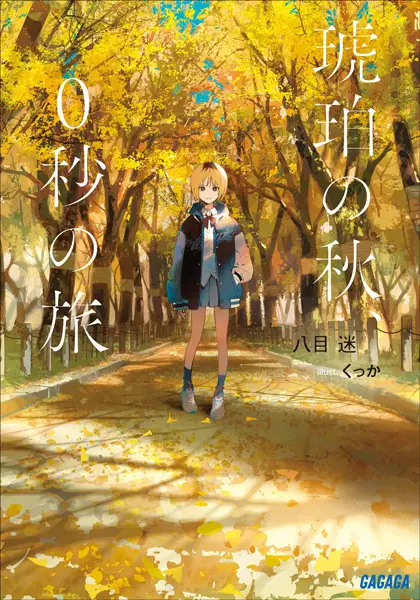
(Note: this review is based off a fan-translation. As of 2024/03/13, Seven Seas has announced an official English publication, releasing in Sept 2024.) Out of the three currently released Four Seasons books by Mei Hachimoku, I'd say this was the weakest. But I wouldn't go as far to say this was a disappointment. The story was well-rounded, I just wish there was more to the story before time stopped to help introduce the main character, Mugino, more. The entire story is based on the two main characters trying to travel across Japan whilst time is frozen to try and find why time is stopped. Mugino, the maincharacter, is well written and his character development is really good. The same goes for Akira, if you were to compare her at the beginning vs her at the end you'd think they're two different people. Character dynamics felt good, even if it was just the two of them, and the reveal of how everything worked at the end was really well thought-out too. My only real negatives are about the beginning and ending; it takes about two paragraphs before time stops so we never really get much of an introduction. The ending did make sense but it wasn't really that impressive, it felt more Makoto Shinkai than Mei Hachimoku which isn't a good thing in this case lol. I don't want to get into spoilers but it could have been thought out a lot more. Maybe my opinion will change once the official translation rolls around. The illustrations were good too. I love KUUKA's style for coloured illustrations! They look so good! My only gripe are the black and white ones. They weren't as good as the ones in Tunnel to Summer or Wait for Me but were still good. I still prefer the black-and-white-only style we got in the Tunnel to Summer rather than the shaded versions we got in Wait for Me and Amber Autumn. I think the main issue this had compared to previous entries is the lack of tension. In Tunnel to Summer, there's a constant build up to the final time when Tono and Anzu are set to enter the tunnel and a preparing to throw everything away to do so. In Wait For Me Yesterday, there's the constant build-up and tension leading towards April 1st which we know is when Akito dies. But in An Autumn in Amber, there just... isn't. There also weren't any major events I like to associate with the Four Seasons series, like the summer festival in Tunnel to Summer and sneaking into the school in Wait For Me Yesterday. But again, in this there just weren't any. This is the weakest entry into the Four Seasons series, but if you like the other two, go and read it. It (hopefully) won't disappoint you, just don't go in thinking it'll be as good as Wait For Me or Tunnel to Summer. I do believe that the reason this wasn't as good as it could have been is because the author was writing another series, which looked more to be the priority, at the time. That series finished recently, so hopefully the Winter novel will be just as good as Tunnel to Summer and Wait for Me!!!
[EN/PT-BR] [EN] What would you do if time stopped as you read this review? Would you make fun of people on the street? Would you eat free restaurant food? Would you rob a bank? Or would you walk to another state with a stranger to your uncle's apartment to try to make time run again? If the latter was your answer, then you'd be in the shoes of Mugino Kayatoâthe protagonist of this story. The protagonists are likable, and their dynamic is good. I confess that at first I found Mugino a bit annoying for always scolding Akira for eating restaurant food and not paying, but upon closerinspection, I realized he was acting correctly (and that perhaps I'm a bad person, since I would do the same thing (time stands still, who's going to stop me?)). The story's development revolves around character development, as the light novel focuses more on the relationship between the two than on how the journey to the destination unfolds. And the character development is enjoyable, as they gradually become closer and closer friends, eventually developing a subtle romance between them. The conflict in this book (as in the other books in the author's Seasons series) is the frozen time, and I feel it could have been explored more deeply. Things like why light, oxygen, and cell phones continue to work even when time is frozen, or why only the protagonists can move, are not explained. However, the lack of explanation doesn't impact the reading experience or the development of the book. The romance in this story follows the same format as the other books, so if you've read any of the Seasons series, you won't see anything new, just characters and a different conflict (although still related to the concept of time), and how they relate to each other and deal with the central problem. It's a great light novel and my favorite by the author so far. It's definitely worth reading not only the novel but the entire series. [PT-BR] O que vocĂȘ faria se no momento em que vocĂȘ lĂȘ essa review o tempo parasse? zoaria pessoas na rua? comeria comida de restaurantes de graça? roubaria um banco? ou viajaria a pĂ© para outro estado com uma garota desconhecida para ir atĂ© o apartamento do seu tio a fim de tentar fazer o tempo voltar a correr? se a Ășltima opção foi a sua resposta, vocĂȘ estaria entĂŁo na pele de Mugino Kayato â o protagonista desta histĂłria â. Os protagonistas sĂŁo gostĂĄveis e a dinĂąmica deles Ă© boa. Confesso que no começo achei Mugino um pouco chato por sempre repreender Akira por ela comer comida de restaurantes e nĂŁo pagar, mas ao analisar melhor, percebi que ele estava agindo da maneira correta (e que talvez eu seja uma pessoa mal carĂĄter, pois faria o mesmo que ela (o tempo estĂĄ parado, quem vai me impedir?)). O desenvolvimento da histĂłria gira em torno do desenvolvimento dos personagens, jĂĄ que a light novel foca mais na relação dos dois do que na forma de como Ă© feito todo o caminho atĂ© o destino. E o desenvolvimento dos personagens Ă© agradĂĄvel, visto que aos poucos eles se tornam mais prĂłximos e amigos, desenvolvendo mais para frente, um sĂștil romance entre os dois. O conflito da obra (como nos demais livros da sĂ©rie de estaçÔes do autor) Ă© o tempo parado, e sinto que poderia ter sido mais aprofundado. Coisas como porque a luz, oxigĂȘnio e celulares continuam funcionando mesmo com o tempo parado, ou porque apenas os protagonistas podem se mover nĂŁo Ă© explicado. PorĂ©m, a falta de explicação nĂŁo impacta na leitura e nem no desenvolvimento da obra. O romance presente na histĂłria segue a mesma forma dos outros livros, entĂŁo se vocĂȘ leu qualquer obra da sĂ©rie de estaçÔes, saiba que nĂŁo verĂĄ nada novo, apenas personagens e um conflito diferente (mas ainda relacionado com o conceito de tempo), e como eles se relacionam e lidam com o problema central. Ă um Ăłtima light novel e minha favorita atĂ© agora do autor, sem dĂșvidas vale a pena a leitura nĂŁo apenas da novel como tambĂ©m da sĂ©rie inteira.