Links go to search results. Availability varies by region.
01 ZERO ONE
41
3
Finished
Apr 22, 1999 to Mar 30, 2000
5.3/10
Average Review Score
0%
Recommend It
3
Reviews Worldwide
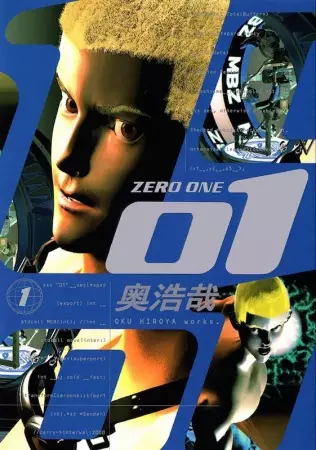
Zero-One is a Seinen, Sci-fi, Action manga about a virtual reality game called MBZ; where players are pit against each other, in superhuman bouts. The overall plot is very interesting and somewhat engaging but this is ruined by the story. The story follows a particular young teenage boy (Nero Isurugi) who lives a meagre life but all things change when he encounters a MBZ champion (Yagami). With the protagonist and the antagonist set, pretty early on, all that’s left is to see how the story unfolds. The flow of the story is pretty typical for this kind of manga but it’s not a bad thing tosee the protagonist develop, through tougher and tougher challenges. Nevertheless it is a problem when random elements are added to the story; just to make it exciting because at times it fails to make any sense (like “01”) . At least the manga did a good job in introducing some interesting characters later on, but soon after that the story ends. The characters have quite realistic personalities, making it easy to appreciate them however none of them are developed well enough, apart from Nero and maybe one other. So in the end this manga lacks any memorable characters that will remain in your thoughts, after the abrupt end. The artwork of this manga is both amazing and odd at the same time. For those who are familiar with this mangaka’s best work (Gantz) would see the noticeable similarities in the art style; incredibly detailed panels that are easy to follow and bits of CG. However some of the character designs are pretty crude and this mangaka’s obsession with big breast is clearly evident. Overall Zero-One proved to be a fairly enjoyable manga, while it lasted, and people who are used playing online multiplayer games would be able get into this manga and its familiar concept. Nonetheless this doesn’t change the fact that this manga was left unfinished, so reading it will leave you feeling incredibly let down and dissatisfied. ^_^
The year is 2028, location in New Koshigaya. A young boy, Isurugi Neru, lives in a poor family and is forced to quit school so that he can find his own way in life. Neru on the other hand, only thinks of one thing: to take revenge on Yagami, a classmate, who's especially gifted and has humiliated Neru numerous times.
Can we really define "Zero One" as a complete failure of sensei Hiroya Oku, despite it being considered the origin of what would become his legacy? First of all, what is this story about? In 2028, in the futuristic city of New Koshigaya, lives Isurugu Neru, a young boy living in a poor family. His father forces him to work and drop out of middle school to help with the household finances. Neru's father, besides wanting to improve the family's financial situation, also forces Neru to find his talent in life. However, Neru is haunted by a single thought: revenge against Yagami, an extraordinarily talented schoolmate in everyfield. Yagami not only humiliated Neru on numerous occasions but also hurt his sister, inflicting pain and anger that Neru cannot forget. Meanwhile, a virtual reality game called MBZ is gaining immense popularity. Despite the economic difficulties, Neru finds a way to frequent the arcades, where he makes new friends and discovers he has an innate talent for this video game. Through MBZ, Neru sees an opportunity to redeem himself and a way to his revenge against Yagami. The story follows Neru's journey as he delves deeper into the world of MBZ, improving his skills and trying to surpass Yagami in the game, creating new friendships, and attempting to overcome the barriers between him and his father. The manga has a very low rating, 5.94 on MAL, but I want to evaluate this work not only based on what I've read but also on the context and reality it gave us following its publication. A work that, in my opinion, if published in another period and with a different budget, would have had more potential and hopes of continuing. The story is very simple and linear, following the growth of Neru, our main character, with very humble characteristics, in which one could easily identify. Unfortunately, the side characters presented to us are not developedmore than one chapter each, and indeed, they are not that memorable. The artwork, in my opinion, is what makes the work stand out. The unmistakable style of Hiroya Oku is noticeable as always and makes the reading very enjoyable. A very important note is that this was the first work in which he experimented, along with his team, with the technique of 3D rendering using computer software. But we'll get back to this later, explaining its fundamental importance. I would also like to add how nice and nostalgic it is to see in 2024 the way he portrayed the characters of the game MBZ through 3D renderings, because they very much recall the old school style of the characters from "Soul Calibur" from 1999. Regarding the ending, it is inevitable to notice that something is off. Indeed, "Future" chapter 41 of the third volume, is the most painful point of the series, because it concludes right at the climax, where Neru will face his enemy Yagami in an MBZ tournament. The reason for this conclusion is revealed to us in an interview by Tokyo Otaku Mode, where the interviewer asks our artist about his decision to create 3D computer images, Oku tells us: "The work we did there was actually quite fun. Still, after two years of paying assistant salaries, and investing in costly computers and printers for 3D rendering, I used up most of my money. Most of the money I had saved from “Hen” was gone, and I thought I was done for when the “01 ZERO ONE” series started to get published but didn’t do well. I was headed for bankruptcy, so I went and asked my managing editor to let me quit the “01 ZERO ONE” series. But I was not going to let all that technology go to waste, so I implemented 3D in “GANTZ”. In the end, all the investments I had made for “01 ZERO ONE” were for a good cause. That flop has enabled my studio to create images that no one else could." And it is thanks to this interview that we understand why this manga is more significant and important than we think. If we look at the overall picture objectively, works like "Gantz," "Inuyashiki," and "Gigant" would not have existed if he hadn't axed the series or invested in all that equipment for the creation of "Zero One." And this is why I consider this work of inestimable importance. From a technical standpoint, it gets a solid 6, but on the other hand, I can't give a number to define how important this work is. However, I can't deny that now I dream of nothing more than seeing a continuation of the series and seeing Yagami's face being stomped by Neru. I would recommend this manga to anyone who enjoys Oku's work and wants to delve deeper into the origins of his artistic style. It doesn't prove to be a challenging read at all, and in my opinion, one could easily finish it in a single evening of full immersion.
"01" es, básicamente, el embriĂłn de la carrera de Hiroya Oku (autor de Gantz). Y...bueno, el problema es que lo malo pesa mucho más que lo interesante. Los personajes son mecánicos y reaccionan sin matices, la tensiĂłn se siente vacĂa y conveniente, y la obra coquetea con ideas como la deshumanizaciĂłn y el control sin desarrollarlas jamás. El dibujo, a pesar de mostrar destellos del estilo hiperrealista que Oku pulirĂa más adelante, es irregular y frĂo. Todo se siente clĂnico, distante, casi vacĂo, lo cual podrĂa haber sido un acierto si estuviera respaldado narrativo por una intenciĂłn clara… pero no hay ninguna. En conjunto, 01 esuna obra olvidable e inmadura, interesante Ăşnicamente como curiosidad histĂłrica para entender de dĂłnde viene la carrera de Hiroya Oku. Recomendarla más allá del completismo o del estudio del autor resulta difĂcil de justificar honestamente. ENG: "01" is, essentially, the embryo of Hiroya Oku's (author of Gantz) career. And... well, the problem is that the bad far outweighs the interesting. The characters are mechanical and react without nuance, the tension feels empty and convenient, and the work flirts with ideas like dehumanization and control without ever developing them. The artwork, despite showing glimpses of the hyperrealistic style that Oku would later refine, is uneven and cold. Everything feels clinical, distant, almost empty, which could have been a strength if it were supported by a clear narrative intention... but there isn't one. Overall, "01" is a forgettable and immature work, interesting only as a historical curiosity to understand where Hiroya Oku's career came from. Recommending it beyond the pursuit of completeness or studying the author is difficult to honestly justify.