Links go to search results. Availability varies by region.
ドゥルアンã‚
6
1
Discontinued
Sep 9, 2019 to May 9, 2020
5.0/10
Average Review Score
33%
Recommend It
3
Reviews Worldwide
Duranki is easily one of the worst works to ever grace the covers of manga. Obviously created as an experiment, not a serious project, Miura himself had no part of this production beyond a previous story. Clearly, people did not bother reading the volume, as this is laid out in the work itself, that the script was rewritten from Amazones. Duranki is barely what Miura even intended, and that may be the best part of the work, that they aren't actually writing anything near what Miura would have made. Elaborating on what this actually means, Miura's original script centered on a Greek Mythology Isekai, very clearlyinspired by Pygmalio (which Miura has cited as the main inspiration for Berserk's Dark Fantasy setting) as well as elements lifted from Kaze to Ki no Uta (another work Miura cites as the 'emotional' context behind Berserk). Gender bending, male-on-male romance, with a shotacon lead, in a dark fantasy world. In this sense, Duranki is spot on with the original intent of Miura's work. In practice, it is executed in an entirely different fashion. From reading Miura's script, even he wasn't as shameless enough to include the blatant lolicon and pedophilia (that he often supported, see his one shot work fighting the implementation of laws to protect minors). The original script, while sexualized, and heavily cartoonized version of actual serious trauma, doesn't include blatant skin on skin content between children under the age of 12. Much of it actually mirror's a lot of Berserks format, and functions a lot more like your typical shonen than a simple mythological adventure, which is one of the main problems of Duranki. The setup reads like Dragonball, akin to Journey to the West but structured around Sumerian myths which (leaving aside someone with a comparative religions degree's criticism on how poorly executed that whole aspect of the story was) are wholley detached from their ancient contexts. I get this is what the Japanese do with their myths. I get this is how they see the west. But it's crass, and ultimately removes the spiritual value of the content. This fantasy that Miura, and many other mangaka have, that "mythology" are like yokai and kami to be played around with is a childs idea of these religious systems. They aren't Superman and Batman stories, they are archetypal evolutions of context applied very specifically, when decontextualized trashes the entire meaning. Who is Utnapishtim in this story? It makes no sense. Nothing about his role makes sense. Nothing about his son makes sense. There is no contextual logic, it's just an excuse to draw fun things, which is great, but again makes this more of an experimental art work than a "manga" meant to have pacing, flow, and reading directionality within movement. You can be inspired by Pygmalio and Kaze to Ki No Uta all day, but when you totally misappropriate what they are doing, you are only going to end up with a hollow shell of a work. That's just the structural basis of the work itself, leaving aside the lack of any character development, and be graceful with the "unfinished" nature of the world (HxH and Nana aren't finished, so that is not a major flaw for me in Duranki). Wanted to love a story about Sumeria, and ended up reading pedophile hentai. Just gross frankly, and at the end of the day Studio Gaga should be completely ashamed with what they produced. Better to have never published this than to tack it onto Miura's posthumous legacy as what is clearly a cheap cash grab.
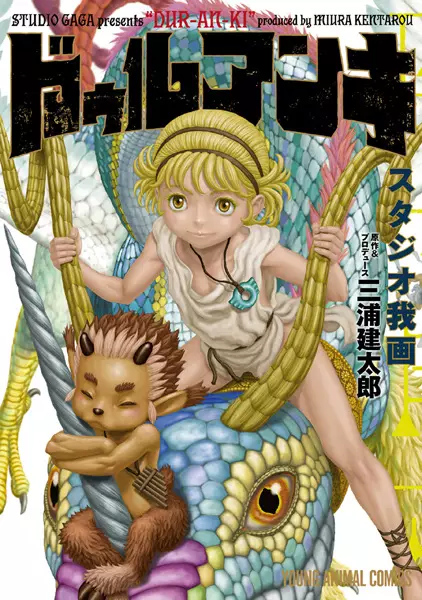
In ancient times, a wondrous child is born of the gods. Neither human nor god, neither male nor female, Usumgal has an inventive mind that can create solutions where they are needed most. Descending from the holy mountain, Usumgal finds friends among humans, and with each fateful encounter comes adventure and perhaps... their destiny! (Source: Dark Horse)
English Language: Duranki is the last work written by master Kentaro Miura. The work has beautiful art, an intriguing premise and well-made characters. The plot takes place in a fictional world where a baby was born with both sexes, and she was sent by the gods to be looked after by an elderly couple in a region where no one can enter because it is considered that whoever enters there will be cursed. The story will revolve around Usul getting to know this new world that people live in, and showing their colleagues their inventions. The big problem is that I can't say more than that because theauthor passed away, and there were only 6 chapters that didn't even cover an entire volume of history. I recommend reading it for anyone who is a fan of Miura, because if not, you will have an incomplete story with a lot of potential. ART 10 STORY 10 MIURA 10 CONTINUED 0 ;-; FINAL GRADE 7 (As it will never be completed) LÃngua Portuguesa: Duranki é a última obra escrita pelo mestre Kentaro Miura. A obra tem uma bela arte, uma premissa intrigante e personagens bem feitos. A trama se passa em um mundo fictÃcio onde nasceu um bebê de ambos os sexos, e ela foi enviada pelos deuses para ser cuidada por um casal de idosos em uma região onde ninguém pode entrar porque se considera que quem lá entrar será amaldiçoado. A história girará em torno de Usul conhecendo esse novo mundo em que as pessoas vivem e mostrando aos colegas suas invenções. O grande problema é que não posso dizer mais do que isso porque o autor faleceu, e foram apenas 6 capÃtulos que não cobriram nem um volume inteiro de história. Recomendo a leitura para quem é fã de Miura, pois senão terá uma história incompleta e com muito potencial. ARTE 10 HISTÓRIA 10 MIURA 10 CONTINUAÇÃO 0 ;-; NOTA FINAL 7 (pois nunca será concluÃdo)
Duranki – Spoiler Free – Mixed Feelings TLDR Story – 4/10 – 4 x 0.275 = 1,1 Art – 9/10 – 9 x 0.2 = 1,8 Characters – 4/10 – 4 x 0.225 = 0,9 Enjoyment – 5/10 – 5 x 0.3 = 1,5 Total: 5,3 -> 5 Story – 4/10 It is art to judge a story that is so clearly unfinished and only has a single volume. Duranki is about the birth and part of the infancy of Usumgallu – a new myth born out of the Serpent gods of Wisdom. It seems to be clearly inspired by ancient Mesopotamian mythology, as Usumgallu is an entity – and also related tohorned snakes – in the Akkadian mythos. Unfortunately, the story is highly unfinished, as Miura died before advancing on Duranki beyond the first volume. The story ends in a not-concluded fight scene, which once again only comes to show that it ought to have more development. From what we have, the story is not brilliant, but it is rather dull and futile to judge a clearly larger project by its first volume alone. It will never make sense with the rest of the story, as the story isn’t like Giganto Makhia, which has a conclusion of its own. Art – 9/10 Miura’s art is incredible, there is no doubt about it. Characters – or what would have been the characters – are design-rich and are easy to tell apart from each other. The work that Maura made on Usumgallu is nothing short of amazing: for an androgynous character, Usumgallu surely looks really androgynous. The scenarios and backgrounds are impeccable and it is filled with detail. However, it does not deserve a 10 (as a normal late-stage Miura usually would do): page composition is mismanaged, for it is stuffed with panels with little emphasis and ridden with dialogue with small fonts; there is also a proliferation of little panels and definitely not what we are used to in Berserk. Usumgallu’s birth is an Miura-like panel: awe-inspiring and definitely sets a tone to what could have been a great manga. But it is hard to comment on the art of a one-volume long unfinished manga. Characters – 4/10 Characters are barely presented, as—once again—this was supposed to be a larger manga that wasn’t concluded. As it happens in the story, it is really sterile to discuss the characters in their present form, for they would make no sense without context and further development. Enjoyment – 5/10 One would gladly recommend Duranki to any die-hard fan of Kentauro Miura – as is my case. However, and for the sake of honesty, it must be said that this work pales in comparison with his other works – even Giganto Makhia, which is also one volume long. It is simply an unfinished work that only serves as the beginning (and not so great at it) of a more epic story. There is no doubt that it could have been great, but we simply don’t have any more material to work on. For all these reasons, it is more deserving of a mixed feelings stamp than a recommendation: it serves to satisfy the hunger for Miura’s work and the curiosity of all those who follow him, but not much else in its current state. To what could have been: rest in Peace, Master Miura.