
Links go to search results. Availability varies by region.
悪の華
23
3
Finished
Dec 19, 1974 to Nov 20, 1975
9.0/10
Average Review Score
100%
Recommend It
2
Reviews Worldwide
This work written by Hideo Okazaki and illustrated by Kazuo Kamimura has deeply unsettled me. It's one of the heaviest stories I've ever read, not only due to its powerful imagery but also because of the meaning it carries. "Aku no hana" [悪の華] or Flowers of Evil, or even 'Fiori del male' as per the Italian title if you prefer. Narrates the story of Rannosuke Hanayagi, head of the Ikebana school of the Kurokami clan, where floral artworks conceal a terrifying world of extreme sexual perversions. Rannosuke, right from the start, is a character under heavy legal accusation for having killed over 800 women,yet somehow manages to temporarily escape it thanks to his political power. Later on, the character of Sayuri comes into play, the true protagonist of the story, who ends up in Rannosuke's clutches, becoming throughout the narrative a plaything for his perverse games. All these elements become a metaphor to address two fundamental issues. The first concerns political power, in Rannosuke's hands, which enables him to manipulate politics as he pleases, even going so far as to incite a war. He has created a dark world in which prominent figures can fulfill their most perverse desires, seeking new experiences by surpassing their limits through the use of aphrodisiacs and drugs secretly created by the Kurokami school. It's a world of which the population is aware, but nonetheless, remains ignorant. Here, the brief exploration of individual responsibility for knowing but staying silent is relevant. Even Hara, Sayuri's fiancé, leaves the newspaper he works for due to their silence about the truth concerning Rannosuke, despite knowing something. Moreover, it should not be overlooked how a cultural and artistic medium like Ikebana becomes a tool in the hands of the powerful. In the story itself, the hierarchical structure of the Kurokami school is likened to that of a mafia-like caste, but as the story itself emphasizes, the former survives. However, the most intriguing aspect of the work, in my opinion, is how its authors aimed to confront the issue related to the patriarchal society and its power over women's lives. Right from the start, it's noticeable that the art of Ikebana is primarily taught to women since being able to beautify one's husband's home is deemed a virtue worthy of a good wife. It's precisely by embarking on this path that Sayuri ends up in Rannosuke's clutches, as if the authors intended to caution female readers against pursuing a predestined path set by the ruling class, still tied to conservative values that deprive women of their autonomy. Rannosuke exercises complete control over Sayuri's life, even extending to managing her sexuality. The girl will suffer numerous sexual abuses that increasingly deconstruct her once-pure image as a woman about to marry the man she loves, who himself falls into Rannosuke's grasp, becoming a puppet whose desires are controlled by his tormentor. Rannosuke also commands a group of school women entirely loyal to Kurokami's perverse philosophy, even willing to die for it. Furthermore, he merely snaps his fingers to repudiate his wife Akane, of whom he's grown weary. "Aku no Hana" is a disturbing work through which its authors shift the focus to a dark world concealed from public view, where those within have the power to control every single aspect of citizens' lives, and where power holders exploit their immense influence to act beyond the law and fulfill their perverse desires. They're willing to commit even worse atrocities to maintain their status.
Rannosuke Hanayagi, the 17th heir to the Kurokami house, runs a company of vice and cruelty under the cover of a renowned ikebana school that covers the whole country. He consumes young girls like cigarettes, tortures them and humiliates them at will. Through his ties with the economic and political world, which he holds firmly by giving him the benefit of his sexual slaves, Rannosuke is an untouchable sadistic prince who reigns over an empire of lust. He begins to educate a new girl, Sayuri, who is to become the new queen of this empire. It becomes the ultimate object of the master's desire. (Source: Editions le Lézard Noir, translated)
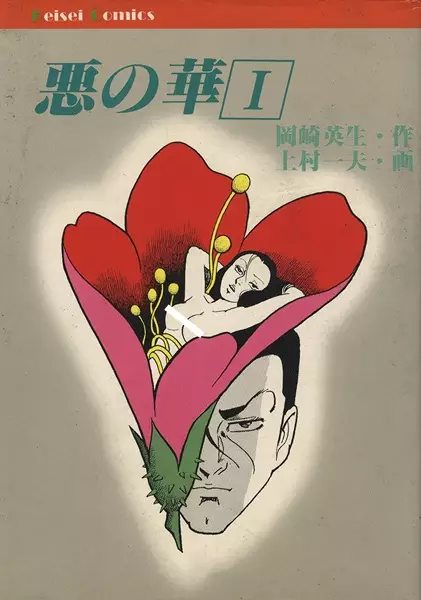
"In order to dominate a flower, you first have to beat it all over without sparing any parts. You shall not concede it a single fragment of a soul. You have to violate it, to abuse it, to humiliate it all the way, you have to make it hit the bottom while carefully switching between pain and pleasure. If any bits of "soul" remains, swiftly nip it in the bud. Make it understand in its deepest core that it is but a mere flesh vessel. It is only then that an absolute and passionate control over the flower will be achieved." Controlling the most influentpersons of the political and economical sphere and having become rich thanks to its wide cultivation of drugs and narcotics, the Kurokami house, expert in the art of flower arrangement, has insidiously become one of the most terrifying faction that ever existed, secretly controlling the country in the shadows to hide what happens inside its mansion… This mansion is controlled by Rannosuke Hanayagi who has, since his 16th birthday, started kidnapping, sequestrating and killing young women amongst his followers from which he preserves the vaginas in jars as the sole memento of their past lives. Aku no Hana starts right of the bat with his trial, proofs having finally been found against him after 20 years of misdeeds and the death of over 800 women. Hanayagi will not even try to hide his acts, worse than that, he brags about it in front of the entire audience. That's because he knows he doesn't risk anything and has complete immunity over any kind of punishment: his prosecutor dies mysteriously in a car crash the same day and a bomb is dropped on a foreign country so nobody will bother focusing on his crimes. Back to his private mansion, the Master of the Kurokami house will soon enough be presented to Sayuri Kawabata, a girl barely 19 years of who has just graduated from university that has recently decided to attend an Ikebana class. Immediately entranced by her beauty and her virtuous looks, he decides that he will train her to make her his new wife and to become the centerpiece to his new "expositions" that he holds regularly. The pristine appearance of Sayuri might however hide another side of her personality that could lead the entire clan to its demise… “The one who makes the flowers live must first learn to know them. Women are flowers but they are also their vase.” Published in Manga Erotopia which was, with Gekiga Hustler, one of the pioneer adult magazines to deal mainly with sex and violence, its authors created a new boom in erotic gekigas (already initiated by Miyaya in the late 60s); Aku no Hana was one of the pillars of the magazine in its early days with the Raping Monk by Kai Taizawa, both series often featuring on the covers while they were running. Despite what its name might suggest, especially due to the great popularity of the manga of the same name written by Shuzou Oshimi, this Aku no Hana has almost nothing to do with Baudelaire, if anything, it is more similar to the works created by the infamous Marquis de Sade than to the brilliant French poet, and one could draw many parallels between this and the 120 Days of Sodom. Although it doesn't go as far as Sade (obviously), the comparison should not be undermined if you want to pick this up because it's still fairly transgressive and the work is seeping with bad taste, from the forced cross-dressing and homosexual intercourse, the incestuous relationships or the human skin leather tanning inspired directly by some of the Nazi practices in concentration camps. As much as I am fascinated by the grotesque and the deviant, it's par for the course not everyone will enjoy it but if you're still willing to give it a go, Kazuo Kamimura's artworks are still as bewitching as ever, every drop of blood swirling around his brush to create as many scarlet flowers, bodies melting under each other's embrace, writhing in agony until reaching the perfect and absolute orgasmic grace. His composition and the different aesthetics metaphors shine all the way through. Hideo Okazaki's writing is not to be left out either because aside from its eroticism, it also manages to become an engrossing thriller by brilliantly crafting every kind of side characters, each having a different motivation to kill Rannosuke Hanayagi and trying to achieve their ways in many different fashions. Aku no Hana, despite its relative inaccessibility by the theme it deals with, proves once again the talent and expert craftsmanship of Kazuo Kamimura who never ceases to impress.