Back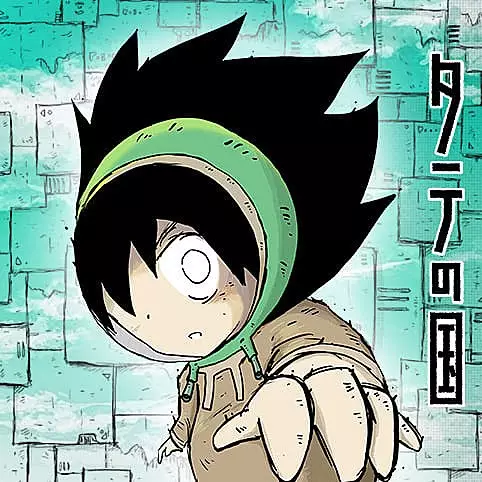
Where to Read
Links go to search results. Availability varies by region.
Find a Specific Chapter
120 chapters total
The Vertical World
タテの国
7.70(1K votes)
Ranked #2085Popularity #8690chapters
120
volumes
—
Status
Finished
Published
Jan 10, 2019 to Apr 1, 2021
Authors:Tanaka, Kuu
AdventureFantasy
Worth Reading? — Global Verdict
9.0/10
Average Review Score
100%
Recommend It
5
Reviews Worldwide
International Reviews
moozooh
Recommended
9
A boy is living in a strange world that stretches vertically, resembling an enormous pipe. The boy doesn't know what's above or below the level he resides on or what is outside the walls, how deep is the seemingly bottomless pit next to his dwelling, or how to scale down. But more than anything else, he wants to know. And as he's pondering these thoughts standing on its edge, an unconscious girl is seen falling down the pit from somewhere very far above. Does he rush to catch her? No—instead, as he watches her vanish into the black abyss, he feels frustrated that she beat himto exploring the unknown. And, without a second thought, lunges after her in an attempt to catch up. With this weird encounter starts their bizarre adventure, transcending time and space to uncover the secrets behind the Vertical World. But seriously, wow. The Vertical World is the textbook example of a hidden gem, and I couldn't have been more glad to find it in a sea of sheer obscurity. As a matter of fact, while writing this a few days after it finished its run, a grand total of 726 users had it on their list on MAL. Perhaps owing to the lack of punchy art, it is being grossly overlooked even despite being published in Jump+, the online counterpart to the wildly popular Jump series of manga magazines. Astoundingly, this is the case both abroad and at home in Japan, as stated by the author who, fortunately, was given the green light to finish the story as planned despite the poor viewership. And I'll admit to being guilty of negligence myself, as the cover art didn't exactly look inviting by any means and made me hesitant to even start. But as I'd learned shortly afterwards, what lied underneath this humble exterior was a high-octane, deeply emotional, intellectually stimulating story that does a stellar job escalating the stakes and making you hunger for the next chapter the further in you are. Much better than most of the regular Jump manga, in fact! Truth be told, it's been a while since I'd read a work so genuinely captivating, imaginative... ...And at times, utterly confusing! As I've implied earlier, The Vertical World is, among other things, a time-travel adventure—but even that is just the tip of the iceberg. Being a very "soft" sci-fi, the story contains a lot of elements that push the limits of speculative fiction, but rather than hand-waving away the more implausible elements, it attempts to explain everything that sticks out. Furthermore, it does so in a simple, concise manner that enables a solid and surprisingly consistent (even if not very scientifically sound) narrative—while remaining fun. The decision to put it on the softer side of the spectrum pays off handsomely here: instead of confining himself to the most proven of scientific principles, Kuu Tanaka lets his imagination go absolutely wild and spares no effort invoking all sorts of purely theoretical phenomena to enhance the story he is telling and the world he is portraying. And by gods, what a unique world it is! If you've ever been fascinated by the gargantuan technological megastructures of Blame!, the abstract horror and ontological mystery of Cube (and/or its less accomplished sequel), or the exploration rush of the Metroid series and similar games—and I certainly am—you're probably going to have a blast with it. What it lacks in moody desolate atmosphere, it makes up in weird and creative ways to utilize the setting and scale it up well into the mind screw territory, with layers upon layers of scientific abstraction ranging from pocket universes and wormhole traversal to digitized minds and computer viruses given flesh—all in the span of just 120 short chapters. And no, that list doesn't comprise even half of the phenomena you're about to encounter. The story starts off relatively tame and the early chapters give off a rather cozy, whimsical vibe reminiscent of Kaiba which clearly inspired some of its visual direction. But by around 2/5 of the run it picks the pace up considerably and never slows down from that point. Every time you feel like you're about to finally learn an answer to one of the core mysteries, a previously unconsidered facet emerges, and the path to a more complete understanding becomes more twisted and challenging by the chapter. It's so easy to become overwhelmed by the complex plot weave that even the publisher is inviting us in the short afterword blurb on the last page to re-read it from the beginning in order to put the earlier parts of the story into the context of the later revelations. How often does that even happen? And I'd say it shouldn't be considered a simple recommendation, but rather a part of the actual reading experience—much like with Primer, Memento, and some similar works with a top-heavy narrative structure which opens up like a flower bud once you look at the reasons for every plot turn in retrospect, and hence demands repeated viewings. (Also, having a visual timeline chart definitely wouldn't hurt in this case.) Now, of course, this way of storytelling is inherently problematic because of how insistently it piles up mysteries and red herrings, making it easy to lose track of what's going on for the reader and the author alike. In this respect, The Vertical World is certainly closer to Twin Peaks than Primer—and although it does give off the impression of careful planning, there still remain many bits and pieces that are hard to reconcile even knowing the full truth, and some creative liberties that look outright silly regardless of context. In particular, the arbitrary magnitude of injury (or the complete lack thereof) characters take from falls or hits, or the ability of certain characters to grab onto smooth wall or cliff sides when falling down—sometimes while *also* holding another person or two. It can become tiring by the end. I get that the world is stretched vertically (duh) and so people are bound to fall *a lot* simply because the premise invites them to, but come on—I have disbelief to suspend here! In general, the physical prowess of the main cast is often overstated for no good reason, and at times that makes the manga look somewhat dumber than it deserves. It doesn't help either that the art, as I've already mentioned above, can be described as minimally functional at its best—and "kids' doodles" at any other time. It really is on the level of the original One-Punch Man and ONE's other early webcomics. This does give it a certain charm, but if anything, you still need to get used to it. It does get somewhat better over the course of the run (though it would be fair to mention that OPM also does) and at some point starts feeling natural. In either case it does highlight the strength of the writing, as people are reading these works not because but rather *despite* the poor art, and still remain loyal. The fact that pages are elongated and are designed to be scrolled down rather than turned over is definitely a big counterweight to the art deficiencies, and this, along with manhwa publications by Carnby Kim, is one of the best examples of such appropriate usage of the medium. In any case, fortunately, I'd say none of the problems I've listed are a real deal-breaker. The Vertical World still excels in the most important aspects, remains wildly fun throughout and delivers engaging character interaction without forced interpersonal drama. And it actually nails a flawless ending (a depressively rare occurrence!): not rushed, nor stupid, nor needlessly melodramatic, but Just Right. I don't even remember the last time I was so deeply satisfied by the ending; it's positively cathartic and it reduced me to a sobbing mess for a good few minutes. So if you are willing to look past the sketchy art and the often cartoony approach to human physiology, the experience you'll be met with is best described by a quote from one of the characters: "I haven't the slightest idea what might've happened... But I can tell you one thing. You've all been on an amazing journey, haven't you?" Couldn't have said it better. (P.S. Since this is published in Shonen Jump+, you can read the entire manga for free on Shueisha's official site and mobile app, Manga Plus. There, you have no excuses to postpone reading it anymore.)