Links go to search results. Availability varies by region.
フリージア
84
12
Finished
Sep 29, 2001 to Aug 25, 2009
8.6/10
Average Review Score
81%
Recommend It
16
Reviews Worldwide
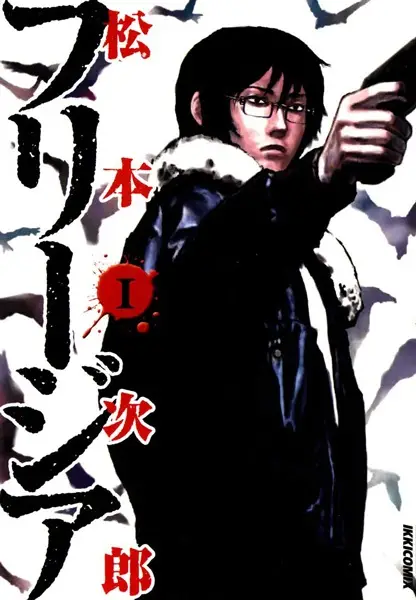
Criminals do not always receive justice. If a murderer serves several years in prison and yet shows little change or remorse by the end of their sentence, should they be free to roam the streets and move on with their life? Written and drawn by the deranged Jiro Matsumoto, Freesia depicts a world where these criminals can be legally executed by a group of trained killers, formally known as 'enforcers'. Rather than meeting a swift and painless end, targeted criminals are legally able to defend their lives by hiring a small group of bodyguards. If they cannot afford one (which is likely- a single bodyguardranges in the hundreds of thousands of dollars) or do not have a friend willing to put their life on the line for their sake, the state will give them one free of charge. Or at least that is what they are led to believe. Far more often these 'free' bodyguards will abandon the criminal and leave them to an almost certain death. Corruption permeates the world of Freesia, but so too do many other awful things. If legal assassination sounds implausible or absurd-- it kinda is. It would be one thing if these criminals were tried in a court and then executed via hanging or lethal injection, but instead innocent lives are put on the line for a twisted game of murder. I suppose entertainment in a story comes before realism. Freesia is not a manga to be read while in high spirits. There are so many disgusting and inhumane events in the story that it is likely to make you pop a few anti-depressant pills. Gore, rape, betrayal, insanity, infidelity, corruption and domestic abuse are among the things that paint Freesia's cruel world. There is the ever-present theme of nihilism, and while it is not too overbearing, the lack of humanity in *any* of the characters is continually made apparent. Yamada is possibly the only character in the entire story who is not an absolutely terrible person, and that is even including the dozens of background characters who appear for only a few pages. This misanthropic portrayal of humanity feels a bit forced. The constant misogyny is also quite bothersome; if the girl has not been raped, she has been victimised or abused in some other way. On the other hand, all the male characters fall into the macho tough-guy persona. For a manga that deals with so much mature content, it can be awfully immature in how it chooses to portray it. Thematic issues aside, Freesia does an excellent job of developing the main character, Kano. While he never becomes truly likeable, he does become more transparent. It is impossible to have any clue in hell what is going on with him at the start (what with his frequent hallucinations and out-of-place commentary), but his behaviour gradually becomes more coherent. Kano understands that something is driving him crazy and chooses to fix it. He realises that it was not the world around him, but he who was falling to insanity. He could have easily existed as a stereotypical anti-hero (the sort that 12-year-old boys go crazy over), but the mangaka thankfully treats Kano as a three-dimensional character. His role becomes less a plot device and more the central theme as the story treads on. The same cannot be said for all the primary characters. Mizoguchi is as archetypical as they come, a cackling lunatic who kills for sport. He accidentally kills innocent bystanders during his job and does not bat an eye. He beats his wife and screams at her simply for doing as he asks. There is no redeeming feature in Mizoguchi. Not a one. A well-written character would at least have a believable personality, but Mizoguchi is a contemptible psychopath "just because". How did he become such a horrible person? Who knows. He receives little to no character development and exists largely as a catalyst for Kano's own issues. There is no excitement to his appearances; it is just another "Oh, great, it's this guy again!" Freesia succeeds in making the reader care about the enforcements that take place. By spending several chapters developing the criminals' backstory and motives, it becomes difficult to decide who to root for. When they take that bullet to the face, they are permanently taken out of the story. It's always a bit of a bummer to see interesting characters perish in an instant (even if they were terrible people who deserved it). There is emotional weight to each and every major event. There is also a bit of black humour spread throughout, such as during a scene where Kano casually sips his coffee as a bullet flies through the window right next to him. Are these moments even funny, though? ... Not really? It's hard to find humour in a world filled with chaos. Some of the scenes (like Kano having sex with his girlfriend on-top of his old, dying mother) are just downright disgusting. It takes a certain type of person to find scenes like that amusing, and I am definitely not one of them. The artwork of Freesia is abrasive and sketch-like, though that isn't necessarily a bad thing. The lack of refinement makes the awful events of Freesia stand out all the more. Had it looked clean and polished, these scenes would only feel out-of-place. This does not excuse the many instances of lazy drawing, however. Panels frequently contain backgrounds that resemble doodles, while others (mostly the gore scenes) are drawn with expressive detail. There's absolutely no consistency to the artwork. Is Freesia an enjoyable manga? Absolutely not. Is it a good one? Sometimes. There are some really interesting themes tucked away in here, but they are inevitably held back by the constant gore and childish misanthropy. Freesia regularly switches from maturity right back down to immaturity. It does not quite know what it wants to be or what it wants to say. It will take a skin of steel to handle the awful things Freesia throws at you, but if you can look past that you will find something much more thoughtful. Probably.
Freesia is set in an alternative Japanese society that is at war, and has passed a law legalizing retaliatory killings. If somebody kills your loved one, you are legally sanctioned to kill, or hire someone to kill, the victimizer. The manga is set around a character who works for a firm that specializes in these retaliatory killings. (Source: OneManga)
As someone said elsewhere, Freesia is a great manga for traumatized people. The level of enjoyment that you will get from this manga depends on your ability (and willingness) to relate to a cast comprised exclusively of various kinds of broken people, maniacs and madmen. If it’s not your cup of tea, then you will, probably, see it as a weak political satire on modern society, full of forced gibberish dialogues and illogical actions. If you can get in sync with the characters’ idiosyncrasies, than you’ll read it as a witty essay on the two most important searches, that any person conducts throughout its life– the search for the goal and the search for the balance. Freesia doesn’t allow sane characters into its main cast: the trio of protagonists consists of a clinically insane guy, a psycho and an idealist. The lead character, Kano, is an unstable schizophreniac, who experiences hallucinations, delusions and memory failures on daily basis. He somewhat compensates for this with his ability to become invisible. (The setting isn’t exactly realistic and allows for some usage of ESP powers.) While technically the plot is organized around the cases taken by the vengeance killing company, that employs the three main characters, the author is more interested in the personal stories of the company's workers and their victims. The manga explores how people affect each other in both physical and psychic ways. (The revenge agency really isn't the point, I have no idea, why people focus on talking about it in legths in the reviews.) The best part about Freesia is that it is not safe. It doesn’t embellish its characters, it doesn’t pity them and even their darkest moments are shown mercilessly, all with a great dose of dark humor. Be warned though that the manga contains large amount of gore and several rape scenes. The art won’t be to everyone’s liking. It is not pretty and it doesn’t try to be. Though, if you’ve read some works by Nihei or are familiar with Dorohedoro you will, most likely, discover its appeal. The drawings are raw, unpolished and gritty, backgrounds are overloaded with details, faces are often oversimplified for the sake of expressiveness. The composition is superb. The art slightly changes from volume to volume: the first ones are a bit unpolished, the last two have slightly different tone to them. Freesia has most of the features, characteristic of Matsumoto’s works – it is dark, dirty, satirical and twisted. But while some of his latest mangas seem to be style over substance, Freesia is still very focused and content-rich. It is a very mature and, in the end, very humane statement on the complicated art of living and on the way we have to fight constantly with the world in and around us.
This manga was incredibly bizarre. It had a decent plot overall. The concept of enforcers, the politics, corruption, and the entire system is pretty interesting. That combined with some decent action during enforcement and the stories of those that were being targeted but wanted to live also made each episode interesting. However, there were major issues with the main characters, in that they were all crazy, which makes sense considering their job. Kano, the main character especially, was really crazy. That can be made to work sometimes, but here it was just ridiculous, with him never making any sense and a good amount of what's going on being hallucinations. It was interesting at first, but the novelty woreoff quickly as it ultimately felt like there was no point to it. Wrapped up in that madness there probably was some sort of deep commentary on society or whatnot, but I wasn't able to parse it at all. In the end, it all felt pointless, where it made no sense why what was happening was happening, why we should care about any of it or anyone involved, as everyone that seemed even kind of likable ending up getting some sort of bad ending before that. Also, the art style was really rough and to put it frankly, quite awful. tl;dr: A manga that seems strange in every aspect to such a degree it's hard to get invested in any of it.
Have I ever told you the definition of insanity? Freesia is written by Matsumoto Jiro, a man that makes manga that are pretty hard to figure out if they are art or simply ramblings by the mind of an insane person. Freesia, his longest work as of date, is the manga that made me realize that its simply both. Honestly, all the other manga that I read from him, Wendy, Netsutai no Citron and Benchin no Madala, were all manga that, even though I enjoyed, I wasn't that big of a fan, but I continued to read mostly out of curiosity, because it was sodifferent than any other mangaka that I had found so far. Freesia as most of Jiro's staples in it, the weird art, the weird characters, the sexual themes, and the dark atmosphere, while at the same time being more stable and taking more time to really establish the story, settings and characters, that's why Freesia is the first manga of his that I really put among my all time favorites. There's something about Freesia. You know those works that really makes you hate humanity? Those movies, books or anime that just show the worst in people, that every character is made for you to hate? That's what Freesia is. a story about horrible, insane people, that ultimately are human. The manga starts with our main character talking to a imaginary friend, in a coffee shop. Eventually a woman that looks like the imaginary friend comes and convinces Kano to join a organization that is supposed to execute ex-cons if a relative of the person the ex-con killed wishes to. Everything is approved by the government so that the people forget the war that's going on. This war is never explored much, it just exists in the background, there lingering and creating tension. If you think this story is about why the woman looks like the imaginary friend, it's not. That plot is revealed pretty early on, and in the words of Kano: "Oh, that's all there is? I thought it was something important." This manga is full of those moments. Things that seem important to us, and to the people around Kano, ultimately end up being nothing in his mind, of course, his mind is a mess. There's a scene where he doesn't kill a man because: "He felt like the man didn't want it", even though that's his job. It's almost like he's a child thrown in that environment and is just going with the flow. But Kano isn't the only one in this state. A lot of the main characters have some kind of delusions and hallucinations going on. The fine line between reality and hallucination is never fully revealed until it's too late. In the end everything falls together. It's not like we get every explanation to every question spoon fed us, but it connects very well and what needs to be explained is explained. It's a manga that feels much like the movie Fight Club, Filth or Memento and has the same kind of surreal feel to it. The only bad point I can find is the art, which either you like it or you don't. It's unique and it works well with the atmosphere, but I can see how a lot of people would be put off by the messy lines and horrible faces. All in all, this is a great manga and if you're into psychological stuff you're going to be highly entertained by this work.
Did you ever think that criminals deserve a much harsher punishment than being sent to jail to serve time? Ever thought that the famous law of Talion should be in vigour? Freesia portrays such juridical system in which the victim's family may issue a warrant to have the aggressor executed legally. The story of Freesia is narrated in a society plagued with war, in which killings are legalized and are carried out by enforcers, who are trained killers or ex-soldiers. The protagonist Kano is recruited by Higuchi to such an agency, in which he cooperates with the newbie Yamada and the senior Mizoguchi. There is moreto Kano - he is not your typical protagonist; he has a disturbing personality, is very antisocial (unable to communicate accordingly with fellow humans) and he is plagued by hallucinations. In the beginning you have literally no idea what to think of this character. The manga also displays a lot misery, corruption, cruelty, gore, paranoia, insanity and misogyny. A bit in excess in fact, impacting the story in such a way that it seems that no humanity is portrayed in society at all. Other thing to mention is the war that takes place: basically nothing is explained about it, why it did happen, how is society affected by it, none of these questions are answered, making the war a mere plot device to justify the current juridical system, which leads to other point of the story: the "enforcing". First off, there is a gist to the system: instead of criminals being executed in a controlled and official environment, criminals are hunted down by enforcers. The criminal is free to hire bodyguards to defend against the prosecutors, but these are often unaffordable, which leaves the criminals with no other option then to rely on their friends or family members. Nevertheless, they have the liberty to choose a place where the enforcement should take place. The idea is interesting, but there are problems associated with such a system: trying to assassinate each other in populated areas, hence involving and risking the lives of many innocent civilians? This would never work in reality, leaving the reader with a somewhat unsatisfactory story setting. The development of the main character Kano is one of the strongest points in Freesia. Besides of being an interesting character, Kano himself is aware that he is insane, and not the world around him as he thinks in the beginning; he tries to change it gradually, which he does through interactions with different characters and events, and his own hallucinations. This cannot be said about the other characters. There is Higuchi, who apparently has a motive for working in such an agency, but this is never portrayed throughout the manga. The same could be said about Mizoguchi: characterized by being a total psychopath, who beats his wife on regular basis, killing innocent bystanders, without having a single positive characteristic to him. Nothing is explained on why possibly he displays such behaviour. A lot of secondary characters are introduced, with some being interesting as "The Phantom", the grandma, but a lot of those are shown in some pages and just disappear, as in the case of the serial killer. This character seemed to have some importance to the story development, but after being displayed to the reader, suddenly isn't mentioned before. Or the lover of Keiko, who suddenly disappears as well. The art style of Freesia is sketchy, which fits well with the theme of the story, making it able to display the cruelty and gore of the world well. Nevertheless, inconsistencies could be found in the manga, as well as characters design being simplistic and hard to distinguish from each other. Overall Freesia was a compelling read which suggested an interesting juridical system for themes such as revenge, but failed to convey these in a realistic manner. The characters were somewhat lackluster, and lacked in humanity, Kano being the most appealing one of the narrative. Definitely recommendable to anyone who seeks a dramatic action manga. Thank you for reading.