Links go to search results. Availability varies by region.
ホットロード
18
4
Finished
Feb 13, 1985 to Apr 13, 1987
8.3/10
Average Review Score
100%
Recommend It
3
Reviews Worldwide
Lurking around the internet looking for a quick read, I come across Hot Road. To be honest, I wasn't expecting too much but I got so much more from this series that I felt compelled to write a review. Hot Road may not seem like much at first glance, but it truly is a very well done manga that I recommend! Story: (8) The story is simple. A simple, quiet girl ends up getting involved with a motorcycle gang and ends up getting romantically involved with one of the gang members. The manga is not too dramatic, though, and at times it almost feels like a sliceof life. There aren't many plot twists or overly dramatic portions, just a beautiful simplicity that allows the characters and their relationships take the main stage, which the mangaka handles very well. Art: (7) Like most older manga, the art takes a little time to get used to. With time, though, it really comes to grow on to you and there are a few particular panels where the art is really, really well done. Nonetheless, sometimes the character's expressions were sort of dull and the backgrounds sometimes weren't very clear, so I can't rate it any higher than a 7. Character: (9) This is where Hot Road shines. Kazuki, the main heroine of the series, is not your typical shoujo protagonist. She's serious, quiet, and keeps to herself. Every once in a while she does cry, but it feels fully justified and not at all over dramatic. Haruyama, her love interest, starts out as a typical rough gang-type character but in a few chapters comes to grow to so much more. Better yet, the two grow, mature, and develop as the series progresses in a very satisfactory and realistic way. Supporting characters are not given as much backstory and development, so I cannot rate this section a full 10, but they were given a satisfactory amount that they do not feel flat and boring. It may leave pickier readers wishing for more, but I was fully satisfied. Enjoyment: (10) I got a lot more than I was expecting from this series. I was just looking for a way to kill time and ended up finding a very well-done, interesting, and enjoyable series. I planned on reading the series over a span of a week and ended up finishing it in two days since I kept wanting more and more. Overall: (8) Hot Road shines in its simplicity and captivates you slowly and fully. It's not a masterpiece, but it certainly is a very good and well-done series that is worth looking into.
Kazuki always felt a barrier between her and her mother, because her father, who died when she was still a child, was someone her mother hated. She wasn't a child born out of love. One day, Kazuki is persuaded by a friend to meet Hiroko-san, the girlfriend of the head of the motorcycle gang "NIGHTS." And there, she meets Haruyama... (Source: JShoujo Scans)
Hot road is a popular shoujo series in the 80's which tells the story of Kazuki Miyachi and how she got to meet the "NIGHTS" motorcycle gang and a boy named Haruyama. In it's base, Hot road is a very youthful story. It feels very rebellious and "punk". Aside from the motorcycle gang rivalry and business (which is pretty minor) we can see all sorts of experiences that a lot of teens can relate to and understand:stuff like rebelling, without cause sometimes, against parents and teachers. Feeling like no one understand you or your actions, and sometimes not understanding them yourself. Problem dealing and communicating withthe adults, and finding that friends are above all... even stuff like first love. All of that is not new in story telling, but Hot road bring it in a very authentic yet simple way. A lot of stuff feel dramatic, as teenagers often feel about things. The excellent way of understanding and getting across the mind of youths in what really amazing in the story. The thing that could only be a minor disappointed was the fact that there were drugs in the manga (very rare!) but the author never really dressed it or the problem properly, in my opinion. As for the characters, a lot of them feel real. They have problems at home, especially our Heroine, which feels unwanted and unloved at home, finding comfort in the gatherings of the "NIGHTS", finding love from Haruyama. Haruyama is also case of "rebel without a cause", living apart from his parents and doesn't want to communicate with them, yet deep inside he blame himself for that. Although a lot of people love him and adore him, he has a case of self hating, which can lead to self harm. This we see a lot in this manga. The characters usually do stuff that can lead to your own demise, because that's how teens are. They live, they laugh, and often they don't think things through the end. Getting in trouble and just enjoying the company of each other. The art is... well, pretty bad to be honest. It's not just the matter of old fashioned art or something like that, the problem is character design. It's just not good, most of the time. A lot of characters are similar (same face) and it's really annoying when you try to figure exactly who is who. But, as said before here, the style is great. The perspective, the paneling and of course the zooming when we can see only the eyes and the mouth of the characters, adds a lot. What lacks in the art, the style is covering for that. Overall, it's a great manga. It's young and fresh and as said multiple times-simple. It's not really hard to understand and it's short. The thing that may bother you (and bothered me, a little bit) was how dramatic the love story was-of course, it fits perfectly for the story, as teenagers often feel like their first love is the biggest love of their life, and that they could never love like that again. But still, I can usually never stand love stories like that. If you like good, realistic teen stories, I believe you would like Hot road.
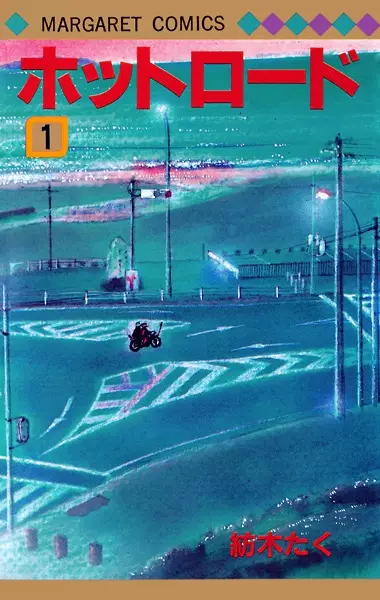
The expanse of the night. Headlights. Motorcycles roaring loudly. The 80s were the heyday for the bosozoku as they took reign of the roads and terrorized the old by bringing chaos wherever they went. A social phenomenon that caused as much indignation as it did fascination, with plenty of fictional works, either at the time or later on, taking inspiration from them. Whether through the bombastic, gruesome portrayals of how the bosozoku operated, or more light-hearted, comedic even, depictions of bosozoku, there is no shortage of titles to choose from. Hot Road is a special case where it actually feels like a lived-through experience of thattime, in part thanks to the introspectiveness of the narration, and in part thanks to the art. The background art is dazzling, particularly when scenes of the road are depicted and emphasized. Dialogues unfold in spread-out sequences across panels, causing the scenes to appear fragmented, going along with the characters’ intense state of mind. The protagonist, Kazuki, is an extremely interesting character. It's through her inner world, her lenses, that the story takes a down-to-earth, almost intimate approach. A messy home environment and a sense of justice as she defends a classmate from harsh scrutiny lead her to say goodbye to the "good girl" facade and embrace the recklessness of youth as she starts skipping classes, dyeing her hair, and meeting with her local biker gang members through a friend of a friend. There she meets resident bad boy Haruyama, a high-ranking member of the "Nights." Although they have an awful first encounter, they soon realize they're more similar to each other than they thought: kids misunderstood not only by their parents, but by every single person around them. It is through Haruyama that Kazuki starts feeling alive; the way he drives his bike at such a speed, how he gets into fights without thinking and luckily comes out of them in one piece—all of which in a certain way makes her gender envious, an envy for freedom that Kazuki's been denied until then due to performing strict gender roles. It's a thorough read on the no-consequences attitude all teenagers act upon or admire. Small details, such as Kazuki trying to ride a motorcycle for the first time, peers from her age group that she isn't exactly friends with but who still agree to invite her over to their houses when she runs away from home, and having small but difficult conversations with her concerned teacher at school, all make Hot Road such an authentic depiction of what it's like to be young in that stage of life where everything to you is a do-or-die. It is no wonder why, to this day, it's a well-regarded work in Japan. While reading this manga when it first came out, back in the '80s, must have felt uniquely special, I think it's a work that will continue to be worth a read. It's no easy job to transport readers to a time and place different from our current one. But in Hot Road's case, you don't need to be well-versed in Japanese culture or the particularities of it at that time. It's enough to have been young once to get it. My only gripe with this manga is that the ending lacked a punch—a very standard “surrender to social norms.” Otherwise, it is still a great work I highly recommend reading at least once.