Links go to search results. Availability varies by region.
ææăźăăżă ă
65
10
Finished
Jun 30, 2005 to Aug 30, 2010
8.6/10
Average Review Score
95%
Recommend It
20
Reviews Worldwide
What makes a good story? For many people the answer to that question is very simple - enjoyment. For some though, enjoyment is only part of the equation. Originality, innovation, technique, development and visualisation are all integral aspects of the storyteller's art, and even though there are tales that utilise themes, plots and settings that are already prominent in manga and anime (school based romantic comedies for example), the application of these techniques can turn something mundane into something very, very different. Wakusei no Samidare (or, The Lucifer and The Biscuit Hammer - although a more literal translation of ææăźăăżă ă might be Planet Samidare or Samidare'sWorld), is a strange and slightly demented tale by Mizukami Satoshi that follows the lives of thirteen disparate people who have been brought together to protect the world from the mage Animus and his dreaded Biscuit Hammer. Amongst them are Amamiya Yuuhi, an antisocial college student who wakes up one morning to find a talking lizard in his room, and Samidare Asahina, the "princess" and leader of the Twelve Animal Knights who is the living embodiment of the power that opposes Animus. There's just one problem though. Unbeknownst to the most of the Animal Knights Asahina wants to destroy the world herself, which is the only reason she fights against Animus, and to make matters worse, Yuuhi secretly agrees to help her. One of the main problems that some people may have with Wakusei no Samidare (I refuse to call it Hoshi no Samidare), is that the story can, at times, be a little on the convoluted side. In addition to this, there are occasions where the author seems to have a little trouble getting to the point and at times the manga seems to simply ramble on for a few pages. However, those who are willing to overlook these relatively minor gripes will find a rather strange and interesting tale that plays on several well known themes. The plot is broadly centred around the stereotypical "sentai" format (think Power Rangers et al), with several key differences, the main one being a sense of maturity as the manga moves away from what one would expect as the story develops.There is also a lot of subtext added that is often missing from other sentai tales that may not be readily apparent at first. One example of this is Asahina's use of the name "Lucifer", which signifies her deception of not only the other 11 knights but Animus as well. The irony is that this nomenclature is also applicable to the story itself as while it may look like a "normal" sentai tale and feature the stereotypical princess and knight pairing, it's actually something a little deeper (more on this in a bit). Wakusei no Samidare is an unusual looking story as Mizukami Satoshi has opted for a look that doesn't really fit with today's manga offerings, and unfortunately this is the main reason why people may not read this series. The characters, for example, may look like individuals, but they all follow the same core design principles and because of this the series is rife with strange body positions and evil grins. That said, the simplistic approach to character design works surprisingly well throughout the series, and makes for some interesting situations and set pieces. Mizukami has also rendered the backgrounds and settings in a manner that is reflective of the mentality of the series, with much of the scenery following the same simple method as the character design. Surprisingly, this approach actually enhances the characters in a way that, again, may not seem obvious at first, and because of this many scenes have more impact on the reader than one might expect. My gripes with the artwork though, were the minor ecchi moments as they seemed totally unnecessary, but thankfully those occasions were few and far between. Now any story that features a host of characters will undoubtedly face some issues when it comes to development, and while Wakusei no Samidare does encounter some of those problems, the majority of gripes one might have are nothing more than nit picking. That's not to say the characters develop in the standard manner though, as Mizukami has clearly tried to be innovative in his approach where they are concerned. Many readers consider Yuuhi and Asahina to be the two main characters of the story, however this manga is written in a manner that brings not only each of the knights and Asahina herself to the fore, but also focuses on Animus and the "opposing power". There is a fair amount of time spent on Yuuhi as he is the only knight who knows of Asahina's plans, but it quickly becomes clear that he is not the only important character. One aspect of the writing that I loved was that the other characters are equally as important as the two leads within the bounds of the tale. What do I mean by that? Well, there are several figures who aren't key to the main story but have a lasting impact on the characters and their development. In addition to this the series isn't afraid to leave the main characters out of the picture completely, and there are whole chapters that don't feature one or both of the leads. Wakusei no Samidare is a very odd manga that features odd characters and situations and wraps them up in what appear to be stereotypes, and I loved every page of it. That's not to say it's perfect, as although I wasn't really bothered by the look of the story, it's understandable how people would be turned off by it. One thing that does bear mentioning though, is that this tale isn't exactly what it appears to be on the surface. Yes, there are elements from a number of other manga used throughout, but one of the things that the reader needs to understand about Wakusei no Samidare is the importance of the relationship between Yuuhi and Asahina, as it's not as straight forward as it first appears. At first glance it's a typical princess and knight format, and that perception is reinforced by the usage of those titles. In actuality though, the relationship between the two is that of the sorceress and the knight, which is a very different concept, and one that harks back to older folklore and legends from around the world. This relationship is only one of the less obvious aspects to the story, and while readers may not appreciate the difference at first, it is relevant as it allows for a very different approach to developing the plot, as well as a different understanding of events by the reader. One of the nice touches was that Mizukami made the effort to camouflage these aspects rather than hitting the reader over the head with them. It's just a shame that so many people judge a manga by how it looks.
One day, college student Yuuhi Amamiya is approached by talking lizard Sir Noi Crezant. Crezant immediately launches into a fantastical story: the powerful mage Animus intends to destroy the Earth with his Biscuit Hammer, a huge contraption looming high in Earth's orbit. Earth's only hope lies with the princess and her Beast Knights, whose task is to protect the princess and defeat Animus. Yuuhi is chosen as the Lizard Beast Knight, and despite his misgivings, is quickly forced to defend himself from a golem created by the mage. He is saved by his neighbor, the princess Samidare Asahina, and swears loyalty to her. However, the princess does not intend to save the Earth at all. She lets Yuuhi in on her real motivations: to prevent Animus from destroying the Earth, only to then annihilate the planet by her own hand. The pair continue to fight off attacks by Animus' golems while the remaining Beast Knights are slowly being gathered and learning to use their powers. As he grows closer to Asahina, Yuuhi will have to decide for himself whether to go along with her plans or to save the Earth. In the process, he must also confront his true self and determine where his loyalties truly lie. [Written by MAL Rewrite]
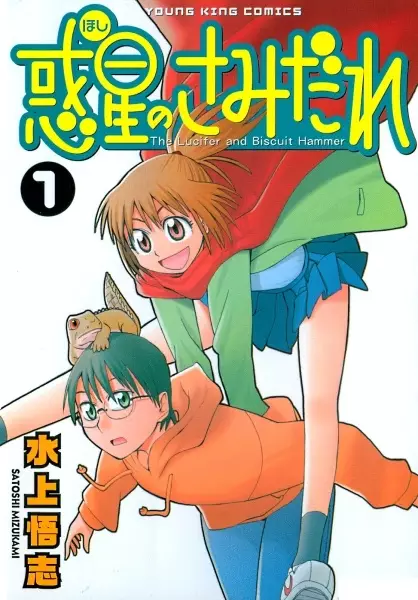
At first glance The Lucifer and Biscuit Hammer may not look like anything special, however looks can be very deceiving. It very quickly blossoms into one of the most engaging, funny, and at some times tragic stories that I've ever had the pleasure of reading. The story may not be anything particularly original, but it easily makes up for its lack of originality with numerous twists and quirks that make for an enjoyable read that never fails to surprise, right up until the last chapter. Little things, such as the Princess' motivations for wanting to save the world, or unexpected character designs keep it interesting. Oneof the things I appreciated most about the story was its uniformity. There were no noticeable plot holes or contradictions that most manga are filled with. Most mangaka seem to make things up as they go along, which leads to inconsistencies in the story. It was clearly planned out, at least loosely, from beginning to end. The humor is an integral part of the manga. The author makes use of an extremely dry sense of humor, that I'd expect from something out of Britain, not Japan. The thing is though, it works. I honestly laughed out loud a number of times, which is rare for me. It constantly pokes fun at typical shounen cliches, such as characters naming their techniques. The characters are particularly interesting. The author makes very little use of character archetypes such as tsunderes, which have become increasingly common. Nearly every character is unique and given the attention they deserve. They're all given a proper back story, and each has very different reasons for why they fight. I also can't say enough about the growth that Yuuhi exhibits throughout the story. It was fascinating to watch him grow, and not just in the traditional sense. He gets physically stronger, yes, but he also matures tremendously throughout the story, all in an extremely natural way. The art, while nothing impressive, is still quite good for the most part. The characters are all instantly recognizable. The fights are easy to follow. The author also makes extensive use of capes for dramatic effect. If something epic is happening, it's almost always accompanied by a cape or something similar blowing in the wind. I consider it to be the authors trademark, as it's present in all of his works that I've read. This is one of my personal favorite manga, and I haven't talked to anyone who hasn't liked it. If you're still skeptical though, take five or ten minutes and read the first couple of chapters. I guarantee you'll be hooked.
As a forewarning, this is my second review and consequently Iâd like to try something a little experimental, so this review is going to be very Trope Heavy. For those of you who donât know what that means: pull up a tab and go to TvTropes.org, then, when you emerge some hours later blinking into the sunlight, head on back over [and congrats on breaking free of your Small Secluded World]. Lucifer and the Biscuit Hammer [also referred to as Hoshi/Wakusei no Samidare] is basically what would happen if you took What the Hell, Hero? and made an entire story around it. Hoshi no Samidareinitially presents itself as an action/adventure-romance-comedy [or is it a comically action packed romance?] that, quite fittingly, grows into a Coming of Age Story [see what I did there?], with clever Genre-Savvy humor and noteworthy character development all throughout. The manga begins with Amamiya Yuuhi, introverted misanthrope and bespectacled college student, who wakes up to find a lizard in his bed, which he throws outside and promptly goes back to sleep, The End. ⊠Alright Iâm just foolinâ: This lizard, a certain Noi Crezant, informs him that it is The End of the World As We Know It and asks for his cooperation as one of the 12 âBeast Knightsâ in protecting The Princess and defeating The Mage, the latter of whom plans on destroying the Earth with his gargantuan Biscuit Hammer, which is Invisible to Normals [Note: the Biscuit hammer isn't actually made of baked flour, but it IS named after a song by The Pillows]. Much to Noiâs surprise, Amamiya doesnât exactly Jump at the Call, as not only does he want no part in the war; he seems to be completely apathetic to the whole ordeal. That is, until he is attacked by one of the mageâs Pet Monstrosities and subsequently saved by the princess, who turns out to be his neighbor, Asahina Samidare. Sami, being the resident Hero Antagonist, and Woobie, Destroyer of Worlds, wastes no time in recruiting Amamiya to her cause; her ambition of course being to save the Earth from the proximate danger of the Biscuit Hammer⊠âŠso that she can destroy it herself. She confidently proclaims to Yuuhi and Noi, wearing awe and horror stricken faces respectively, that if the Earth is going to meet its end then itâs going to be her Fists of Mass Destruction that do the job [well, that, or the fearsome power of moe]. Amamiya, having always wanted to Put Them All Out of My Misery , or perhaps inspired by the inherent determination of her words, vows to be her âdemon knight,â and so begins their battle to defeat the Mage Animus and his increasingly powerful golems; all while hiding their secret agenda from the other Beast Knights. On the outset, Hoshi no Samidare is a comedic adventure story about a 3-way battle [with the main duo being the secret third party] to either save or destroy the world, but soon it becomes quite apparent that there is, in fact, a fair amount of depth to be found as well. While I couldn't find an exceptional amount of thematic relevance within the story, the relatively simple themes that it does touch on; such as the significance of family and friends [and conversely, the dangers of isolating yourself from them], the value of unity when faced with an overwhelming and enigmatic foe, and even [though briefly] what it means to be human, are only made that much more impactful by their relative scarcity. Not to mention that, despite there being a fair amount of loss, the plot never really descends into the morbid or depressing, as the action [and hardship] is interspersed with a fair amount of levity. Hoshi no Samidareâs story treads a fine line between tragedy and humor, poor handling of which can result in Mood Whiplash, but thankfully the comedy is implemented in such a way that it never seems out of place, instead facilitating character development and serving to lighten up an otherwise somber atmosphere. This and the relatively smooth pacing provide the framing for an adventure chocked full of Plot Twists, Crowning Moments of Awesome, Tear-Jerker moments, Villain Protagonists, Panty Shots [subverted, itâs only used as a joke in the beginning], and everything else that makes for an engaging, well-written story. Art: Normally I care very little about the art in manga, but in this particular instance I have to point out that the Biscuit Hammer in and of itself is cleverly used in a variety of ways to symbolically illustrate emotional tension, with the manga often panning to it looming ominously in the sky, poised to destroy Earth, during times of emotional turmoil or desperation. Itâs also used as a visual aid to hammer in [:D] the ever-present direness of their situation, even during times of relative calm. If there is one thing that I could complain about, itâs that tears are drawn somewhat oddly, flowing down the characters faces in cartoonish rivulets. This wouldn't be much of a problem, but thereâs a pretty hefty amount of [justified] crying during certain parts of the story, and it somewhat ruins my immersion when the characters look like they just finished being water-boarded. Aside from that, the art is alright and the paneling paneling is excellent; they both serve their respective purposes. Characters: While Sami and Yuuhiâs subversion of your typical âknight and princessâ clichĂ© alone is well worth the read, I found myself quite enamored with Yuuhiâs depth of character in particular. Yuuhi is an astoundingly likable character and, despite his initial villainistic leanings, is surprisingly relatable as well. In a fine example of Becoming the Mask, he begins as an Anti-Villain who feigns being one of The Good Guys in order to fool the other Beast Knights [and regards the imminent destruction of Earth with little more than passing disinterest] but, through his interactions with the rest of the cast, he gradually grows into his role as [one of] The Hero(s). Likewise, Yuuhiâs journey from asocial Stepford Smiler to someone with a genuine appreciation for his life and that of those around him is conveyed in a compelling and realistic way, and I never once found any of his interactions to be implausible or contrived; though, to be fair, his back story with his grandfather was...odd. That of course isn't to say that everyone else in the story falls by the wayside; in fact, the other knightsâ back stories [barring the detective, I found his to be comparatively mediocre] were interesting as well and, remarkably, all receive some manner of character development or another. The sheer variety of novel interactions in this story ensure that character progression never stagnates and, between the most Gar characters being an overweight man and a twin-tailed middle school girl, you can guarantee that the writer doesn't follow typical conventions, instead opting to create a distinguished group of refreshingly unconventional âheroes.â By the time I had finished reading Lucifer and The Biscuit Hammer, I was rather fond of the cast [including the mage Animus, who is pretty Affably Evil]; their individual growth, which occurred as a subsequent result of their experiences [and losses] on the battlefield, really resonated with me. All in all, the characters are charming and endearing, and I found myself quite moved by them and [most of] their struggles. Summary: I chose this particular format because seldom have I seen an anime/manga that managed to coolly subvert or lampshade so many shounen tropes, and all while weaving a charmingly hopeful tale about what it means to be an adult and the importance of serving as a good example for the next generation. Lucifer and the Biscuit Hammer, admittedly, has it's ups and downs, with it's ups being quirky at that, but I can say with all confidence that though it may start out in a deceptively easygoing manner, it finishes in a spectacular and satisfying way [with a Name Drop, no less]. At any rate, whether you've read 10 manga or a thousand, I sincerely doubt that youâll find another story quite like this one.
"My heart... bowed completely to the wishes of the little devil standing before me, in this story of the Earth's destruction." Before I start the actual review, let me just get something out of the way. From this it may seem like I give out 10s to manga, like I give candy to children on Halloween. In fact it is the opposite, this is the only true 10 rating I ever gave to a manga. I have another one in my list but that's for special reasons. So, as you probably realized already, this is my all-time favorite. Still, I will try and go through whatpeople may point out as its negative points as unbiased as possible, while knowing that doing so completely is impossible. Oh and sorry if this turns out extremely long, anyone who reads until the end deserves a virtual high-five. I hope you like this review and, more importantly, I hope you give this manga a chance. Onward to the actual review, starting with an introduction. Many times people ask me what I like about manga. They ask me why I don't just read a book, watch a movie or see a play at the theater. It's always hard to answer this question. I always answer quite vaguely. Manga has a unique style of storytelling and a unique style of story itself. It goes beyond books in its own ways of expression. It develops better than movies with its panel, dialogue and image display. I try to say something along these lines, but, I don't know if its due to a certain bias, a certain stereotype connected to manga/anime and its fans, or simply due to my social inabilities, people always look at me as if I was an ignorant, illiterate kid. Hoshi no Samidare would be the answer to that question. I am positive that it does what no movie or book will ever do in a way they can never do. It is a manga that doesn't try to be anything else but the very example of what manga can manage beyond movies and books. Some manga are praised because they are so realistic and their contents could very well be the contents of the aforementioned 2 entertainment mediums, like Monster for example, where people always say something along those lines: "It's like a book", "it could very well be a thriller movie", etc. Not to degrade Monster in any way (since I like it quite a lot), but I can only see that as an insult on manga as an entertainment business. It's like saying that the best manga stories can almost be worthy of books and movies, basically implying that it is inferior to those 2. HnS wouldn't work very well as a book, much less as a movie, and I'm damn glad with that! [Story] "My ladyâs goal is to defeat the wizardâs ultimate golem which orbits around the Earth, the Biscuit Hammer. Then, she will destroy the Earth with her own fist. She is the lady of the ring who will save the Earth, as well as the evil Lucifer who will crush this planet. And I am her ever loyal subject." - Yuuhi, the main character. HnS's story is, to say it quite simply, absurd in many ways. Ridiculous could be used to describe one or two plot points, in fact. Not in a negative sense though. Basically there is this giant titanic hammer floating in space called Biscuit Hammer, which will smash it to pieces, thus bringing the end of the world. A princess and 12 knights were chosen to defend the Earth, by fighting the golems sent by the creator of the Hammer, who is initially referred to as Mage, each knight has an animal companion and is gifted one wish in order to compensate for entering such a fight. Our main character is Yuuhi, a guy who had a pretty traumatic childhood, which made him a bitter, lonely and plain person. He wants no part of it until he is drawn by Asahina Samidare, the princess, and her crazy plan. Samidare only plans to destroy the Hammer in order to be the one destroying the Earth herself, since in her eyes the Earth is hers! The story goes through several phases as we meet the other 11 knights. The pace varies greatly with those phases. There are several chapters in the middle that almost feel like a slice of life, to give a quick example. In these variations lies a good or bad point depending on the reader. Personally I loved how the story doesn't settle for one steady simple pace, taking hold of the reader and guiding him along on a journey as events go by. But I can also see people getting frustrated with it, as there are some quite slow paced scenes dedicated merely to character development. That can be quite frustrating if youâre too excited to see whatâs next and how our characters will proceed. If you look at it that way, indeed it slightly breaks the flow of the story. That is something you have to be prepared for. Donât crave for whatâs next, let the author draw you in in his own way. Everything has a meaning in HnS. The story doesnât waste chapters, doesnât simply go to the beach for the sake of it. The simple interactions between the characters that make up a big portion of the manga is essential for the story itself. The dialogue is quite awesome. It made me want to learn Japanese to find anything that is lost in translation. The dialogue and how it is displayed is very important here. Enjoy the panels one by one and see how they were carefully placed. Read the lines and notice their sequence and where they appear considering the characters. These small details are a part of what makes this amazing and itâs a pity that fast readers usually go through them without care. Some lines seem meaningless but may hold important value later on. Cherish every word and donât just read as fast as possible in order to just say you actually read it. When it comes to genres, HnS is a mix of most of them. It has drama, romance, action, comedy⊠There are several scenes dedicated to each of them. The deadpan humor of the beginning is hilarious, and on later volumes you can always count on the usual joke to light up the story every once in a while. I will address romance in the characters section. The action is not very good itself. You should NOT read this for the fights. This is NOT a battle manga. Thatâs a very important point that has to be laid out clearly. If youâre looking for awesome fights with over-powered opponents and cool power-ups every ten pages, look elsewhere or you wonât be satisfied. But if you are looking for meaningful battles that can get you excited due to your connection to the characters, then maybe you will be satisfied here. I really liked the battles but theyâre in no way the main point of the manga. The drama and the emotional parts are well done but they depend on the reader. If you pay attention to the character development and feel like it was good, then most likely you will love the emotional parts. I nearly cried twice and that had never happened to me in any anime, manga or anything else. It can be very strong at times, and it is magnificently helped by the outstanding dialogue as well. [Characters] This is, in my most honest opinion, the best point of the manga. It has the best character development Iâve seen. It is incredible how well most of the important characters are developed. Yuuhiâs development is insanely good and actually believable. Samidareâs reasoning, personality and connections are revealed and evolved in an outstanding manner. Every wish made by the knights bears meaning considering their personalities, so by analyzing their wishes you can draw conclusions about them and see them play out later on. Here, I canât be unbiased so Iâll just present my reasons. Iâve already said this in my Onani M. Kurosawa review but I prefer weak characters over the awesome, all-powerful, genius, gains-power-from friendship characters. I like to see portrayed the weakness in people, their dark side. It makes them more believable and relatable. Yuuhi is one of those. Heâs cold at times, has no interest in pretty much anything, basically lives life just for the sake of it. That is justified and understandable by taking a look at his childhood. But he changes. He doesnât become a hero overnight like some characters I could mention, but he changes gradually. Every volume you see a little thing changing in him. Either due to Samidareâs influence, due to his meeting with his grandpa, or to the first group of friends he ever found himself in, Yuuhi changes. Heâs only human after all. Then the relationships between characters are very good as well, particularly the strange one between our lead characters. A master-servant relationship, a friendly relationship, a romantic relationship, it takes many forms throughout the story culminating in some tear-inducing final chapters. One other important detail is the relationship between the knights and their âpetsâ. I hate every strange animal that for some reason shounen authors seem to love including in stories, honestly itâs just irritating and I canât, for the love of God, understand why theyâre even included in any stories at all. Well here itâs a different situation. The animals are essential. And most important of all the relationship between them and their masters is absolutely priceless. Not to spoil, but every time I read the end of chapter 6 I feel a tiny need to cry at the interaction between Yuuhi and Noi, amazing moment right there. [Art] The art is different from the usual. It isnât brilliant, but you grow into it. And most important of all it fits the story and the character designs are appropriate. Considering that, not much to say here. Donât let your first impression of the art deter you from reading on. [Enjoyment & Overall] I enjoyed every bit. Most things have been said already so I donât have much to add. Itâs a very peculiar manga. Itâs quite hard to put into words what makes it so strange besides its ridiculous plot points, but I think youâll get what I mean as you read on. I canât guarantee youâll love it, I can say itâs very likely youâll like it, but I can safely say itâll remain on your mind as a particularly unique experience as a manga reader. A modern classic that shouldâve been more popular only in order to bring about a new age for manga, in order to give birth to pride in the industry. If that happened, maybe hearing âwow it almost feels like reading a bookâ wouldnât be that much of a compliment.
Aaaah, Samidare. When a friend lent me the volumes, I thought "Well, this is gonna be the oh-so-typical manga about a princess and his servant, loaded with boring clichés". Boy, I was dead wrong. In fact, Samidare does employ some clichés and definitely has some faults, but it turned out to be one of the most enjoyable mangas I've read recently. It is a rare case of a work regarding which I'd like to be completely objective and to acknowledge each and every lacking feature of it, but its merits completely outclass everything else, proving that you can have something outstanding even if not allthe parts of it are of the same, sky-high quality. I'd even dare to say it represents a bold and unconventional take on the princess format, capable of holding its own as a unique work in the genre. In this manga, the heroes must face the evil Animus, a man with supernatural powers who wants to destroy the Earth with his Golems and his mightiest weapon, Biscuit Hammer. He is opposed by his twin sister Anima and her twelve animal knights, that is to say twelve normal people who have sworn to become knights in symbiosis with guardian animals. In return, they obtain psychic powers and the right to express a wish. Anima herself is a "guardian" of the young Samidare Asahina, the princess who can save the world. The element of novelty is that Samidare herself wants to destroy the Earth for her own reasons, and she is aided by Yuuhi Amamiya, knight of the Lizard (alongside the lizard Noi Crezant), who has sworn eternal loyalty to his beloved princess. This element alone brings a unique taste to an otherwise banal plot, because the reader is always engaged with this element of persistent instability and uncertainty: will the princess turn against the other knights? Or she will fight alongside them? If that wasn't enough, there are little twists to make the plot more exciting, and a consistent series of climaxes which grants the story an always engaging pace, to avoid any form of boredom; it's worth to mention that the author employs narrative devices to prevent the plot to be always linear and too predictable. There is a fine balance between highly dramatic moments (be prepared to shed some tears, too!), action, dialogues and comic relief in a typical Japanese fashion - never to the point of becoming annoying, though. The story is of course brought forward by the action and the battles with Animus's Golems, but despite this the reader does not get the feeling that battles are the most important things. They are fairly planned, but also quite plain, and they do not benefit from the art style either - this one being really simple in every aspect, and a tad lackluster in the graphic representation of monsters and special powers. So, what ultimately glorifies an action manga with ultimately average action? It's the characters. Samidare's most astonishing accomplishment, and also the reason why the story can capture you so efficiently, is the depth of its characters: the twelve animal knights are intensively characterized, each with chapters completely devoted to their development; some (coherently, the adults), have a set personality developed in years of life, but we get to look extensively to their backgrounds and motivations; others (especially, but not only, the children) can change quite drastically during the course of the series, they GROW. The best things about the characters is that they feel alive, and are all protagonists in their own right. Sure, Yuuhi and princess Samidare are the "main" protagonists, but aside from the mere plot reason there are other characters who experience a growth of the same magnitude, and EVERY other character is graced with the same level of characterization. This counts for Anima and Animus, as well: they are more than mere humans, so they tend to present divine characteristics, but never once this leads to plain and generic godlike characters, quite the contrary in fact. The author also takes time to experiment with the peculiar eleventh golem - discover it for yourself, but I can assure you'll be surprised. Keep in mind that this remains an action-oriented manga, so do not expect Freudian psychoanalysis or other pleasantries: but in the genre, they are some of the most compelling characters I've had the pleasure to emphasize with. The ultimate message is about becoming adults and understanding the things that make life worth living; in this sense, it's crucial to note how we get a detailed epilogue about our heroes, ten years after the events of the main story. It's so beautiful to see how our knights have found their place in life and how they "grew a little more". Talk about awesome characters... All-in-all, Samidare does have some weaknesses in some pretty basic aspects, like the princess herself, but the enormous strengths displayed elsewhere make this manga a little gem: the story is good, the pace is infectious and the superb character depth and development will capture your attention. You will feel like an animal knight in your own right. So put all possible prejudices aside, as I did, and enjoy this little masterpiece. STORY: 8 - ART: 7 - CHARACTERS: 9 - ENJOYMENT: 9