Links go to search results. Availability varies by region.
人形の国
54
9
Finished
Feb 25, 2017 to Aug 26, 2021
7.3/10
Average Review Score
50%
Recommend It
8
Reviews Worldwide
Its interesting and strange to me that people write reviews for unfinished or ongoing manga, but in the case for Aposimz - even its now "finished" status is actually forever unfinished due to a hasty cancellation. Nihei was forced to attempt to cliff note about 50 chapters worth of story into the last 4 because of that. I won't judge Aposmiz for the hilariously rushed ending, however I didn't find rest of the story or art to hold up regardless of that forced ending. As per the Nihei Blame usual you have a rather stoic MC with a small gun that has the powerto punch a hole through everything, travelling around a mechanical dystopia with a female sidekick (actually 2 this time), some Abara style transformations, and at times the lighthearted goofiness of Sidonia. The biggest change is probably how generic and "not-Nehei" the manga feels; things quickly devolve into shounen battles with tiered enemies, special superpowers, mascot animals, ass pull fights, explanation of said fight/abilities, etc. Technically Nihei always has moments almost like that, but not to the same degree and frequency that Aposmiz has. It is very much a watered down and shounen-y story overall. There are hints of the expert world building of Nihei, but it feels rehashed from his older works, except now straddled by this atmosphere killing shounen battle nonsense (along with some very obvious and clear "influence" from Nausicaa). That being said nothing here is really new for him, besides his continuation/advancement of the Sidonia artstyle, which is something I personally think just looks rather boring and lifeless in comparison to his older heavy ink stuff. Its lacking in shading at times, being mostly empty white, a single grey tone, and then ink for hair and lines of objects. I appreciate trying a new artstyle; but it feels more simplified in its shading, more boring to look at, like less effort is being put in, and honestly sometimes hard to make out what things are exactly due to that lack of shading. A look at his coloured pages are obviously a huge step down from his previous efforts, not even in a different style, they are simply just flat out worse and look like he barely tried at all. Faces and people are also far more cutesy, utterly gone are the uncanny and strangely spaced faces from his older works which stood out from other artists. The atmosphere too is very similar to Sidonia because of how much more playful characters are and how lighthearted things look. Silly jokes and even ecchi scenes coming up again and again through the story, but are mostly just generic and played out nonsense. Nothing like the ol naked girl walks into the bathroom and then hurts the MC for looking at her titddies, never seen enough of those epic gags, right guys....? Maybe I am no longer Nihei's target audience with things like this, but I never found these "jokes" very funny even when I was younger, and more importantly is that it's so overdone that I believe it's absolutely worthy of criticism. Its a shame to say; but with this manga, Sidonia, and the Blame CGI movie - I think I have to say that modern day Nihei is completely washed up. He seems more interested in having cute girls, slapstick humor, shounen battles, and awful romance than creating the gritty, mysterious and dark worlds he was known for. Its fine to change your style, but if your new thing is just trying to make yourself more accessible and generic - then I'm not going to pretend its anything other than bad. I don't like having to say that, but I think its the truth at this point because he threw away his own unique style and then watered himself down to be more "accessible". Essentially he sold out, which was probably clear as day with Sidonia, but I was holding on hoping that maybe it was only a one time thing. That is not the case, and really I expect him to make an even more egregious attempt to commercialize himself in the next story he creates due to the failure of Aposmiz.
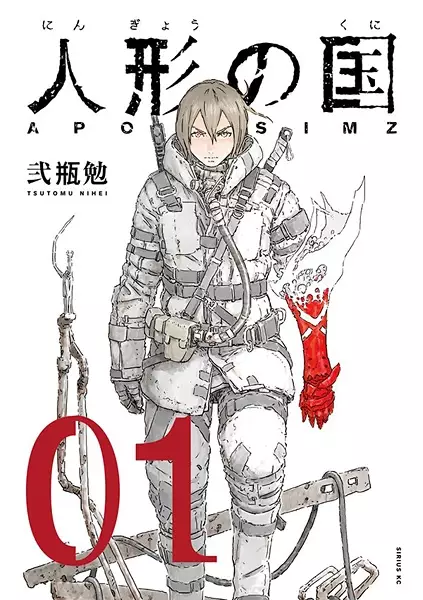
The 200,000 KM diameter artificial celestial body of APOSIMZ. Most of its volume is its core space, which is covered by a superstructural shell. Fifty centuries ago, the people who lost a war against the core lost their right to reside legitimately in APOSIMZ, and were left behind on the extremely cold surface. They face the spreading Frame disease. And aggressive automatons which appear frequently on the ruins level. Yet even so, somehow people survive. (Source: Comixology)
Ningyou no Kuni (or Aposimz) is a science-fiction manga from renowned artist and writer Tsutomu Nihei, a creator known for his unique, detailed, and often bleak worlds. While the series may feel slightly toned down compared to some of his other works, it still delivers a compelling narrative set against a visually stunning backdrop. This manga is a great example of world-building done right, even if its story concludes with a bit of a rush. Story and Pacing For 5,000 years, humanity on the planet Aposimz has been locked in a struggle for survival. The plot follows Etherow, a young man who, after his settlement is destroyed,is transformed into a "Regular Frame," a biomechanical being with immense power. He embarks on a quest for revenge against the powerful Rebedoa Empire, guided by the automaton Titania. The story is highly engaging, consistently raising questions that drive the reader forward. It maintains a strong pace for most of its run, but the final few chapters feel notably rushed. This acceleration leads to a conclusion that, while unexpected and satisfying, feels like it relies on Deus Ex Machina to wrap up the plot. Despite this, the twists and turns are genuinely surprising, and the ending is a worthwhile payoff. The themes of survival and humanity are at the core of the narrative. Etherow is a standout protagonist because, unlike many others in his world, he never devolves into a "hate machine." He fights for revenge but is also defined by his humanity, often going out of his way to protect friends and strangers alike. This moral grounding provides a strong counterpoint to the more ruthless, morally grey characters, including some on the antagonist's side. Characters The main trio of Etherow, Titania, and Keisha are likable, and the story effectively establishes characters you can root for and those you can despise. However, the series falls short on meaningful character development. While Etherow's humanity is a defining trait, it doesn't evolve much over the course of the story. A fourth character introduced late in the manga feels especially jarring, as if they were added solely to push the plot toward its quick conclusion. Interestingly, the more compelling characters are often not the primary antagonist. The main villain, while in a position of power, feels more like a plot device than a fully realized character. Instead, side characters like Jate, a lower-ranking member of the antagonistic forces, prove to be more fascinating and memorable. Art and Visuals As expected from Nihei, the art is a major highlight. While it may be toned down compared to the dense, black-and-white linework of BLAME!, it still masterfully conveys the grand scale of the world. The stunning, sprawling landscapes and massive megastructures are a testament to Nihei's world-building prowess. The character designs are enjoyable, and the paneling and page layouts are easy to follow, even during intense action sequences. The art effectively communicates the necessary information without becoming overly busy, allowing the reader to fully appreciate the desolate and dangerous world of Aposimz. Final Verdict Ningyou no Kuni is a must-read for fans of Nihei's previous works and anyone looking for a visually striking science-fiction story. Its strengths lie in its phenomenal world-building and a compelling protagonist who serves as a moral compass in a brutal world. While the character development is lacking and the ending feels rushed, the overall narrative and satisfying conclusion make it a worthwhile journey. It’s a great example of a manga that focuses on its visual strengths and a solid core premise to tell an engaging, if somewhat flawed, story.
Aposimz is a mixed bag, but I'd still recommend it to Tsutomu Nihei superfans. Tsutomu Nihei has an incredible ability to craft unique sci-fi worlds that function on their own rules of nature. He then crafts epic stories that slowly reveal those rules to you through exploration and character interactions. Sometimes, on the way, events lead to those rules fundamentally changing, requiring you to figure things out all over again. To me, this is the main appeal of Tsutomu Nihei manga. So will you find this in Aposimz? The short answer is yes, but it takes a while to get going. I'll say right now that if youlove Tsutomu Nihei and you're thirsting for more of his work, you're gonna want to read this. If you've never read anything by Tsutomu Nihei, you should probably check out his more polished work first. Blame!, Biomega and Knights of Sidonia are all great. If you're interested, I recommend you stop reading this review now and just start. But I'll share my spoiler-free thoughts below anyway. --- The biggest difference between Aposimz and other Nihei works is that, here, the main driver of the plot is the characters' emotional motivations (at least at the beginning). This is in stark contrast to Blame! and Biomega, where the characters barely have emotional motivations - and if they do, it's something larger than life like "become god" or "see heaven." Even in Knights of Sidonia, where the characters' emotions were on full display - the primary motivator of the characters from a plot perspective was the existential threat of extinction, and any cheesy romance tropes were intertwined with unique sci-fi concepts. But Aposimz isn't like that. Unlike most Nihei works, Aposimz starts out as a simple revenge story, entirely driven by the main character's motivation to get back at the bad guys who crossed him. There are hints of the epic Nihei sci-fi plot going on in the background, but that takes the backseat for the first good chunk of the story. This makes it awkward to read since, in my opinion, Nihei really struggles to write characters you're supposed to empathize with. This makes the first act feel like a generic plot with generic characters in an interesting world. However, about halfway or a little over halfway through the story, more actors enter the mix which makes things a lot more interesting. This continues into the rushed ending, which many reviewers here disliked but I personally enjoyed. It was very reminiscent of other Nihei works which I love. That's all I'll say about the ending to avoid spoilers. One other thing to comment on though is the fight scenes. Many of the fight scenes in Aposimz take the opposite approach from Nihei's typical "show-don't-tell" style of writing. This manifests in many ways including shounen-style narration, and the moment-to-moment thoughts of both characters engaging in battle. It usually reads pretty cheesy, but it helps you appreciate the decisions the characters make in a way you otherwise wouldn't. That's pretty much all I have to say. Nihei takes a very different approach to storytelling and writing in Aposimz - mostly for the worse, but it does shape up by the end, and the uniqueness does make it interesting to read as a Tsutomu Nihei fan. That's why I only recommend this series to existing Tsutomu Nihei fans, and say everyone else should read his better works first and come back when you run out of Nihei content to consume.
TLDR: Story: 4.5 Stars Art: 4 Stars Characters: 4 Stars Uniqueness: 5 Stars Mind frick: 3 Stars (Lower then usual for this author!) Aposimz is a manga series written and illustrated by Tsutomu Nihei. The story takes place in a post-apocalyptic world where the remnants of humanity live on a frozen wasteland, forced to constantly fight for survival against monstrous beings known as "Gaunas." The series explores themes of power, oppression, and the consequences of war, while also subverting traditional manga tropes and delivering a compelling and unique story. The world-building in Aposimz is top-notch, with an intricate history and mythology that gradually unfolds throughout the series. The setting is bleak andoppressive, with a sense of hopelessness that permeates the story. The Gaunas are terrifying creatures that are a constant threat to the characters, and the various factions and organizations vying for power add layers of complexity to the narrative. The characters in Aposimz are also well-developed and nuanced, with their motivations and allegiances shifting over the course of the story. The protagonist, Jihl Nabaat, is a former soldier who becomes involved in a rebellion against the ruling class. His journey of self-discovery and his relationships with other characters are the heart of the story, and his struggles with morality and loyalty make him a compelling and relatable protagonist. The characters in Aposimz are one of the strongest aspects of the series, with each character being given a unique personality and backstory. One example of this is the character of Samira, a young girl who is part of the rebellion against the ruling class. Despite her age, Samira is shown to be intelligent and resourceful, with a strong sense of justice. In one memorable chapter, Samira confronts one of the ruling class's soldiers who has been harassing her and her fellow rebels. Rather than resorting to violence, Samira engages the soldier in conversation, appealing to his sense of honor and decency. Through this interaction, the reader gains insight into Samira's character and her approach to conflict resolution. This scene is just one example of the many nuanced and well-written characters in "Aposimz." One of the strengths of Aposimz is its subversion of traditional manga tropes. The series eschews the typical "shonen" or "seinen" archetypes and instead presents a story that is more nuanced and complex. The female characters, in particular, are given agency and are not merely relegated to love interests or supporting roles. The series also has a diverse cast, with characters of different races and backgrounds. The art style of Aposimz is unique and striking, with a mix of detailed linework and stark black and white contrasts. The character designs are distinctive, with each character having a distinct silhouette and personality. The action scenes are also well-executed, with a sense of weight and impact that makes them thrilling to read. Overall, Aposimz is a subversive and interesting story that is well worth reading. The world-building, characters, and themes are all well-crafted and engaging, and the series' subversion of traditional manga tropes makes it stand out in a crowded field. Fans of post-apocalyptic fiction, political thrillers, and manga in general will find much to enjoy in Aposimz.
that was the correct word to identity this manga , after a Fabolous begging and mysterious introduction we found ourselves facing a shitty sorry end I felt he mast battle as so simple and rushed I read it twice almost didnt ge t what just happened I questioned myself am I dumb the thats it thats the end of it besides that when I was dying of curiosity to know what the true nature of the core world and it turned out to be some thing as matrix like seriously , I believe our author here was wondering to put and of his story sojust give us something random lol regardless it story has some good moment that keeps you going throughout every chapter specially in the half way , I dont spoil most of my time in my reviews so if curious how it end just read it and dont expect something unusual as his previews manga BLAME because you will get frustrated Additionally the art style was not the thing You enjoy looking at it , the whole manga was white yeah WHITE kinda all characters looks the same , the world looks the same and sometimes it will get you confused at the end imma gonna say it just something fine read it when you bored .