Links go to search results. Availability varies by region.
ć€©äœżăźăăŸă
1
OVA
Finished Airing
Dec 22, 1985
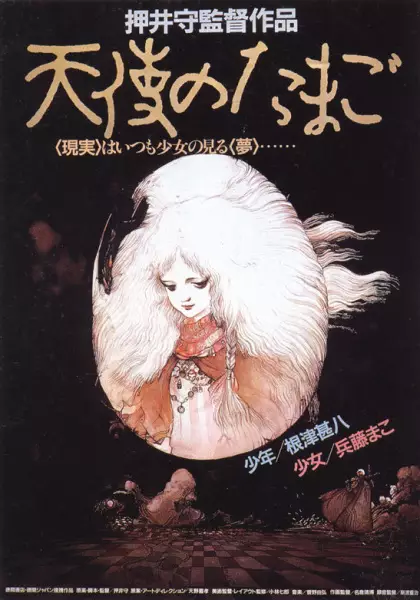
The surrealist world of Tenshi no Tamago is desolate and devoid of the bustle of traditional everyday life. Instead, the world is filled with ominous phenomena, including floating orbs populated with statues of goddesses, gargantuan army tanks that seem to move unmanned, armies of fishermen who chase after the shadows of nonexistent fish, and caverns solely decorated with glass vessels of water. In this run-down world, a young girl takes care of a large egg and scavenges for food and drink. She encounters a mysterious man with a cross over his shoulder, who soon becomes curious about who she is and what her egg contains. They decide to explore the lost and broken landscape together, questioning each other about the nature of faith, the purpose of the world, and the origins of their lives. [Written by MAL Rewrite]
7.0/10
Average Review Score
60%
Recommend It
20
Reviews Worldwide
âWhen it comes down to it, I think the director doesnât know everything about the movie. Everyone always thinks if you want to know something, talk to the director. I donât think thatâs true. I think the answer lies inside every single viewer.â - Mamoru Oshii As cliche as it is, Iâll say it regardless: this movie is not for everyone. By the end youâll most likely be calling your mother, asking her to hold you. Begging her to tell you everythingâs going to be all right. Angelâs Egg is a 70 minute joyride through the enigmatic mind of Mamoru Oshii that has more Christian symbolismand allegories than one might care to see in their lifetime. On top of that, the movie is incredibly slow paced (not really a joyride is it...) and has the bare minimum amount of dialogue to keep the story progressing. Which might I add, calling it a story is either the greatest insult or greatest compliment to the film and is something each individual must answer themselves. As mentioned above, each viewer will decide for themselves however deep or shallow the story and its message is. As such, Iâm not going to analyze the story and its many symbols because while it may mean X to me, it most likely means A-Z for the next 25 people and this is where Oshiiâs words speak volumes. Itâs an interpretive story. However much (or however little) you want to search for the films meaning, you arenât necessarily wrong. There is no conclusive answer. I consider it to be a surreal and highly thought provoking piece of interpretive art. But one manâs interpretive art is another man's garbage. Itâs understandable why people donât like the movie and why it failed when it was initially released. It is highly Christianic themed and is often considered as an interpretation of Oshiiâs early life when he was studying to become a priest. With this in mind, the film may come off as pretentious and overbearing, but perhaps it is just a roundabout autobiography of Oshiiâs early life. The true intentions of this piece will most likely never be known. The story is meticulous, slow and every scene deliberate and full of detail. While on the surface it may not mean much, it may mean a great deal underneath in its ever so mystifying allegories. As such, the film requires a great deal of attention and open mindedness. The elongated scenes, to me are some of the most vivid cinematic experiences I've witnessed in any film. This technique will most likely make you remember these scenes, even long after the movie is over. Regardless of if you liked the scenes or not they contain a lot of meaning and detail. At the same time I can understand how they may deter viewers, adding to the list of why this movie isn't for everyone. Aside from these deliberate and almost painfully slow scenes, the film progresses slowly and the world and its characters are spectacularly developed as the movie progresses. The characters are fantastic. Both the boy and the girl have a mysterious air to them and many questions are left unanswered about both them and their pasts. They donât really understand who they are or why theyâre here. The lack of answers doesn't detract from the film, in fact quite the opposite, their recondite nature draws the viewer in. The greatest strength of the characters is that their interactions are genuine and realistic. The girl is innocent and timid. She emanates warmth and even acts childish around the boy at some points adding a rather heartwarming feel to an overly bleak atmosphere.Their subtle gestures and actions are used masterfully in the stead of dialogue, creating a very unique experience. The orchestral score serves to further encapsulate the dark atmosphere of the film and is often foreboding at times, creating a sense of suspense for the viewer. It is serene, emphasizing the beauty and fragility of this poor innocent girl whilst it is equally melancholic highlighting the dark undertones of the dystopian world. The score wholeheartedly compliments and dramatizes the film. The art is nothing short of amazing. The attention to every minute detail in each individual frame and background is truly something to behold. Not only is the art visually rewarding to look at because of this, but the combination of its dark color palette and entrancing cityscapes, skeletons, machinery and everything in between goes above and beyond in staging such an eerie and mystifying atmosphere that consumes this dystopian world. The characters are equally well designed and given as much detail and attention as the scenery. Amano Yoshitakaâs art truly makes Angelâs Egg what it is. Angelâs Egg presents its viewers with an obscure message, enveloped in equally obscure symbolism and allegories. It indubitably blurs the line between the understandable and the incomprehensible. And as such, what each individual takes from this movie is subjective and is no more right or wrong than the next personâs interpretation. As Oshii said, the answer lies inside every viewer. On that reason alone, this movie will certainly fall short for some, and itâs absolutely understandable. But perhaps solace should be taken in the coalescence of the filmâs breathtaking art and its mesmerizing music score. Perhaps, above all else, Angelâs Egg is a paragon of visual art. Thanks for taking the time to read.
I heard that this anime was underrated, and then decided to check it out. After watching the film, I was doing two things. One, I was scratching my head, and two, I was trying to pry my jaw from the floor. Wow, what a surreal, vivid, creepy, terrifying, amazing, astounding, memorable work of art. STORY The story here is quite simple, and is presented very slowly. The main character does not hesitate to observe and admire her surroundings. The pacing has been complained about before, and I halfway agree with these complaints. On one hand, the extra-slow paced lingering shots may bore you, and on the other hand,they will create a lasting impression on you once you finish the film. It's kind of a catch-22, which is rather unfortunate. The slow pacing is both good and bad. ART The artwork and animation are almost indescribable. I was completely astonished at how lifelike and detailed the characters were animated. For its time, the animation must have been groundbreaking, and it looks great even today. I feel that it transcends the "anime" style. The style and the background artwork I also enjoyed. I haven't seen many animes with a feel quite like this one. It's an extremely moody, creepy and somewhat realistic style. The backgrounds are very imaginative, memorable and often ambiguously symbolic. It's creepy and absolutely mesmerizing. SOUND The music was orchestrated and consisted mainly of vocals and choirs. Nothing really to complain about here. The music fit the scenes, enhanced the scenes and didn't detract from or overpower them. It was sometimes downright dreary, yet it was oftentimes whimsical and fantastic. I loved it. CHARACTERS There were only two characters, and they were portrayed in a very simple way. Their actions developed them the most, and although they lacked much dialog, it wasn't really needed. Their actions and looks spoke volumes. I wished that they could have been developed a little more, so that we could come to know them. That, unfortunately didn't happen, but seemed to meld perfectly with one of the themes of the movie. I felt that the director, Mamoru Oshii, preferred developing the world over the characters, because there is more time dedicated to showing the nice scenery. ENJOYMENT Are you going to enjoy this movie? Well, that, my friend, depends on whether you are able to sit tight and enjoy a very slow movie. Are you watching anime for the art and message, or for the entertainment? Angel's Egg requires the viewer to be on the same mental wave-length, so to speak. And if you are, you will enjoy this film immensely. It reminded me in some was of the film 2001: A Space Odyssey, and if you enjoyed that movie, you will most likely be intrigued and engaged. OVERALL Angel's Egg is a memorable, slow-paced, mesmerizing and beautiful film, and although somewhat ambiguous and confusing in its message, it will still stick with you and affect you. Whatever the message is. I felt that this film was expressed very sincerely, from the bottom of Mr. Oshii's heart. He himself said he didn't know what it meant. I got some allegorical and Biblical what-if's out of it, as well as symbols of hope, future and loss of innocence. You may find something else. It is incredibly deep, and it's not laid out for you.
Preface: Angel's Egg is my favorite movie, animated or not, and I donât expect everyone to like it as much as I do... this is just my opinion. Also: Spoiler Warning....... Mandatory ratings of "story" and "character" seem constricting, implying that anime must be a narrative art.. Animation especially seems to have the potential to release visuals from these constructs and to become a poetic association of images or a musical rhapsody of color and movement, which engage us on a subconscious aesthetic level.. Not to imply that Angel's Egg is a non-narrative work of artâ it isn'tâ or that it has no charactersâ it does,and effectively uses them as emotional vehicles. However, the existence of these implies that in art we are looking for an engaging story and psychologically relatable, entertaining, or in some way likable characters. For most, Angel's Egg is not going to present those things, but I do not consider that to its detriment. Angel's Egg presents a few images suggestive of something beyond themselves that in their significance beg to be taken as symbolsâ inevitably leading viewers to puzzle over them, to ask, "What does it mean?" To ask that question may in some say imply an answer, which there is not. There's no reason to think that an idea of clear authorial intent is behind every ambiguous work of art, that every image and symbol can be reduced to some concept, idea or word, and that the viewer should let this concept stand in for the image in his experience of the work. In other words, there's no reason to interpret Angel's Egg allegorically. To sum up my view on images, I'll quote the poet Basho: "There is nothing you can see that is not a flower; there is nothing you can think that is not the moon." I think he is suggesting that all of our perceptions, thoughts, and words are images. We perceive images all around us and it is only through these images that we communicate. Abstract ideas have no existence outside of our ability to IMAGine them; we conceive of our feelings in terms of images; we conceive of ourselves in terms of images. Eventually these images become abstracted from present material experience and enter deep into the realms of our desires and subconscious, and as they are ingrained in our culture's collective web of meaning, they become archetypes. I include this tangent because I think that Angel's Egg works directly with archetypes, casts them like a spell, and we as viewers want to make sense of what we experienced by assigning a meaning to them. I don't want to suggest that no meaning is present. However, I do want to inverse the usual understanding that some meaning in the artist's mind is the starting point, and the symbol is subservient to that. In fact, a pure image is the primary thing-in-itself, and this image may be suggestive of a whole shade of meanings, and like a word these suggestions can have ranges of connotations for different people. It's like in music, when notes and melodies and atmospheres can for a listener evoke specific memories or messagesâ but no one would say that such a message is the primary purpose of the musicâ which is nothing but notes. Rarely does one talk about what music âmeans.â Such would I say are the images in Angel's Egg. So for me, what is the sum total of these images? I could shorten this whole review into a single sentence by saying that when I watch Angel's Egg, I feel like I'm viewing the dreams I saw when I was sleeping inside my mother's womb. The atmosphere is so dark, so delicate, that to compress it into some ideas and themes would be to collapse its subconscious delirious atmosphere. I feel like this story is something being played out in my mind, below and between my conscious understanding. The egg, the cross, the mechanical God, reflections, water... all of these and more are symbols in Angel's Egg. Yet rather than asking, âWhat does it mean?â I'd rather ask, âHow does it make me feel?â And these images arrest me: feelings of lost innocence, holding on to a bit of faith, deeply buried memories, the unreality of experience, existential confusion, the fear of abandoning and being abandoned by God... all of these are contained in my viewing of Angel's Egg. Both characters start to embody aspects of myself which, for being on a screen, start to feel more real. "You have to break something to find out what's inside." The same could be said about this movie itself. When I'm watching, the images become indicative to me of something larger, but I can't necessarily pinpoint this significance down into an allegorical understanding. I feel like I too am clutching this egg with so much passion. What it is could be a number of completely personal things to me or it could be something else personal to another. But that desire of clinging onto that fragility associated with maidenhood, and the converse questioning cynicism that seeks to break it, feel real, regardless of whether or not I can articulate whatever Oshii was "trying to say." The Christian symbols don't become instruments to make some "point" about Christianity; they're just presented, and they can either start to mean something to you personally, or not. This movie isn't going to try to make you enjoy it. Its content in being itself and it's up to you whether it moves you or not. Amano's artwork, with its exquisite delicacy and detail is perfect for the atmosphere of the film, and along with the score and pacing, /is/ the atmosphere of this film. There's not really anything else to add on the matter other than that I find the artwork gorgeous and evocative. The colors create a distinct world-- one of shadows and reflections, mirrors, and windows through which darkness is distorted and parallel worlds open up. In fact, more than almost any I've seen, Angel's Egg's "world" becomes almost self-consciously so-- one enclosed existence among many-- truly dream-like and expressionistic, as if these egg's dreams are projected onto a screen and a moment's sensation becomes a visual palette, and in this palette other realities converge-- and this world belongs only to the girl, and this strange nameless soldier is passing through from one world he can't remember, collapses this world, and under the malignant transcendent reality of the mechanical god who devours individuals, passes on to another.. The final shot reinforces this impression. The interactions between the two characters take on a strange poignancy; in this desolate, unreal, left-over place, a persistent desire for contact and a deeply human curiosity become the forces that destroy the egg. Despite the work's expressionistic, unusual, or inaccessible nature, there's something deeply immediate about the sad look on the soldier's face at the end of the movie, as he stands alone... In the end, this movie leaves me with the impression of a world abandoned by God, where, left with empty meanings, only suggestions of happiness and reality are contained elsewhere, a world haunted by promises and vague suggestions of fulfilment, yet left in the dark and alone. The score embodies this impression, alternating between beautiful melodies, waltz-like rhythms, and dissonant dissolutions; it feels like a transient dream always on the edge of being real and graspable, yet ultimately transient and unattainable in its distant beauty. Rather than talk about how I choose to interpret every image in the film, I think it's best to leave it at that, as every viewer will have a different reaction and interpretation. Obviously this film moved me deeply. Maybe it won't move you at all. That doesn't make one of us right and the other wrong. This movie's images tapped into the subconscious reservoir of my fears and desires, maybe the images will mean nothing to another. It's an expressionistic work, that however exquisitely crafted, will fall flat for some people. What it means for others, however, has nothing to do with what it means for me.
There's a moment in this film when a little girl stands at the side of a street, watching an army of phallic-shaped tanks roar by. The animators made extra sure the shaft part of each tank dick, which protrudes to its left, passes directly over the girl's head. If there's one compliment I can give the anime, it's that moment. The scene encapsulates perfectly how I feel having sat through this hour's runtime. Minute after drawn-out minute, Angel's Egg is a bunch of anime writers swinging their dicks at you, moaning how smart they are. Worst of all, they're right. This IS a smart film, andit's probably going over your head, pillar and stone and all. But "smart" doesn't mean good. You'd rather have a dumb friend who knows what he is and lives his life to the fullest, than be around a boff who does nothing but brag of the latest thoughts to pop in his head. Same with anime. I know because I used to be one of the latter type of people, except I really wasn't that clever. You see, this film is unique. It's so different, it's so artsy. Surely that alone makes it better than the generic ecchi harem to come out every season right? Well, the thing with cliches is, the tropes themselves become tired because they have an inherent appeal. To someone seeing it for the first time, tsunderes are cute, no matter how shallow the character. To a 12-year-old boy, accidental groping is funny and awkwardly exciting. Not to insult people who like that stuff, of course; I'm just explaining the nature of tropes and how creators come to overuse them. Angel's Egg is devoid of tropes not because it takes a fresh approach on portraying life, but because it's completely devoid of emotional appeal. Its "plot", if you could call it that, can literally be summed in two sentences. That's not what you normally call unique. It's just... nothing. Let me expand on my point. This film is about Christianity and the death (abandonment) of God. That much I and most people gleam from the film alone; I watched a 30-minute passion analysis reasoning everything in the story, and I'm all like... That's it? As it turns out, Mamoru Oshii was inspired for this film after his loss of faith in Christianity. Everything in the story, few as they are, is some symbol relating to ideas of faith vs atheism. Everything is symbolic, it's all dark and grimy and supposedly desperate. None of it is engaging. Because even as you can see the pain and anguish in every picture and song of this film (art and sound are fine), he doesn't give you a single reason to care. The characters are so NOTHING that you can't even call them one-dimensional, because that would imply they have some sort of breadth. You can literally describe them in one word; that's not just paper-thin characterisation, that's no characterisation. I don't mind shallow characters if it fits the point of a story but this movie has their suffering as its only thrust. And it offers SO little to latch onto. Okay, Mr Oshii. I can see it's affected you very much. I can see how these characters would feel lonely, whatever in this post-apocalyptic world. But you don't explore this emotion at all. Why should I give a damn about these people, or this world, or about you? If you don't care about the characters, you don't care what happens. A few things do happen - FEW emphasised, each scene is so quietly, so agonisingly stretched out, I swear I could hear the soft masturbatory strokes of this movie's creators somewhere. Of the things that happen, none of it makes sense. It's all chalked up to being symbolic, nothing else. I'm not the pedantic type. I very easily forgive a show for plot points that others call "contrived". But there's a line, and Angel's Egg is miles across it. At that point it doesn't just break suspension of disbelief. It's entirely unengaging. "Oh, that happened. I WONDER what that means..." "Oh, it symbolizes despair this, innocence that. Don't care." Geez, there's so little going for this movie to do anything. I have to wonder why it hasn't been forgotten. It has no philosophical or social commentary that millions of Woke atheists haven't already said. It contains no predictions on the progress of mankind, like Serial Experiments Lain had on the boom of the Internet. I consider myself a fairy average person with fairly average tastes. I respect people who like this kind of stuff, and if you're one of them, give it a go. If you loved stuff like NGE, Texhnolyze, and SEL, you'll probably like this too. But if you're anything like me, don't. It's boring as shit, and you probably won't get it on the first watch. If it were that one needs to enjoy this kind of stuff for bragging rights, then I don't want those rights at all.
Angel's Egg, or Tenshi no Tamago, sits at the forefront of a list of bizarre and eccentric anime that includes Cat Soup and Iblard Jikan, while its niche but most enthused audience promises that its complex allegory is as beautiful and philosophical as the most serious of art-house films. Directed by Mamoru Oshii (Ghost in the Shell, Jin-Roh, Patlabor, Sky Crawlers), Angel's Egg is perhaps Oshii's most personal and best work. However, as interesting and surreal as it is, beneath its murky surface Angel's Egg suffers from classical problems in Oshii's stories. Past the compelling mystical, spiritual, and psychological nature of the work, there ismissing a profundity and artistry that keeps Angel's Egg from being anything more than a small sample at a Michelin star restaurant; it is rich and possesses depth of flavor, but leaves an empty feeling in the stomach and a hunger for something more. From the start, Angel's Egg is not the most approachable work. In line with other minimalist anime like Serial Experiments Lain and to a lesser extent Texhnolyze, the film sacrifices dialogue and characterization in favor of atmosphere and visual storytelling. The very beginning of the story features a set of hands that move in near absolute silence. It is only when the childlike fingers transform into a pair of brown and calloused hands and we see and hear the knuckles clench and crack that we realize that the work was indeed intended to start without a sound. Lovers of action packed sequences and fleshed out characters will probably find themselves moaning at long drawn out walks and a pair of individuals who seem to be nothing more than the reflection of certain theological beliefs. Even those who can stand slow paced material might be confounded at scenes that, if not for the flickering of the flames, seem like stills that stretch on forever. Despite its sluggish pace, Oshii comforts us with a wide array of intriguing and fascinating visuals to pass the time. One of Angel's Egg's strengths is its good looking art and Shinji Kimura(Akira, My Neighbor Totoro), who was responsible for the backgrounds, has drawn some really wonderful images that build a haunting atmosphere almost by themselves. The first descent of a large eye from a blood red sky has a rather sublime quality to it, especially when one realizes that its black surface is lined with a seemingly limitless number of ancient Greco-Roman figurines, stretching around a glimmering aquamarine center that gives the iris its luminescent and imposing appearance. One could complain that the color palette of the anime seems a bit one dimensional even despite its beguiling visuals, as given by the dominating prevalence of different gradients of blue in the drawings. However, it's the use of colors in this fashion that highlights some of Oshii's control of visual storytelling. The use of blue, for instance, reflects the never ending motif of water, the melancholy, cold, and even lifelessness associated with the color, and the inevitable contrasts that appear in different points in the work demonstrates how one can change the impression and tone of a story with simple alterations. The girl in the story, clothed in pink and white, stands foreign in a dilapidated world, and it is by no means a coincidence that the one she travels with is draped with a blue cloak. From the strange duck-like creatures that inhabit mysterious translucent shells to the foreboding appearance of a gloomy forest to the stoic and morose appearance of the city's fisherman, Angel's Egg possesses a number of great visual moments that unnerves us with their creepy yet alluring presence. From that perspective, these surreal moments may be reason enough to watch this anime. In addition, Yoshihiro Kanno, whose only anime compositions have been with Angel's Egg, provides just the right balance of spiritual and ambient music that complements the uncanny images that we are confronted with. The lamenting chorus featured during the opening title echoes the scene's mourning and longing while the powerful and sharp notes of bass instruments complemented by booming timpani strike with the same intensity of fisherman hurling their long harpoons at the shadows of fish. The rarity of the music is another strength, as silence leaves us pondering the calm before the storm, piecing together fragments of the puzzle while the entrance of music causes us to briefly forget our speculation and draws us in and surrounds us with the intensity of the moments in which it appears. With both art and sound elements, I was surprised to find that I was rarely bored when trying to uncover what Oshii meant when he gave birth to the anime. Oshii seems to have made this anime as a meditation on faith, one that eventually leads his audience to understand a supposed rejection of the deity he had worshiped for years. Oshii was trained in the priesthood from a young age and would presumably have pursued the life of a Christian priest had events in his life lined up in a different way. It would be foolish, therefore, to ignore the popular and purposeful religious symbols and allegories that exist throughout the film. Oshii's main influences draw from Noah's ark, but The New Testament is also featured prominently in different areas. Oshii builds a world that is, ultimately, divorced from known biblical history, which is thematically consistent with his intention of slowly renouncing some of his theological foundations to embrace a new calling. The decisions made by the man are perplexing and leaves the audience wondering whether or not Oshii intended him to be a mirror of his own self-doubt about the existence of the deity and if this man fell on the side of moral good or not. There are numerous other questions as to the nature of the tree that the man describes, the man's perplexing motivations, the girl's final transformation. Most importantly, what great beast from within that egg is just waiting, waiting ever so patiently, to be born? These questions are interesting and many answers can be found by evidence in the story, some answers stronger than others. Surprisingly, while some may be absolutely flabbergasted by some of Oshii's more esoteric and bewildering works (Mezame no Hakobune), Oshii definitely has certain thematic messages and a story that he means to drive home here. The plethora of interpretations that one can draw from various significant imagery, such as the tree, the fossilized angel, and the egg itself are plenty, but there is still a certain consistency and wholeness to the work that leaves us with a story that is, at the final moments, a complete experience. There is indeed a point to Oshii's work, one where a society rejects God, and God, perhaps acting according to Oshii's hopes and idealism, departs without a single word. In despite of this praise, what is wrong with Angel's Egg? The anime has good visuals, complementary music, and even if its characters are mere belief systems personified, Oshii has provided us interesting themes that presents itself through a complex and subtle story. Angel's Egg spends a significant amount of time building up to a critical climax, but before Oshii can deliver the final blow, he adds in the longest monologue in the film, where the man narrates the story of Noah's ark, with a twist to the ending, to the audience. This is a point of clarity that is not only unneeded, but ruins the subtlety that the work was building on. Whether it was from the times the ark was shown on screen or the overwhelming importance of water, one could have come to the reasonable conclusion that the story of Noah's ark was an important element. While it is certainly true that the man's story departs from the biblical event, telling the entire story diminishes the effort that Oshii made throughout the film to reveal bits and pieces of the world around him. At best, this was just a needless monologue that explained what the audience knew, and at worst it ruined the finer points of the story, reducing them to mere unnecessary components because all you needed to know about the world in Angel's Egg was to listen to that single monologue. I will admit that such criticism is perhaps harsh and even elitist to those who may have not easily picked up on the religious allegory, but I think such criticism reveals something even more fundamentally wrong with Angel's Egg that prevents me from bestowing it higher marks. Make no mistake, Angel's Egg is a fine work for what it is, but ultimately the themes and the artistic execution of those themes are at a level rather average compared to works that have dealt with the same issues, which is why explaining such a simple biblical story when the rest of the work had already been suggesting its relevance hurts the work as a whole. It reduces the work to its simplest conclusions. Oshii is tackling a work where a man and society is rejecting the deity, but outside of the fact that we understand that the man is intent on doing so, there is very little reason why. Are we to assume that this desolate world is the only reason, that he rejects God because of the destruction wrought upon this desolate blue metropolis? I don't think we, as an audience, can easily extrapolate and give Oshii that benefit of the doubt. Does the man lack faith? Perhaps, as his allegory so conveniently mentions, but not only does the scene provide nothing but the ordinary laments and complaints that underline the most common and prolific of atheistic complaints (the prolonged absence of God, the existence of worldly suffering, all of which can be poignant points were they to be expanded in a beautiful way), it is, once again, a scene that is bereft of any subtlety and complexity. There is little poetic language, little visual storytelling, and little insight. It is merely a word for word retelling of a biblical story with a minute presence of creative liberties. Again, we return to the monologue that I have criticized above, and again, its blatant exposition leaves me with the need for more substance. The girl's representation is also incredibly simplistic. Her potbellied appearance with the egg underneath her dress attests to a pregnancy, which gives us the idea of a birth of a new life. There's an astonishing innocence to her, giving us the idea that this is a virgin birth, and harks us back to imagery of the Virgin Mary. But she is nothing more than a vehicle of blind faith. Perhaps it is Oshii's intention of exposing the ignorance of her position, by demonstrating her selfishness by holding onto the egg for her own devices, but this is once again, such a simplified perspective that despite its rich simplicity, the anime's unsubtle treatment of issues leaves one who has engaged in works of similar theological questions wishing for something much more substantive. The death of childish innocence is by no means a grand and unexplored message, and when the anime does nearly nothing with it, it once again leaves one questioning what substance does the anime really have to offer? Perhaps it is in that simplification that Oshii believes he has developed something beautiful, and certainly those who see the beauty of Angel's Egg will speak to the pleasantness of such a simple story that sits above a sea of allegories, but an issue as complex as one's detachment from a life of religion is rarely a simple affair, and while I cherish a simple story as much as others, Angel's Egg is constantly evoking something that is more than simple and half-boiled ideas but we are left with nothing but a rather simple and soft-boiled egg. Its allegories and mysteries are difficult to piece together, but that is because of Oshii's obtuseness and not because the concepts in which he is trying to expound are intrinsically complex. This is not to say that Oshii's themes are bad or unworthy of merit. There's certainly something to glean from the work, but a simple message that sits behind purposeful obfuscation are not the winning formulas of a masterpiece, and I can give Angel's Egg nothing more than the appropriate score to reflect that. To leave this on a note that isn't too critical, I will say that despite my last few hundred words of criticism, Angel's Egg is still one of the better anime out there. It's the one work from Mamoru Oshii that I've actually enjoyed, and despite its simple conclusions, the work itself is still interesting enough that it's fun to figure out exactly what Oshii is saying. If you're into challenging narratives, minimalist anime and want to see one of Mamoru Oshii's underwatched works, definitely give Angel's Egg a try.