Links go to search results. Availability varies by region.
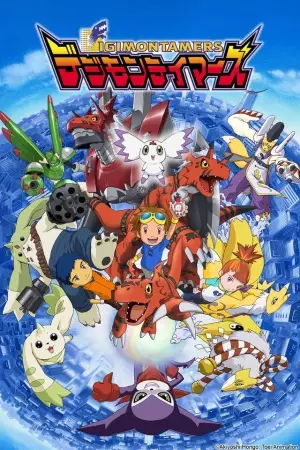
デジモンテイマーズ
51
TV
Finished Airing
Apr 1, 2001 to Mar 31, 2002
Ten-year-old Takato Matsuda loves playing the Digimon card game with his friends and immersing himself in its imaginative world. One morning, he finds an unfamiliar blue card in his collection and swipes it through his card reader. Little does he know, his decision leads to its transformation into a D-Ark Digivice. When the mysterious device scans his designs for an original Digimon named Guilmon, it generates a Digi-Egg that later hatches into a living version of his own creation! Although Takato is thrilled to have a real Digimon, his idealized fantasy shatters when he realizes that his rambunctious new companion requires constant supervision. Adding to his troubles, Guilmon is targeted by Ruki Makino, a rival tamer who commands her partner, Renamon, to gain power by defeating other Digimon and absorbing their data. Luckily, Takato finds allies in his schoolmate Li Jianliang and his sassy Digimon partner Terriermon to help him on his journey as a real-life tamer. With sinister foes appearing at an alarming rate, Takato must strengthen his bond with Guilmon to protect both the human world and the Digital World. [Written by MAL Rewrite]
8.8/10
Average Review Score
90%
Recommend It
20
Reviews Worldwide
I liked the first two seasons of Digimon as a kid, they were the only ones they aired here in Finland. After some years I matured and began looking down on them. Let's face it, the idea that ENIAC, the world's second computer, was capable of twisting space-time and created parallel dimension where computer data took physical form and gained sentience on its own, and then interacted with human kids' emotions to reconfigure the data to combat monsters, was quite silly, and the show mostly served only commercial purposes. (This creation of the Digital World is explained in the Wonder Swan games relating to DigimonAdventure 02.) The plot of the first season also was quite nonexistent, fighting one big bad with world-domination fantasies after another. Then, after many years they decided to air Digimon Tamers in the kids' weekday morning program slot. I hadn't seen it back on the good old years because I didn't know Japanese, didn't want to watch English dub and subs were not available, which was quite surprising, considering Digimon is, or once was, very popular franchise around the world. I started to watch it mostly for nostalgy. Digimon Tamers however turned out to be much more actual cyberpunk than kids' show. Digimon Tamers' plot is built upon the concept of unintentionally created artificial intelligence. It is, too, a bit strange idea, especially given that it's creation is timed in 1984. But then again, Digimon Tamers officially is stated to take place in different universe, so we can assume some technology had advanced asynchronously. Or perhaps the same quantum phenomena that affected the creation of the Digital World played a role here. Anyway, the backstory is not fully explained in the show, there's a novel called Digimon Tamers 1984 which would be a good companion to watching it, but it hasn't been translated either to my knowledge. Tamers is loyal to the original ideas of Digimon however, and the fact they made them believable, even if eccentric, is one of the things that make it so good. The childrens' ability to interact with the Digimon in unique ways and the fact the main character actually CREATES his own Digimon are justified with the concept of DigiGnomes - programs that were originally intended as a part of a children's toy, designed by a group of programmer students at University of Palo Alto in the 80's, until the project was cancelled. The art of the physical world is decent, but when we get to the Digital World it's amazing, acidic. We have packets of garbage data running around deserts in coils, our physical world's information networks manifested in the sky as a huge shining globe with greatest data streams arranging around it like debris rings of a planet, and all your classical Digimon weirdness - mansions inside glass bubbles underwater and completely monochromatic old-skool town etc. The CGI and normal animation in this show are in perfect balance. Some evolution scenes (basically those from adult stage to perfect stage) aren't very cool, they could be much better, and that's about the only actual complaint. I've always considered all incarnations of Digimon to have excellent soundtracks, and Tamers is not an exception. The second ending theme 'Days ~aijou to nichijou~' is so sweet and dreamy I have on many mornings after not sleeping the night (like was the case at the time when Tamers aired here on kids' mornings) listened to it on loop about ten times and got a really good feeling. After that it temporarily loses it's charm, but on the next morning it's restored. The opening 'The Biggest Dreamer' is really groovy too. Tamers has more futuristic and/or digital sounding BGM's than the other seasons, fitting it's themes and atmosphere perfectly. The first evolution sequence music, 'Evo' is probably the coolest Digimon evolution music ever, but the others send chills to the spine too. Try listening those in Youtube even if you don't plan to watch the series. Characters are better developed than in any other Digimon incarnation, and some have relatively dark backgrounds. Our main hero is way far from typical shounen hothead with big ego and exaggerated goals and bad manners. He's what you'd call an artistic soul, and his development into a sort of knight on a white (though it's really red here...) horse is interesting. The Digimon also have distinquishable personalities that aren't paired with their owners' personalities in any typical - balancing opposites nor overly similar - fashion. We have serious adventuring group drama here where half of the 'people' just happen to be artificial intelligences gained physical creature-ish manifestation via quantum physics. Also, the Digimon aren't initially friends by default. Wouldn't you be surprised, confused if you just happened to encounter a talking battling mutating video game creature? Their slowly developing bonds are quite serious. And we get to explore the differences and similarities of humans and Digimon. At the beginning, most Digimon are guided by their basic instinct to battle, absorb the opponents data, convert it into utilizable form for self, and evolve, bestowed upon them by humans themselves. Neither is there any over-the-top world-saving premise - the characters become involved with it through pure chance, bit by bit, through their own choices. Our main villain is, unlike the Digimon, an emotionless program. Originally created to keep the numbers of copies of data files in given limits, in order to prevent viruses from spreading themselves that way and collapsing the budding 80's Internet, he has now gained physical form too, and become what you could call an 'eco-fascist', calmly launching plans to reduce the numbers of humans after calculating there're too many of them for the planet to withstand. This is an interesting, thought-provoking concept really. We don't have big bad guys who are bad just for the sake of it here. Sans the few rogue monsters in the beginning that serve only as ways to initiate character conflict, every villain has understandable motives for whatever they do, and most turn out good after some serious misunderstandings and political or religious differences crossing the border of two different worlds have been cleared. The question whether or not we are gods and masters of our creations is also explored in many episodes - even if our creations believe in gods completely of their own. And the final battle is on par with Gurren Lagann's. No, I'm not kidding. They have many things in common in fact, as one Digimon's final form is like giant green dog-faced mecha, and both involve quantum physics you actually have to think a bit for them to make sense. Overall, it's weird, trippy, cool and enjoyable to both children and adult science fiction fans. Not everyone is going to like it of course, mostly probably because it has lots of monster battles, the beginning is slow, and because some things of the backstory are left a bit obscure. Also some have called it Evangelion's child, which in turn has pissed off some fans of Evangelion, which I think is completely justified - indeed it doesn't go to same depths over same subjects. Some have called it a bad Evangelion-wannabe, but I don't think they have much in common. Both are good though, so let's not start an argument over this one. If you watch Tamers expecting it to be like Evangelion, you're going to be disappointed and probably hate it. So don't do that. Tamers is worth liking it. It doesn't try to be a ripoff of ANYTHING, it's honestly completely its own kind of work. There simply isn't anything like Digimon Tamers out there.
Click an episode to read its synopsis.
This is the third Digimon series and one that had a very challenging road ahead: after Digimon Adventure 02 essentially failed in the ratings department, another sequel (Adventure 03 if you might) would most likely be unable to deliver the audience the franchise so badly needed. So it was boldly decided that the best way to gain new viewers was to star over, from scratch. And there's no better way to make old viewers watch again that the concept "What if you could create your own digimon?" while also appealing to new ones. As such, Digimon Tamer triumphed and saved the franchise by denying ithad a past at all and making a whole new world and timeline from scratch. Sure, there are callbacks and common elements, but Tamers (and so Frontiers, Savers and Xross Wars) decided that it was the best to follow its own path. At its best it is an extremely satisfying, poignant, enjoyable and inspiring journey, but at its worst it is drag, filled with awkward, anti-climatic and filler moments, but luckily it only does that bad for about 5 episodes or so. There are at least 15 memorable ones, 15 averages, and the rest are all good. Now, let's see the hits and miss of the series: Story wise: We have three arcs in this series and all of them are quite different in themes and quality. First, the tamers beginning: this is a kind of prologue that goes from episode 1 to 13. Most episodes are just fine, with some really good characters moments. Every single Digimon series have always started a bit slow, but that's only so we can get to know our characters and so it is understandable. Here we are presented the concept of cards, which is an amazing support system so that the human can aid their digimons in battle, as well as we start to understand the dynamic of this series; it is darker than the previous two, we don't have chosen children, we have children who happen to become tamers, so there's no actual deux ex machina to keep them safe and so the danger feels quite real. Even while in this first arc there is not such an extreme danger, the feeling is there in the air and it will pay off later on. Second, devas: it goes from episodes 14 to 36 and here is where Tamers hit the lowest of its quality (except for episodes 33 to 36 that act as an introduction to the final arc); devas are the worst villains I've seen in any digimon series (and maybe in any given anime). Their motivation is poor, their design is dreadful and they are just plot fodder and not actual characters; we spend so much time with them that they just fall flat to make any impression. The worst episodes of the series features them, they are extremely boring or passable at best. Yet, when you ignore the devas, what happens around is fine or even good to great, as luckily our main characters are treated quite better, and such it is not a deal breaker. There are only 3 or 4 crappy episodes in this long arc, about 2 or 3 memorable ones, and the rest are just fine or slightly good. When you ignore the devas and focus on the rest of the characters everything is fine, but as soon as they appear they drag the show down. Third and final, D-Reaper: Here is when Tamers shines; it is the best arc of the series and Tamers shows us it's not afraid to go dark. We see the worst of some characters and the best of them; we get to feel fear and despair. Remember how I told you earlier there is no deus ex machina? Well, just 3 episodes before we enter this arc one of our character's digimon dies (permanently) and a digivice breaks, something we've never seen before in a digimon series, allowing us to peek at the darkest of two characters just before it pays off for both of them, showing their best character development. As this arc starts both worlds, digital and ours, enter in such a huge crisis that is almost impossible to predict how it's going to get resolve, and to do so everyone have to work together, not only the children and the digimon, but the adults as well, and so we get into a full set war against the new enemy that is filled with despair, but also some moments of hope to make an incredible smartly shaped finale. Everything we see here has been foreshadow before handed, and as such every moment feels earned, it's not rushed nor convoluted, it's just greatly structured and when you add that to some great characters you get one hell of an anime. If just there was no devas, this could have been just as great as Adventure (or even better) Characters: Mostly the character work is great; however there are some misses too here. But let's see each character: Takato: here I just have to applaude the writers. Takato started as a crybaby and a coward, but slowly he became more and more brave, accustomed to fighting, he became considerate, but he never stopped feeling like the same character. Though he changed he still felt like the same Takato. There is a moment when the writers just wanted us to hate him, around episode 32 or so, and though I did hate him quite a lot, I have to say that I loved to hate him, and I also was pleasantly surprised by how they handled it to make a character that came from annoying to likeable to hateable to be likeable again; it's not something any person can pull, and by the end of the series, Takato's character treatment is fairly the best and something that should be praised. Ruki: A close second for best character treatment, just behind Takato, as she comes from ice cold with an "I don't care about anyone" attitude to someone who cares deeply about her friends, is dependable and never stops being cool and badass. Her changes are slow and gradually made, and as such it's never rushed and feels naturals. As she says by the end "humans don't change that easily" and those words fits her perfectly. Her character is just outright awesome! Jenrya: Here the writers made many, many mistakes! Though he is never annoying he is never all that relevant. Sure, he has his moments, but he never gets fully developed; we get just a bit of background in earlier episodes and no more, and he just feels like a character that acts as plot fodder rather than being a fully fleshed out one. Still, he will never be bothersome. Impmon/Beelzebumon: here's another character that started as a broadstroke and got amazingly developed. His background is consistent with his personality and he takes some courses of actions that largely impact who he becomes later and he must endure the weight of the choices he makes. He is by definition the "conflicted character" and when you use a conflicted character right in a show, it adds more layers of deepth to it, and as such this character gets it right! Juri: I'm amazed that she came from annoying girl to what she became later on. I won't enter on details, but after episode 33 we got to really explore the darkness of her character and shows us how even kids can hold up some very hurtful stuff; by the end of the series these conflicts get resolved, yet it is amazing to see someone who was so cheerful in the beginning (to the point it was outright annoying!) showing her darker self and overcome it. Kudos to the writers! The three main digimon: It's important to say that all the three digimon have fleshed out characteristics that makes each one feel real. I won't enter into details, but I can tell you that Guilmon is loveable, yet silly in the beginning and he grows smarter and deeper as we progress, while never losing his cuteness. Terriermon is a relaxed type of digimon who learns little by little to take things more seriously and Renamon is a digimon that rather stays on the background, but just as Ruki she warms up to the rest gradually, while never letting go her characteristic self of staying in the background. Other supporting characters: Tamers have several! It takes focus on others tamers as Ryo, Hirokazu, Kenta, Shuichon, the families of our main tamers and a group of adults trying to save the world, and develops them at their fullest while keeping them at the background. Ok, maybe not Ryo, but the rest all get as developed as they can in the limited screentime they have, and that's something to praise, as not many shows care to do so. Sound: Outstanding. There was a very well made decision here; some of the themes from the previous series were kept while also adding new ones, more techno that goes along with the sci-fi air this series have. Songs like "Slash" fit that really well, and the opening theme "The Biggest Dreamer" is just amazing and fits the series general theme. Enjoyment: As I said earlier there are moments that are a real drag, quite bad to just outright awful, while there are also magnificent ones, specially coming from the last story arc. Still, as a whole most episodes are just good, but considering how extremely satisfying the final arc was, I decided to upgrade it from "good" to "very good", ergo the 8 score. Tamers stands as my third favorite Digimon series behind Adventures and Savers. It made many, many mistakes (I'm looking at you devas...), but as I re-watched it I realized it was worth to keep up with it and to endure the worst of it, because the highlights of the series are extremely good. As such, we can't see this as the masterpiece Adventure was because it is not as consistent as that one, but it surely aimed for the greatest, it was filled with potential and it managed to explode more or less some of it, but not all. Still, it is a great Digimon series, and one worth re-watching. Also, it made possible the herculean task of delivering a finale as good as Adventure did, and that's not a small feat. Stary observations (funny facts and bits of information I got while re-watching, which might contains some spoilers): -Juri to Takato (episode 11): "Always talking about Digimon". Well, I'm 21 years old and I'm here writing these reviews so... yes, always talking about Digimon. -Guilmon (episode 16): "I can do a handstand" Isn't Guilmon the cutest digimon ever made? -There was a ravel callback in episode 18! It was the ringtone from Nami-sensei! I thought it was worth writing it as it was an important song in both previous series. -There are multiple foreshadows: for instance Juri becoming a tamers gets mentioned before Leomon appears, the Ark becoming Grani is also mentioned beforehanded, and so the theme of magic vs data in early episodes, among many others. This shows how much thought and effort there was on this series! -There was a moment in episode 29 where a dog bullied Culumon. I won't even try to understand it. -Kenta (in episode 31): "Sukamon fits Hirokazu" I thought the same! -Episode 45: "Justice Kick" worst ultimate attack ever! xD -Episode 51 (finale): when the digimon left I couldn't help but cry. Also, I smiled when Takato found the gate to the digital world. And that's it! I hope you liked this review! There's much more to say about this, but I won't make you endure it any longer. See you! Next time: Digimon Frontiers took the risky concept of human becoming digimon and failed to keep an audience, almost killing the franchise.
"Good and Evil are not absolute. It depends on how someone see things. While the point of view shifts, everything else does as well." -Chou Sensei Yes, that's what I got from Digimon Tamers. Tamers isn't same like your previous digimon series, its settings are completely different and the content is also different. I can say that Digimon Tamers is the only Digimon series that cling to its original concept. I originally watch it for nostalgia when I was watching on TV when I was just 9 years old. But after I grew up, it really made me surprised of how kids show can becomeso controversial like this. I heard from people that the story is darker and edgier, in reality it doesn't seem to be really dark, it had quite a lot of heartwarming and sweet moments, it didn't just being too serious. Tamers mainly deconstruct the genre of -mon series and make it believable. Let's just go into it.. Story: 10/10 Why I give it a 10? Well, for me the pacing was completely perfect. After reading the light novel Digimon Tamers 1984 and also the Drama CD, it doesn't need to be rushed and it doesn't need to be so slow, hence it starts with a slower tone, introducing into its general problem with mostly are directed into the daily lives of the human characters, moments of how they do life with their digimon before the real truth is revealed. There's almost no annoying plotholes like its previous series and if there is, it doesn't that important. For the story itself, it was very interesting. Scientists tried to make a new invention: a life inside a computer, they grow, evolve, and mainly they survive from each other. Because of something related from primitive computer inventions via quantum physics, the digital life itself gain physical form, involving some real computer histories references. The project was cancelled until Digimon series airs and kids try to love them, playing the card games. Unlike the previous series, kids KNOW Digimon, they have knowledge about it. Digimons start to gain its physical form in order to seek for human partner to help it evolve more to survive. Some of kids accidentally found blue card that makes them tamers of digimon, even a kid CREATES his digimon. There was some very controversial things that involved both human and digimon such like: what makes human and digimon different, why human rejects other existences, what makes someone believe in their own gods, what make them think that something is good or evil, what evolving really means, etc. The digimon in the first are only seeking for preys and absorb their opponents' data in order to evolve into higher level. They then become aware of what's the real chaos they're going to face eventually. Reason why digimon is evolving and for what did they evolve, they all have reasonable meaning. There's no fighting to become the best or fighting to become a hero. They all just simply want to survive and live by fighting what threaten their lives. Death is not something to face easily in Digimon Tamers unlike other series. Even there's been discussion about "What if digimon die? And where are they going?" Every concept was told clearly and pretty detail, not just things happened that way and blahblahblah and get going. Even evolving is not as simple as the other series. In other series, evolving is such like a trump card, and a way when the real battle has just begun with power ups for the protagonist, when their digimon evolve and win, they can just say "YEAAAYYY!!". In Digimon Tamers, evolving can cause your digimon won't be the one you know before. It can evolve into another digimon with different self, no matter if you've won the battle. Evolving means getting bigger, what if your digimon can't revert into its original form? What if people see you with your big digimon which people will assume it as a threatening object and then got arrested and eventually killed bcos it's a monster? The concept of digital world isn't that simple, not just an alternate worlds with being same like earth. It had very detail explanation such like digital world has 4 layers, every layers had its own differences. It's also told that there's a layer deep inside the digital world that no one had known. Villains were much more interesting than previous series. They're not cliche like your typical shounen villains with world dominating motivation, being just evil, and so on. They had their own reasonable motives of what they do, what they think of human and digimon, there's even discussed about how they thought about something and why they thought like that, what do they actually just believe in. The last villain was surprisingly unique, it's not what you say evil swarm or such things like that. It was only do what it's made for, and when you understood of who it really was and why it was here, it became much complicated and made sense. I can say that there's no one who is completely evil just for their sake, they all have an reasonable point of what makes them do that and why so. Characters: 9/10 Being more concerned on slice of life things, Tamers had made their characters become much more realistic than some other series also great characterizations. Most of them do just like what kids on their age in real life do, think, and feel. They have their own sufficient enjoyable moments, not just being too focused on the story without understanding more of the characters. What I really like is Digimon Tamers had sweet and bearable teen drama, especially when the Tamers were just being alone with their digimon, vent along each other. Takato was the only child in the family, he had burden of his crybaby behavior. He's not your typical hotheaded, silly, stubborn, and annoying Main Character also he's not the one who usually said "let's go everyone!!". Takato was rather tenderhearted, doubtful, and sweet boy. He's just a big energetic digimon fan everyday child, always dreamed of getting a real digimon and eventually become real. You know how happy a 10 years old child was when he saw his unrealistic dreams become true? Things went more complicated when Takato felt when he found that his digimon was just merely a bunch of data. Not of something he can face easily. He also had burden when he must reveal the truth with him to his parents, how his parents feel especially his mom when their only child had to go somewhere they don't know. How such an only 10 years old kid in the family feel when he has to leave his home for not a short time? Takato's character development went really well. He could overcome his burden in himself through episodes, not just keep being crybaby everytime. There's also some moments when we could see his degradation, when he just did bad things but then he tried to overcome it. He's not a character without any flaws in his development progression. Jian Liang was only a game addicted child and he had 3 siblings with him being the 3rd child. Unlike other seasons' 2nd main character, he isn't the one who you call 2nd main character or rival, he isn't the type of cool guy and coldhearted. Having more siblings made his life more complicated and also he had burden of "always blaming himself for such bad things" behavior and also he had problems of not to use violence due to his past of using tai-chi to hurt someone. Things got more serious when his little sister got involved with something she couldn't face bcos of her age, how Jian could face of such things. His development went well when he eventually understood what he was fighting for and when he deepen his relationship with his father and little sister. Ruki was the only child in family. She was rather coldhearted, being lonely wolf, strong-girl type, stubborn, and kinda tsundere (but not your typical tsundere girl). She had burden mainly with her family especially her mother, bcos her mother was a model and rarely return to home, Ruki had no good relationship with her mother, also Ruki didn't like her mother's favorite and what her mother had Ruki to wear. And the fact that she was left by her father when was a littler, divorced with her mother, made her being a lonely wolf and coldhearted girl. Her development went really well when she finally understood what digimon really is after understanding her partner for making some mistakes and when she tried to improve her relationships with her family especially her mother. Juri was firstly just a happy energetic girl who also is Takato's classmate. Things got more complex when her truth was finally revealed. She had a trauma of her late mother and the fact that she didn't have good relationship with her father and stepmother made her feel really depressed when seeing someone died, bcos death wasn't something the characters can face easily and real death prevails. Her character development went well on the 3rd arc of the series. Impmon is maybe the only digimon who have a complex problem. It has a reasonable reasons of why it didn't trust human even it hated human. Things got more serious when Impmon felt into a glutton digimon, thinking only absorb data and getting stronger until he felt "oh god, what I have done?!" and felt into deep desperation. Its character development went really well when Impmon eventually met its tamers with Impmon's tamers being developed and ask forgiveness to Impmon. Hirokazu and Kenta are also Takato's classmates who always play digimon cards with him. They were rather just merely entertainers of the series and they might not got much developments but they really did some best job in the series especially when the third arc. Other supporting characters like JianLiang's little sister, Ai & Mako (Impmon's tamers), Ryou (though he's the only one who had bland characterization, but well, he's just supporting chara), the wild bunch and another adults especially the tamers' parents also did very well in the series, not just being dumped as if "adults are useless." This is not a digimon series where kids and their digimon are enough to fight and save the world. Heck, even they must use logical scientific theories in order to solve something that can only be done by the adults. They're not fighting just with power and courage, but also with some strategy and logic. Hence, those adult especially the wild bunch have a major role in this series. Not just the wild bunch, the tamers' parents also had a big role in this series. Things like parental relationship with the children were also one of major things in this series. Without them, we can't even know well about the tamers' characterization deeper and their development with their family and other things. The main characters digimon: Guilmon, Renamon, and Terriermon also had very well development, especially guilmon and renamon. Guilmon was firstly just behaving like a baby born digimon, but guilmon's character development went really well, it became a level-headed digimon and sympathetic one thanks to its deep relationship with Takato and what Takato had taught it. Renamon was firstly thought just about fighting other digimon, absorb data, and evolving. After its relationship went much better with Ruki and also knowing each other, Renamon became a digimon which isn't thinking only for fighting and absorbing data, but instead becoming a digimon which had level-headed mind and even having sibling relationship with Ruki. Music/Sound: 9/10 I believe that digimon always had good opening, ending, and insert songs. Tamers is exactly not an exception, they did great music especially the OSTs, based the masterpiece Arisawa Takanori. I really like how they can synchronize the OSTs with the situation in there, they fitted perfectly, especially when they used sweet jazz music in some heartwarming dramatic moments. Happy, sad, heartwarming, shocking, traumatic, and other moments were fitted well with the other OSTs. Their character songs were also very good, I really like their collaboration character song of the 3 main characters "3 Primary Colors". Such a sweet heartwarming song especially when it was played on the right moments. Almost perfect. Art: 8/10 The art wasn't that great anyway. It had a decent one for being a 2001 anime. The real world was quite decent also the character designs were good to great especially the digimon. What really surprise me is the digital world background. Dust packet everywhere, even there's something like a warp portal. It looks like when you're in a real digital world. Evolution scenes were good except the evolution into perfect level. I really like the evolution into adult level, it's just like a REAL evolution process. Other than that was just decent. Enjoyment: 9/10 Digimon Tamers had really satisfied me very well, and even until now it's my best digimon season also one of best anime I've ever seen. When the ending came, I couldn't help but crying. After went to the Drama CD, it made me cried more and relieved. Best ending for me. Overall: 9/10 Digimon Tamers had done it really well. I recommend it for any Digimon fans, only they must get rid of "they changed it, they sucks" thoughts. That's not right at all. I can also recommend this for non-digimon fans which is seeking about things like the existence of artificial-intelligence in real life or another thing. I hope my review helps, thanks
Okay for all you who watched the first series of Digimon, you may have not enjoyed it, well...neither did I. Until Digimon Tamers I always thought of Digimon as a fairly...boring and plain anime...Digimon the tamers...has a plot that to me...kind of resembled evangelion where angels come to conquer and they have to be stopped... But in the form of massive Digimon...all the characters are different so you can see where their views clash. Riku was more of a lean mean ass kicking machine who was relentless and gave no mercy, she thought of Digital Monsters as nothing but pieces of data. The other characters beleive inthe power of digimon and them as real creatures. This becomes obvious very early on in the anime. There are three main digimon / heros of this unlike the other series where there we're countless. Basically these evil things coming to try destroy all Digimon, these have to be stopped. Through out the series you follow the paths of these three main character who are very well animated for their personalities...Their look reflects their attitudes greatly. I really liked the art and sometimes there was some really nice visuals and the sound make this quite an emotional trip through the characters eyes you may feel sad or angry at the events or actions of characters but overall it's pretty amazing. Just watching the journey these people come on is a great experience by itself, especially following the path of Riku. This is my first review so I hope it made sense lol...hope you enjoy the anime too..I really enjoyed this anime and think it has a really high rewatch value...
It boggles the mind why so much anime try to prove their maturity by using bleak colors, adult characters and realistic design. Digimon Tamers has none of that. On the surface, it’s a child-friendly battle shounen about kids and their cool pets. A surface is easy to copy, though. Putting things beneath the appearance is harder. Like Medabots, Digimon Tamers is a subversive, original and challenging work that doesn’t think children are stupid. This is not the dull Adventure, which was just about beating bad guys. Evil is not being fought here. It’s an anime that imbues its adventure with ideas and emotions, rather than justtelling us the bad guy is powerful. It constantly raises questions and it stares suicide, depression and death in the face. A truly meaningful and engrossing journey would not consist of only victories. What makes adventures so exciting is because they’re supposed to be a roller coaster of emotions. Tamers uses the adventure not just to have the characters beat up the bad guys by powering up, but by seeing how they cope with breakdowns. In fact, no bad guy is actually being beaten up here. Every character has a clear worldview, and they modify each scene they’re in. It’s not just the main characters who have differing views on what they should do with their Digimon. The brilliance is not even in how they bring to life side-characters like Kenta, Kazu and their parents. The show’s treatment of its so-called antagonists is where it shines. Yamaki is first presented as a stereotypical antagonist. He wears a suit, sunglasses (even when inside) and works in a government agent. He’s out there to destroy the Digimon, but he’s not an attempt to sell DVD’s by hating the government. Yamaki is a real person. He’s a man of control, who loves order and wants to bring it to the world. We don’t get the false dichotomy of joyful chaos and depressive order. The Digimon who bio-emerge into the real world are causing destruction and mayhem. The children may enjoy their cool pets, but the world suffers because of that. Yamaki isn’t an antagonist but a person with a reasonable worldview. He, like any other character, reaches his breaking point. It’s not a complete 180-turn. Since the show knows that humans are only rational with what they got, Yamaki adjusts and improves his worldview. He doesn’t simply switch sides but becomes a better version of himself. Impmon is even better. To have such a character in a kid’s show is brilliant. He’s a perfect example of an Antichrist Superstar. Impmon rejects society, which also rejects him. Yet, he can’t truly exist outside of it. He relies on feedback from people, even if the reaction he wants from them is fright. He wants to subvert and change things. He needs to power to do that, but his power becomes his objective instead of means. Power alone can’t make him feel any better. You don’t fix a car by just having a wrench. So he goes around, demonstrating how powerful it is only to realize he’s leaving worlds destroyed. Society can reject you for being weird, but it will only hate you and actively try to destroy you if you try to harm it. All his power and data he loaded only worsened his troubles. It’s all very impressive, but none of that compares to Jeri’s story. Death, depression and suicide are all connected in a sick cycle. They cause peolpe to question their whole existance. Just read Dylan Kebold’s mother’s essay. How to cope with death, or with your own desire to die is perhaps the greatest philosophical question. The D-Reaper is not just a personification of death. He’s a standing symbol for suicide. His whole program exists to reach the conclusion that death is better than life. It was initially meant to get rid of excess data, but any desire to ‘get rid’ can get out of control when no one’s watching. The D-Reaper distorts every emotion it encounters to turn it into an argument for death. Love is a weakness. It makes us rely on people and we get sad when they go. Hate is terrible. It just makes us want to hurt other people. The problem with suicide and depression is that almost anything can be distorted to fit the conclusion. Some people complain that a friend is sexually attracted to them. Even such a positive thing can be turned into a nail in the coffin. The D-Reaper has no choice, though. He’s a program. Humans, at least according to many are not just programs. We have free will. We can distort every good thing to give us a reason to die, or we can hold on to its beauty. It’s no easy to task. Jeri fights hard, but even she couldn’t do it alone. Tamers doesn’t provide an easy, comfortable answer. Yes, we should look for the good things in life, but we should also help each other to do so. D-Reaper shares common elements with Terminator‘s Skynet. Both are ways for us to look at ourselves, our self-destruction and question it. Like Skynet, D-Reaper is so frightening because he’s logical. It’s not destruction for its own sake but from a coherent philosophy. A villain is only effective if we understand him and recognize that a part of us is in him/her/it. The D-Reaper is not something from outside that comes to wreck our world. It’s a thought many people have. There are things to talk about, like animation, pacing and all that fun stuff. Yet none of that is as interesting as what I’ve just described. It’s better in every aspect than the first Adventure. Even the Digivoltuion sequence aren’t as annoying as before. They’re more dynamic now, coming off like a cool music video. The action is still not much to talk about, yet the only two serious fights are driven by their meaning and not movement. Who cares, though, when you got all that D-Reaper symbolism? It’s worth mentioning that the design of the Reaper and all his agents is also brilliant. They’re similar to Evangelion’s Angels. They look completely alien, but the creators found a different enough style that separates them. Each of the agents’ design is unique and beautiful in a grotesque way. As for the Reaper himself, if I will ever be able to design such a thing my life will be complete. The few flaws, like some episodes dragging feel like nothing. A brilliant show is one that overcomes its flaws. Talking about a dull action scene or an unnecessary episode feels pointless when you could instead discuss the characters, the brilliant design of the Reaper and the meaning underneath it all. 5 reapers out of 5