Links go to search results. Availability varies by region.
ćăăăăăźăąăȘăšăăăŁ
1
Movie
Finished Airing
Jul 17, 2010
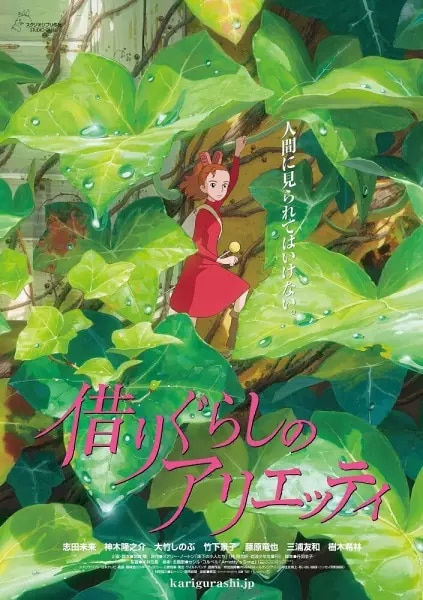
While spending the summer at his aunt's house, the young but sickly Shou makes an amazing discovery: after following the house cat into the bushes, he gets a glimpse of a miniature girl about the size of his finger! Calling her kind "Borrowers," as they survive on tiny bits of human possessions, the girl introduces herself as Arrietty. As he discovers that she lives in the house basement with her parents, Pod and Homily, Shou becomes imaginably excited at the idea of such unique neighbors. However, he fails to understand the adversities they face on a daily basis. In addition to keeping their existence hidden, they must also embark on perilous adventures into human territory, from the house to the outdoors, in order to make a living. Despite her parents' warnings, Arrietty befriends Shou, stirring up unexpected events that may change their lives forever. Delighting the eye and conquering the heart, the breath-taking story of a friendship transcending the tensions between two different human kinds begins. [Written by MAL Rewrite]
7.9/10
Average Review Score
80%
Recommend It
20
Reviews Worldwide
Studio Ghibli is quite renowned for itâs rather large portfolio of acclaimed family movies, and you could definitely add Karigurashi no Arrietty to that list. Ghibli usually makes two types of movies, either fantasy movies that focus on themes that are rather critical of problems in society (Miyazakiâs Princess Mononoke and Nausicca come to mind), whereas in more recent times weâve seen more slice-of-life fantasy adventure movies. Arrietty fits more into the latter, with itâs setting being modern day society with a small little twist; there are tiny, tiny people living under the house, and they borrow from humans to survive. Tiny as in maybe5-8 centimeters tall. One of the charming aspects to this movie is, without a doubt, the amount of attention paid to the little details that makes the presence of little people so believable. The creative, yet simple, ways in which Arrietty and her family are portrayed are captivating, such as the little toolsets Arriettyâs family made in order to explore the âhumanâ house. They use everyday items like fishing hooks, double-sided scotch tape, and spools of thread to create their own little sets of backpacks filled with tools they use to make their lives a little easier, and make the characters fascinatingly believable. The creativity and thought put into the tiny details are awesome, from the fishing hooks and scotch tape, to the little neat cubes of sugar that fits like a well-sized package in the hands of Arrietty. What I really enjoyed about this movie is how it is told from the point of view of little Arrietty as opposed to the perspective of us âregular humansâ. Simple things that you could find in your everyday backyard, from Arriettyâs perspective, all of a sudden have a grandiose feeling to them. Things such as a simple vine you could find creeping across the wall of any old house transforms into an intricate ladder of leaves and stems to the rooftops, or a field of grass and flowers becomes a vast forest. This movie takes your everyday backyard, and turns it into a vast new world to explore. It doesnât hurt that the scenery and artwork was vibrant and lush with color. The soundtrack is especially fitting for this movie. The absense of Joe Hisashiâs music in this Ghibli film is instantly noticable, and while some of the pieces here may lack a slight bit of the grandeur of Hisashiâs works, the soundtrack is still well done. What is a bit unusual here is how the soundtrack was actually done by CĂ©cile Corbel, a French singer and Celtic harpist, who was a huge fan of Ghibli works and sent samples of her work to the studio. The Celtic influence in the soundtrack is immediately noticeable, but it was definitely an excellent choice on Ghibliâs part. Characterization of the actual characters wasnât exactly anything mindblowingly original or exotic, but the main cast was rather believable for the most part, and had their own charms to them. I found the innocently curious, yet straightforward and resolute attitude of Arrietty quite likable. Her rather odd relationship with Sho, as well as how Sho perceived her, turned out to be quite fascinating and, in a sense, admirable. The subtle tension between the elusive tiny people, and the gigantic humans, are played upon quite well here, which adds quite a few tense moments between Arrietty and Sho. Iâd say characterization was quite tastefully handled here for the most part. And now, for the biggest weakness for this movie. The plot progression and characterization were all fine and all, but the conflict and villain were practically a joke in terms of setup. Seriously, what grudge did old lady Haru have against the little guys? They didnât explain in detail why she was hunting out the little people, giving only a flimsy excuse that theyâre âtheivesâ in a degrogatory tone. The villain just felt very underwhelming, and just doesnât fit in with this movieâs atmosphere at all. The conflict was kind of discredited in my eyes because of the poorly integrated main antagonist, and there is certainly room for improvement here. Plot progression, while fine and all, was also rather slow at times. While I personally didnât mind the slow pacing (it lets things sink in more), there were definitely plenty of slowly-paced scenes in this movie. What makes Arrietty a great watch is the tremendous attention to the details of itâs setting, the beautiful art and music, and the wonderful direction for itâs characters. The plot is admittingly lacking (especially the major conflict, oh boy could it have used some more work), but as a premier film for a new director, this film turned out to be an pleasant surprise. The ending does feel very open ended, though, with a lot of loose ends that feel as if they have yet to be tied up. While the likelihood of a sequel for a Ghibli movie is very slim, I would be totally fine with a sequel for this particular movie. Animation/Art: 9.0/10 Music: 9.0/10 Setting: 9.5/10 Characters: 8.0/10 Story: 7.0/10 Overall Enjoyment: 8.5/10 (Rounded up to a 9 on MAL)
This movie started very similar to Spirited Away by Studio Ghibli 2001. Driving in a car to somewhere introducing us to the 'main' character. AUDI in Spirited Away, Mercedes in Arrietty. With a similar opening theme 11 years later they must have found it effective. Hayao Miyazaki writer and Director of Spirited Away, Howl's Moving Castle(2004), and planning and Screenplay for The Secret World of Arrietty. The storyline is based on 'The Borrowers' by Mary Norton and the music, which incorporated many celtic themes especially enhanced by the harp, was by Cécile Corbel.The story could have been so much more thrilling. I enjoyed the character development and appreciated the situation of Arrietty and her family however, it took too long to grip my interest. I was expecting an adventure to occur as the family is trudging through the woods right at the end of the movie. From 14 year old Arrietty figuring out how she fits in with her family, what her role is and who she is, to 'borrowing' her first item(a pin) from the humans, Arrietty is curious. She decides to talk to the human Sho, who is physically sick but had heard from his mother that there were small people in the house. He sees Arrietty and desires friendship and so tries to help them out by replacing first the dropped sugar, then kitchen from a dolls house to 'help' Arrietty's family. This brings about unwanted interest from Haru the house maid and brings what little humour there is to light when she captures Arrietty's mom and calls the Exterminators/'Capturers' to deal with the small people. Arrietty's family decide to move because they were seen, Arrietty feels responsible for this because she was seen, and so they leave to find a new house. Sho feels his connection with Arrietty weakening and for some reason follows the house cat and finds Arrietty and says farewell. I needed something more. The elements were there but were not taken advantage of to capture the interest of it's viewers hence the '6'. The animation was fantastic looking and transitioned very smoothly from scene to scene. There were minor CG sections that enhanced the overall calming effect I received. There were a few scenes of Sho standing infront of the house where he looked quite static however. The music was brilliant. I thoroughly enjoyed the celtic twist and jig rhythms that were interspersed throughout the film. The harp at the beginning of the movie was simple yet magical with clear ringing tones that unexpectedly melded with theme of the movie. (Interestingly Morestsu Uchuu Kaizoku (2012) emotes this theme as well) One thing I noticed was when Arrietty 'sheathed' her pin through her dress a metal-on-metal sound was played that was not for any affect I could relate to. Arrietty's character was developed the most in the film, which is to be expected as the main character however I felt her qualities and traits only scratched the surface. This movie wasn't about her character as much as the progression of her over the journey. There was not much reflection until the very end where she apologised to her parents and then cried at bidding farewell to Sho. The show focused more on her world than her and if that was what was desired then they did a good job. I enjoyed the film as I did not know what to expect but my expectations were apparently too high as I left feeling like there could have been much more conflict for Arriettys character. I would have loved to have followed the family down the river to where a new adventure may await. That is where the story could have taken hold for me. Story: 6 Art: 8 Sound:10 Character: 6 Enjoyment: 6 Overall: 7
Studio Ghibli has a massive reputation in the world of animation, deservedly sitting at the zenith alongside the equally excellent Pixar. Cars 2 might have been a lull in the otherwise excellent back catalogue; unfortunately itâs been a long time since I could happily call myself a fan of Ghibli. Since the Oscar-winning Spirited Away, the studio has been stuck in a state of ever diminishing returns with the frankly over-rated Howlâs Moving Castle, Ponyo and the low point in Tales of the Earthsea. Ghibli is back in 2011 with the Borrower Arrietty, the immediate question that strikes me as a fan is whether thisis a return to form or is the rot continuing to eat away at their exemplary reputation? Even before this film had seen the light of day it was victim to scoffs aplenty thanks to this being a remake of the already well-travelled literary classic The Borrowers by Mary Morton. In case you havenât encountered this tale before, both it and Arrietty tell the tale of a young sickly boy who discovers that there is a family of incredibly small people living under his house. These small creatures are the Borrowers they get their name from borrowing small items and foodstuffs that wonât be missed. The daughter of the family, the titular Arrietty, has a run in with the sickly Sho and they both end up changing each otherâs lives for the better. There might be a lack of conflict but you are smothered with the warmth of it all that you really donât have the time to stop and take stock. Arrietty is a simple tale told well. It is also the most straight-faced film from a studio known for all things fantastical. Despite the screenplay being written by Miyizaki this has none of the flights of fancy or ecological themes that he is known for nor does it have the social commentary of an Isao Takahata film. Diehard Ghibli fans might call shenanigans on such a straight film being housed under the iconic banner, others, me included, see this as a simple film free from the complexity of some of its most famous cousins. Additionally this is a perfect entry point into what is something hard to access for the casual and mainstream viewer. As popular as both anime and Ghibli is there are very few occasions where you can say that something which fits under those groups can be watched by anyone, Arrietty is such a film. The only other film which is both a piece of Japanese animation and accessible to a mainstream audience is Porco Rosso, Miyizakiâs Casablanca stylised story of a man turned into a pig for cowardice during the first world war. It might be the most straight adaptation of a famously concept heavy studio, yet thatâs not to say this doesnât have anything in common with its older cousins. Making such a sweeping statement would mean you have missed many little touches and homageâs. The way in which the film places such value on the everyday and the natural world make it the perfect companion piece to My Neighbour Totoro. In fact these two films would make the loveliest double bill imaginable. Sho is a recycled character model of Pazu, the male lead in Laputa and there is a warrior boy who appears midway through the film, called Spiller, who is remarkably similar to Ashitaka from Princess Mononoke even down to the garb that he wears being the same. The most prescient thing you will notice when watching Arrietty is the sheer unadulterated beauty conjured up by the skilled hands of the animation team. In this age where near enough all animated films released in the West are computer generated it is so refreshing to see something with the personality of hand drawn animation. There might not be the scope of vision of a traditional Ghibli film but that hasnât stopped the artists on board with this film from representing the everyday whether it is a simple garden, or the even more mundanely the rooms of a house, with such care and affection. There might not be a great amount happening on-screen and there might not be a great deal of conflict save for the final third of the film but itâs one of those films where the visuals and cinematography is so inch perfect that it becomes a visual spectacle. The only negative I can really think of is the sung soundtrack, instrumentally it fits perfectly. With lyrics like âI am 14 years old, I am prettyâ, it really made some songs a bitter pill to swallow. The Borrower Arrietty, Arrietty or whatever you want to call it might feel more like homage to one of the most beloved film studios in the world and I, for one, do not construe that as a negative. This is a beautiful animated and affectionately told story with a cast of well-rounded characters that pays off in all the right ways. This film by director Hiromasa Yonebayashi is a perfect entry point to anime and all things Ghibli. Give it a watch if you get the chance but make sure itâs either in the original Japanese or the English dub. The cast of the American dub is enough to cause nightmares.
I think this anime is kind of unique, with mini sized human live as theme, makes me very interested to watch it and leave a deep feeling of it. The shades of fantasy is so strong but not exaggerate. Story: It a simple one, with fine pace, without any boring scene. Ending is almost perfect. Art & Sound are so-so, I like the background art of it, I don't really have any comment except that. Characters: the design was fine, either with their personality, seiyu voice are suited well. Enjoyment: I think Karigurashi no Arrietty will be enjoyable by anyone, although they're not an anime fan. As I mentionedit before, it leave a deep feeling for me, so for me it feels like there's not enough if watch it just one time, makes me want to rewatch it again.
Arrietty is a tiny person. When I say tiny, I mean only about 10cm tall! The tiny people live in the house of a sickly human boy named Sho, who has always heard about the little people of the house from his mother. Arrietty and her family are borrowers, tucked away in the house and âborrowingâ items that the humans are unlikely to notice are missing. After narrowly escaping being seen by Sho whilst outside, Arrietty is excited to start on her first borrowing herself, with her father, Pod. When an encounter with Sho leaves her family very concerned, Arrietty must decide whether the bridgeinto the human world is one which she wishes to cross. So lets start with the characters. We have the suspicious house keeper, Haru, who is totally onto the family of borrowers. Sheâs quite a nuisance and you began to hate her weird reaction to the little people. Sho is quite tranquil and is not super insistent in intruding into the lives of the little peopleâŠrather, he leaves them little (or should i say huge) gifts like sugar cubes that will last them many cups of tea. We have Spiller, the outsider caveman little person that shows Arrietty and her family that there is life beyond their hideaway house. Arriettyâs mother and father keep things in their house running. From making tea to ensuring they have enough âborrowedâ resources, they work quite well as a team. In terms of the plot, I personally felt it was quite lacking. Their is quite a bit of exposition on how the little people steal the things they need and seeing from their perspective is quite fun. Bugs, rats and birds are not their friend! They have glowing red eyes and are out to get them, but Arrietty turns out not to be such a weakling after she arms herself with a pin. The tension and story progression is what appeared most lacking to me. Arrietty hates Sho and hates how encountering him has turned her life upside down. And then she doesnât anymore. There are no true villains, except for Haru, who really falls short in that criteria. She does look like a titan from Attack on Titan thoughâŠso bonus points for that? The relationship between Arrietty and Sho was meant to be deep, meaningful and a merging of their worlds of the little and big human beans. Did I mention they call them human beans? No idea why, but this movie is filled with nature and foliage, which is definitely the most visually appealing aspects of this anime. Arrietty really only comes to him out of desperation, he helps her out and thus they have an eternal bond forever that can never be overcome by any obstacle right? Wrong. Really, not much happens at all between them. Sho wants a glimpse into Arriettyâs world which she doesnât want to provide, but when there is no way around collaborating with Sho, she does. So romantic right? Even though the romance/companionship is quite strange and hollow in the first place, the significance of Arrietty giving her little âborrowedâ hair clip to Sho was quite cute. The animation, though was pleasing, didnât appear extremely memorable to me. Though the huge tissue boxes, sugar cubes and Arriettyâs little home and the dollhouse were well detailed and pleasing to the eyes, nothing really stood out to me.The music on the other hand is lovely, with Arriettyâs song carrying with it the magic that this movie was trying to portray. There are too many questions left unanswered. Where are all the other little people like Arrietty? Why did Shoâs mother leave her critically ill child with his Aunt? Quite a jerky move by the way. My favourite character was most definitely the sassy yet dependable cat. You can never go wrong with cats in an anime. Go check this out if youâre looking for a nice relaxing break from the human world.