Links go to search results. Availability varies by region.
黒いきこりと白いきこり
1
Movie
Finished Airing
Jul 1, 1956
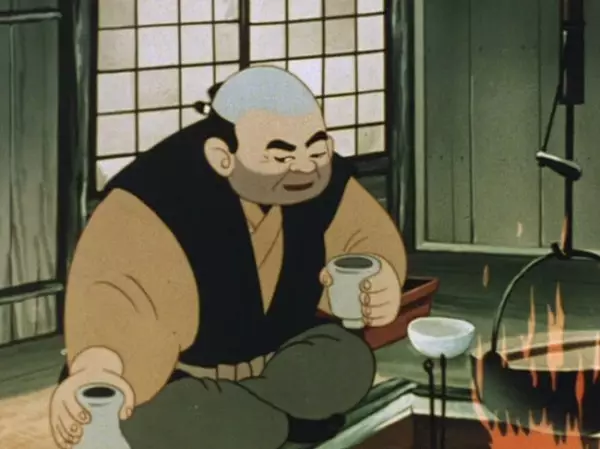
Within a wintry forest live two woodcutters: one clad in black and the other in white. While the black-clad woodcutter sees no consequences for exploiting the forest's resources as much as he can, the white-clad woodcutter strives to live in harmony with the forest creatures. As the chill of winter grows ever harsh, only time will tell which of their strategies will allow them to prosper. [Written by MAL Rewrite]
8.3/10
Average Review Score
100%
Recommend It
3
Reviews Worldwide
"The Black Woodcutter and the White Woodcutter" is the first Japanese animated film that resembles what one would associate hand drawn animation with today. With a washed out watercolor palette, a very Disney oriented art style, and a folk tale inspired story, this film encapsulates a moralistic theme of sharing and looking out for one another in hard times. The film's themes are heavily contextualized by the time it released to the public. 1956 Japan was a time of great upheaval. The Occupation years had just ended and the country was at crossroads of economic development. Poverty, hunger and loss were still widespread in theIsland nation - and the post war period had led to the rise o the "lost generation". It was a period of hardship and also a collapse in the self confidence of the Japanese in their nationalistic ideals. The moral of this movie is pretty clear - hard times are easier passed together in the strength of unity. Scheming against one's own neighbors and participants in a common struggle would be the cause of downfall. This children's tale is pretty simple, but the manner in which it is told - stoic, almost peaceful and calming renders it a gravitas that makes its themes endure well past the time it was produced for. The technical quality of the animation also makes a giant leap with this film. Almost all modern hand drawn animation and storyboarding techniques that we would consider part of the animator's toolkit can be seen at play here. The enhancement of visual color also introduces a depth and realism into the art that captures a broad veneer of verisimilitude.
黒いきこりと白いきこり - Kuroi Kikori to Shiroi Kikori is an animated short film of 15 minutes including opening and ending credits. The anime was first released in 1956 and the story is from the original work by Hamada, Hirosuke. Story: Good vs. Evil - Actions & Rewards - Early masterpiece, a beauty of Japanese animation (8/10) It is about a bear, a fox and a squirrel trying to find warm shelter during a snowstorm. The story starts slowly but becomes increasingly exciting. The author of the original story, Hamada Hirosuke, was born in Takahata in 1893 and was one of the most famous children's and young people's authorsof his time, along with Mimei Ogawa and Tsubota Jōji. Some of his most famous works are "The Tears of the Dragon" and "The Little Mouse Who Tarried". The anime adaptation of Kuroi Kikori to Shiroi Kikori presents itself as an old folk tale and stays true to the original story. At the same time, it tries to give young viewers the moral guidance one would expect from a children's book. Characters: simple, good vs. evil, plus anthropomorphism - interesting (8/10) Anthropomorphism is the practice of attributing human characteristics to animals, gods, etc. Human characteristics can be both physical and behavioural. Mori, Yasuji, who was already known as an illustrator of children's books, was a master of his craft. He was the first to make the later very popular style of anthropomorphism socially acceptable. Not surprisingly, this anime bears Mori-san's signature, with beautiful animal drawings with human characteristics (e.g. walking on two legs). So why a bear with a collar, a fox and a squirrel? Perhaps simply because they were cute to draw. On the other hand, considering that Shintoism is an elemental religion in Japan, perhaps it is worth looking at the characteristics of animals in mythology.Every development begins with the first step. If you think about it further, you will come to today's stylistic device, "Kemonomimi". For example: "Spice and Wolf", Kitsune as a fox deity with fox ears and tail. Kuroi Kikori: The black woodcutter represents the evil craft by treating the bar, the fox and the squirrel badly. Shiroi Kikori: The white lumberjack has the appearance of a grandfather. He represents the good character who cares for those in need and will not leave them without help, welcoming them and offering them food and shelter. Yuki Onna: The Snow Woman is a fictional Japanese folklore character classified as a Yōkai. She is described as a petite woman or girl dressed in a snow-white kimono with knee-length white hair. In rare cases, her hair is depicted as pitch black. Visuals: Animation and graphics are wonderful, character drawings are charming (8/10) The first thing you notice is that the art is amazingly detailed, especially the character drawings by Mori, Yasuji, who was and is famous for his cute animal drawings that still bear witness to his creativity. All of his work was important for the next generation of mangakas and is still used as a reference today. On top of that the animation is brilliant, energetic and expressive. Please remember that this was 1956. Everything had to be done with cell animation, which is relatively difficult to do as it requires a lot of experience, especially in colouring. The artistry of the backgrounds and characters, as well as the animation of the fire in the open fireplace, the small flowing stream and the movement in general, elegantly show that we have an often overlooked treasure from the past. Even those who are aware of the strong influence on many Japanese animators of the late 1930s (Disney) and subsequent decades cannot deny that this is an altogether beautiful animation. It took a few more years, but in the 1960s, manga artist, animator and film producer Osamu Tezuka modified many of the techniques used in Disney cartoons, sparking a veritable manga/anime revolution. Not to be misunderstood: Osamu-san liked Walt Disney's cartoons. But he was the pioneer who set a new trend in the Japanese manga and anime industry. He was the inventor of the distinctive 'big eyes' style of Japanese animation. But that's another story. Sorry, I got a bit carried away. Sound: good BGM, no VA (7/10) There are no dubbed voices, but gesticulating and facial expressions make the whole story easy to understand. The musical arrangements by Kojun, Saito and Takanobu, Ito evoke the appropriate emotions in the audience. Even when no words are spoken, the intention of the plot is well understood. The anime is a little treasure that, simply put, tells a story about "it is blessed to give rather than take". Watch the anime to the end, I am sure you will enjoy it. Thank you for reading and have fun watching!
Rate a 7 Musical no subtitles nor voices with the exception of animation noise. Art Film Story A dedication to perseverance. Sad to say others would rather help them selves rather than others during times of troubles. While there is some benefit to that there is some benefit against it as well. As the story plays out one finds the moral of the story that there is strength in numbers. A good kind hearted message. The only downside to the film is it is based on hunters. I would say more but that says enough without ruining the story. Art Two my knowledge there are two versions of this animation. Thereis a moderately colorized and an a high definition colorized version. Noting the difference between the two is easy. I recommend seeing the non high definition version. Personally, i feel high definition doesn't mix well with old art. Not only that but to force modern technology on older technology defeats the purpose for what it stands for. Character Demonstrates individual personality. Enjoyment While i already admitted that this story is kind hearted with it is message it is also perplexing as well. There is at least two takes one could have on this film. The other being the act of learning wasn't done. For example kids will touch a burning stove even though they know it will hurt. In this case a pointless cycle is kept. Despite the perplexing character decisions i suggest watching this animation. While the story did not quite do a good job at illustration keep in mind there is two hunters. This is not a piece where time progresses and it is the same hunter just older.