Links go to search results. Availability varies by region.
正反対な君と僕
12
TV
Finished Airing
Jan 11, 2026 to Mar 29, 2026
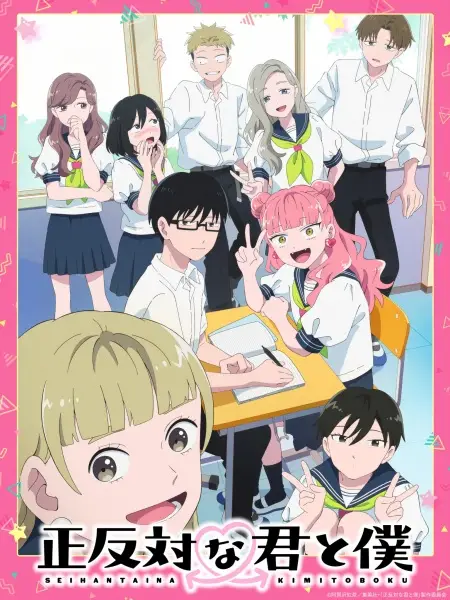
Miyu Suzuki is a high school girl whose cheerful outlook on life is tempered by her need to fit in. Coincidentally, beside her in the classroom sits Yuusuke Tani, a boy unconcerned with others' expectations. Their exchanges rarely extend beyond brief discourse, yet the polarity of their demeanors unexpectedly draws them to one another. As their mutual interest grows, the newfound feelings are no longer easy to ignore. Eventually, Suzuki voices what is inside her heart, forcing both of them to confront the unspoken affection between them. With each passing moment, their relationship evolves, and they gradually come to better understand themselves and the person who is their polar opposite. [Written by MAL Rewrite]
8.4/10
Average Review Score
90%
Recommend It
20
Reviews Worldwide
You and I Are Polar Opposites The final episode perfectly ties into the story’s central theme—and I only fully realized it at the very end. This anime is, quite literally, about opposites attracting each other. Suzuki, who has always been extroverted and popular, saw in Tani-kun someone genuinely kind and never cared about the social position he seemed to have in class. Tani-kun, on the other hand, struggles with communication. Yet throughout the story he grows and matures, doing everything he can to show Suzuki—the girl he loves—how special he truly is. Yamada has always been popular and surrounded by girls. However, with Nishi he finds a completely differentkind of relationship, and even gives up parts of his usual behavior so she can feel comfortable and grow alongside him. Nishi, who was extremely shy and barely interacted with anyone, finally pushes herself to improve her social side because of her love for Yamada. Taira has always been full of insecurities, someone who would never imagine himself being involved with someone like Azu. Little by little, though, he learns from his friends that many social conventions are more meaningless than they seem—and that caring about Azu would never be a waste. Azu, meanwhile, has always been somewhat troubled, constantly trying to act like an adult and jumping from relationship to relationship. Yet beside Taira, she seems to rediscover her youth—having fun, seeing the colors of adolescence again, and supporting his growth. Seihantai na Kimi to Boku executes its central theme beautifully. In the end, the idea that “opposites attract” becomes something deeper: the adolescent effort to love someone and grow together with them.
Click an episode to read its synopsis.
You and I Are Polar Opposites proves that sometimes the most dangerous thing in a high school romance is not a love triangle, not dramatic heartbreak, but simply two teenagers trying to talk to each other without combusting from embarrassment. And somehow… that alone becomes ridiculously entertaining. The story opens with Suzuki, an extremely cheerful and expressive girl who tends to say things faster than the brain can process them, and Tani, a quiet and reserved boy who overthinks absolutely everything before speaking. The contrast is almost comically obvious. Loud sunshine meets professional overthinker. Social butterfly meets internal panic simulator. On paper it sounds simple.In execution? Somehow adorable, chaotic, and weirdly heartfelt at the same time. Watching Suzuki confidently throw herself into conversations whilst Tani quietly spirals internally two seconds later becomes comedy gold. Moments like overanalyzing a text message, realizing something embarrassing was just said out loud, or attempting to act normal while feelings are clearly malfunctioning… somehow feel painfully relatable and ridiculously cute at the same time. Honestly, the amount of secondhand embarrassment and “aw that’s adorable” energy packed into simple conversations is impressive. But here is where the series suddenly becomes even more impressive. The romance is not just about one couple. The story gradually introduces multiple pairings within the friend group, and every single relationship feels completely different. Characters like Yamada and Noshi or Azuma and Taira develop their own romantic dynamics that contrast beautifully with Suzuki and Tani’s relationship. Some couples are playful and chaotic, others are awkward and emotionally cautious, while some slowly build chemistry through small absurd interactions. And somehow none of them feel repetitive. Each relationship explores a different way people deal with affection, and emotional vulnerability. Looking the entire friend group progressively navigate love together creates this feeling that the story is not just about romance, but about growing up socially. And honestly? The variety of dynamics makes the entire cast feel alive. Like… actually alive. This is where the writing of Kocha Agasawa deserves a huge amount of credit. The characters feel carefully observed, almost like real social behavior has been studied and translated into fiction. Supporting characters are not just there to cheer for the main couple. Everyone has their own insecurities, awkward habits, and emotional perspectives. Group conversations become some of the most entertaining parts of the story because personalities constantly bounce off each other in unpredictable ways. Someone says something awkward. Someone else overreacts dramatically. Another person silently overthinks the entire situation for five minutes straight. The result feels less like scripted dialogue and more like a messy but lovable friend group where everyone is slightly emotionally confused but trying their best. The grounded nature of the storytelling also makes the romance surprisingly relatable. Instead of giant dramatic conflicts, the story focuses on small emotional moments. The nervous excitement of realizing a crush might be mutual. The fear of saying the wrong thing. The relief when someone understands a feeling that was difficult to express. Those tiny emotional beats are what make the romance so satisfying to watch. Somehow the series turns everyday awkwardness into something genuinely heartwarming. And yes… occasionally extremely cute. Almost unfairly cute. Like, suspiciously cute. The anime adaptation elevates these strengths far beyond expectations. Aesthetically, the visual direction captures the expressive personality of the manga with energetic facial reactions and lively character animation. Comedic timing is handled beautifully, with exaggerated expressions appearing exactly when needed to make scenes funnier without breaking the tone. Even simple conversations become entertaining because the characters constantly communicate emotions through body language and subtle gestures. Music adds another delightful layer. The opening and ending songs match the youthful romantic atmosphere perfectly. Background music leans into light and playful melodies that make scenes feel warm, cozy, and occasionally mischievous. Instead of overpowering the story, the soundtrack subtly enhances emotional moments and comedic beats. Some scenes become even funnier simply because the music understands the vibe. Voice acting ties everything together with excellent chemistry across the cast. Performances feel energetic but natural, allowing jokes to land effortlessly while emotional moments remain sincere. The interactions between Suzuki and Tani are especially charming. Awkward pauses, nervous reactions, playful teasing, everything flows with a rhythm that makes the relationship feel genuine. The supporting cast also shines, making group scenes feel lively and spontaneous. Additionally, it is also important to understand the limitations of the story. This is very clearly a "romantic comedy." So for anyone expecting extremely dramatic romance filled with heavy conflicts and emotional breakdowns every episode, this series is probably not aiming for that style. The focus remains on romance and comedy first. That does not mean drama does not exist at all. There are moments where characters confront insecurities, misunderstandings, or internal struggles. However those moments are usually handled with a lighter tone because the story prefers warmth and character interaction rather than intense drama. This creative choice also leads to one of the few noticeable weaknesses in the story. Some people might feel that the relationship progression happens a little too smoothly. Certain romantic developments appear quickly, and the characters sometimes become a couple earlier than expected without long dramatic conflicts beforehand. The story does contain emotional tension and personal struggles, but because the focus is romance comedy rather than heavy romance drama, those conflicts are often resolved in a gentler and faster way. In some cases the world of the story can feel slightly idealized compared to real life. However, what the series lacks in intense external drama it more than compensates for through thoughtful internal writing. The author is particularly strong at portraying internal conflicts and subtle psychological struggles. Characters deal with insecurity, social anxiety, self-doubt, and the fear of misunderstanding others in ways that feel surprisingly honest. These themes are handled with more clarity and emotional intelligence than many heavier romance dramas that attempt similar topics but struggle to deliver them convincingly. Even though the tone remains playful, the emotional insight behind the characters often feels deeper than expected. For anyone who continue with the manga, the story becomes even more rewarding. The relationships grow more nuanced, the characters continue developing, and the emotional tone occasionally shifts into slightly melancholic territory while still maintaining its warmth. Those moments add an extra layer of depth to the series. As a fellow manga reader, following the story further feels very satisfying because the character writing continues to evolve. There is much more growth waiting beyond the anime adaptation, but the conclusion is something better experienced personally rather than spoiled here. Lastly, to sum it all up. Through vibrant characters, grounded emotional writing, and a surprisingly strong adaptation, You and I Are Polar Opposites becomes far more than a simple romantic comedy. The story captures the chaotic excitement and sweetness of young love in a way that feels funny, sincere, and incredibly easy to enjoy. Multiple couples growing in different ways, a friend group that genuinely feels alive, and character writing that understands insecurity and affection with unusual accuracy… all of that creates a series that is not just entertaining but genuinely charming. The result is a romantic comedy that feels warm, lively, occasionally hilariously awkward, and honestly a little addictive to watch. The kind of story where one episode ends and the immediate reaction becomes something dangerously close to: “Wait… that was it? Already?” Anyway, keep in mind that no opinion is ever purely objective, and every perspective remains open to discussion. Even so, each viewpoint still holds its own value. If you happen to see things differently, simple mutual respect is more than enough. That same respect is the spirit behind this reflection as well. Wishing everyone a peaceful day ahead, and thank you for taking the time to read.
It really ticks me off how much of the discussion and praise surrounding this anime revolves around how it "subverts" the much-maligned romcom cliché infamously known as The Misunderstanding™, which I do admit can sometimes be really damn grating (sometimes being the keyword here, I've read a couple of works that have done it masterfully, e.g. Bokura ga Ita and When The Day Comes). A lot of people have also pointed out how the main couple getting together at the end of the first episode is "totally refreshing and has never been done before!!" and this is supposedly what makes Polar Opposites — an animethat ticks every trope checkbox on the worksheet — the great show that it is. And to that I say: hell no. Let's face it, nothing is original anymore. Every possible cliché has already been written. Tropes are just that - templates. Authors wield them as a crutch to familiarize the audience with the characters' personality and dynamics. The Misunderstanding™ being included in a story is not a criterion that determines whether the narrative is fundamentally crap. Agasawa Koucha clearly understood this assignment. You could infer from the way Polar Opposites is written that the author knows how these high schoolers actually think and talks to each other. Yes the characters do use tropes as a pre-established framework, but fortunately for us Agasawa has the skill to paint them with layers upon layers of vibrant color and life. How these kids immaturely try to navigate their surroundings, which from the narrow perspective of their short seventeen years of life may not be quite life or death, but something close to it. Of course it does, their limited understanding of how life actually works are realistically going to cause friction and misunderstandings between themselves. In real life, there is no way all of these kids would be so good-natured, but how Agasawa explores this friction in a low-stakes, lighthearted but still grounded in reality way is what allows this show to transcend its own clichéd foundation. Okay with all that preaching out of the way, let's talk about what ACTUALLY matters — the ships. Suzuki and Tani. Okay, disregard everything I just said in the previous paragraph about transcending clichés or whatever because goodness gracious these two sure as hell did not. Suzuki is great when she's interacting with the whole friend group but even her endlessly bubbly and charming personality can't save her from having negative chemistry with Tani. Her complex about conforming to others' expectations is never again mentioned or developed beyond the first episode and Tani doesn't even have the decency to have a reason for being an extreme caricature of the quiet glasses-guy trope. They are trapped in the confines of forever going through the obligatory checklist of generic post-confession couple routine that I've seen a couple hundred times before. I guess it's fine if their interaction are fun, but watching Suzuki try her hardest to get Tani to contribute to a conversation with anything other than "yes", "no", and "It's fine" is the very definition of .... well, not fun. Sorry. Yamada and Nishi. There isn’t much to say about them except that their relationship is the literal embodiment of the word “sincere.” What they like about each other is the way they present themselves to the world just as they are, and in my sincere opinion, their interactions are definitely the cutest. At last but certainly not least, Tairazuma. By far the numero uno best pairing in the show. It's amazing how fleshed out their life and circumstances are considering their relatively limited screentime. They are superficially polar opposites, yes, but both of them are actually pretty similar in the ways that matter. Their low self-esteem stems from the lingering trauma they experienced in the same middle school, each from very different social circles. Taira is the social outcast; the continual rejection from his peers led him to erect social barriers around himself and his obsession with social hierarchies originates from his need to justify the awful treatment he got in the past. Azuma on the other hand have a similarly cynical perspective, but hers stems from her being in the "popular" circle. Her experience of constantly being taken for granted led her to ignore her own needs in order to satisfy the majority crowds, and that she's the one responsible for keeping the harmony. This charade is also a form of protecting her own feelings. By making light of the situation she's in, she never has to process how much it's grinding down her sense of normalcy. And because of these different yet fundamentally similar experiences that they're able to cover each other's blind spots. Azuma constantly interrupts Taira when he starts spiraling into his toxic overthinking mess of a headspace while Taira can pinpoint the exact problem within the complicated web of relationships Azuma is stuck in, helping her see that she deserves to value herself more. Honest to god they perfectly complement one another and I am waiting patiently (not) for them to take the next step in their (hopefully romantic!) development next season.
Another wholesome and cute anime, with similar plotlines like horimiya, fragrant flowers, skip and loafer, etc. but this anime has its own charms and able to entertain me even with such a cliche premise. The overall story are very light with little to no drama, so perfect to watch if u need some relaxing and funny anime. The comedy also nice and funny. The romance are building with such a perfect pace, typical innocent highschool puppy love romance. The romance between the main couple are cute but the side couple are even cuter! Each couple have perfect chemistry. And the relationship and bonding between everycharacters are nicely built and it's so wholesome watching them having those kind of friendship. The art style also really cute and fitted the overall vibes, especially when they use chibi style (it's just so cute) Overall it's really well made and entertaining even with cliché plotlines, they have their own charms in this kind of anime genre
1. Kaguya-sama 2. The dangers in my heart 3. This anime This is a tier list of the best romance anime for me. Yeah. You and I Are Polar Opposites is an anime that feels both traditional and not; it plays around the tropes that we are familiar with, but gives them their own special spin, such as the "energetic gyaru girl" and the "quiet, calm and analytical guy", which is the MAIN PAIR. I was really surprised at how they handled that calm guy, which is Yuusuke Tani. He's not just a blank sheet, not the usual boring copy paste character, but someone who actually has depth.The author actually built on the trope, and wasn't lazy. That said, some of his traits and the pieces of personality are SUBTLE. He isn't the only character that does this, but I feel like this is something that makes this anime a bit more realistic than other romances. If this subtle quality is something that bothers you, then this probably isn't the best anime for you. I said that he was part of the MAIN PAIR. That's another untraditonal part of this anime: there are multiple. What? The side characters actually get development? This is insane! Yes, that was also my reaction. This anime has multiple of the introverted type characters, but each and every one of them is very unique and well-built. Additionally, this show doesn't tire you out but is quite quick on adding romantic developments, whereas other anime might drag on and on and on. And so, I rate this anime a 9 out of 10. It isn't perfect, but it's pretty high up there.