Links go to search results. Availability varies by region.
僕のヒーローアカデミア FINAL SEASON
11
TV
Finished Airing
Oct 4, 2025 to Dec 13, 2025
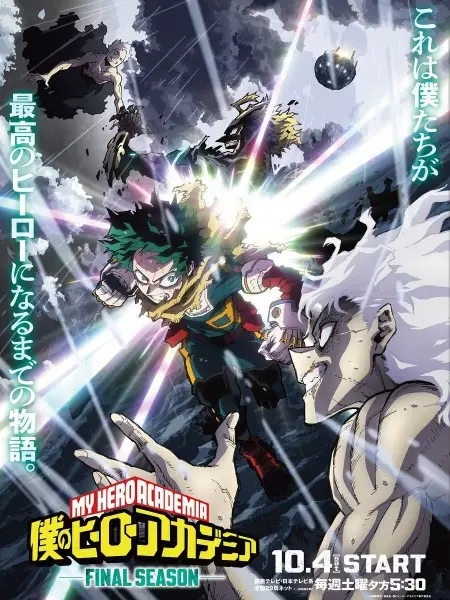
The final stages of an all-out war between heroes and villains unfold as the world watches its symbols of peace and destruction collide. When All Might is critically injured, global fear takes hold as the fate of society hangs in the balance, and the threat of All For One and Tomura Shigaraki makes it clear that the conflict is far from over. As hope begins to fade, Izuku "Deku" Midoriya stands at the forefront, refusing to let the war end in despair. Pushed beyond his limits and supported by Katsuki Bakugou and other heroes fighting beside him, Deku becomes the central force opposing collapse. The conflict becomes a defining turning point for society—one where the future will be entrusted to the victorious side. [Written by MAL Rewrite]
8.1/10
Average Review Score
75%
Recommend It
20
Reviews Worldwide
In 2015, on a random week at the end of October, the first season of My Hero Academia was green-lit. At the time, my excitement was through the roof, like a kid at the candy store. It made all in the sense in the world to capitalize on its popularity. Animating this show was also no brainer with the growing trend of superhero media in the modern era. Here we are 10 years later, the final season of My Hero Academia is upon us. The rivalry between the heroes and villains in this franchise has been old as time. To make a strong impression, we're thrownback between the struggle on both sides: All Might and All For One. Their battle has much more impact than just than saving the world. From All Might's point of view, he's trying to save the next generation of heroes. In a plot scripted way, he's also destined to clash with the villian boss. It's a cliche of good vs evil yet My Hero Academia has embraced on its idea. Similarly, My Hero Academia does rely on some common superhero cliches in the final season. One of the recurring themes is character redemption as seen with Aoyoma and even lesser extent, the hero killer Stain. All For One's past is also revealed including his hatred for a certain character and his quest for revenge against All Might. Sound similar? I'm sure you've seen a superhero movie or two about a villain's crusade to exact revenge. In the present, Bakugo also manages to follow his own path, not one with redemption but his own character. His fight with All For One represents selflessness and growth beyond his usual arrogance. It contrasts against All For One's one-sided blindness to achieve power and domination. Rather, Bakugo's endurance and to prove himself establishes him as a true hero this season. And finally, we cannot forget Deku's archrival in the show: Shigaraki. They're polar opposites of one another. Deku walks the path to create peace and hope, while Shigaraki seeks destruction and chaos, while trying to make things right in his vision. From his perspective, Shigaraki sees the hero system as flawed and tries to correct it in the most extreme ways possible. In one of the most profound moments in the season, we also see how Shiagraki reacts to his feelings and reponses. Even his final words show that he followed his path from the start, to destroy, than to create. However, this season finally allowed Shiagraki to find peace and end of his own suffering. For Deku, he managed to win a battle of ideals. His character is the foil compared to Shiagraki and like in any hero/villain story, one had to win and one had to lose. My Hero Academia's path to get to the final season was never an easy one or without flaws. It suffered from some pacing issues and perhaps introduced more characters than we bargained for. Among the cast, some got lost in the fold while others were oversaturated. Deku, Bakugo, Shiagraki, and All Might are those who recognize the most throughout this franchise. And indeed, the final season put the spotlight on them to finish all their character stories. The final season also resolved the main storyline of the Final War Arc, a conflict that manifested from the first season. It took 10 years for the anime to reach such a conclusion but no doubt one worth waiting for. My Hero Academia: Final Season is the amalgamation of Kōhei Horikoshi's hard work and colorful ideas written into a story for his fans to enjoy. While the series has its ups and downs, the final season didn't hold back to give a final conclusion, one that made the most sense from a plot perspective. There are times when I felt like the series tried to milk itself or stayed longer than its welcome. But for this season, 11 episodes felt just enough to sent this season into the sunset. The 10-year saga of the mainline MHA anime is now finally over.
Click an episode to read its synopsis.
Where should I even begin? Season 8 of My Hero Academia disappointed me just as much as Season 7 did. It was tedious to watch and felt completely rushed. The story jumped from scene to scene, creating a confusing mess. What exactly happened to the previous holders of One For All after they entered Shigaraki’s soul? The series leaves the viewer alone with far too many unanswered questions. The fight against All For One had no real consequences. It was predictable, and of course every student had to get their own moment against him. To me, the battle against All For One was one of the worstif not the worst final battles I have ever seen in an anime series. There was no drama, no tension, nothing at all, because everyone survived even in a fight against the supposedly greatest villain of all time. The ending was stretched across several episodes, but I wasn’t truly satisfied with it either. I’ve spent a significant amount of my life watching My Hero Academia across eight seasons. So before anyone assumes I’m just a hater, they should keep that in mind especially since I rated several earlier seasons very highly. This is criticism, and I believe it is justified. Everyone is entitled to their own opinion, as long as it is expressed politely and objectively. Conclusion: The animation was excellent, as one would expect from MHA, and the soundtrack once again left a positive impression. The story, however, was messy and rushed. The final battle did not deserve to be called a final battle. My rating: 3/10
What does Boku no Hero Academia teach us? - There has to be a reason behind why a person is evil, he has to have a background full of grief and the onus on you to hard reset his very own beliefs. - The bully and the victim should be treated equally, they are both at fault. Adults should not help the bully to change his worldview, eventually, he will definitely get a character development phase and there it is, he is a full-fledged grown-up which society admires to the fullest. - Governments should provide the most prominent figure in its liberation history a salaryman job. There area lot of characters that did not get share from the story (Principal Nezu, Fillers in Class 1-B, Lady Nagant, Doctor really what happened to him?, Midoriya’s father, Mirko) and characters author forget to mourn at the end (Star and Stripe, Twice, Shimura family)
I never leave a review. I have almost 90 days of watch time I've never left a review. This is not going to be a meta review, moreso the thoughts and feelings that I had after watching the final season. My hope is that in understanding how much I would have to be moved to write this out, you will understand why I personally find this to be the best ending to any story I've ever had the pleasure of expriencing. My Hero is a story that has always put the "other" first. Everything the heroes do is for the betterment of others. A hero puts theirbody on the line for others. A hero cares about everyone. A hero can't help but think "how can I help someone else". It's honestly so moving for me. I think Horikoshi does an amazing job in encapsulating that. For all of My Hero's faults at the end of the day I *love* this story. I think throughout the story Horikoshi is constantly saying "Helping others matters. Helping others works". Through a principled stance of caring about people, you can make a difference. And I think the ending does such an amazing job of driving that home. When you take action people notice and people get inspired. And yet Horikoshi says that's not enough. Literally. And I LOVE that, because it IS not enough. You **must** find a way to pass the baton, to help the next generation as they are inspired to continue helping others act that out. There is so much love in this story. I guess at the end of the day that's what a hero is. Someone who loves. Whether that's as grand as loving humanity or as singular as loving your partner-- you become a hero to those people you love. My Hero boldly declares that love is words and love is action. Unfortunately the words are escaping me right now but the way that everyone just cares for each other so deeply, it's something so beautiful it can't really be encapsulated by words. It's something you have to experience-- start to finish. I love this story. I love My Hero's message. I love the amazing cast. I love the villains too. I love the dialogue. I love the VA’s performances. I love the soundtrack. And damn it I loved every second of this ending, start to finish. I love anime so much
My Hero Academia has finally, after 8 seasons of unrelenting cringe that would make even an edgy teenager wither, has finally come to its conclusion. Good bye and Good Riddance. This is a garbage pile of a series that somehow manages to rip off Sky-High, a terrible B rated superhero movie about high school super heroes, while still being worse.... MHA as a series that is extremely overrated, and is fundamentally, just not a good show. The vast majority of the series is just Midoriya embodying all the worst traits of the "Well I want to try and redeem the villain regardless of how many peoplethey killed" trope. And besides our main protagonist, the rest of the cast is so large that in essence they all end up being defined by one or two dimensional tropes based on relevance to their plot. This series even had a character (Mineta) that was purely defined by his incel-bait misogynist slobbering over any woman who is near him. Mineta as a character completely trivializes many horrible experiences women have to go through when it comes to obsessive men as "Comedy". The dichotomy between "All for One" and "One for All" is some weird reference to the book "The Three Musketeers", being just the breaking up of their main 'catchphrase'. Yet, it takes the catchphrase and manipulates it into trying to fulfill instead representative of a stereotypical good v. evil factions? All for One being embodiment of evil, One for All being embodiment of good, which misses the point of the original quote "All for one and One for all" that was in the book, and I absolutely despise when people randomly put references from literature into their media while having such a lack of understanding of it that I can only conclude that they never actually read the book in the first place.... I would rather do anything else than have to sit through the absolute travesty that is this series again.. The only redeeming thing about this season of the show is that it is the last one. Thank god.