Links go to search results. Availability varies by region.
æ»äșĄéæŻă§éŁŻăéŁăă
11
TV
Finished Airing
Jan 7, 2026 to Mar 18, 2026
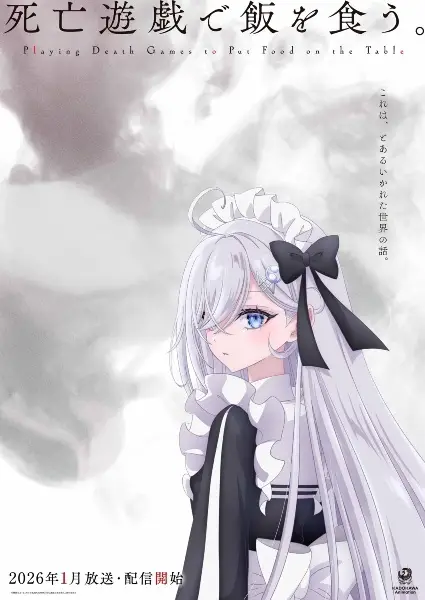
Yuuki wakes up to find herself in an unfamiliar manor, wearing a maid uniform and lying on a luxurious bed. Soon, she discovers five more girls, all dressed the same as her. This is the Ghost House, and the only way they can survive is to make it through the traps that lie in waitâdeadly games full of blowguns, buzz saws, locked rooms, and weapons. It's a hopeless, terrifying situation for everyone there...well, everyone except Yuuki. After all, this is her career at seventeen. Do you think that's odd? She would agree. But that's how some people areâthey earn their living playing death games. (Source: Yen Press)
6.3/10
Average Review Score
55%
Recommend It
20
Reviews Worldwide
Shiboyugi feels more like an art project than an actual story. Thereâs a strong, creative vision behind it that is obvious from simply watching it. The art style is uniquely minimalistic, the music choices are purposefully empty, and the characters are written to feel mysterious. In theory, this sounds interesting, but in practice, it shows that Shiboyugiâs issues are not the result of poor execution but of deliberate choices. Everything the studio chose to do was executed perfectly, but followed through on a plan flawed from the beginning. I also suspect the source material didnât help much with the characters and plot, but I canâtspeak on that since I havenât read it. Starting with the visuals, the anime alternates between two very different styles. For long, mostly still shots, it generally uses a soft art style and draws its characters with strikingly gorgeous eyes. During action scenes or less important dialogue moments, the characters are drawn in a minimalistic style that lacks all facial features. The result is animation that frequently looks well below-average, but contains the occasional well-composed still image. Additionally, the aspect ratio constantly shifts, often becoming wider (or shorter) than the normal ratio. If done right, this trick can build tension or look cinematic, but here, it happens so often that itâs jarring. By the end, it almost feels like they did this simply to reduce the amount of space that had to be utilized. Shiboyugi also implements completely black title cards between segments, similar to the Monogatari series. In Monogatari, these add to the rhythm and personality of the storytelling. Here, the chapter number is presented as a fraction, making the purpose seem like itâs to tell the audience how far through a light novel they are, or to pad time, not as a meaningful stylistic choice. The final aspect of the visuals to critique is the character designs, which are uninteresting and mostly all the same, especially in the minimalist style. In these moments, when characters have the same hair color, it becomes nearly impossible to distinguish them from each other. Unfortunately, the premise itself doesnât fare much better, with the death games lacking all intrigue and rarely generating any real tension. There are two main reasons for this. First, the nonlinear narrative removes any feeling of suspense for the main character, Yuki, since we already know she survives. Second, the other characters are so uninteresting that their survival or death carries almost no emotional weight. It doesnât help that Yukiâs dialogue is short, bland, and never reveals anything meaningful about her. We rarely learn how she actually feels, and when we do, itâs through third-person narration, leaving a feeling that we are told how she feels, and not shown it. Again, this is on purpose; sheâs supposed to feel detached from the world, but this detachment makes her terribly uninteresting to watch or become invested in. The games themselves are at least varied in structure. The smaller games generally involve a group of girls working together, and ultimately, some must be sacrificed. These are more focused and had potential to explore the characters, but the show rarely takes advantage of this. If it does, itâs done through third-person narration, which feels drawn out and needlessly complicated to follow, and ultimately doesnât make me any more invested in the characters. The other games are almost like large brawls, where a ton of girls separate into two groups and then kill each other. These games donât get decent explanations of what is going on, so they just feel like a bunch of girls killing each other for kicks and giggles, devoid of any real strategy or emotions, which ultimately undermines some of the characterization the show tries to do. By the end, I felt like I had learned almost nothing about the settings or characters aside from a few surface-level details, and there was no buildup to something exciting that may or may not occur in a possible second season. Shiboyugi had potential. There were interesting elements to the series that, unfortunately, were not chosen to be focused on. Instead, we get a story that doesnât actually have a lot to say, with characters that seemingly only exist to be allies or enemies for Yuki. Any attempts at characterization are fumbled through dull, third-person narration for a backstory that doesnât usually make a whole lot of sense. The visuals could have been striking; like I said, the static shots are pretty, but the directorial choices hold it back, causing jarring shifts between the two art styles. The music successfully invokes a feeling of emptiness and, from that, dread, but honestly, Iâm not sure I would have noticed a difference if it were completely absent. In the end, Shiboyugi tries to distance itself from other high-stakes games by attempting to be contemplative and artsy, but ends up losing what makes the genre engaging in the first place. Instead of tension, mystery, or emotional investment, it delivers an experience that ultimately feels empty and plain boring. Because of this, despite some interesting stylistic choices, I cannot recommend Shiboyugi.
Click an episode to read its synopsis.
The overall concept of this anime is somewhat interesting by itself. To put it short, itâs basically a cross between Squid Game and Saw where anime women play games with their life on the line. They're often working together but sometimes there are decisions that need to be made where not everyone is able to survive and or sacrifices need to be made. This is encapsulated really well in the first episode where the main character has more experience than everyone in this game, and she realizes that she has control over who lives and dies. I thought it was a really messed up but,interesting theme, because she is basically playing god choosing who gets to live. The first episode was pretty interesting at parts, and it set up themes that made this anime have a lot of potential. Although I wasnât too into it yet. I thought the side characters still could've been better and the games could've had more depth, but I felt like it was a solid intro overall. The second game is more of the same with slightly more interesting characters. After this game, I was hoping the anime would start improving on some of the problems I had with it, but instead of getting that, it does a complete 180, and it quickly becomes almost unwatchably bad. After episode 5, it felt like the team was trying to outdo themselves every episode to see how much worse they could make every episode than the previous. After episode 5 the anime becomes unwatchable because of how much of the actual games they skip, and how much focus they put on everything the anime is not supposed to be about. They stop following through on the promise of the themes and concepts they've set up early on. Instead of this anime making serviceable, relatable characters that we want to see make it out of these games alive and who tragically fell victim to a society where they felt forced to do something like this to make money to begin with, the anime does its very best to make you hate the entire cast as much as possible by making every character extremely annoying. In the later games, people start killing each other for no reason even when they don't need to, in order to survive. The characters also sometimes speak in nonsensical metaphors so it just annoying to watch. Even when the characters were serviceable it was still boring. They mostly just had generic reasons to be there like being in debt and needing money. Although, I liked Shiori a little because of her unique motive of wanting to save up enough money to become a shut in and separate herself from the society she didnât like. Still, she is just a side character who becomes irrelevant after the second game. I didn't really care for the main character either. I always found her goal of beating 99 games to be lame and random. I would much rather watch if she had any other reason that forced her to keep playing these games at some point besides her just wanting to beat 99. There are aspects to her character that could've been interesting if it was done better, so I can see how some people might like her, but overall she just feels like a failed attempt at what could've been an interesting main character. Not only do the characters get significantly worse halfway through, they start dedicating entire episodes to these characters. During the game with the most interesting concept by far, which is Candlewoods, the concept for this game is completely overshadowed by 2 terrible characters Kyara and Moegi. We end up spending more time watching their fake sad backstory than we do watching the actual game. Moegi is a terribly written character. They try to make you feel bad for her and relate to her but she's such a trash character you can't at all. Sheâs killing everyone in the game, even her own teammates, for the dumbest reason. Moegi could've been an interesting character if her mentor wasn't such a bad person/character. All they had to do this game was follow the theme of hunting and surviving, and it would've been a compelling arc. Especially, if they had Moegis mentor have the opposite viewpoint of survival from Yukis viewpoint, where surviving is about killing to survive. This would've been an interesting philosophical dichotomy between the two parties, but instead, they just make her pure evil, and they kill people for no reason which makes watching this infinitely less interesting. Furthermore, the themes they had set up about fighting for survival, were not developed at all. It just makes this anime feel really underwhelming. Later on, most of the character deaths happen off screen. We almost never get to see what actually happens to these characters, because they are constantly skipping fight scenes. Or stuff is happening randomly and you can't tell what's going on half of the time. So, if there was a character you wanted to follow outside of the main character or the villains... good luck, because theyâre probably either dying off screen, or youâre never seeing them again. This is part of the problem with this anime trying too hard to be avant-garde with its directing style. As for the games in this anime, theyâre honestly so uninteresting, to the point where it breaks the immersion. You aren't solving anything with the characters. You watch these characters do random escape room stuff, and are force-fed the idea that the characters are smart for figuring things out. Most of the time random stuff is happening like random keys spawning, and sometimes, a whole section will happen off screen. Due to this, the games feel very un-alive. In this kind of anime, having games feel alive is completely essential. A perfect example of this is Kaiji's rock paper scissors game. This game is a perfect example of a pvp game that actually has real strategy, where the whole area feels dynamic and the circumstances are constantly changing around them. The characters decisions have real impact on the entire game for everyone. However, in this anime there isnât anything remotely close to that. Not only is there no real depth or strategy to any of the games, but they practically skip over 90% of the games and whatâs actually happening in them. The only time I felt immersed was during the first two games. However, it was still having the problems I mentioned previously. The last game in the anime easily had the coolest concept, but sadly the game gets none of the focus. Instead, they spent too much time focusing on annoying characters. The production of this anime is the last part I will talk about. It seemed like they were trying too hard to be artsy with this project. I immediately noticed this when I realized the anime is in movie aspect ratio, which already came across as wanting to be different. There are times where I liked the production. However, they start overusing things they shouldn't. For example, this pastel artstyle where you can't see the characters faces. They start using this for 1/3 of the episodes runtime, and it gets really annoying when you can't see their faces during the fight scenes. Sometimes the screen shrinks and you can't see whats going on like the abyss presence from observation duty appeared on the screen. Sometimes, I felt like they tried using the unique style as a means of being lazy. For example, there are times where we look at a still image for 30 seconds at a time. There were times where I genuinely thought I had paused the anime on accident. Due to how unalive and bland the backgrounds are, these scenes get boring. I respect the studio for trying on this adaptation to begin with considering the source material only had around 1000 members on MAL. The last episode is the worst offender of them trying too hard to be avant-garde. The directing choices were so over the top that you couldn't even tell what was going on. You can try interpreting it, but the only conclusions I could come up with don't make sense. She is somehow able to see characters from the future when this arc takes place in the past which I don't understand. So overall, while I felt like there were some aspects of this anime that really had potential, every interesting idea they set up derails into something far worse. When you have an anime that's supposed to be centered around deep characters and death games, and it completely flops in both of these fields, you're left with not much to enjoy about it at all. Anime Score- 3/10 Favorite episodes- 1, 2, 5 Least favorite episodes 7, 8, 9, 10, 11 Favorite character- Shiori kotono Least favorite characters- Moegi, Mishiro, Kyara, Riko
The most confusing part about Shibou Yuugi is trying to find out exactly what people find confusing about it. Ever since the first episode premiered, this series has been referred as âpretentiousâ, âartsy fartsyâ and people constantly asking questions about the things that happened in the episode, and I cannot comprehend what is supposed to be pretentious about this show or what exactly is confusing about it, this series is very simple and mostly straightforward. I know, the word âpretentiousâ is basically a buzzword at this point used to point out things that look âweirdâ, it can be because the series goes from an arthousedirecting or because the art style the characters are drawn in is weird, itâs not like I havenât been confused before as to why some shows are referred as pretentious, if you ask me, this show is as pretentious as Tatami Galaxy, as in, it isnât pretentious at all. The reason of why itâs called that way is because of Uenoâs directing, he clearly is trying to use some unconventional techniques instead of doing it in a generic style, this makes him standout as some weirdo, this is clearly an attempt at giving the series he directs more personality and to make a style distinct to himself. Sure, itâs not like other directors donât have a similar style to his, the most common comparison Iâve seen is that he is a discount Shinbou, and I would very much agree with that sentiment, as while Shinbou is a genius who gives a very unique and almost incomparable style to any series he directs independently of their content, Ueno, while I appreciate his efforts, is definitely much rougher around the edges. I mean, at some point you have to stop and think with what studio and staff he is working, Iâm not expecting high quality animation (or any kind of actually competent quality) from Studio DEEN, and this is clearly why they brought him, he is capable of working with the little resources available and do something different, clearly low quality things like the characters looking like MS Paint in multiple scenes across every episode could be intentional due to his style, but I really donât think this is something the series would be doing so much if he had a better studio at his disposal. In general, this series suffers a lot from the quality of animation even if it has an interesting aesthetic thanks to Uenoâs style, but when the characters are actually drawn, they look pretty good, and the author clearly wanted to have these girls in as many fetishistic outfits that he wanted, which I completely approve. The writing of this series is actually quite simple, which is the reason I donât understand why some people are so confused about it, a lot of things are just explicitly spelled out to you, what am I supposed to be confused about? The rules of the games? They are clearly explained, the only game that doesnât have the rules spelled out to you is Golden Bath. Am I supposed to be confused about the characters? Their way of thinking? Their backstories? All of the backstories we see are pretty clear, Mishiroâs backstory is extremely clear despite the presentation, she attacked her sister because she was jealous of her, things like Moegiâs backstory is even more explicit, everything about he reasoning of participating in these games, even Yuukiâs character gets explained across the series and the last arc basically explains how she got to how we see her in previous arcs. Am I supposed to be confused about the arcs not being in chronological order? You arenât losing anything, except for Yuukiâs reason as to why she wants to participate in 99 games, which is told to you anyway. Am I supposed to be confused by the metaphors? âWhat will happened to me if I donât become a swan when I grow up and stay as a duck?â is the most basic Ugly Duck metaphor you can possibly make, is this supposed to be confusing? Is it pretentious for saying stuff like that or because it repeats lines of dialogue multiple times when a character is thinking? All of these things are explicitly spelled out to you. There ARE some parts that arenât explained, but they are still easily inferable, in one death game Yuuki clashes with a locker, from that locker, boots fall out, the girl that was fighting with Yuuki is also wearing the same kind of boots, thereâs a floor that nobody touches without the boots and instead climb on furniture to not touch it, and when Yuuki touches the floor, she uses the boots that were clearly shown on screen before; they donât explain anything or why you need the boots, but it is easily inferable that you need those boots to be protected from that floor, which is the reason why Yuuki didnât walk on it before, itâs a good showcase of something that doesnât need explanation but youâll know whatâs happening as long as you pay attention to your screen. If anything, the problem with Shibouyugi is that it is too simple, it really is a series about young girls wearing fetishistic outfits chosen by 1% rich ojisans to play death games (without blood, because blood is yucky) and get money from it. Iâm sorry, I just cannot see whatâs supposed to be confusing about it, let alone how it is supposed to be pretentious when it is so simple, this isnât a problem with the series, itâs a problem with the person watching it just not actually paying attention, things like this is why Evangelion is considered difficult to get despite the fact that its episodes 25 and 26 explicitly spell out to you whatâs happening, the charactersâ state of mind, their problems and the themes of the show. The complain Iâve seen repeated the most aside from being confusing or pretentious is that it is a bad adaptation, I cannot speak about it, as Iâm a filthy secondary who hasnât read the manga or novel but I will do so later, if it is true then I can see it as a valid complaint, but as it stands, the anime seems like a very solid product with a very clear and simple story and an interesting directing style, so I will take it as such. Thank you for reading.
Shiboyugi is a show that takes an introspective aproach in death games. This is reflected in the way the anime looks (as if it's an painting), in its music and also in its pacing. The show deliberate slows itself as a way to make the watcher reflect upon what's happening on screen. But the artistic direction also works as a way to mask its shortcomings. Most of the shots are distant ones, with porly drawned characters. But it does have fluid animation when it needs to, like in fights or traumatizing deaths. The worst thing about this anime is the pacing. It's too slow. Sometimes you willkeep watching a static frame for seconds. And other times they will repeat the same sequence in a loop. As I said before, that's a deliberate artistic choise, as well as a cost saving method. But a lot of times it makes the watch boring. But there's one thing to praise, which is the sound direction. Not only the music creates the exactly vibe the show wants, but the VAs did a great work. Their cries, both the sad and painful ones really transfers the weight of what's happening on screen. Overall, it's wroth to watch the first episode, which is 50 minutes long and depicts one game fully. How you feel about it is a good indication about how much you will enjoy the rest of the show.
The final episode of Shiboyugi aired last week amid a broad atmosphere of controversy and incomprehension, both in Japan and in the West. This is a series so radical in its aesthetic and narrative choices that it left most viewers behind. Many were expecting a straightforward, accessible piece of entertainment, or at least a faithful adaptation of the light novel. What they got instead was a deeply hybrid, avant-garde work â as disorienting as it is beautiful â that seems to hold together all sorts of opposites. Most surprising of all, it remains artistically coherent. In Shiboyugi, what strikes one first is the refined, ethereal qualityof its atmosphere of death, along with the contrast between the brutality of the games and the charactersâ mineral, almost inhuman softness. It is a series with a highly singular directorial vision, one that had to compensate through style for the constraints of the television format and Studio Deenâs limited resources. Thematically, it is a story of existential emptiness, suicidal temptation, and social alienation. It is also a search for selfhood through emotional attachment, however degenerate that attachment may be. These underlying forces overshadow the games themselves, which give YĂ»ki an opportunity to escape her emptiness and immerse herself in violent, carefully orchestrated thrillers staged by a corrupt society in which every moral principle seems to have been abolished. To my mind, this disturbing work becomes clearer in two ways. First, one must understand that YĂ»kiâs monologues, which lie at the heart of the story, are also the disenchanted thoughts of its author, Ukai YĂ»shi. Without going so far as to call it a biographical confession, one still senses a deeply personal investment in the writing. Two levels of reading must therefore be kept in view. Secondly, the anime as a whole is a retrospective account of YĂ»kiâs death games. This is suggested by the third-person narration, and by the many scenes in which she appears before a screen or a camera. Once this is understood, many questions about the chronology fall away, and the heroineâs erratic behaviour becomes easier to grasp. While Shiboyugi has a clear internal logic â surviving ninety-nine games â it remains, above all, a hazy and symbolic work. Many viewers were thrown off by its fragmented narration, its proliferation of silences and omissions, and the density of its cultural references. Ueno SĂŽtaâs experimental direction turned the series into a poetic proposition in which everything must be detected, inferred, and gradually reconstructed through repeated viewings. To appreciate it, one must commit oneself to it: think through each scene, revisit it, recover a taste for enigma. Judging by the reactions, however, this daring gamble seems to have paid off only with a minority of viewers. Visually, the series is as beautiful as it is unsettling. Its liminal settings feel haunted. It turns moe imagery into something luxurious, not least through the sculpted, mineral quality mentioned above. One cannot help but admire the devotion with which the artists chisel, carve, and polish these figures before sending them to their deaths. At the end of each game, a cleaning crew coldly and methodically removes the bodies. The direction is fully aware of this horror, yet treats it with phenomenal aesthetic care. Ethically, Shiboyugi is indefensible. It tells of a society that has industrialised the spectacle of young girls killing one another in enclosed spaces for the perverse pleasure of spectators. Its very premise is to aestheticise and sensualise violence; to sublimate these bodies by holding them in suspension between life and death. If any human warmth remains, it is trapped within these nightmarish enclosures, where intimacy can only unfold through calculated violence. Episode 5 marks a turning point and contains the seriesâ only concrete political proposition. Kaneko, Kinkoâs father, calls YĂ»ki and urges her to conspire with him to bring down the organisation behind the games. She refuses and tells him he is mistaken about her. The truth is that YĂ»ki likes risking her life. Rather than standing against this vile system, she endorses and perpetuates its principles. At that point, the series tips over to the side of evil, and its Japanese title becomes clearer: meshi o kĂ» (to eat, that is, to fill the fridge) refers both to the author and to his female alter ego, since both make a living from this morbid commodification of spectacle. What YĂ»ki ultimately refused was a form of political commitment that no longer offers a credible answer to her existential distress. Her refusal strikes me as generational. Social responsibilities have become our burden. We would rather endure the worst, and go on taking our pleasures in imagined worlds, than try to reclaim a society that no longer seems worth the effort. Where Mushoku Tensei, for instance, responded to the crisis of meaning through reincarnation into a vast and exhilarating fantasy world, coupled with the rebuilding of a family, Shiboyugi loses itself in the despair and violence of modern society, aestheticising to an extreme the feeling of abandonment. A black jewel for those who tread the shadows.