Links go to search results. Availability varies by region.
ă˛ăăăăă
1
Movie
Finished Airing
Sep 19, 2025
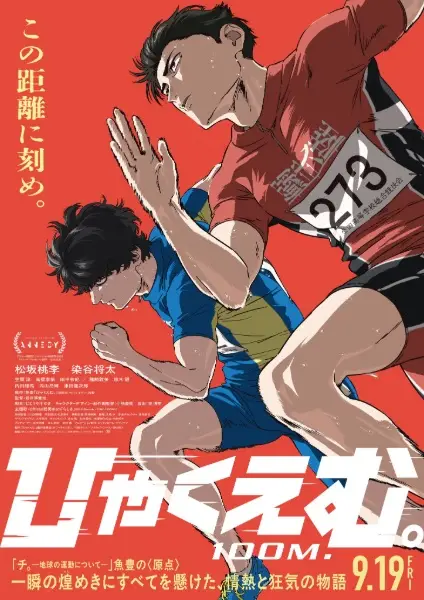
For as long as anyone can remember, Togashi has been the fastest elementary school student around. His speed makes him untouchable during every gym class and sports day, and there is nowhere his skill shines brighter than the hundred-meter dash. Bored by the lack of competition, he decides to help train Komiya, a transfer student who loves to run, but whose bad form leaves him consistently in last place. For a short time, the two are inseparable, united by their pursuit of speed. That is, until Komiya moves away just as suddenly as he came. Years pass, and both boys continue to hone their skills. While their paths and obstacles differ, they each strive to push themselves to the limit, and find out whether Togashi's long-held beliefâthat all problems can be solved by being the fastest runner in the hundred-meter dashâis true. [Written by MAL Rewrite]
7.4/10
Average Review Score
70%
Recommend It
20
Reviews Worldwide
100 Meters is a very personal piece of media. As a big fan of Madhouses adaptation of the authorâs other work, Orb: On the Movements of the Earth, as well as a longtime former Track and Field athlete, my expectations for this movie were high. Somehow, they were all shattered by the time I finished the movie. The cinematography is amongst the best Iâve witnessed in the medium; the statement âthese characters behave like real peopleâ has never been more applicable to an anime. Conversations flew naturally as characters dynamically interacted with each other, sprinkled in with subtle character movements. During the race and training sequences, eachrunner had a slightly different running form, each character mounted into their blocks at the start of the race at slightly different ways and cadences, and each character had unique running shoes that corresponded with brands that I used to look for in Footlocker myself years ago. This is all thanks to an unbelievable usage of rotoscoping technology placed on-top of stellar, hand drawn looking background art, a feature sorely missed in many modern anime. These kinds of things culminate in a very particular scene (youâll know it when you watch it) depicting the preparations a set of runners perform up until the moment before the race starts; the entire scene a single, jaw dropping shot in the likes of which have not been seen in any animated media Iâve consumed. The cinematography could not be complemented better by the narrative told within it. The story centers around the athletic journeys of the sprinters Togashi and Komiya. The former is a natural athlete with an unheard-of proficiency for the 100 meter sprint, the latter a promising athlete with an undisciplined technique. The two bond over their shared passion for the sport but eventually go their separate ways. Where the interesting themes of the narrative start to shine begin when the two begin high school. The philosophies the two runners develop to tackle the sport begin to flourish as they encounter success and tragedy as they compete. Komiya focuses on results, statistics, and performance, Togashi however, is purely driven from his success. Once Togashi begins to fail to perform, his mentality towards the sport drastically changes. This mentality towards self-betterment is examined thoroughly by the film; this is also when the movie began to feel personal. Togashi spends a fair amount of his future career âgetting byâ, competing but not performing. Running to pass time, not to learn and improve. The idea of putting so much time into something you love, only to end up going through the motions of what used to be why you shot out of bed in the mornings is a terribly disgusting, yet horribly relatable feeling. Countless sports, arts, hobbies, and interests of our youth tend to be forgotten or set aside as we age; much of this stems from hitting âthe wallâ. That time you fail to attain in the 100-meter run, that drawing technique that seems to escape your abilities, that level of proficiency you just cannot seem to achieve when learning a new language. The wall presents Togashiâs first feeling of true defeat, much like you and I. How Togashi overcame the wall will differ from how you and I might overcome the wall, but to do so requires reawakening the discipline, fascination, and love you had for this activity when you started, just like Togashi did. After all, his final race in the film finishes with a smile. Thank you for reading.
Watching Hyakueme made me realize that I havenât truly given my best effort at anything in my lifeânot even once. It felt like pure fate that my friends booked tickets for this movie. What began as a casual outing turned into one of the best anime movies Iâve ever watched. As someone who ran track and field in elementary school in China, every year we had a sports day to see which class in each grade would come out on top. I was always in charge of the 200m, 400m, and the menâs 4x100m relay for my classâand I always placed first. But one year, around fourthgrade, another kid won the 400m with ease while I struggled to keep up. I canât quite remember how I felt, but I know it wasnât great. That season, my parents started scheduling basketball practice for meâjust for exercise, they said. But by the next year, something had changed. In fifth grade, I ran the 400m again, and this time, I won easily. I can still remember that day vividly. The track was a 200m oval, and the other kid stayed ahead for the first lap. I kept up behind him, and at the start of the second lap, I felt him slow down. I shifted to the second lane, passed him, and sprinted like my life depended on itââlike a deer,â as my parents described it. At that moment, nothing else in the world mattered; everything around me blurred, and there was no one left in front of me. I was the winner, again. When I was thirteen, my family moved to Canada. Before that, I had started learning tennis because, after a field trip to Canada, my dad told me that people there played tennis more often than badminton. Looking back, I might have had some natural talent. My coach even invited me to join the junior professional team alongside his son. After a few months, I could finally keep up during rallies, and a year later, I managed to beat another player to move up from last place on the team. Over the next two years, I joined tournaments across the province and earned a respectable ranking. But unlike the kids training daily after school, I only practiced on weekends. By sixteen, I could beat about half the players on the team, but I had never once defeated my coachâs sonânot even in practice matches. Then, in one tournament, fate placed us against each other in the finals. I knew I was likely going to lose. Like Kaido in Hyakueme, I had accepted reality. But I decided to play as if it were the last match of my life. I tricked myself into believing I was already the winner, and somehow, that belief changed everything. I played freely, fearlessly, and for the first timeâI won. Looking back, I think I might have pulled him into my imaginary world. He felt pressured, dominated, afraid of losingâand that imagined confidence became real. A year later, though, I retired due to a shoulder injury. After watching Hyakueme, I couldnât help but wonder: what if I had truly devoted myself to recovery? What if I had ever given my absolute best, like Togashi did? Maybe a miracle would have happened for me, too. Throughout my life, Iâve felt regret, but never reconciliation. Perhaps thatâs why I never tried my best at anything. It was easier to make excusesâto tell myself that I didnât fail, I just didnât try hard enough. But this film helped me realize something deeper: even if the results donât go your way, peace comes from knowing you gave everything you had. Hyakueme reminded me that effort is not about winning or losingâitâs about honesty with yourself. Thank you for reading and for sharing some of my memories with me. For those who have already given their best, I respect your courage and spirit, and I wish you the best of luck in the future. And for those like me, who have coasted on talent and still achieved decent resultsâremember, talent is on your side, but never rely on it. One day, an ordinary warrior will challenge you, and youâll witness the power of sheer will.
The race is never the point. Running becomes a language, almost a confession. The film understands that sometimes winning is impossible, and yet movement still matters. Not as triumph, but as proof that you havenât abandoned yourself. The movie is about agency, choosing movement when stagnation would be easier, choosing effort even when âwinningâ is off the table. What I loved most is how deeply personal it feels. When artists channel what theyâve learned from life into a physical discipline, it strips away performative inspiration and leaves something painfully honest. Thatâs exactly what this film does. âIf winning a race isn't possible for me here, then I'll justdo all I can to escape this reality. And doing that means I still have hope for myself. It means that my attitude in life is to not give up on me. There might be other opinions out there, insights, truths too, even enlightenment getting thrown around. I only recognize my own.â This quote is deeply personal for me, I love the idea of choosing hope on your own terms. No borrowed wisdom, no forced enlightenment, just the belief that your perspective still counts, that not giving up on yourself is reason enough to keep going. âIf I keep living for yesterday, Iâll never be able to be in the present and give it everything Iâve got.â â Thatâs where the film quietly devastates you. It frames nostalgia as paralysis. The past isnât comfortâitâs a weight. The present is brutal, demanding, uncertain, but itâs the only place where effort actually means something.
100 Meters articulates, in a clear and efficient manner, a reflection on obsession, identity, and the reduction of the individual to performance, using sport as an existential metaphor. However, despite the intelligence of its writing and thematic coherence, the film remains overly restrained in formal and discursive terms. Its approach favors direct psychological exposition, avoiding structural ruptures, deeper ambiguities, or narrative experimentation that could further tension its discourse. When placed in dialogue with works that explore similar thematic ground â such as Ping Pong the Animation, Look Back, or the literary tradition of Camus and Hemingway â it becomes evident that 100 Meters opts forsafe execution over aesthetic innovation and a deeper exploration of emotional consequences. As a result, the film establishes itself as a solid and well-crafted work, but not a landmark; its impact lies more in the efficiency of its statement than in its ability to expand or reconfigure the language it employs. But does that mean 100 Meters is a bad film? Far from it. The film knows exactly where it intends to resonate with the viewer. Its reflection on the sacrifices demanded by a life devoted to sport, the idea of overcoming not as an absolute endpoint but as a continuous process, and the transition from loss of identity to reconstruction through physical performance are all treated with clarity and sensitivity. There is narrative awareness and respect for its own discourse, which sustains the film even when it chooses not to push further. This thematic solidity is amplified by highly competent direction and production. It is evident that the creative team was given sufficient time and care to develop the project, a fact that is directly reflected in its technical execution. The most striking example of this is the decision to adopt rotoscoping from the midpoint toward the filmâs conclusion â a choice that does not function as a mere stylistic gimmick, but as an expressive reinforcement of the filmâs core proposal. Rotoscoping serves not only as a visual identity, but as an emotional conduit, enhancing human expressiveness, particularly through the charactersâ gaze and physicality. It is at this moment that 100 Meters reaches its peak, when form and content finally align in a more daring way. This choice elevates the film to the level it deserves, even if it ultimately falls short of becoming a definitive high point within its genre.
I didn't think Orb was so great as many people said, so I wanted to give this a try to see if it surprised me. And what to say, I didn't like it as well XD. I knew from the creator it wasn't going to be a spokon so I wasn't expecting to get excited from this, so yeah the running bits were boring but I expected it (though detailed from what I got from the Wiz-Pip review). So what is this movie about? What I got is the author trying to answer some philosophical questions one could ask about running. And to be honest someonecould get more value out of a documentary about running than this movie. I think this because the author does absolutely nothing to justify why the runners say the things they say. It might resonate with you, but not because this movie said some crazy insightâprecisely because it doesn't have any insight, it's just some vague answer to the questions. There were various questions I'm not going to say all, but for example there was this constant question: Why do we run? *spoilers* The kiddos at first answer this: Komiya: "Because reality becomes blurry. Doing something that causes more pain than reality makes me feel good." Togashi: "Running the 100 meters faster than everyone else can solve almost everything." Ok simple but yeah they are kids. Komiya I get it, you have it rough because you are kind of weird. And solve what Togashi? What problems are you solving with running, certainly not the boring of life because as you said "Honestly, I've never enjoyed running with anyone." Well yeah simple answer that is kinda dumb but yeah you are just a kid. Nigami: "To get out first, of course." Ok why do you wanna get first...? To feel superior? To be the best? To get attention? Can you give more insight please? Nope :p. Now when they grow up: Togashi, we saw you getting pressure and all that shit, we saw you evolve, we even saw you collapse and cry (the scene was a bit funny to me sorry). What you got for us after all this time: "It's really obvious. We run to give everything we have. We don't need anything else. Now that I think about it, I've always led a very hectic life. I was afraid of losing and being isolated from everyone... So I started to believe that I was invincible. As a result, I avoided thinking about defeat. I had the strange idea that something was protecting me. But I am here thanks to my past. The heart is our true home. We don't belong anywhere else. The mind creates solidarity, empathy, and affection. Everything in the world produces anxiety, and ultimately, we all die at some point. Think about it. We're all broken in one way or another. However, none of that can take away the immense joy... that we feel when we give our very best. I've seen this in thousands of people... and I've felt it thousands of times too." Okay still not really a justification to say what you say, a purely emotional answer that's nice? So you ran because it was fun, kinda contradictory of what you said before. The only time I saw you smile while running was in these recent races (you always had a poker face) but ok I guess this could be justifiedâyou don't necessarily need to smile to be happy. But yeah so before you got anxiety and now you just fuck off people and just run for fun, that's nice but I still don't agree a lot with your justification. What do you mean the world creates anxiety and the mind creates solidarity, etc. Wtf? Precisely anxiety is about the mind. I remember Robert Sapolsky in his podcast said: "What anxiety is about instead is nonspecificity and fear of the unknown is description of what anxiety is. Novelty, if the future is a scary place, if any of those things are the case, you are being set up for a nonspecific sense of dis-ease, which is what anxiety is about." It's a conjunction about the world and the mind, and is mostly about the mind in the world not the world as focus. But yeah ok it's your own idea, doesn't really help to get some insight about running apart from the obvious that running is fun. Komiya: We saw you go from escapism to now trying to get better, we heard you say "Is it too late to try and learn to run faster?" and then even more to a point of "My goal is to achieve a record that transcends numbers and statistics." And you took pretty seriously the thing Zaitsu said about sacrificing yourself to achieve glory. I mean I get you, as you said when you were young this is all you had. So what you got for us now... wait.. you don't know? And you are asking the question yourself.... and you say "This pointless game has no solution." Ok man :p. And Togashi wanted to give you his way for yourself but because it doesn't really have a logical substance and it's emotional, you didn't take it and you waited to see if you feel it yourself. Well I wish you luck as I don't know the answer since the movie ends before giving the answer. Nigami: I know you were pressured before and you injured your back, why did you come back and run? Nigami are you there? I didn't find any more insight Nigami said apart from after they kicked his ass he said "But anyway, I feel great." So I guess it's similar to Togashi. Kaido: Kaido the eternal second, why do you run?: "Because it's possible to escape reality. If it's unrealistic for me to win, then I must escape that reality. If I do, it means I have hope. It shows I haven't given up. I don't care about the opinions, truths, or revelations people have about me, because I value myself. That gives me a mission, a reason to live... and to work. That's why I run." Okay so your motivation is that even though it's "impossible" to win over Zaitsu you are trying to win over him. Okay fair enough, still doesn't help me really. I mean people like to do stuff to compete, that's pretty obvious but yeah cool. I mean I don't totally agree that's "escape reality" but if you see it that way cool. Zaitsu: And the last guy Zaitsu, you answered before to the question: "You've become invincible, why do you keep seeking challenges? I am a living being. I will die and never be reborn. That's the reason." Ok what do you mean? Is it like a weird FOMO, I have to do this because this is my only life, not really a sentimental reason as Togashi just because you are a living being? Ok what does that mean? Well at least he gave more insight after and said: "I'm terrified of defeat, and I want to get results." Kinda getting it, and after some time he said: "I lost my fighting spirit trying to get the title of 'undisputed champion'. The faster I run, the further behind everyone else gets. When I look to my side, I can't see a soul. The view from there is the same as the view from the last person in the pack. It's the most boring thing in the world." Okay so your reason was because it was fun, but now winning all the time was boring for you. Ok again a sentimental reason. Why did I talk so much about this? Not because I wanted an answer to this, as Kaido said "Everyone has their own answers" but the answers have justification, and as I tried to show, the justifications the characters gave to answering these questions were pretty simple. Why did I focus so much on this? Because as I said in the start, I thought this movie was going to be about this, give insight, talk a bit more of a different part of the sport, and it tried but failed in my perspective. I focused on the most "important" and predominant question of the whole movie, but this movie had a lot more questions and with a lot less insight. So it isn't really fun as I didn't get any spokon epic hype moment, the insight was pretty weak... what was the point of this movie? Nothing positive, at least :c. That's why I said a documentary about the sport is better, you get a real answer to the questions this movie asks. Why does Usain Bolt run? I don't fucking know and this movie doesn't help me at all answer this question about any runner in this world. If I wanted to answer this I would just watch an Usain Bolt documentary about his life or something. Running is fun but we don't need this movie to tell us that since we all have run as kids. So yeah I don't see the point of watching this. Well the movie is more than this, the struggles about sport (in general), sacrifices and stuff like that. I still maintain my position as I think they are not well developed to have an answer to this, but well I mentioned them to say they exist. Don't really wanna waste more time of you and me talking about how they have the same problem, and that they aren't really something new. I didn't see a point but maybe you liked it, maybe you liked what was shown and that's ok, equally as ok as me not liking it. I just wanted to share my perspective :p. This part about fiction is part of the reason I didn't talk about the production values. As mostly that part is sentimental, I didn't like the animation. Some examples of it are for example when they were talking about reality becoming blurry when they run, it looks horrible in my opinion. As well as I didn't like the rotoscoping because of that weird camera shake it had. But that's just how I feel and I can't really justify why, instead I could justify why I didn't like the just throwing philosophical questions and not really answering part.