Links go to search results. Availability varies by region.
ćăźćżăźă€ăă€ă〠珏2æ
13
TV
Finished Airing
Jan 7, 2024 to Mar 31, 2024
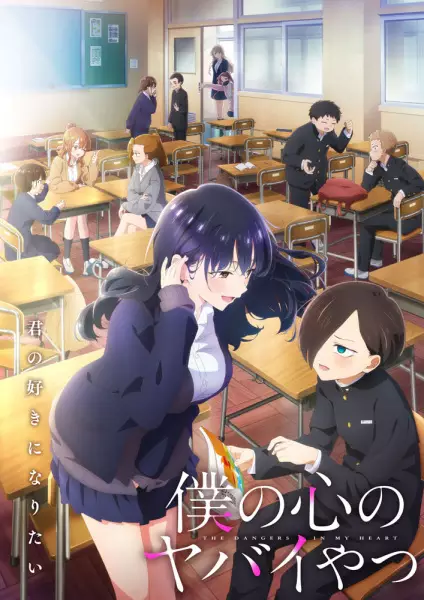
After an eventful winter break, Kyoutarou Ichikawa and Anna Yamada reunite with a stronger bond. They continue to grow in their own ways, with Yamada taking on more challenging photoshoots and Ichikawa maturing both physically and emotionally as he tackles his affections for Yamada. However, spending time together outside of school allows for their relationship to deepen, and it becomes increasingly difficult to deny their budding romantic feelings. Grappling with these unexpected and new emotions, Ichikawa and Yamada realize that, with the passage of time, their relationship is bound to changeâand they must ultimately decide whether they wish to remain close friends or finally become a couple. [Written by MAL Rewrite]
9.8/10
Average Review Score
95%
Recommend It
20
Reviews Worldwide
The Dangers in My Heart Season 2 was an incredible run from start to finish, and I cannot believe how far we have come since the âcringeâ start at the beginning of this series. This season has provided a ton of fun, quite a few laughs, quite a few pay-offs, and some emotional moments as well. Apart from the sheer sweetness of this series, Kyoutarouâs growth has been incredible to watch, and as someone who shares some of the same traits as him, like being an introvert, some of his character growth really resonated with me, and he continues to be easily my favourite characterin this series. It is so early in the year, but it is already an anime of the year contender for me. I tend to like most romance anime that I have watched, but the one wall that they almost always hit is never really escaping the âWill they, wonât they?â phase of the show. Characters meander and the story progression goes at a snailâs pace, which in due time, makes the story lose its charm. A big reason for that is the caricatures and tropes of the characters that are in love. For example, whenever the main female character is a tsundere, all we see is her punching the dude or denying her feelings. In this show, there is no such annoying trope, and the dynamic between the two leads is a breath of fresh air. Itâs just two somewhat socially awkward teens just getting to understand one another, without the progression being too dragged out. Of course, I also love seeing the female lead be taller than the male lead, as it is just a unique touch to the whole dynamic. Another aspect of the series I really enjoy are some of the subtleties to the character growth. The characters feel somewhat realistic, in that they physically grow, something normal for their age of course. Kyoutarou grows a little taller, his voice deepens a bit, and Anna might be a bit excited, but it was never a huge deal. The characters understand more about one another at a nice pace. What was unknown at one point gets learned later on, such as when Anna understands how Kyoutarou would retract back into his shell when he was in certain situations, or Kyoutarou would understand how Anna would feel at a particular time. When they talk to each other, they might stumble on their words sometimes, but when it matters, they know exactly what to say. Overall, I really enjoyed how the show never got âin your faceâ about the character growth. Kyoutarou has been a pretty relatable character to me to some extent, especially with his introversion. Kyoutarou's challenges with socializing and public speaking kind of resemble how parts of my life have went. I was a pretty chatty kid, but as I grew into my teenage years, for some reason I got more reserved, and I had stage fright and a fear of public speaking. Yeah, I took drama classes, and classes that required me to talk with others, but I was not, and still am not the most talkative person around in the slightest. Whenever I saw Kyoutarou talk to his inner self, while it might feel somewhat clichĂ©, it always was executed perfectly because it acknowledges that a lot of the time, the biggest thing holding someone back is themselves. Deep down, they know they can do whatever they set their mind to, but they sell themselves short. Like people say, sometimes a person's worst enemy is themselves, so whenever Kyoutarou achieved something substantial, I was so proud of him. As for the other characters, there arenât any real weaknesses to the cast. Anna of course is a very cute, somewhat awkward character that put a lot of proactive care into developing the relationship further. Most of the other characters were really fun to watch, and support the main duo very well. They all know about Kyoutarou and Annaâs blossoming relationship, but they always let the two grow by themselves (save for that flash mob group), even if they would sometimes create situations where that was possible. The parents, relatives, friends, everyone in their social circle were so supportive, and happy whenever both Kyoutarou or Anna were successful, to the point where it would always warm my heart. No unnecessary family drama, no unnecessary love triangles, just friends and family being wholesome and supportive. Moeko and Kana probably had the best moments as side characters, but there is not one bad character in this series. No, not even the perverted guys. Sure, it might be a bit exaggerated, but people at that age always have something dirty to talk about. The visuals and directing were for the most part, very solid. The blurriness does get a little much at times, but it never hindered my enjoyment. The staff did a fantastic job of really having the emotional moments hit hard. Kensuke Ushio, who worked on the music, continues to show that he is one of the best in the business right now, right there with Kevin Penkin and Evan Call, possibly Hiroyuki Sawano as well, at really elevating the show to new heights. It has been nothing but joy watching this show every week. I never thought a romcom could surpass *Kaguya-sama: Love is War* for me, but this has been something truly special. The sheer state of giddiness I would be in before starting each episode was a testament to how much of an impact this show has had on me. Whether or not we see this series return anytime soon, itâll still hold a place near and dear to my heart, which was in danger almost every week of watching this. 'There's no guarantee we have a tomorrow together, and if there isn't, then maybe I should try for what I want a little."
Boku no Kokoro no Yabai Yatsu, or "The Dangers in My Heart" (abbreviated as Bokuyaba), has been one of the greatest surprises I've had in my over 15 years in the anime/manga industry. It's the unequivocal proof that, even though the industry may seem saturated with works featuring similar elements, genuine and refreshing stories can still be crafted to surprise and excite us, breaking away from the established conventions they impose upon themselves. In this case, we're talking about a romantic comedy of opposites attract, something we've seen numerous times within the genre. However, it stands out for being a touching, nostalgic, and precious storywith authentic and real characters. It subtly explores the internal conflicts of a young heart in the midst of self-discovery. Despite Bokuyaba being a RomCom at its essence, balancing equitably and fluidly between its romantic and comedic moments, that's just its surface layer. Once we delve into its deeper layers, we realize that besides being a beautiful and captivating story of youthful love, it's also a tale about the changes we undergo during one of the most complicated and turbulent times of our lives: adolescence. It's a change that manifests both physicallyâwhere we see our characters develop their bodies, grow taller, change their voices, as well as attempt to alter their physical appearance by losing weight or changing their look with a simple haircutâand mentallyâwhere our characters mature, learn from their mistakes, face their insecurities, take on more responsibilities, become more aware of their surroundings, and always strive to better themselves. But above all, it's the emotional change where we discover our preferences and fall in love for the first time. Bokuyaba portrays impeccably and convincingly how the feeling of adolescent first love is; the nerves we feel when we're with the person we like, the anxiety to see them again, smiling unconsciously when they talk to us, and blushing relatively easily. We try to act differently than we would with others because we want that person to see how great we can be, to make a great impression. Staying up late talking on the phone, worrying when several days pass without seeing them, feeling jealous when they're with someone elseâthere's a plethora of mixed emotions that confuse us and make us doubt. It's a reflection of the inexperience we have at that age. But beyond that, Bokuyaba also focuses on something very important that most of these high school romance anime forget or omit, and that's the building of emotional bonds that go far beyond love. While love is the predominant feeling throughout the story and the main motivation for both characters, it's just the tip of the iceberg because Bokuyaba prioritizes building a relationship on foundations as important as trust, respect, and honesty between both parties, mutual understanding, being aware of each other's problems, being an emotional support in moments of fragility, having the patience to wait or listen carefully when the other wants to say something, and being able to empathize with their situation and try to help them in a selfless manner. It's a story that goes beyond simply showing sweet or cute interactions between the protagonists; it's a deep emotional connection that feels real and human. All of this can be seen reflected in its two protagonists. On one side, we have Kyoutarou Ichikawa, a shy, reserved, short, and friendless boy. At first glance, Kyoutarou seems to be the typical lonely protagonist without any outstanding qualities. However, as we delve deeper into his character, we realize that he is much more multifaceted than he initially seems. Kyoutarou is quite withdrawn and dislikes socializing with people, but he doesn't hold back when expressing his dislikes, he prefers to blend into the background and not get involved in others' affairs, although he often acts impulsively to help his classmates, despite being quite intelligent, Kyoutarou struggles greatly with self-esteem issues stemming from his past and a negative event that marked him, making him even more insecure and fearful, creating a complex of inferiority, as well as self-hatred and disdain. Throughout the story, we will see Kyoutarou constantly having to confront these internal problems stemming from his past, while simultaneously discovering these new feelings gradually blossoming within him, such as falling in love for the first time. We will be witnesses to how both aspects conflict internally within his own mind, causing him to wonder and question how he should act or what step he should take next to confront these new emotions. However, it is through this that Kyoutarou, unlike the vast majority of protagonists we see in romantic comedies, will progressively change. As he interacts with his classmates and makes new friends, he will open up to the world, revealing his most intimate and human side, his unknown facets, his phobias, and quirks. But no matter how much Kyoutarou tries to change, he will often stumble, doubt, or make mistakes, he will thinks doing it wrong and regress, he will feel afraid of this change and what it might mean for him and the relationship he is building because maturing is a long process and a path full of curves where we will constantly see Kyoutarou searching for answers to these new stimuli he has never before experienced. On the other hand, we have Anna Yamada, our co-protagonist and the romantic interest of our Kyoutarou. Anna is a box of surprises, a completely unpredictable and very expressive girl who is completely opposite to Kyoutarou; she is quite tall, cheerful, charismatic, and very sociable, although she may seem a bit clumsy at times. Additionally, she works as an actress and a magazine model. The first impression she may give off is that of the "ideal girl" that every man would like to have. However, as we get to know Anna from Kyoutarou's perspective, we realize quite the opposite, showing us an ordinary girl with her own problems and flaws. Anna is a girl who has been "forced" to act like an adult, to mature prematurely, and to have more responsibilities due to her work. But Anna is still a 14-year-old girl, emotionally very unstable, who cries relatively easily, feels useless for not being able to help, and thinks she's not a reliable person because of it. Since childhood, she has grown up with certain insecurities and frustrations, seeing that there was always someone better than her in everything she tried. She is afraid that the people closest to her will eventually hate her for who she is, presenting a wide range of internal issues that will be revealed through her dialogues and interactions. Bokuyaba shows us that both Anna and Kyoutarou, no matter how "different" they may seem from a superficial perspective, are much more alike than they imagine, and that idealizing someone based on their appearance or status without knowing that person is one of the greatest mistakes we can make. The development of their relationship is fantastic because there is a sense of progression and continuity, where it's gratifying for the viewer to see both characters grow personally as their romantic relationship evolves. Many RomComs seem to "live in the moment," giving us episodes that only aim to show something cute and disconnected. In these anime, you could watch the episodes in non-chronological order, and the impact would be minimal because the characters would act the same, and only the "setting" would change. In contrast, in Bokuyaba, it's the opposite; there's a continuous progression where you can see how the characters grow closer and fall in love as they meet at school and talk daily. At first, they are just classmates, having short and direct conversations, both maintaining a certain distance with minimal eye contact and no physical contact, displaying a much more formal and respectful attitude. Here, we won't see our protagonists walking home together in the first episode, let alone seeing the girl in a bikini at the protagonist's house after only speaking a few times at school. There's no sudden intimacy that arises overnight because Bokuyaba develops their relationship slowly but steadily. Our protagonists go through various phases in their relationship: they get to know each other, talk daily, and become friends. Trust and intimacy grow, they become more comfortable being together, grow closer, take more liberties, start to become curious about each other, a curiosity that gradually transforms into interest, they want to know more about each other, from interest comes attraction, and then, love. It's a romantic construction where even the smallest details persist throughout the story and are extremely significant to the characters. A small bottle of milk tea that the boy gives to the girl to calm her in a moment of guilt will continue to be present as a decorative element in her room in the next episodes. A small gift like a keychain will become one of the most important and valuable objects for the character because of its meaning, becoming a kind of talisman that accompanies them everywhere throughout the series. The same goes for many dialogues and interactions that directly influence each other, many doubts that linger in the character's subconscious for several episodes, they will regret having done something wrong or question what they could have done better, he understands that he is in love but he doesn't know what the next step he has to take is. Furthermore, it's a relationship that feels incredibly organic and human because of the way both interact with each other. When one wants to say something to the other, the other patiently waits to listen. When one has doubts about doing something, the other encourages them to move forward so they can do it. It's a relationship that constantly feeds off each other; there's no "passive and active" dynamic. In Bokuyaba, both actively seek each other out to talk or simply spend time together. Both have moments where they go on the "offensive" or "defensive" by saying or doing something that surprises the other. They both gradually open up to show their most intimate and vulnerable sides, becoming more aware of each other's personal problems and trying to help each other move forward and overcome all the barriers they encounter along the way. It's a relationship that grows like a plant, where you have to water it every day and protect it from possible external dangers. It has been cultivated with a lot of time, understanding, and patience, a progression that gradually unfolds without haste, where neither of the two characters wants to make a misstep. Obviously, many doubts arise along this path; as I mentioned earlier, their insecurities are constantly in conflict, the fear that everything they have built up to that point might fade away will be present. They are two teenagers experiencing love for the first time, but even so, Bokuyaba shows us straightforward writing that doesn't beat around the bush, where misunderstandings or situations of total "breakdown" between them are resolved in a mature and natural way, without the need to prolong the conflicts or enter into vicious circles that lead nowhere. These are two characters who, thanks to the honesty and trust they both feel for each other, and obviously, the courage they muster at that moment, can resolve their problems by talking about them directly. Speaking of characters, in Bokuyaba, we have a cast of teenage characters who, incredibly, act like teenagers, where Norio has fantastically captured what the school environment is like at that age. It's not a story that drastically infantilizes its characters with the aim of making them "extremely pure," where we see 14-year-olds acting like 7 or 8-year-olds. Here, we see 14-year-olds acting like 14-year-olds. I mean, who hasn't made dirty or perverted jokes with their classmates? Exactly. In Bokuyaba, there's an excellent representation of everything that involves that school environment, both in groups of boys, where we see they are much noisier, unbearable, and more perverted, with hormones raging, liking to act "cool" in front of the girl they like, having a much rougher and prouder attitude, etc. As well as in groups of girls, where they have closer behaviors among themselves, more contact, take more liberties, are much quieter and less noisy, have much "sweeter and fluffier" interactions, etc. But above all, what stands out most about the secondary characters of Bokuyaba is that they are an excellent complement to the story. Not because they really have any kind of individual development, but rather the opposite. They are an excellent supporting cast for what really matters: the main couple. Where the vast majority of anime would insert their secondary characters as "destructive" elements or ones that constantly intervene, unnecessarily prolonging things, creating misunderstandings, or hindering the progress of the relationship, here it's the opposite. We have a cast that, in addition to being excellently characterized with different personalities to give us a broader and more diverse comedy, helps the couple directly and indirectly. From the friends Kyoutarou makes during his school journey to the beloved Nigorikawa, who appears as a kind of alter ego of Kyoutarou in his introspective moments, as well as Anna's friends or her parents. But the ones that stand out the most are Kanna (Kyoutarou's sister) and Moeko (one of Anna's best friends), two characters who, although we don't know them in depth, manage to be endearing and beloved characters. Because both are aware of the situation between our protagonists and will show very noble gestures towards them. Instead of interrupting them, they will give them the private space they need by leaving them alone so they can talk or inventing an excuse for them to stay together. In moments where something stagnates or there are doubts, they will be the first ones there to push our couple to take the next step. The supporting characters in Bokuyaba are everything we need in a romantic comedy: charismatic and funny characters who, at the same time, don't steal the spotlight from our protagonists. And although many of them are aware of the situation between them, they don't interfere and give them the necessary time to flow and continue advancing their relationship at their own pace without feeling pressured or obligated to confess prematurely. Another thing I would like to talk about regarding Bokuyaba is the naturalness and expressiveness that the work has in all aspects. There are many school romance anime where you hear two characters having a conversation and you feel that deep down it's all very artificial. Let me explain; there are conversations where you hear one character and immediately hear the other, and you feel that what they are talking about is something "written by a scriptwriter," where the voice actors follow the script "to the letter," it's all very "robotic" and "plastic." In Bokuyaba, it's the complete opposite, and this is due to many factors involving direction. Here, the use of timing is masterfully handled, as well as fluidity and spontaneity in their conversations. Many times, one character is speaking and the other interrupts, or both talk about different things at the same time, they will also be surprised by each other's unexpected responses or actions, the rhythm and dynamics of their conversations are unpredictable. Here, we are not facing two characters "reading a script"; we are facing two "people" speaking naturally, and we see this reflected in their small everyday chats that often aren't even important to the story but are there. There are many times when both fall silent because they can't follow the thread of the conversation or run out of topics to talk, they stutter or overthink things, even going to say something but then regretting and retracting, showing gestures of nervousness or guilt, sweating in their hands, changing expressions on their faces, gesturing and body movements, sometimes moving their fingers or balancing their feetâgestures that speak louder than words-. It knows how to portray genuine feelings of discomfort and shame, convey powerful tension, and give us wonderful and unforgettable moments of emotional catharsis, all accompanied by fantastic voice acting from the seiyuus (mainly those of Anna and Kyoutarou) who have managed to immerse themselves so well in the characters that they know very well how to make a perfect intonation in their voices to transmit the essence and feelings of each scene. Another notable aspect of this show is its production and adaptation. Although I consider the manga a must-read for every fan of the work since there is much more information about the characters and contextualization of all the subtext the story possesses, the adaptation it has received is masterful in every sense, providing a completely new experience with fantastic adaptation where they have managed to add small changes and details that often make the scenes more impactful or emotionally weighty. There are precious moments of intimacy and an appropriate pace for each situation to flow naturally, accompanied by a wonderfully orchestrated soundtrack by Kensuke Ushio, which perfectly captures the characters' feelings throughout the entire story. There are pieces for every type of situation, from ones that start with several instruments timidly playing out of sync but gradually try to connect to create a coherent sound and a melody that represents moments of approach and discovery of new feelings, we have melodies that are tranquil and friendly, with slower and more varied sounds for everyday moments, others that are soft and calm but maintain a certain degree of intensity for scenes of greater intimacy, and others that, although starting slowly, progressively escalate in intensity until they explode into a wonderful and powerful melody alongside the uncontrollable overflow of emotions from our protagonists. All of this is accompanied by real scenarios, fantastic art, and the use of lighting and colors that are often used as visual metaphors, where we see Anna being illuminated by a bright ray of light as a representation of the salvation Kyoutarou has found in her, creating unique and immersive atmospheres, with orange and reddish sunsets in more impulsive and overflowing scenes, and blueish evening skies in calmer and more contemplative scenes, all thanks to the direction of Akagi Hiroaki, who has known how to transmit the essence of the manga and its characters perfectly. Norio-sensei is a meticulous author like few I've seen, and this is reflected in Bokuyaba. The amount of subtext in the story is monumental, but unfortunately, very few people realize it. This is due to many factors regarding the translation. There's an immense amount of wordplay that is impossible to convey meaningfully in our language, several hints or "hidden" messages that go unnoticed by the audience, various actions where there are more intentions than it seems, the use of certain words and the misinterpretation that characters may have when hearing them, certain conversations that seem inconsequential but will gain relevance in the future, or that the characters will remember. It's one of these stories that you can watch over and over again, because, besides being a very dynamic and entertaining story, you gradually realize all these almost imperceptible details the first time you see it, details that greatly enrich the work on a personal level. Bokuyaba is a story that keeps you on the edge of your seat for all 24 minutes of each episode, a rollercoaster of emotions that leaves you eagerly awaiting what will happen next, much like an action shounen would do, but not because it has frenetic action or epic moments, but rather because you want to see how the story unfolds, you want to see if the protagonists will be honest with their feelings, if they will be able to take the next step. Many times, the narrative itself will play with our anxiety and make us think that our protagonists will take a step back or cowardice at the last moment, or at least that will be our sensation for a few minutes. And just when we let our guard down, we'll see how our protagonists, with great courage and determination, take that step we've been eagerly awaiting, with powerful cathartic scenes where emotions are running high, beautifully orchestrated scenes that transport us directly into their world. Personally, I have to admit that I quite like romantic comedies, but lately, I was feeling tired of seeing "more of the same." I mean, stories like Takagi-san, Nagatoro, Sono Bisque Doll, Sukinako, Komi-san, among others, are very nice, entertaining, and with some, I've even been moved. But I feel like they're missing something. Perhaps substance? Perhaps more credibility in their interactions? I'm not really sure what it could be, but Bokuyaba has shown me something completely different from all these romantic comedies. When I watch an episode of a romantic comedy and finish it, I'm left with the feeling that "it was a nice episode," but with Bokuyaba, I found myself saying every time I finished an episode, "this was truly beautiful and captivating." It has managed to awaken feelings that I thought had already died within me. I could be writing for hours and hours about this work, but to not drag on any longer, to summarize my review: Bokuyaba is a teenage romance story that explores the conflicted and turbulent heart of adolescence. It's about change, growth, and maturity, about creating emotional bonds. It's a gripping, addictive, and captivating story that leaves us with a sense of nostalgia, with powerful personal messages and life lessons: learning to love and accept yourself. 10/10
Don't let the haters fool you, this is peak rom com and not waifu bait at all. Sure some people consider her a Waifu, but those people are creepy af for drooling over a 14 year old. This and the first season are written incredibly well. The character development is on point, it's seriously the highlight of the show for me. This isn't just some reverse Shoujo attractive girl falls for less than attractive guy, their love is more based on personality and is more wholesome. It also depicts accurately falling for someone. I feel the first intro for the first season captures that feeling pretty well. I believeit's a very aptly named series. It reminds me of being younger, it reminds me of being in love for the first time, for real. Personally I feel most teens are in lust, not in love. However you can feel the genuine affection each character has for each other. Especially with Yamada's goals and ambitions, Kyotaro is her rock in supporting her. This genre can honestly feel dead at times, but this, and the first season are gems that should be watched whether your male or female. I feel it can fit into either genre. 10/10, must watch.
While I donât think Bokuyaba is the best romance ever, itâs certainly deserving of a lot of the praise it gets and is one of best developed school romances out there. A must watch for any romance fan and the gold standard for romance manga adaptations. Perhaps no other series has captured the highs and lows of early adolescence quite like Bokuyaba. Middle school is such an interesting time because our bodies and emotions are developing at a very fast rate, often faster than we can comprehend. Thereâs a whirlwind of emotions hitting all at the same time and itâs easy to get swept up inthose. This series does such a good job of showing the complex mood swings and feelings than can arise in teenagers as a result and it really feels like weâre proud parents watching our kids grow up in front of us, establishing a level of emotional connectivity not seen often. Kyo and Annaâs unlikely love story is the core of the story. Two people who on the surface couldnât be more different, yet in reality are able to bond over shared insecurities and interests. The perfect model Yamada may seem like sheâs got it all figured out. Popular, a model and drop dead gorgeous, anyone would be lucky to have her. But few really understand her, at least on the level that Kyo grows to. An introverted stereotypical chuuni who at the start of the show canât do anything but write down how much he wants to kill people in class, Kyotaro arguably has some of the best character development in the medium. If youâre able to deal with his cringe antics through the first two episodes or so, youâll really be rewarded, especially in this second season where he continues to come into his own and really takes a leadership role in his class. I couldnât help grinning from ear to ear with each milestone he completed. Half the fun of this story is seeing two people who could seemingly not be more different defy expectations and find out they have more in common with each other than with anyone else. While we may not all find a Yamada or Kyo, I think thatâs a powerful life lesson to be learnt. We can find the best of people in the most unlikely of places. Thereâs so many moments in this show that had me giddy like a high school girl. With each episode, both leads got bolder, coming closer to shattering the thin glass between them. Itâs a very satisfying process unlike most romance stories that feature poor communication, over complication and characters who canât stand next to each other for 10 seconds without running away. While there is definitely some awkwardness between Anna and Kyo, itâs more so normal âI have a crush and am in middle schoolâ type of awkwardness rather than unrealistic shonen manga stuff. A testament to the authorâs ability to create realistic characters. Further to that point, the seiyuus do a good job of conveying the sort of youthful naĂŻvetĂ© youâd expect at this age without sounding too anime-y. Thereâs definitely some tropey moments, but theyâre not overwhelming. That leads into the last and perhaps the biggest reason for Bokuyabaâs success. Its production values. I knew of studio Shin-Ei from Takagi san and Kakkou, but man I did not know they were capable of this type of direction and cinematography. This had SHAFT/Kyoani levels of quality and for such a ground level and character driven story, it manages to feel exciting and fluid thanks to the use of on screen text(think Monogatari), camera movement and scene cuts. Not to mention the gorgeous visuals, genius use of lighting, shadows and colours. And we havenât even talked about my particular favourite, Ushio Kensukeâs OST. Ushio-sensei has worked on many of my favourite OSTâs including Koe no Katachi, Tengoku and Liz to Aoi Tori. His pieces add such weight and impact to the big emotional set pieces and this show would not hit the same without it. He knows exactly what literal and figurative notes to hit at exactly the right time. So, whatâs the verdict on Bokuyaba season 2? Itâs a massive improvement over season 1 in every way. From story, to romance to character development, it all takes a massive step forward just like our two leads. Progress is gradual, but satisfying and if you at all liked season 1, youâll love this season too. Itâs not the best romance ever, but the hype is largely deserved. Itâs a simple, but effective coming of age story that doesnât rely on fan service or too many tropes to make its point. If thereâs one thing we should all take away from this show itâs that we shouldnât be afraid to open ourselves up and connect with people, even if they are seemingly polar opposites of ourselves. Bokuyaba season 2 gets a very easy 10, out of 10.
TL;DR: I understand that this review is stupidly long and kind of personal. If you are even on the fence, give this show a chance, itâs great. And if you can allow yourself to enjoy something so eagerly sensitive, you wonât regret it. One night back in late 2019 shortly following one of the worst months of my life, I was called over to sit next to this mysterious girl while riding the bus. It turns out this person was in my creative writing class and recognized me, she liked some of the stuff I wrote. We hung out a few times before the semester ended.It turns out despite being in a life science her real dream was to write for a living, she also somehow comprehended a lot of my strange ideas, she was unintentionally pretty, and elegantly dweeby. Anyways. At this point, I think Boku no Kokoro no Yabai Yatsu can be pretty confidently considered one of the great raid bosses of romance anime, a modern classic of the genre if you will. You take a cleverly written, dense, yet still approachable romantic scenario and have it be brought to life by a seasoned industry experts, then you have the perfect recipe for a potentially exceptional experience. I feel like any praise I heap on Bokuyaba could be taken as some kind of overhyping, since at the end of the day itâs a fairly straight forward romance show, the kind where the main leads brush their hands up against each other and start blushing or some kind of other histrionic nonsense. But at least for this style, specifically in the heavily streamlined form Bokuyaba depicts, I canât see a better form possibly existing. This is as good as this shit is ever going to get, and in that light, it deserves whatever praise its small but emboldened fanbase wishes to heap. Even though Iâve talked at length already as to why I enjoyed season one, I think itâs important to break down the general reasons why this season has specifically been propelled to the top of the charts. Since Iâm sure for months now people have been incredibly confused as to why some seemingly frivolous high school bullshit is fighting alongside decade defining works like Vinland Saga. Which, if you hear me out, shouldnât be that hard of a sell. Part 1: It looks perrrrrty Boku no Kokoro no Yabai Yatsu isnât a show that escapes the aesthetic trappings of its setting, this isnât some experimental extravaganza like Sonny boy. The source material is bound to a simple middle school (not high school) setting in a typical Japanese Tokyo metropolitan area taking place sometime in the late 2010âs. Yet, Bokuyaba gracefully, almost like it was born to, is able to elevate its largely blasĂ© setting into an immersive environment where beautiful, enriching romance is blooming before your eyes. Season two specifically somehow outpaces season one in almost every aspect visually, and in particularly regards to its direction. In terms of storyboarding, character art, animation, music choices, editing, among other more micro directorial decisions, this season stands a step above the previous, and above most slice of life anime. This isnât to unnecessarily deride or insult romance stories that didnât have the privilege of an incredibly dedicated team of digital photographers that meticulously elevated every idiosyncratic moment, but bokuyaba does, and this sets it apart. Combined with Kensuke Ushioâs ethereal, heartstrings-pulling soundtrack, Bokuyaba is able to sell basically any scene under the pretenses of its own nostalgic adoration of adolescent love. Moments are often captured in this ephemeral liminality kind of like sports anime, moments feel substantially slower and more significant to the parties involved than what we would normally witness in real life. Most of my complaints about the original seasonâs production have mostly been cleaned up in the six month intermission the staff had to make season two. As such, the show largely looks beautiful, with quirky, endearing character designs and atmosphere that is able to convey both the silly, the dramatic, and the intimate. In January of 2020, I decided to get a buzzcut out of raw curiosity since I had had largely the same hairstyle since high school, it looked terrible. Like many with a buzzcut, my hairstyle didnât demonstrate anything about my personality nor did it flatter my appearance by any stretch. Yet, when I saw that same girl I mentioned earlier in the following semesterâs creative writing course, she complimented my cut. I was appreciative but confused, Iâve never had someone compliment me on such a run of the mill style before, I wasnât sure what to think. But her compliment made me consider when we got lunch in early February, could this meal together, and our previous hang out sessions where we went to the Museum, or made pancakes together, be considered dates? âAbsurd,â I thought, âthereâs no fucking way.â Yet, there was a part of me that desperately wanted it to be true. Part 2: The characters actually deserve each other Despite having the series being so romance focused, Bokuyaba fundamentally cares about its characterization more, preserving its development, while still providing its audience the small moments of wholesome satisfaction and progress that comes with these cute or sensitive love stories. Often times in romance subplots in media oriented toward men, the main couple getting together is taken as such a given that I find it hardly something worth getting invested. Firstly, the girl is basically designed to be as likable to the audience and the protagonist as possible, where the only reason theyâre not fucking from episode two is because either the main character has to prove to the universe heâs worth anything (not to the girl), or basic narrative contrivance. Secondly, sometimes I find âmain girlsâ in anime so eager to be liked as to be boring. The characters in anime I tend to remember and appreciate the most are ones that contain compelling flaws that add to the greater themes of the work and blah blah blah, Iâm sure youâve heard this a million fucking times at this point. Thankfully, the featured couple Bokuyaba has enough down to earth insecurities to make the characters feel dynamic enough to be genuinely engaging. Iâve already talked about Kyotaro at length in my review on season one, but what makes his arc so satisfying this time around is that the sheer degree of his neuroticism becomes the core piece holding the relationship back. Things are made as obvious for this kid as possible, but because of his vast insecurities and feelings of inferiority, he canât take the steps necessary to cement his relationship with Anna. In fact, even when it becomes undeniable this chick likes him, he can only contextualize it within specific constructs that seek to justify his anxieties and low self-esteem, âI have to be extra careful because if I make any serious mistakes, sheâll immediately hate me!â Bokuyaba forces Kyotaro to go through the initial hazing necessary to build the prerequisite self-worth to finally move his relationships forward. He needs to overcome himself to love someone else, this means going outside your comfort zone, getting involved in activities you normally wouldnât, a making friends that arenât JUST your romantic interest, these efforts build essential trust in your own competencies. It helps that thereâs this bishounen imaginary friend guy, which could be thought of as the confident part of Kyotaroâs brain, that helps ground the story in something that isnât unadulterated anxious speculation. Kyotaroâs own conception of who he wants to be through this shoujo manga pretty boy also reinforces the narrativeâs general themes about needing self-love to love others. Because, dating Yamada wouldnât possible if he always felt like sheâs heads above him in terms of social status and characterâwhich of course, if you pay attention, is a dead fucking lie. When I watched season one, despite enjoying her character, I still sort of wrote Anna off as this coomer-bait wish-fulfillment female lead who was kind of autistic. Only after starting season two, when Anna opens up to Kyotaro about her insecurities for the first time, did I realize how much the main characterâs perspective colored my interpretation of this character. While anna is to some extent an idealized anime character, someone whom the author put every trait she âfound cute in girlsâ into, she is flawed in the ways a young teenager tends to be flawed. Anna is childish, gluttonous, easily jealous, slightly obtuse to the people around her, againâsuper normal shit. But even Anna herself struggles with her own inferiority complex that, up until the showâs beginning, was a hindrance on her own growth as a person. And while Annaâs insecurities arenât enough to prevent them from dating, Kyotaroâs standoff-ish personality forces her to unearth and confront her flaws in order to get closer to him. That they would openly make the female lead of an anime romcom so imperfect but in a way so banal, is a testament to Norioâs writing prowess and the unwavering faith she has in her audience. Furthermore, because Anna is trying SO ungodly hard to connect with Kyotaro, her effort unintentionally pays off by further inducing some kind of action from him. But this is why the overall romance works, both characters have their own issues to navigate, but they are fundamentally willing to put in the effort to be together. So, even though this style of romance story isnât necessarily my thing, I think the sheer simplistic brilliance of the writing becomes something I can latch onto. And while the main couple is the focus of the series, thereâre a handful of other solid characters whom entire spin offs could be made to explore their own interpretations and experiences of the same period of time. And I, depending on the character, would probably watch that shit too, thatâs how consistent the writing is. The voice acting also adds to the show as well, and is so well done that even overdone cliches that would normally piss me off I can at least forgive, like all the damn puppy dog wimpering and squeaking that tends to happen in these types of shows. Boku no Kokoro no Yabai Yatsu is just so damn consistent, down to earth, and likable, that it can depict basically any romcom clichĂ© and still come out the better for it, the writing is solid enough to keep everything fresh. Itâs simultaneously like every romance anime ever made, yet somehow it surpasses them all by a confident distance. Now, you might be wondering with all the praise Iâve given this show, why my score is so low (at a mere 8 out of 10). Well... thatâs going to need a bit more context. Part 3: The part of the review where I reveal too much about myself on the internet Around the time of the aforementioned lunch with that girl from Creative Writing, I realized I was, unfortunately, stupidly into her. It makes sense, she was tall, had the face of Emma Stone but a crazier body, pearly skin, an inquisitive mind, an incredible capacity for nuance, a passion for writing, she was amazing. Reflexively, I understand now that I suffered from some kind of limerence where I felt almost sick I liked her so much, though thankfully I could successfully suppress it when we were together. Though, as we were walking back from that (not) date, she confided in me that she had been in a substantial number of short and long-term relationships in the past; and her history had left her scarred to the point where she thought her ability to love someone had been broken or lost, like some spatula you swore you left in the cupboard right of the sink, left of the fridge, but now its missing. I felt an incredible weight after that, I, whom at the time hadnât dated anyone for longer than a few months, didnât feel like I could help her. That, even if we got in a relationship, I couldnât find that elusive cooking utensil she wistfully desired. So, despite my love sickness, and my incredibly loose inclination she might be interested, I held back from confessing during the winter (My lack of general confidence also didnât help). However, in March of 2020, one of the biggest global events of the century occurred, and suddenly almost every student at my university was sent home until the following semester. During this chaotic time, this now somehow nostalgic early spring, this same girl and I were talking far more often than what was standard for mere classmates. It was the kind of environment where she would throw out future in person plans like she was casually playing a game of bags, or we would have facetious arguments about why the color orange was better than the color purple, it was strange time. I remember a night in early April, hours after our zoom classes had ended for the day, when I thought to myself this was the moment to confess. Even if my understanding of her feelings was fundamentally opaque, I could at least relieve myself of that three month crush. I found the right situation too, it was clearly nearing the end of the conversation, but neither one of us wanted to sign out yet, we were fulling engaged with each other. But⊠I didnât. I look back now at things like her promising to force me to read Happy Potter, or suggesting I start a podcast because I had a ânice voice,â or sending me an email of her favorite bands because I was an uncultured swine who only listened to anime music, and it was so egregiously obvious she was into me. But, all the baggage from my adolescence, coupled with her comments from two months priorâserved as the perfect justifications for my anxiety to imagine potential disappointment and the ruining our connection. Because, no one could ever truly like me, right? So instead, I opted to wait until we met in person again, and if our feelings were the same then I would say something. Of course, around early July she would end up dating this other guy in our now completed creative writing course, whom coincidentally shared his contact info with her on the last day of lecture for what Iâm sure were âpurely platonic reasons.â When we eventually met up in person again come August, I asked her about what she mentioned before about finding love. She told me that her new boyfriend helped her find it again, since they had to actually wait to do anything physical, she was able to build a stronger emotional connection to her new partner. Meaning, if I had just told her that night, then it wouldâve been easily possible to do the emotional labor together to make the relationship work, that I worried for nothing. Still, we continued to be friends for another year or so and I ended up dating someone else a few months later, so to some extent I moved on. Though, in early 2022 she told me she effectively was no longer allowed to have male friends as a stipulation from her boyfriend, despite them dating with ostensibly no indication of potential infidelity. I told her off, and said I was incredibly dismayed that she enabled whatever insecure ass, anxiety-ridden shit her partner was demanding. My disappointment was the last thing I could convey to her, for we havenât talked since. If you couldnât tell by now, Anna Yamada, though not completely, consistently reminded me of âthe one who got awayâ (at least the closest I have). I watched the Twi-yaba shorts back in January and I was absolutely shocked how I always came away with that same impression. Whether it be Annaâs innocence, strong personality, or sense of humor, they were there in nanosecond flashes. And Kyotaro, to an extent, shares some similarities with what I used to struggle with. The reason, I canât give Bokuyaba a higher score is for a very silly reason, it hurts too much to watch. Not to sound melodramatic as fuck, but I regularly felt this pain in my chest while I was binging most of this show, and that is likely⊠me being a little bitch. Itâs that jovial November afternoon in the library cackling up a storm, itâs that warm habitual âsupâ we lobbed back and forth each lecture, itâs that drowsy, cheeky glare we flashed each other when we were up talking until 12am, itâs the lingering echoes of her. Iâm confident Iâm going to return to this show in the future, maybe with a hypothetical new long-term partner, and at that time Iâll slap the 9-10/10 this series deserves on my mal. But right now, watching Boku no Kokoro no Yabai Yatsu was such a pleasantly enjoyable, yet bizarrely uncomfortable experience, that I canât in good conscience give it anything higher. Because, unlike me, Kyotaro was able to reach out with his shaky, hardly confident hands, and grabbed the happiness he so desperately sought. To love someone to battle yourself, with all of your ugly deficiencies and traumas, so you can understand another person and find joy with them. Love is a struggle, but when you can bask in your most hard-fought victories, life is glorious and sublime. Congratulations you edgy Spiderman 3 looking ass motherfucker, you did it. Have a nice day.