Links go to search results. Availability varies by region.
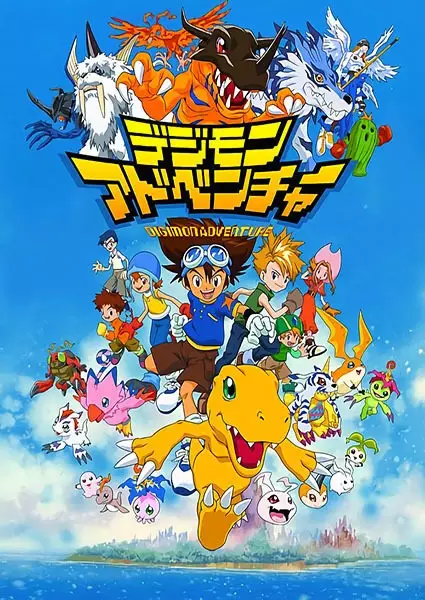
Digimon: Digital Monsters
デジモンアドベンチャー
7.79(270K votes)
Ranked #1219Popularity #633
episodes
54
Type
TV
Status
Finished Airing
Aired
Mar 7, 1999 to Mar 26, 2000
Studios:Toei Animation
ActionAdventureComedyFantasy
Synopsis
When a group of seven children go to summer camp, the last thing that they expect is snow falling in July. In the confusion that follows this phenomenon, they each receive an odd device that transports them to another world. As soon as they wake up in this new world, they encounter strange creatures who call themselves "Digimon." The Digimon tell them that they've landed in the "Digital World," far from home.
With only the Digimon and the "Digivices" as protection, the seven children set off to find their way home and learn the reason why they were brought here. Led by the impulsive Taichi Yagami and his hungry Digimon partner Agumon, this group will have to fight unknown evils as they discover more about this outlandish Digital World.
[Written by MAL Rewrite]
427,226 Members
Worth Watching? — Global Verdict
8.9/10
Average Review Score
100%
Recommend It
20
Reviews Worldwide
International Reviews
Lil-Bird
Recommended
9
Constantly accused of being a Pokémon rip-off, Digimon has struggled to find a big audience, particularly in the West—it doesn't help that its marketing never really took off out here. However, despite it never gaining a huge fanbase like its rival, Digimon continues to be a strong—if not struggling—franchise that still has a foothold in countries outside of Japan complete with its own loyal fanbase. So when most people think of Fox Kids or Saban Entertainment, they fondly think of either Power Rangers or Digimon (usually the first season), and not so much of the network itself. But for years, it meant risking an all-outplayground civil war bringing up Digimon's name even when Pokémon's popularity was steadily declining, and one had to be hard-pressed to find someone who was a fan of both shows. To this very day, a mere 16 years after its first airing, there are still folks who are bitter towards Digimon and aren't afraid to fan the flames when provoked (Yu-Gi-Oh! had its share of hate, but not to the extent of Digimon's).
As a fan of both Digimon and Pokémon, I don't see how it's impossible to like both shows even though at the time I loved Pokémon to death and still do. They may have their similarities, but they are two vastly different creatures who just happen to inhabit the same genre. In fact, despite my love for Pokémon, I find Digimon to be immensely better in the anime department (the games not so much, ironically).
Story (8): Seven young kids go to camp for the summer, and wound up living in a digital land where they meet creatures called Digimon (short for Digital Monster) that evolve—called “Digivolving”—through six stages: Baby, In-Training, Rookie, Champion, Ultimate, and Mega. They use Digivolving and power of friendship to save the digital world from evil.
That's the simple, cliché response. In reality, Digimon goes much deeper than that, and it soon stood out from the other shounen 'Mon shows of the time. It still retains that cliché plot, but the thing about clichés is that there are different ways of playing with them, to help separate it from another similar clichéd plot. This doesn't automatically make the writing in Digimon perfect, there's always going to be flaws, but it makes it more watchable (or tolerable) than other similar shows.
Yes, seven kids (later it became eight) end up going into a digital world where they meet their Digimon partners. However, these kids end up discovering, or re-discovering themselves and grow up as characters to be better people. The Digimon technically don't change, although they are catalysts, and they do become stronger based on the inner strength of their partner. It's a form of teamwork, but more along the lines of “Believe in me who believes in you”.
But why were they sent to the Digital World? Because they are the Chosen: the DigiDestined who will save the Digital World from the bad Digimon who will do anything in their power to take over the world. Digimon was originally supposed to be about 13-26 episodes, however, high ratings in Japan was encouraging enough for Toei to continue for a total of 54 episodes. The series is thus commonly split into arcs named after the big bad: Devimon, Etemon, Vamdemon (Myotismon), and the Dark Masters. Each arc has its own fans, but typically the general consensus agrees the Myotismon arc is the highlight of the series.
Outside of your typical friendship and teamwork, Digimon is not afraid to tackle themes such as death, divorce, adoption, and fear of losing a loved one, and for a kids' show (especially given the time), it approaches them with maturity. And the average dub-hater will be pleasantly surprised to learn just how much Saban got away with all in a time where not even 4KIDS themselves wanted to touch such subjects (usually). Sure, Digimon has its share of censorship in the States, but only on an outward-appearance level (again, usually). Luckily, the script stays fairly true to the original while it developed Saban's signature gag dub trait, so a lot of the themes and atmosphere of the series remained. Still, the choice to watch the sub or dub rests all on the viewer, either are fine choices, both have their gains and losses.
Art/Animation (6): Let's totally be honest here, Digimon has a small budget, and it shows (Toei Animation has this problem a lot, it seems). Stock animation is rampant throughout the series, and there's off-model moments and other animation errors, but they typically try not to let you notice, and for the most part, they worked the best they could within their budget. As a digitally-colored show (heh, digital), the colors and line-art is clean, albeit kind of flat due to lack of lighting more often than not. The backgrounds (well, backdrops) stand out to me the most with this show in how everything looks holographic—in the Digital World, anyway, as the real world looks more normal, and thus more “real”. It's a stylistic choice that I feel is a staple to this show. Character designs are unique to the series in that everyone is distinguishable (big traits that stick out to me are the eyes, hair, and how big their hands and shoes/feet are—which is admittedly weird), and monster designs are varied from Digimon to Digimon. This helps them stick out in a line-up of other shounen anime, as well as pave the way for merchandise.
However, due to the small budget, the art is dated compared to later Digimon seasons, and even other anime of the time. The CGI Digivolutions in particular are the worst offenders (although for the time, it wasn't all that bad). The only exception I can think of where the animation was stellar and holds up very nicely (as well as go beyond its usual budget) was episode 21 when Mamoru Hosoda directed the episode.
Sound (9): Sound-effects in general are generic, however, the beeps, drones, and screeches of the Digivice stand out the most in that department—I would go so far as to say it's iconic to the series. The soundtrack itself is spectacular. Composed by the late Takanori Arisawa, Digimon's soundtrack is full of adventure and wonder, while being almost in an electronic/techno genre to give it a more digital feel. Every DigiDestined has their own insert song, and character score—two versions, to be exact—not really unheard of in such shows, but it's a big deal to Digimon. Villains even have their own character songs, if not theme scores, and they are wonderfully kept in character. The opening theme, “Butter-Fly” by Wada Kouji, is honestly one of the best anime theme songs in a kids' show (if not in anime in general), perhaps one of the more recognizable from the intro alone this side of Pokémon. “Brave Heart” by Ayumi Miyazaki is also well-known as the Digivolution theme song.
Saban Entertainment, like most dubbing companies of the time, composed their own music. By themselves, the musical score is good, it's clear they got talent in the musical department. However, the editor(s) of the episodes completely went overboard with the music and just slapped pieces together to fill up the entire episode, rarely leaving a single scene quiet. But the musical score isn't as well-known as the ungodly catchy, simplistic theme song, simply titled “Digimon Are the Champions”. And now you have the English theme song in your head. You're welcome. Bonus points if you can see the intro play out in your head.
Voice-acting in the original is solid, though likewise with the English dub, some voices don't really fit the character. It's thankfully few and far in-between, and it's not like the voice acting is terrible. However, because I'm not fluent in Japanese, I'm slightly biased when it comes to voices regardless if that was the original intent on the casting director or not, thus I cannot judge them just based on how they sound alone. I do personally feel there are voices that work best in the original, while others are enhanced better in the English dub.
Speaking of, given the time, the English dub is surprisingly phenomenal with a great voice-cast—yes, a late-90s kids' anime has an amazing English dub, script and soundtrack aside. It took a bit for the directors and voice actors to get comfortable with the show, but they were able to bring the characters to life in their own special way. Many of them were in the field for years prior to Digimon, and are well-known to the anime community: Joshua Seth, Michael Reynolds, Edie Mirman, Mona Marshall, Derek Stephen Prince, and Lara Jill Miller (at this time, she was well-known from NBC's “Gimme a Break!”, her being cast in Digimon happened at the same time she returned to Hollywood) stand out best in memory, but many of the cast is well-done. However, as I said before, it, too, has its share of voices that just don't work out. This is more-or-less limited to side-Digimon that you don't see often outside of one or two episodes, so it's the main cast I have more praise towards (though Mimi is a bit of an exception in some areas—Ai Maeda in the original makes Mimi more likeable/listenable than Philece Sampler).
Characters (9): This is where Digimon truly sticks out as a show. It's very uncommon to find a show with as equally-complex and diverse a cast as Digimon Adventure. The eight main children made this show, even though their Digimon are good characters in their own right and serve as great foils/combos with their human partners.
The characters are as follows: Taichi “Tai” Yagami (Kamiya), the leader of the group who acts before he thinks (but isn't stupid); Yamato “Matt” Ishida, the cool-headed big brother of a lone wolf; Sora Takenouchi, the motherly tomboy; Koushirou “Izzy” Izumi, the young, know-it-all technical wizard; Mimi Tachikawa, a spoiled, rich girl who never hesitates to speak her mind, but has her heart in the right place; Joe Kido, the more down-to-earth of the children who has a paternal side to him; Takeru “T.K.” Takaishi, Matt's younger brother who provides a more innocent outlook to the world; and Hikari “Kari” Yagami (Kamiya), Tai's younger sister who is good-natured and soft-spoken.
Each of them have a backstory, and their own inner demons (well, maybe not so much with Kari according to some folks). Among the eight, any of them can be relatable to the viewer. Many of them struggle to become better, more mature people, but they aren't alone. The Digimon partners: Agumon, Gabumon, Piyomon (Biyomon), Tentomon, Palmon, Gomamon, Patamon, and Tailmon (Gatomon). They, too, grow as characters and have their own personality, although it's Gatomon (and possibly Patamon) who has the most character development. But their main role as Digimon partners is to protect and be supportive, and for the most part, they fulfill their duties. They are likewise the mascots of the series, and yet are more than just pieces of data.
Meanwhile, partner-less Digimon play important roles to the story, perhaps even more-so than the human protagonists. Some examples (off the top of my head) are Leomon, Ogremon, Piximon, Wizardmon, Myotismon, Etemon, Pumpkinmon, and Gotsumon. These characters had depth despite being in a few episodes at the least, but they also were just that memorable to the point they have fans to this day.
Special mention goes to the children's parents for adding a depth to the show most kids' shows don't do. Parents in Digimon were very supportive of their children, as well as loving, but were also the most human. While they don't go through the same experiences as their children (for the most part), it still affects them greatly to let their children go and save the world without knowing why it is they have to. They had to put their trust in them, and thus they (and the writers) gain my respect when they could've been like every other adult in similar kids' shows. If somehow the children don't grow on you, then perhaps their parents will.
Enjoyment (10): It's truly a damn shame Digimon has never gotten as popular as Pokémon. Both franchises were being worked on at the exact same time, neither creator knowing of each other, and yet it was Pokémon that was finished first, and would overshadow every other 'Mon show that would come out since. Is it possible to blame bad timing for why it is Digimon has to constantly work to get noticed? Maybe. But how do we know Pokémon wouldn't have gone through the same ridicule had it been Digimon that came out first? How do we know that Digimon would have gotten the same popularity? Would it still have struggled? Would it have been a worldwide phenomenon?
Do I wish Digimon would have a bigger audience? Truly, I do, it clearly deserves recognition and praise. However, at the same time, I feel it was a good thing Digimon has remained rather... quiet under many people's radars. For one thing, it felt more special to me, as a kid, to know that as sad as it was, the show was more for me (and my brothers) than anyone else. I didn't want the magic and wonder of Digimon to be sucked up by anyone else, I wanted to experience it all for myself. In my mind, everyone else had to be just as special to like it as much as I did.
Another reason I'm kind of glad it stayed low was unlike with Pokémon, Digimon has never really been accused of the same things its rival went through (at least, that I know of). If it had, I don't think Digimon would have survived. Pokémon had Nintendo, tons of merchandise, and millions of children (and dollars) to back it up. What did Digimon have? Fox Kids? Saban? Toei Animation? Some of Pokémon's percentage of fans? What good would any of those have done to keep Digimon afloat against the onslaught of attacks?
Even with the cheesiness of a gag dub, I still find Digimon to be highly enjoyable. Yes, the original Japanese is superior in everything, but the English dub is special, even if highly subjective, and thus I can't forsake the dub. It's just as memorable as Pokémon's dub, and yet though I managed to find a way for Pokémon and Digimon to co-exist as friendly rivals, it's the better of the two (although I honestly would have a hard time picking my most favorite). Saban Entertainment took good care of Digimon at this time, and I thank them for that. It's the only thanks I can really give them besides “Thanks for Samurai Pizza Cats” and “Thanks for the Fox Kids block”.
In the end, I think “Butter-Fly” says it best for Digimon as a whole (translated):
“After an endless dream, in this world of nothingness
It seems as if our beloved dreams will lose
Even with these unreliable wings, covered in images that tend to stay
I'm sure we can fly, on my love”
Community Discussion
195 found helpfulMar 9, 2015
Were_Vampire
Recommended
10
First of all I want to apologize before handed for any grammar mistake you might find in the review as English is not my native languaje. Second, I have to say I'm utterly disappointed with the score Digimon Adventure has. 7 is not a bad score, but is way below of what I expected. This is a kid show, and as such it should be scored as how satisfaying it can be to kids, just as how shonnen should be scored as how they satisfy their teen audience, seinen their older audience, and so on. I feel like many are comparing and scoring anime without anyfilter, as if you could score this anime a 5 just because you compare it with Code Geass or Shingeki no Kyojin, which are 9 if not 10s. And that's unfair. Digimon Adventure is a stand out in what refers to kid shows and I'll explain why point by point.
Story wise: It is very well constructed, and smartly thought through; there are misteries that are unveiled as we move forward, and every revelation is handled with care and it is affected by how the characters feel about it. There are plenty shows that just try to be awesome by delievering mistery after mistery and revelation after revelation with no care of their characters whatsoever and fall flat in making any emotional resonance, but it's not this one. The story is tightly attached to its main 8 characters and their digimon, while giving us the sense of many plots developing under their nose, but strickly related to them. The first 10 episodes are introductory, a prologue if you may, and then we go fully into know what the world they are in is and how it affects ours. Sure, some people could say "why wait 10 episodes to get to real deal?" For starters, those 10 episodes are not bad at all, they are very entertaining and they give us a sense of adventure (hence the title) and exploration that this anime wants us to feel, and it passes with flying colors. The following 44 episodes follow 3 different story arcs, but all related to the same story plot, all of them linked together, with every single episode affecting the following ones, which mean there is no such thing as filler episode, and that's something we should applaude, as not many kid shows are willing to leave a filler comfort zone (I'm looking at you Pokemon).
Characters: Here is where this anime shines brightly. Character development is at its finest here. Each character has a distinctive personality, quirks and even tics that make them feel real, or at the very least smartly outlined. At first we get broadstrokes, but as we pass episode by episode there's an incredible development in each character; they are distinctive from each other and they never act out of characters, their actions are not made in order to move the plot forward, but rather to show us who these kids are, which is great, as many animes (and not just kid shows) tend to sacrifice character insight in order to get the plot moving; this one doesn't. They will always move accordingly to their personalities and we get to see all of them develop. While some others shows would mainly develop 3 or 4 of their main characters, all 8 get to grow in each episode by what happen to them, and even they realize how they grow (and even how they don't, how they might be stuck) and how much they have to move forward.
There's a cute concept here that is "values are power" and each character has a distinctive value, may it be courage, friendship, love, sincerity, love, and so on. They grow around these values, but they also get lost in sight of them, when they try to push them they fail as opposed when they let it flow naturally it always work. It's a wonderful lesson for kids, and it is something we all should add to our daily life, it would make this world better. But putting that aside and returning to the characters, there is not even one that's left undeveloped, all of them have satisfaying characters arcs.
Sound/Music: Digimon has a beautiful soundtrack. Wada Kouji was a talented musician (rest in peace) and scored some really great songs that made you dream. Digimon is a series that aims for kids to dream and to learn the power of values as well to portraying excellent character development and mature themes explained to them, and as such it needs the right score at the right time, and Wada Kouji just got it right, from Butterfly to Brave Heart, even using classic music as Ravel, the timing is just perfect and while there are surely better OST, this one is among the better ones.
Enjoyment: it is highly satisfaying! I'm 21 years old and as I re-watched Digimon after 12 years I enjoyed it as much as I did when I was 9, and that's because I could realize how well constructed it was. Besides, it made feel like a llittle kid again. The plots are smart, the character development is spot on, the music is gorgous, the art may lack a little now and then, but is never too bothersome, and the evolutions are damn right exciting and funny! And so I could keep praising it until I'm left out of words. But I think I made my point.
In conclusion: This is defenitely the best Digimon series, as it is the one that gets all plot, character, music and themes right, and delivers them in a highly satisfaying manner. As such, it deserves to be acclaimed, and a 7 is a low score for it.
Is this a realistic anime? No, not at all, but it's not meant to be anyway. It is an anime that is meant to make us dream. You can't compare it to, say for instance, Shingeky no Kyojin which explore fantasy elements as realistic as possible or Code Geass, which explores character insight in the midst of war and revolutions. No, of course no, those are targeted for an older audience. But Digimon Adventure is no less satisfaying, and that's because while it aims for children, one can always appreciate how smartly thought are the storylines and the characters development. It is a show that knows its potential and limitations, accepts them and just aim to be the best it can be, which result in being an awesomely made kid show.
All in all, we have to see Digimon Adventure for what it is and not for what we might want to be. And as on what it is, it is straight awesome.
96 found helpfulMay 20, 2013
KC_Writes
Recommended
8
If you were to ask me what it was that possessed me with such a desire to re-watch the Digimon Adventure series I saw when I was younger, I couldn't tell you. Before now my memories of Digimon were not fond, the dubbing in the show was terrible, to the point were I hated the vast majority of the entire cast. I was a lot younger back then so I didn't understand that the occasional stupid things characters did/said were because the script was being hacked up. But beyond the negatives of the show there was a strange charm that reached me, and having re-watchedthe show completed in Japanese I understand that strange charm was just me knowing what a really good show it truly was underneath the hacking. So now I hope to show you what I saw, and still see, in Digimon Adventure season 1.
--
Story:
Like most lengthy anime series it starts off fairly slow, and like most shows in general it has a lot of typical things you'd expect from a show of this genre. Chosen children in a faraway land, partnered with strange creatures, that need to prevent the evil from destroying the world. We've all seen it, but that doesn't mean it can't be well done enough to be damn good in the process.
Starting off with the kids searching for a way home it's pretty episodic and gets into a pretty standard pattern for the first 15 episodes or so. But after that they begin the next adventure, searching for their respective Crests. Another small series of episodic episodes, but they're interesting enough that you wouldn't notice that; and they're all truly just a springboard that launches the show from 'fine' to 'very good' on my scale. Introducing Vamdemon (Myotismon for you dub people) and starting the search for the eighth Chosen Child.
It's here that the story takes a much darker tone, and it only gets darker as it goes on. The show pulls no punches, and though it's aimed at children it doesn't insult your intelligence (or at least in Japanese it doesn't). Though there can be a slight cheese factor in some of the more emotional parts, it's done well enough that you won't mind and might even find yourself smiling at the very thing you might have rolled your eyes at.
Art:
Even with all the improvements today I still find this art really impressive, and I even prefer it in some instances. There's a strange realistic feeling to all the characters, sure most have the typical accessories to tell you they're from an anime but I wouldn't find it hard to believe if they were based on real kids. But in a show with evolving and fighting monsters who cares how the characters look right, we wanna see wicked awesome monsters!!... Savages, all of you; alright, lets get to the monsters.
They're awesome, to say the least, there may have been one or two creature designs out of them all that I'd consider lame or stupid. And in a show consisting of 54 episodes and dozens upon dozens of monsters, that's damn good. The evolutions are awesome, the only ones that are a little lame are the 4 CG ones; it's not too bad though, considering when the show was made (they're also not very long). But now to move away from the creature designs, I'll talk briefly about the background designs, which I found to be incredibly pleasant compared to over a dozen other shows I've seen.
Though each background doesn't exactly stand out in any particular ways, it's the simple fact that they blend in so well that I like them. They're designed well enough that they look like scenery, you pay attention to it to get a grasp of what's around the characters and move on; it still sticks in your mind but it's not taking over the screen, it's not exploding to try and be noticed, it's simply doing the duty of being background scenery. I also found that for a show from the 90's there's a surprisingly low amount of re-used footage. Sure there's the occasional 'yeah I've seen that Mega Flame before', but for the most part each one fresh and reflects the scenery around it.
Characters:
It's strange that a show about elementary school children would have a fairly large amount of character development and depth, but that's Digimon Adventure for you. Each of the Chosen Children has their own issues, their own past that's slowly explored as the series progresses, and by the end they've all developed into fully grown characters. They're all clever enough to question situations and surroundings, but they're only in elementary school so they all still have the charm and innocence of childhood.
But people aren't the only characters here, no no, the Digimon have their own personalities too. Which are, in some ways, better than the children in my opinion. Though the children grow and change as characters, and the Digimon basically stay the same, they're still a high point and occasionally contribute a large part of the humor or drama in many episodes.
Sound:
Ungodly catchy. The Japanese intro and outros are both very good, so good that I've even downloaded them and added them to my iPods playlist of anime songs. Though they are very good, and catchy, they're nothing too spectacular. The audio during the show is also pretty standard, with most of those songs being ungodly catchy as well; awesome, but still nothing too great.
Enjoyment:
For a show that I once would have only given a five out of ten I'm so glad I went back and watched it over again with the proper audio. To charm me still after ten years have gone by it truly goes to show that this show is something people of all ages can watch and enjoy.
Overall:
A very good anime that's sadly under appreciated. Though not perfect, Digimon Adventures is definitely worth watching, or re-watching; especially if you read this whole review!!
92 found helpfulJun 6, 2010
Objective
Recommended
8
“Remember? How could I ever forget?” Digimon Adventure 01, a household name, a childhood memory, what did this blast from the past have in store for us? That one time at band camp... I mean summer camp. Seven children dubbed the Digi-Destined find themselves in an alternate world, filled with bizarre creatures and a luscious ecosystem, where they soon discover the inevitable path they must walk, together. Although initially hostile, they are each partnered with one of these bizarre creatures known as ‘Digimon’ whom they must work together with to not only save the Digital world, but human world as well. Digimon is best describedas a coming of age tale. Each of our Digi-Destined must fight their own demons, in order to progress and ultimately have enough to strength to defeat the “Dark Masters” of the digital world.
When you think about it, there’s no way these children who aren’t even teenagers yet could handle a situation such as this without any hiccups. Each have their own shortcomings, insecurities and past memories that haunt them, which correspond to their crest, allowing deep character progression. Although their emotions are easily manipulated, the maturity to come to their senses and read the situation is also shown consistently throughout. But don’t forget their partners in crime, the Digimon. They resemble the voice of reason in each partnership, almost like a parental figure, although they are shown to be quite childish at times themselves. They switch from cute and cuddly, to imposing beasts in order to protect the ones they cherish, as if they were protecting their young. The evil Digimon are similar in an aspect, they generally represent adults and their personalities tend to stay the same throughout the show.
For 20th century animation, I think Digimon is still top notch. Scenery is blended in beautifully, character emotion is easily distinguishable and the animation is fluid. But let’s not forget the action scenes. I still get goose bumps from almost every digi-evolution that took place even with the hints of poor CGI. It’s the unique character designs that allow the action scenes to truly stand out, each with their own outrageous special attacks, such as breast rockets. What more can you ask for? If you can think of something, they’ve probably already done it.
Although repetitive, the soundtrack for Digimon Adventure is well done in both English and Japanese. But for the sake of this review we’ll look at its English counterpart. The trademark OP/ED of the Dubbed Digimon franchise is memorable if anything. It isn’t an addictive theme, but it gets the job done. The second major theme used “Hey Digimon” on the other hand is as enticing as they come: upbeat, light-hearted and catchy. Used during the last few minutes of most episodes, it portrays the strength of the digi-bonds created. The background music which usually incorporates deep brass instruments and melodic strings tends to suite the mood well.
Not just a children’s show, Digimon adventure breaks this conceptualization and showcases its strengths in a suitable fashion. Deep character progression, a loveable cast and hilarious humor and just some of the reasons that will make this show an enjoyable viewing. Both English and Japanese versions presented very well, so it basically comes down to personal preference, which personally, dubbed wins based on nostalgia alone. So with the upcoming installment Digimon Adventure Tri right around the corner, what are you waiting for? Give Digimon Adventure 01 a Tri.
55 found helpfulJan 16, 2015
SoldierDream
Recommended
9
It’s August 1st, 1999! On this day exactly 20 years ago, these were the words spoken by an 11-year-old boy after discovering at his home in Odaiba during his summer vacation that...well, I don’t want to spoil anyone here. It’s been exactly 2 full decades since that odd snowy summer day when 7 children were sucked by a giant wave into an unknown world where they would meet some small, strange talking creatures that claimed had been waiting for them for a long time and would live together the most important journey of their lives, kicking off the story of the 1st series of a franchisethat, despite never reaching the levels of popularity of its most direct “rival” (that only happens to be the most successful media franchise of all time), still managed to become one of the most iconic and most remembered ones for the people living their childhoods throughout the 90s and early 00s. (Seriously, when does time fly this much? And just how old one can get?). As such, it is a very special day for both its legacy and its loyal fans around the globe, so what a better date to make a commemorative review of it than this one?
(Note: keep in mind that this will be a review of the original Japanese version, since the English dub made by Saban Entertainment edited so much the script, removed all the so-called “controversial” content to make it fully kid-friendly for the American families and avoid the risk of the networks getting sued, introduced a plethora of terrible, bad attempts of humor even in some of the most serious and dramatic moments, and composed a new OST with some incredibly unfitting, misplaced tracks, that in my opinion –and one that I know many others share too- totally killed the spirit of the original show).
Making a review for Digimon Adventure comes as no easy task, especially to me. The reason is that there are two forces here that are not exactly perfectly aligned: heart and mind. On one hand, this is one of my absolute favorite anime shows of all time. Yes, this kid-oriented series whose title ends with the “mon” suffix about some children and their powerful, cool-looking pet-partners and with some commercial purposes behind, is among the most beautiful, immensely enjoyable and, for reasons the limitations of human language will never allow me to describe, deeply resonating ones I’ve ever had the pleasure of experiencing, and I’m not ashamed at all and I see no reason why I should be, as opposed to what some might think for someone who’s weeell past his innocent childhood years. (However, this wasn’t always the case, but that’ll be a story for another day). On the other one, despite this strong emotional connection, I can still recognize that it doesn’t precisely come without flaws, which may –admittedly- be a turn-off for the more critical audiences, so I can’t speak about it like it was the “best thing ever” either, like I would want to. In light of this break up, and following the “if you genuinely liked it, it’s because it must have done something right according to you” principle, the best approach I can resort to to compose this review, is simply by explaining which were the reasons why this worked and meant so much to me -which will also correspond to all the strengths I perceive the show has- and also by mentioning the aspects where I think it came as weak and where it could have been certainly better. Nevertheless, I think it’s of utmost importance that we should not forget what the big picture here is, which is that, at the end of the day, we are dealing with a kids-oriented show, a fact that, as I will explain later, vastly helps to reconcile these two forces and to be able to recognize that, despite its flaws, Digimon Adventure not only is one of the best shows of its class, but also a great anime show in general, if watched from the right perspective.
The “digi-destined”
The story of the first installment of the Digimon franchise follows a rather standard good vs evil premise. It’s an isekai show (before the times when every isekai was about a self-insert becoming overpowered and getting a harem in a medieval-like world) about these 7 kids of different ages who are transported against their will into another world called the “Digitalworld” (because they are the “chosen children” or “digidestined”), where they would get partnered with some creatures that call themselves “digimons” and would, along them, be given the responsibility of defeating the forces of evil that seek to dominate both that strange world and the real one, one after another. However, there is more to a series than a simple premise that one can dig under its surface. This is because, contrary to the majority of the shows targeted to this demo that choose to focus on a safe way (though effective and not inherently wrong) only in the cool action sequences and the light humor with little to no character exploration, Digimon Adventure chose to go one step further of this comfort-zone and dared to actually make something more substantial with its cast. In reality, everything in Adventure is its cast. This is not only about a mission of defeating bad guys. This is also and –primarily- about a journey of a group of children maturing and growing up, who will have to learn a lot of things in the way in order to accomplish it, which is the real heart of the series. The task to defeat evil guys here only acts as the stage or means for this bigger purpose. The world could have been any. The villains could have been any and nothing would have changed, because nothing of this was ever the real focus. Throughout 54 episodes, we follow a group of 7 (later 8) children of a wide variety of personalities who will have to overcome their own weaknesses, anxieties or “inner demons”, and learn to solve their differences and conflicts in order to meet that task that was entrusted to them.
And here lies the main strength and appeal of the show that explains why this can be enjoyable by adults as well, despite being a kid-oriented work. Digimon Adventure is essentially an “action/drama show made for kids”. While watching how the creatures evolve into cooler, bigger and more powerful ones to fight the enemies in turn is certainly fun and amazing to witness for the little ones (and the older ones too!), it’s also, and mainly, about watching how the kid-partners evolve in the way. The kids here are not static, one-dimensional characters that never show a sign of realism or development. The people they were in the beginning are not the same they are towards the end, which is not an outcome commonly found in most action/adventure shows of this class. The involuntary mission of having to save the world assigned to them, the multiple tough situations this entails that they have to go through which also represent the tests they have to deal with, and even the psychological manipulation some of the villains in the way use upon them to take advantage of their insecurities and to corrupt them, force them to grow up, make complicated decisions, deal with their issues, learn many life-lessons, learn from their mistakes, support each other and to accept both themselves and the rest. And this immediately makes them way more interesting and richer protagonists than standard kids’ shows ones, who usually aren’t treated beyond devices to move a plot forward or the cool, infallible heroes saving the day or winning battles of any kind. Sure, the main cast may be based on classic stereotypes, some of them borrowed from the shounen demo (the determined, impulsive but well-intentioned natural-born leader who inspires the rest and thinks knows everything; the cool, socially unskilled lone-wolf rival always causing unnecessary troubles; the tomboy girl with mother-daughter and self-acceptance issues; the spoiled, whiny and bratty one who thinks the world is all rose-colored and refuses to deal with the cruelties of life; the genius, curious boy playing as the brain of the team, with his head constantly inside a computer in order to escape from his harsh reality; the voice-of-reason one with a strong notion of responsibility and personal achievement; the crybaby, but cheerful kid who must learn to become independent and fend for himself, and the selfless, seemingly perfect little sister), but these only serve as the starting points for further character exploration, and they never comfortably stay in them, but rather grow upon them while they battle the evil forces of the Digitalworld alongside their digimon-partners.
The other success here related to the development and handling of the cast (that could have gone really, really wrong), and a detail I really like is that Digimon Adventure recognizes and uses to great advantage the potential and the wide appeal its large, diverse and hugely charismatic cast offers (including the creatures); it pulls the maximum out of it. In any circumstance where a group of people is forced to interact with each other to solve problems, some of its members will be more visible or more vocal, some will contribute more, others less, and leaderships and rivalries will naturally emerge. These roles fall in Tai and Yamato/Matt, respectively, the central characters of the show. However, aware of these natural facts, the show still cares to and manages to not let they concentrate all the attention and screentime or get all the credits, but to instead eventually giving everyone their fair share of spotlight, while at the same time acknowledging that those central characters will understandably require some more given their more relevant status inside the group. Despite the distribution of attention not being perfectly even, everyone always matter here and significantly contribute somehow, no one is ever left behind or put aside, no one ever feels just part of the decoration or fodder, and this is something not many series with a large main cast can say (not even DBZ, my favorite show of all time!). Thanks to this, it successfully makes the viewer care for all of them and grow fond with them at every moment leveraging its appeal, since it takes the adequate time to showcase them all, especially during the well-balanced introductory Devimon arc. Moreover, it creatively does so from multiple approaches; individually, collectively or in pairs, which leads to another of its strong points in relation to its large, varied cast: taking advantage of the many combination-possibilities it allowed by mixing the group. Throughout the journey, we see sometimes how the group is split for a while and/or how the members are gathered only in pairs, which gives an opportunity to explore each member more individually or to show how they would work or play together and how their distinctive personalities would clash in combinations or interactions that would not take place in normal contexts where the group is completely reunited, both strengthening all their bonds and, ultimately, making everything for the viewer way more fun to see. Not only does Digimon Adventure shine in character development; it also does in character dynamics.
The “digi-evolution”
To defeat the increasingly powerful digimon villains, the kids’ digimon-partners must go through a process known as “digi-evolution”, where they jump to a higher evolutionary level and become different, more powerful creatures able to contend with said villains. In other words: powering-up. The good news here is that these power-ups are not achieved just because and are actually, technically linked to the whole idea of the show: camaraderie, character development, and learning. The digimon needs his kid-partner to evolve, it won’t be able to do so if he doesn’t overcome his personal fears, doesn’t learn a lesson or doesn’t demonstrate/work upon the virtue their crests represent (courage, friendship, love, wisdom, sincerity, reliability, hope and light), because, in this universe, the digimon and the kid share a metaphysical, spiritual bond, so the ability to digi-evolve is conditioned to the kid’s inner growth as individuals, which acts as the catalyst of the process. To some, this may sound cheap, because they are essentially emotion/virtue-based power-ups, not training/experience-based ones, like they happen to be in Pokemon for example, and it’s an understandable feeling. However, in particular for this series, this is not really an issue, at all. Because first, it’s a kids show, who are not going to think too much what they see or ask for rationality everywhere, and second (and more importantly) because it was a concept reasonably tied to the whole point of it and the good, educational messages it wanted to convey, for any audience, but obviously, especially for the little ones. The physical evolution the digimon goes through comes as a reflection of the psychological evolution of the kid. Evolving, becoming stronger, and being able to achieve triumphs, is not possible if you do not grow up as a person, which comes as something beautiful and inspiring to see. In addition, it’s also something that brings more substantial meaning to the fights and power-ups, which is always something welcome, no matter the way. Digimon Adventure was all about values, and the digi-evolution phenomenon was just one of the means to communicate them to its target audience (besides obviously, looking cool!).
The digimon
But enough about immature children, development and values, this show is called Digimon! So let’s say something about these creatures the show is named after, which, despite not being as relevant as their kid-partners, were still another aspect the show handled well, and that, in my opinion, have more advantages than those of its rival “mon” series. First, because unlike them, they can (all) speak human language, which immediately makes them more appealing, since they can interact with the kids and express themselves better. But, more importantly, because here, while not getting the development focus the kids received (save for one: Tailmon/Gatomon), this didn’t mean they were going to comfortably be put aside and be treated just like the accompanying, obedient pets of the children who were going to be used as the battle weapons in sports competitions and nothing else. No, here the writers respected them as characters and cared to give them a more meaningful participation; while not as relevant in the story as their human partners, they are still treated as significant members inside the group and play a key role in the process of growth and learning of our protagonists (from whom they learned a lot as well, which made the relationships richer). Besides playing the basic tasks of fighting for and protecting their partners, they also spiritually support them with their troubles and anxieties, strive to make they always give and do their best, and help them rise from obscurity once they’ve fallen into it. They are also given a voice here; they think, they have an opinion and suggest ideas about what should or could be done regarding the many situations they have to go through, so they are treated more than just the children’s “slaves” that have to do everything they order them to do (and in fact, they even get to rebel against them whenever some conflicts arose) and the cool creatures with cool designs used to boost the toys’ sales. Coupled with the fact that they are all given their own distinctive personalities, with their own strengths and weaknesses that differentiate them from each other, giving them some layers and which adds an appealing sense of variety, as a result, despite playing secondary supporting roles, the show still successfully manages to make them feel like an important set of characters the audience can care of and become fond of in the way.
Speaking of personalities, there was the question about whether to make the creatures mere character-extensions of the children with whom they were paired, or whether to make them different to some degree. And the (clever) answer was: why not both? which made things way more interesting, since that way the audience could see all kinds of relationships, how they developed and how they contrasted each other. Having opted for just one of the options would have been quite “samey”. There you had in one of the ends the perfect Taichi/Agumon match, both cheerful, vigorous, upbeat and group-motivating, and there you also had in the other one the completely odd, irregular Joe/Gomamon pairing, where the human part was strict and obsessive and the creature part was more carefree and lively, which made this relationship probably the most intriguing to see how would it play given the personalities’ disparities and the fact that they were the ones who most had to learn and understand from each other. Seeing how the pairs complement and interact with each other was another of the main assets of the show.
Finally, it goes without saying that watching the many, distinctive designs of the digimon, which go from very basic, rounded cute forms to more sophisticated, imposing ones as they advance in their evolutionary lines, certainly adds a lot to the cool-factor of the show (especially the Patamon one!).
The adventure
Of course, you can have a large set of well-written protagonists, cool-looking supporting creatures and lesson-teaching goals, but none of it will feel complete or fully-realized without a proper invigorating, exciting narrative, which the series also has; the second word of its title is not mere fancy decoration. Together with everything I’ve already mentioned, what also plays well for the show is that, despite some issues I’ll talk about later, its storyline is generally well-constructed for kids’ shows standards; it’s carefully thought, with virtually no inconsistency, plot hole or bad tonal handling, balancing well all the serious, intense and funny moments, managing to efficiently move forward without ever leaving the characters behind going hand-in-hand with their development, and always finding the way to not fall into repetitiveness by innovating the story-structures in each part, keeping this way the storyline always intriguing while at the same time never losing focus. In addition, another aspect to highlight here is that, being a long 54 episodes show, not a SINGLE one of them is useless or feels skippable and absolutely all of them contribute with the story progression in a relevant way, which is saying a LOT for a successful long-running series and it is something that not many shows of its class can brag about (not even the highly acclaimed Monster!). It never loses rhythm, it’s a non-stop ride from the very beginning to the end with no unneeded stretching, no wasted episodes whatsoever, always keeping the audience interested thanks to the permanent modification of circumstances, the introduction of challenges and the internal development of characters. Not a single of its moments feels ever tedious, and it enjoys having a fantastic, intense climax and a conclusive ending that nicely wraps everything up with no loose ends.
Furthering on this aspect in not so cold, technical terms, what truly elevated this series for me were all these absolutely delightful feelings evoked by this particularly charming way of executing and presenting the story. The show breathes this irresistible, captivating sense of wonder, which, when joined with this charismatic, realistically-portrayed big set of characters and their pet-partners interacting with each other, makes everything translate in the end into a highly enjoyable watching experience. This appears as most noticeable during the first arc, Devimon, and the second half of the third arc, Myotismon, also known as the “real world” arc and the fan-favorite part of the show, since it’s the undisputed most entertaining and thrilling segment of the whole series. In the former, which is basically a story of survival in the wilderness, the kids wander through a wide variety of exotic, unfriendly places and must figure out where they are, how they got there and what are they doing there, while being attacked by various other digimon at each stop they make. This, added to the fact that nothing is revealed regarding what is going on but towards the end and that the locations are pretty strange, surreal and/or lonely, helps to create this immersing sense of mystery, uncertainty and exploration and of feeling disoriented walking aimlessly across an unknown, faraway world, without knowing what to expect. In the latter, since this time the action takes place in our real world, it shows events that could very well be happening in your own neighborhood, and the families start getting involved, which brings a great sense of familiarity and “closeness”. This part may also very well be one of the best examples of how to make a fantastic “action/noir-thriller for kids”, with the group racing against Myotismon to find the 8th chosen child, traveling completely alone through various Tokyo’s neighborhoods at nights, keeping at all times a genuine sense of suspense, and by upping the stakes and the scale of the conflict including the city and its inhabitants in the battlefield. Also, the story for the most part is told with a multiple-POV approach; it jumps from one child perspective to another one, giving the audience a delightful sense of omniscience by having absolute knowledge of all the circumstances and of what each kid is doing at each moment without them knowing themselves all this information. Anyway, the thing here is that, for reasons I can’t accurately describe, the dramatization feels so real and is so carefully thought, that it almost makes you feel you are also part of this team in the midst of all the danger and the unknown. And it’s all ultimately…so damn fun.
The artistic decisions also widely explained and enhanced this particular charm. I’ve read how some complain that the backgrounds were blurry and not well-defined, which is something I don’t understand since that was precisely the idea. First, they were that way only in the scenes taking place in the Digitalworld, since in the scenes of the real world they changed to more defined ones. And this was not random; it was intentionally done this way to highlight the difference between one world and the other. The real world is a known world, so well-defined backgrounds are suitable. However, the Digitalworld is an unknown, unfamiliar and mysterious one where no human being lives, so the decisions of drawing and painting its landscapes and locations with blurry outlines and unsaturated colors were a hit, since thanks to them the desired feelings of being lost in a faraway land and of walking unsafe across it not knowing what to expect that the kids were experimenting, could also be effectively transmitted to the viewer. The chilling, magical sense of surrealism and mystery present in the Digitalworld could definitely not have been fully expressed had the backgrounds art been more well-defined or clearer. And we also can’t in this regard forget about the music, which also played a definite key role here. While not entirely original (some of its tracks had already been composed before for the Sailor Moon series), it’s still plainly and simply…awesome. Everything regarding the music department, from the insanely catchy, legendary and iconic opening theme “Butter-Fly”, the highly stimulating, blood-pumping digi-evolution sequence theme “Braveheart”, the insert songs of every chosen child and the vast collection of memorable tracks that perfectly suit and enhance the mood of every type of moment (especially the famous classical piece “Bolero de Ravel” used for some of the most captivating ones) is nothing short of spectacular and awe-inspiring, and did a top-notch work when it comes to capture all the sense of adventure, wonder, surrealism and thrill the show wants the audience to feel. It even recognizes when it’s the proper time to not use any music at all!
Finally, I’ll briefly close this section to talk about moments. The show is filled with highly emotional and epic moments throughout. All of these work because the series actually bothered to properly build them and to make the viewer care for every character in the way, so none of them comes as unearned. No one is just thrown there easily expecting to generate a genuine impact without having previously worked for it. Without spoiling, in particular, the big moment of the first arc is one of the highlights, because it was so beautifully and silently built up in the way and comes as thematically -and structurally- very significant and noteworthy. Similarly, in relation to this, some contend that the conclusion was somewhat anti-climactic, when to my eyes it was the exact opposite; it was exactly what the show needed to convincingly gain a better, impactful sense of closure, both narratively and thematically for both the story and the kids’ learning journey, in spectacular fashion with a “final bang”, with the most memorable and meaningful villain of the whole series and with the action taking place in the most fascinating, metaphysical location of all. Without it, the ending would have felt somewhat…flat. The final scene is powerfully moving, and possibly the favorite moment of the fan who managed to get fond of this large group of 16 characters throughout their long, tough, but also joyful journey.
Making you feel like a kid again
Last but not least, I didn’t know if to include or not this point, not only because it may sound corny, but also because it’s just very personal. However, considering I perceive it to be this kind of “sum of all ingredients” that perfectly summarizes all the feelings I got from the series after re-watching it 2 years ago, I think it comes as necessary. The magic of Digimon Adventure is that it managed to make me feel a kid again, and this was possible thanks to realistic characterization and story-staging.
Unlike Digimon, not many children programs can effectively achieve that sweet feeling because they choose to have either static, formulaic main characters and/or too-perfect ones. I love other kids’ shows like Detective Conan and Pokemon, but none of them offer me an experience where I can genuinely project into the show the “kid soul” inside me. Conan is this perfect, flawless prodigy kid-hero you know is always going to win, and Ash is always Ash and almost never stops being the same Ash that left Pallet town once. They don’t feel real characters enough. The characters of Digimon, to the contrary, actually feel more human. They are not perfect heroes, they are not over-skilled, over-smart and over-mature people for their ages, but instead, just common, normal kids: they are flawed, immature, let their emotions dominate them, they are insecure, they doubt, they fear, they feel vulnerable, they miss home, they change, they learn, they don’t have this unrealistically happy, nothing-bad-will-ever-happen lives in a happy, totally safe world, they behave and speak according to their ages, they make the mistakes normal kids their age would make, recognize them and take responsibility for their consequences, and have no idea how to travel alone in the city! Which makes them feel more real and at the end, more relatable. Thanks to this, I can see the me-of-my-childhood in them, and feel that one of the kids could have very well been me or one of your normal elementary school’s classmates, which, coupled with the realistic, serialized dramatization of events that takes itself seriously, also allows to feel that it could have very well been the you-of-your-childhood the one who’s given the possibility to do all these cool things and live all these exciting adventures said “you” always wanted to do and live. Meeting and befriending cool-looking creatures, exploring bizarre worlds, getting lost, solving mysteries, and even only walking through the city at nights without your parents knowing or staring how a big, dense layer of fog covers your whole neighborhood from the boring balcony of your room by the time every kid should be sleeping. (I guess this also partially explains why the “real world” arc is the fan-favorite one; because the action takes place from the intimacy and familiarity). Digimon is full of childlike wonder, and successfully makes all those whose internal child-flames are not totally extinguished, can feel as such again. And this is, what sealed the deal to me.
The digi-flaws
Having covered in detail all which I consider the strengths of the series, it’s time now to have a look on the not-so-wonderful side of things.
First, the animation quality. Digimon was made with a low budget, so it is limited. It features recycled animation sequences and still images (although, I contend that it’s not a problem for the digi-evolution sequences, since they are shown in an imaginary setting). The 4 CGI digi-evolution sequences may also look cheap, though considering the time the show was made, they look acceptable. Anyway, it’s not like it looks terrible either, and personally it’s not something that bothers me that much (and I even consider it part of its own charm), but what does bother me in relation to presentation were some episodes where characters looked off-model, especially in the Etemon arc. Second, the poorly characterized villains. They may all look cool/stylized and menacing, many of them based on horror archetypes (demon, vampire, creepy clown and so on), but substantially speaking most of them are simply too basic; their motivations do not go beyond seeking world domination because they are evil, and some of them don’t even have a personality and are just 0-D destroying machines. And I say most because some of them do have a more elaborate background (Puppetmon/Apocalymon). So, if some could have it, why not all? Anyway, at least they were all treated seriously and portrayed as real threats, including the megalomaniac Etemon. Then, some poor conveniences/unrealistic occurrences, not only for the general plot-armour of the kids, but also for example, how a villain in the middle of the battle stands still allowing the group to think of a way to defeat him instead of taking advantage of their vulnerable condition and just attack them, or in terms of narrative how villain number X enters the scene only once villain (X-1) has been previously defeated, like if X had never intended to get involved before despite having always been around there, which undermines its credibility and makes it feel like a videogame. The digimon fights aren’t very creative either, and most of the time boil down to just one attack of whatever type to beat the bad guy in turn, and in this regard admittedly Pokemon had the advantage, since the Pokemon fights involved more strategy according to their types and physical traits. Finally, a general lack of major world-exploration. Being a show whose story developed largely in another world, the Digitalworld, its origins, nature, characteristics, physical laws and so on, are slightly explored, and it’s not treated beyond just the location where the action would take place. The audience never gets to know it in greater detail, which would have been certainly a nice addition. Personally, I’m not really bothered by any of this -save for the off-model characters’ moments-, but it’s understandable that others may be.
However, despite certainly being elements that don’t do it much favor, should we really be that harsh when remembering the audience it was designed for and aimed towards? Besides animation quality (which as I said is just limited, with quite acceptable CGI for the time), I don’t see how any of this should harm the experience, considering it is a kids’ show which is precisely the demo that is least going to meticulously think too much or demand too much from everything they watch (and much less when some of these kinds of faults are some of which not even some celebrated more adult-oriented shows are exactly free of). You can’t judge a kids’ show the same way you would judge an adults’ or even teens’ show, things are very different when the tone and approach are designed for them, so the bars have to be lowered and adapted to their sight. Judging a kids’ show the same way you would do so with a show like Monster, Death Note or NGE, not only is totally silly, but also totally unfair. Does it have a childish tone? It has. Does it mean it’s stupid and we should look down on it? Don’t really think so. Didn’t do it back then when I watched it as a kid and I don’t see any reasons to do it now, much less when for kids’ shows standards, it features plenty of other things working in its favor that make it shine above its class; characters, values, messages, and entertainment value as well. By remembering this and being able to accordingly adapt our perspectives, we will be able to see the solid show it is.
Digimon Adventure, the first of a string of entries of one of the most important and popular kids’ anime franchises out there, is a stand-out when it comes to children’s anime programming. Filled with heart and childlike wonder and engaging all the way through, it proved that action-packed kids’ shows could be more than just so-called “dumb-fun” merchandising vehicles. With its large, diverse, immensely endearing and fleshed out set of characters being the true focus, all of them getting their fair share of spotlight; its well-balanced, well-constructed, filler-less storyline full of epic, well-earned moving moments and a riveting, conclusive ending; its surreal, captivating artwork and great music; all the wide variety of value/lesson-teaching themes of common life it tackles and the fantastic sense of adventure, mystery and thrill that it breathes, it hits plenty of right notes and elevates itself as one of the best shows out there made for that demo that can also be enjoyed by adults who want more than just kids and their pets fighting evil guys (which is also entertaining to watch on its own right) as well, if they are –obviously- able to understand who the show was targeted to and to accordingly adjust their standards in the first place. It falls precisely in that ideal spot where it isn’t overly childish/simplistic to be unappealing to them and where it isn’t overly mature/complex to be inappropriate for the little ones either, with the right, manageable dose of darkness. It’s a show that did not happily hide them the evil, adversity and hostility of the world, but that also at the same time brought them beautiful messages of being brave, to have hope and to see the light in times of despair. It probably won’t become your new favorite show and won’t resonate with you as much as it did with me, but I firmly believe nonetheless that it does have all the credentials to be a very enjoyable and rewarding experience, all the way through this long adventure of 8 normal kids and their 8 digimon-partners. Today, 20 years after it started, it hasn’t lost its touch. 9/10.